The small-press literary scene has had a big influence on me

While still living in the Midwest, I came under the sway of the margins of the literary world more than the more influential institutions and best-selling or most critically acclaimed voices at its core.

In high school, I came across the weekly Village Voice tabloid amid the out-of-town newspapers at Willkie’s downtown and devoured its tales of sides of Manhattan (and the world) the established dailies ignored, mostly of a progressive slant. By college, it was augmented by New York Magazine, which originated under Clay Felkner as the Sunday supplement to the now defunct Herald Tribune; glossy Esquire, with its New Journalism stars; and Evergreen, alive with muckraking politics.

Concurrently, my advanced writing class my sophomore year opened my eyes to the importance of small literary reviews, some with institutional support and others fully independent, most of them published quarterly. Some were student run, others had professional staff; more likely they were a labor of love in the wee hours. Many of them were mimeographed and stapled, before photocopying took over. Now they’re mostly online.

I was already putting out a sporadic mimeo broadside, Dr. Samuel Johnson’s Rambler, on my commuter college campus, which also had a fine student-run review of its own, Nexus (35 cents!).

My next campus didn’t have such an active literary scene, especially of an experimental sort. As a student majoring in poly sci rather than English, though, I was able to sample some influential courses. Film history, for one, and Russian novels in translation in the Russian department, for another, and finally a current American novels class that examined Ishmael Reed, Tom Wolfe, Robert Coover, Thomas Pyncheon, and Ken Kesey. I was also reading a lot of Vonnegut and Hesse. On my return as a research associate in the mid-’70s, I became involved in a lively off-campus poetry circle led by Richard Pflum, Roger Pfingston, and David Wade, along with their annual Stoney Lonesome. The novelists I most often cite as influences were all active in this period.

My favorite literary periodicals were the Paris Review and Kayak, as well as the book publishers New Directions and Black Sparrow.

And then I got serious about poetry and submitting promiscuously. In all, I’ve had more than a thousand works accepted for publication by editors around the globe. Each acceptance encouraged more work in a particular direction, and sometimes comments on rejections (quite rare, I must say – most are mere forms) provided valuable advice. Some of the correspondence got quite lively. And yes, 20 rejections per submission was par for the course, as I’d been advised in that advanced writing class.

Trying to get a chapbook published, however, was more difficult. My biggest near-miss was with Copper Canyon in Washington state.

These days I can see my blogging as continuing in the small-press arena, especially at my Thistle Finch site, which is offering free PDF editions of my poetry.

Remember, feedback is always welcome for a writer, unless it’s purely caustic. Publishing in a void is the bigger struggle. I’d say the small-press scene is ultimately more personal. One reader can make all the difference.

High hippie by degrees – nobody fully fit the stereotype

By the end of ’68, the counterculture phenomenon was metastasizing from San Francisco’s Haight-Ashbury and nearby Berkeley into pockets across most of the country and even Europe. As August of ’69 proved, it was sufficiently established in the East to draw together the unanticipated throng at Woodstock.

Much of the transplanted activity existed at the fringes of college campuses, as I experienced in Bloomington, Indiana, and later Binghamton, New York. For me, growing up in Ohio, I would have rather attended hip, beat Antioch in Yellow Springs, but the finances were way out of our consideration. So a state school was my destination, and at the time, Indiana as an out-of-state student was nearly as reasonable as in-state for me in Ohio. And a bit later, to my surprise, how yesterday Antioch began to appear once I was near the East Coast.

The searing experiences shape what I describe in Daffodil Uprising and then Pit-a-Pat High Jinks. And as I continue to repeat, hippies came in all varieties – and still do. There was no standard-issue, card-carrying member, but each was one to some degree or another. Nobody completely fit the hippie image.

As someone who became addicted at the onset of adolescence to classical, opera, and folk music, I was already passionate about an alternative to commercial entertainment, which was what rock at the time really was. I was one who lamented deeply when Bob Dylan went electric. Sold out, so it seemed. I had the long hair and blue jeans and bell bottoms. I was against the war, tried a few hallucinations, loved sex when I could get it, which wasn’t often.

And then I encountered yoga, which led me to give up meat, alcohol and drugs, and sex for the life I detail in Yoga Bootcamp – and yet, curiously, this was when I felt the most hippie in all of my awareness.

I’ve engaged much of our world from a daily newspaper perspective

Let me express my own everlasting gratitude for Glenn Thompson and his eye for talent, in my case after my letter to the editor and then his offer of an internship, later followed by a full summer. In a seemingly casual interview, he urged me to keep a personal journal, which I actually have. And then came the job offer. Without him (and so many others), my life would have taken a different direction. Gee, indirectly he even led to my first lover. (Look for Mitch in Daffodil Uprising, who’d been a copy boy I met thanks to Glenn’s support. Mitch was the catalyst to the crucial introduction. That dimension, in itself, could be a novel.)

Glenn was the editor-in-chief of the morning newspaper in Dayton, Ohio, and in his own way, a visionary. Behind the scenes, he even brought together the first university I attended, Wright State. And also, through him, I became a professional journalist, even while still in college. Another long story.

The paperback cover …

And he asked questions no one had prodded me with before. How would I change the world? What issues could I raise and address? At first, I was speechless. We were so green, and within a year, everything would look different. The biggest item on the agenda was the Establishment, not even its war in ‘Nam. Civil rights issues were a distant second.

The next summer I was a hundred miles up the road from Woodstock, working for a publisher who totally ignored me and editors who kept their heads down. But a new direction was taking shape for me.

Alas, as I’m also seeing, mine are steps youth today cannot follow. The pathways simply no longer exist, to the larger society’s impoverishment.

As I describe in my novel Hometown News, American journalism has long been based on a precarious business model. News itself is a byproduct of trying to attract customers for advertisers, and many publishers considered news gathering mostly as a costly nuisance. Successful newspapers were defined mostly by their obscene profits, and the pay levels for reporters and editors were often at the bottom of pay scales for professionals. As a priest reminded me before my first marriage, we might as well have been bound by vows of poverty. Oh, yes, and some of the highest quality papers – the kind I aspired to – were fighting for their very survival. We can now add to the toll of the role of the Internet.

So it’s all in flux now.

… and the back cover.

Still, newspapers show up in the majority of my novels, though in Nearly Canaan the field turned from journalism into non-profit organizations where the long, odd hours, public service, and stress nevertheless remained.

As I look back on my own years of being on the management track in a shrinking business, I see how I started out a hot-shot who thought the New York Herald Tribune in its last years was the best newspaper ever – led by an editor who later admitted in a letter to me he seemed to have become a specialist in trying to recover dying papers. Even then, I would have loved to have worked for him.

Despite my own honors, I had some crucial near misses. For one, I wound up in the final 24 for a dozen summer internships at the Washington Post but failed to make the final cut. The next summer, the Wall Street Journal was laying off staff rather than hiring, so their interest evaporated. Ten years later, something similar happened with timing for a high-level spot at the Detroit Free Press. And so my career veered away from the big cities where I had dreamed of living and from the big time, maybe for the best for me personally and ultimately professionally.

Somehow, this also has me thinking back to the lost hippie wannabes at the corner of Third and Main in Dayton during the summer of ’68. Theirs was a story I had hoped to write, but I couldn’t ask the right questions, I was too green myself. But, more honestly, maybe I just wasn’t cold-hearted enough to cut through to the real hurt and relate it without concern for the consequences.

Why I keep returning to counterculture particulars

I wish there were a better label than “hippie” to apply to the counterculture explosion that swept the world in the late ’60s and early ’70s. Contrary to popular assumptions, there was no standard-issue hippie, male or female. Not everyone did pot or ventured into acid and beyond, nor did everyone participate in a protest march or have long hair or have sex every night or at least on the weekend. We all came in various degrees of separation from general society yet, somehow, we also recognized a kinship with each other.

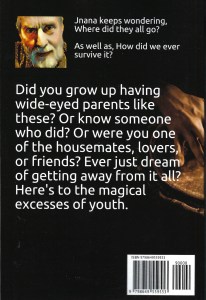
The paperback cover …

“Are you sure you were a hippie,” my wife sometimes asks. So what if I didn’t like rock? Many of my friends had been at Woodstock just down the highway from the milieu I describe in Pit-a-Pat High Jinks. No, we didn’t recite a credo, you dig what I mean?

The only other flash in history I can see similar to this was the mid-1600s in England, with its World Turned Upside Down before the restoration of the monarchy – stresses that would fester until the American Revolution a century later. What we shared was a vision of a more just, equal, and caring society. We didn’t have standard-issue, card-carrying members. Alas, we didn’t have elders or cohesive discipline, either. And the breakdown that followed can’t be blamed entirely on a youth movement crossing over into the dreaded age 30. (Oh, how I’d love to be back there, if only I wouldn’t have to figure out how to survive in the current economy.)

Tom Wolfe, author of “The Electric Kool-Aid Acid Test,” pointedly asked why there wasn’t the big hippie novel, overlooking a few notable entries like Gurney Norman’s “Divine Right’s Trip.” The problem, as I see it, is that the scope of the events was too big and too fuzzy to be encapsulated in a single volume. You had the activist side, from civil rights and draft resistance to pacifism, feminism, and the environment, for starters. Add to that sexual revolution. And then drug use, abuse, and visions, as well as new spiritual teachings and practices. All before we even get to the music and its scene. How could you possibly wrap all of that, plus more, into a single volume?

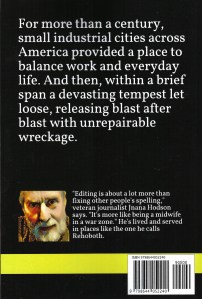
… and the back cover.

Believe me, I’ve tried with my own Daffodil Uprising and its companion “Pit-a-Pat High Jinks.” Hate to admit there’s so much more that could be added to the, uh, pot. Make that “pan.”

By the way, I think there are worthy nominations in each of the subcategories I’ve just mentioned. I’d love to hear more.

Frankly, I think we, as a nation, have been in a state of denial about the era, with its tension between the war in ‘Nam and the Establishment supporting it, on one side, and the opposition on multiple grounds, on the other. Those rifts in the soul of the nation have never been adequately examined and addressed from either side, much less healed. We could start with the MIA-POW myth, for one, or the ways we might have failed to answer our kids’ questions about pot use, for another. They are definitely exploding in our face now.

Meanwhile, Cassia, in What’s Left, has come along to try to make her own way out of the debris.

And so I humbly or brashly offer my own novels for discussion.

Care to share in my field notes from a lifetime’s zigzag trip?

Writing has been a means for me to investigate the question, “Who am I,” and of recollecting fragments, especially those that might eventually coalesce into a larger perspective. Unlike many adults, I have few vivid childhood memories, but what I am piecing together is often troubling. I grew up in Ohio in a mainstream Protestant tradition, became an Eagle scout, loved chemistry, hiked and camped, that sort of thing. I can blame becoming a hippie on my first lover, and thank her, too, for pointing my life in an unanticipated direction even after she flew ever so far away.

In the years since, I’ve followed a zigzag journey that’s been rich in many ways excepting money. Let’s just say it’s been off-beat.

Now retired from a career in daily newspaper journalism, I’ve married for the second time, live in a historic mill town in the seacoast region of New Hampshire, and am an active Quaker. It’s a full plate. What I didn’t expect was how much of my own “contemporary” fiction is now history – so much has changed so quickly in my own lifetime.

It’s hardly the end of the story, though. Not if we can help it.


I’m feeling suspended in time, as in limbo

A curious set of emotions has set in for me. As much as I love living in Dover, I feel myself separating from it. There’s a sadness, as well as the excitement of new adventure ahead, though we have no idea exactly how soon.

Next week? Next month? Next spring or summer? We don’t know yet.

We had enough surprises in trying to buy this place, in what seems a life ago to me.

So I anticipate a crush of time-consuming work ahead in packing and then unpacking our goods, as well as the rounds of changing address and establishing new connections, and that in turn has me hesitating to step up to volunteer for tasks in the groups where I’m a member. Yes, I’m distancing.

It’s happening at home, too.

Moving around the garden, for instance, when we realized we wouldn’t replant garlic bulbs this fall, not here. Or looking at my fern beds and asparagus patch, knowing I’ll definitely miss them.

Or facing household breakdowns, which seem to be multiplying. You know, let repairing them become someone else’s problem. They probably wouldn’t like the color of paint we use, anyway.

Things we’ve never really liked about the house itself but somehow accepted now are acknowledged as irritants. That sort of thing.

I keep thinking we could easily pour another hundred grand into this domicile, if we had that much, but it would never be want we really want or, at this point in our lives, fit what we need.

This all feels so strange, given that I’d settled into a kind of familiar lazy comfort with things.

All of them about to be uprooted.

A time for redirection in my own life

One of my annual practices around now used to be crafting a seasonal itinerary for the coming year, one that included goals for each of the major components of my life – Writing/Creative, Quaker, Relationships, Household – that sort of thing. It was kind of like budgeting, but with a focus mostly on time and dreams.

Closely related was a consideration of what kind of schedule I wanted to follow once I retired or somehow otherwise achieved financial freedom. You know, maybe having a bestseller novel break out to fund it all.

The one thing I realized each time I attempted the planning was that there would never be sufficient time for everything I deemed important. And, as my wife pointed out, there were a lot of mundane tasks I wasn’t even considering.

Looking back, I’m rather embarrassed by what I’m seeing. One thing for sure is that little of my life since retiring is anything like what I had anticipated. I had no idea how much my stamina and self-discipline would be flagging. During the earlier thinking, blogging wasn’t even on the horizon nor was choir or daily swimming. (Well, the latter two are currently off, given Covid.) I’m still not meditating or doing hatha yoga daily, either.

Much of the time has been taken up with the self-publication and promotion of my novels as ebooks, and later, with the deep drafting and revisions of What’s Left, which in turn prompted drastic reworking and even renaming of my earlier fiction. Releasing those in both Kindle and paperbook at Amazon last summer came as a HUGE relief. In many ways, I felt I was done.

Or almost.

What I wanted to do was reshape my daily, weekly, and even annual routines. What are my goals and dreams now? What do I need to do, too, to maintain a suitable living situation? Some of it was even reexamining my self-identities and lifestyle. Well, before I retired I had hoped to take a retreat at a monastery or some such to ponder these bigger issues. Was this now the time?

Instead, I glanced at what I want to do here on WordPress in the coming year, and that prompted several months of heavy writing and scheduling of posts. You know, clear the deck, for the most part. Frankly, it’s been more time-consuming labor than I expected, no matter how much I enjoy doing it.

The thought even crossed my mind: What if I stopped blogging altogether? What would I do with the free time? (Would that leave me feeling retired?)

The latest unanticipated turn, though somehow fitting into this refocusing, has arisen in the joint decision to downsize and relocate. It just might lead to a time of isolation and retreat for me, too. We’ll see how things shake out.

Yes, indeed.

As for those dreams

My wife’s long dreamed of living on an island and had come close to making that a reality. She’s still pained by the way that came apart, back before she met me. Well, indirectly it’s a reason we came together.

So here we are, finally with a destination that’s technically an island, one connected to the mainland by a causeway rather than a ferry.

As for me, Downeast Maine – the lands and waters east of fashionable Acadia and Bar Harbor – reminds me of the Far West, with its long distances to anywhere, the wilds and wildlife, and opportunities to explore nature. But our destination also has a lively arts scene, one that reminds me of Port Townsend on the Olympic Peninsula, back in the early ’80s.

Leaving the Pacific Northwest crushed a passion and way of life, something I’m feeling rekindled in this new setting.

No, it’s not Alaska or the coast of British Columbia and there are no glacier-glad mountains, but the vibe’s right. For that matter, I’m not up for that degree of isolation in my life at this stage.

Somehow, though, this is exciting.

~*~

For us, it’s not quite as simple as packing everything onto a boat and landing at a new dock.

Instead, we’re relocating in stages, eventually merging two households into one. Two households with barns, to an old Cape without one.

Whatever we keep will be strategic, for sure. And yes, it will still be lined with books, lots of them.

Facing up to downsizing

After nearly 21 years in the same house – the one with the small red barn – we’ve come to a difficult decision.

It’s time to move on. Not only is the place too big for just the two of us – remember, there were once five us of living here – it’s also eating up too much of our retirement budget and time. We can’t continue to watch our meagre savings shrinking. For that matter, we can’t even keep up with the gardening and cleaning routines, not if we’re going to indulge in the other desired things on our proverbial plate. An estimate for reroofing the house may have been the tipping point.

We’ve run the numbers of having others renting space here or trying to swap what we own for something smaller close by, and we do love the community, as you’ve gathered from reading the blog, but no enticing alternative has jumped out. Dover’s simply a very hot housing market at the moment.

What has caught our fancy, thanks to a daughter’s investigation, is a small down-on-the-heels city on the ocean at the other end of Maine – one with an active arts community and a nearby Quaker meeting. It is as far from where we are now as is Manhattan in the opposite direction – a five-hour-plus drive. Half of the townships you pass though in the last two hours of that route are uninhabited, except for the black flies, mosquitos, and moose.

Even without that prompting, we still need to sort through our possessions and cull what we can. It’s not just clutter, either. So much of this is essentially frozen time – things we thought we’d want to get to someday or debris from the past, souvenirs we probably won’t ever revisit again. (There’s more on decluttering on my Chicken Farmer blog.)

The key question we’re asking ourselves, “Is this something I’ll need or use in the next five years?” Or, for that matter, really miss.

And so, independently, we’ve started. No matter how liberating the task ultimately becomes, getting there is often painful.

In our case, it’s a multistage process, as I’ll discuss in future posts.

We’ve started with the books, mostly, because there are so many of them and they occupy the most space. They’re also heavy to move.

After that we get to clothing, kitchen goods, garden and home maintenance tools, our personal collections.

For me, that leads to writing supplies and files, concert program notes and playbills from events I’ve attended, my vinyl, CD, and tape recordings.


Here’s another consideration of your worldly possessions

If your house caught fire, what would you miss most?
Or, if you had time, what’s the first thing you would you save?

You know, that Dolley Madison thing of grabbing the portrait of Washington when the White House was burning. (OK, a slave actually deserves the credit, but back to the point.)

I have to admit that having so much of my work now backed up in the cloud, rather than on paper, greatly refocuses my response here.

My journals would be a big loss – there are too many to take them out all at once.

Other people would top the list, and after that, whatever’s closest at hand, probably starting with my laptop.