When you wish upon a star

Back when I lived in the ashram (see my novel, Yoga Bootcamp, for a taste of the experience), I was surrounded by fellow monastics attuned to astrology. They never quite converted me, even while they gave me a respect for looking at individuals and events from any number of archaic and unscientific perspectives. Sometimes their observations were uncanny. Besides, how else do we get down to allowing for gut instincts or intuition, which at times proves truer than rational thought?

Not to rule out fact-checking and logic thought, but surfaces can be misleading and data, incomplete or in error. I can assert that from some very personal experience.

~*~

In the bigger picture, there were times in my life when nothing seemed to be happening and, then, whammy, everything fell together. Searching for a new job, for example, or sending out poetry submissions and getting only rejection slips for weeks or months before any acceptances, which came in a cluster from five journals on the same day. That sort of thing, on the road in sales, too.

As for the love life?

Look to the stars, right?

Among my New Year’s practices I began sketching out the upcoming astrological outlook as part my annual goal setting. Typically, the forecasts offered words of encouragement or even cheerleading. We all need that.

Sometimes they were reminders to look higher or jolts against continuing mindlessly in a rut.

They also countered those seemingly nothing days when I felt I was merely going through the motions, reminders that much was out of my hands, that all I could do was keeping sending out submissions or resumes, for instance, and be in place and visible when the current shifted.

Perhaps most important was the inner dialogue these prompted.

~*~

As examples? Consider one day, releasing “pent-up tension in the weeks to follow. You’re ready to plunge ahead with a project that has been on the back burner for months, or to finally take a big step toward freedom. However, you may encounter resistance from a worried partner. Serious negotiations may be the only way you can settle your differences.”

Or another, that “suggests that a close colleague or friend can assist you with this process.”

Uh-huh. I’ll have to dig into my journals to see what, if anything, happened on those dates.

Sometimes they were encouragements to polish up my appearance and image and self-confidence. At other times, warnings of a “wave of change, with unpredictable Uranus and transformational Pluto upsetting the order that you seek.”

Sometimes, the words seemed appropriate:

“Although you may be progressive in your thinking, Aquarius is a fixed sign, and you don’t always handle change easily. Unfortunately, the more you seek security by grasping at the status quo, the more sudden and shocking the changes will be. Above all, remember that during these hectic times, flexibility is your friend.”

That, or maybe a good therapist.

~*~

I’m not so sure how accurate my journal entries would be, by the way, especially when they track relationships. Did that old flame reenter my life during a retrograde? Did my flirty side offer opportunities for my love light to shine for a whole year?

What did I really learn? Don’t hold your breath.

~*~

More intriguing, though, is the two-year stay of karmic Saturn in a position to bring me “increased professional responsibilities and demands I work harder than ever before. … You get what you deserve – and if you’ve defined your goals and worked hard to achieve them, this can be the big payoff.” Well, it was accompanied by three big trines to balance “your dreams of material success with common sense and persistence to bring your ideas into reality. … This can be the culmination of many years of striving toward professional goals, which are now within reach. If you fall short, however, you’ll need to make critical decisions about whether to continue along the same path.”

This turned out to span the time I took the buyout at the office, began releasing much of my pent-up material on my new blogs, followed by my novels as ebooks. Neither the blogs nor ebooks had really been on my horizon, even though one novel had been released as a PDF edition by a pioneering digital publisher.

~*~

Revisiting these notes does feel unsettling. The practice simply faded away years ago, perhaps along with my big dreams. Or perhaps I had simply had it with so much of the gibberish.
What happens when a journalist attempts a novel

It used to be said that every newspaperman had a novel inside him, waiting for release. (Yes, male. Women reporters and editors were a definite minority. My, how times have changed!)

Frankly, I rarely saw any literary ambition around me. Few in the business read fiction of a serious sort, much less poetry. There were, though, a couple of playwrights. More recently, however, I know of two colleagues who have self-published – one a mystery, the other a political intrigue.

Yes, we’ve had notable exceptions, with Edna Buchanan, Ernest Hebert, Carl Hiassen, and Tony Hillerman topping my list. (Hemingway wasn’t considered much of a reporter in his six-month stint in Kansas City, and earlier giants often cited reflect a much different kind of journalism than what’s been practiced from the rise of the last century.) The crush of daily deadlines is exhausting, and fiction requires an entirely different approach and sensibility to the telling of a story. Journalists are conditioned to put facts first, usually without any concern for feeling, and to be professionally neutral, reflecting the quest of objectivity. These stances place the reporter at a distance from the subject, no matter how fascinating. Journalists also tend to put action ahead of the actors. Most of the resulting novels leaned toward the crusading reformer slant of the Front Page tradition – Down with corruption! – or maybe sports, either way, with the emphasis on the game more than the inner mindset of the players.

Well, there was also one editor-in-chief who took a popular genre novel and did a paint-by-numbers kind of rewrite over it. I think it was a Western, but I’m no longer sure. His connections got it published, and his success led to a half-dozen more. He was sheepish about the whole thing, though. It was more like a game, I suppose.

I wasn’t typical. My first love was the fine arts beat, for one thing. Since jobs there were scarce, I wound up on the copy desk. No matter how much I love politics, I find meetings boring. Press conferences, even more so. My most satisfying post was heading up lifestyles sections. Long story, as you’ll see in Hometown News. Maybe I was mostly a misfit who happened to do some things extremely well.

News writing, for the most part, is supposed to sound anonymous. Short sentences, limited vocabulary, a structure with the most important details at the top and the rest in descending order. As a writer or editor, your craft can soon become dulled. As an editor, one of my skills went to headlines, trying to relate a story in as few as four or five words. I’ve written hundreds of thousands of them, and I can see the distillation as an element of poetry. In my personal writing, I often reacted against the broader restrictions – I wanted a richer range of diction, more accurate language, more varied sentence structure (yes, I love long threads that work), and often more background on the story itself.

Turning to fiction, I’ve learned the importance of withholding details until later in the tale, things like not including first name, middle initial, and last name when introducing a character, much less his or her age and address. As for my poetry, I’ve preferred experimental and edgy, where the image or fractured expression might open into its own ambiguity and potential.

I do remember the first time a poetry publisher reacted to my submission by saying how delighted he was that my work wasn’t what he expected from a journalist. He had received enough to develop a negative opinion, one I fortunately didn’t fit.

My novel “Hometown News” was drafted during my third break from the news biz, when I was approaching 40 and gave myself a sabbatical after two years calling on editors in 14 Northeastern states as field salesman for a major newspaper syndicate. Driving between my calls on the local papers and seeing their newsrooms from the other side of the desk, so to speak, gave me plenty of time to reflect on the industry and then augment what I had collected in my own career. At many papers, as I saw, the managing editor or his equivalent was gone in a year, and with each one, I’d have to start grooming a new connection all over again. Many of them had telling histories of their own. Many of their towns looked like bombed out shells after World War II, their industrial might boarded up or rusting. I kept notes. Many of their skirmishes reflected my own.

Later, developing my novel in a series of routine days set months apart, “Hometown News” gave me an opportunity to see what I could do with creating a computer-generated novel. I set a framework for the day and randomly inserted 80 to 120 markers I could hit with search-and-replace items for each round. There were many other places that had to be manipulated manually, but it the attempt was fascinating, the way working a thousand-piece jigsaw puzzle is.

The result was something like a Jackson Pollock painting, a theme-and-variations curiosity but not compelling reading. Through a series of revisions, I kept the bones but layer by layer added flesh and muscle to bring certain characters to the fore while the dystopian theme deepened.

Thirty-four years after starting out on the work, and seven years after its publication, I am struck by the story’s prescient warning of the collapse of a once very profitable business for the dominant voices, not that our salaries reflected that. What I saw was entire communities under attack, and they still are – not just their daily mirror.

The newsroom I present is a blend of five I’ve worked in over the years – another one was much smaller, and the remaining one was simply different. When you get a group of news folk together and we start talking what one spouse called Bodoni-Bodoni, after the typeface used for many headlines, we all have insider war stories. I hope “Hometown News” gives you an idea how ours translate.

My encounters in a yoga ashram altered my perception of life

I stepped out of my journalism career three times in my life before retiring for good. The first was when I decided to move to the ashram where I could immerse myself in yoga philosophy and practice. Responding to Swami’s invitation to settle into her rural setup was something I did slowly and deliberately, with a large degree of trepidation. As I relate in my Yoga Bootcamp novel, the daily life was intense and evolving. Leaving the ashram was a different matter, with others largely resolving the outcome – out you go. For weeks afterward, I felt myself falling helplessly through space. Eventually, I reestablished my feet on the ground and then headed off for a new life in a town I call Prairie Depot.

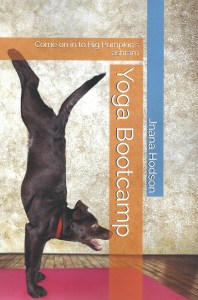
The paperback cover …

What happened for me during my residency was life-changing. I regard it as my master’s degree and my introduction to psychotherapy of an amateur sort. Among other things, it led me to the Society of Friends, or Quakers, which turned out to be the faith of my Hodgson ancestors from the 1660s down through my great-grandfather.

In the novel, I chose to confine the structure to a single day, in part because I had so many lingering questions I could not answer. Yes, within that day individuals could look back on their previous history, but the focus was on the NOW. And a lot could happen there in a 24-hour span. Besides, as I later learned through some candid discussions with a former Episcopal nun, monastic life has some commonalities of its own. As she said, some of the most intense interactions came in trying to choose the flavor of ice cream when the rare opportunity arose. I’ll argue you’re the most human under such rarified circumstances.

On top of everything, when I was drafting the book, I was out of contact with the place and its people. Critically, I had refused an order to return to the ashram after I’d married and moved to Washington state and a follow-up stipulation of heavy financial support was out of the question. A half-dozen years later, back on the East Coast, I had an opportunity to stop by but was not admitted into the house. I did learn that Swami had died and I sat by her grave. So much for making amends.

… and the back cover.

Since then, I’ve reconnected through social media with some of the key players and had a few assumptions, not in the story, deflated. In addition, Devan Malore’s “The Churning” reflects life there a few years after I’d moved on.

The story itself could have gone another way, if I hadn’t wanted to present the ideals that drew us together and kept us going. Especially the humor and playfulness.

More compelling for many readers would have been a more sordid tale of just one more “new religion” outfit run into scandal of a sexual or financial sort, preferably both. There were enough elements for that, as I’ve since learned.

The story first came out as a pioneering ebook in PDF format only and was later updated to Smashwords and its affiliated partners. A more recent, quite thorough recasting (again, blame the influence of Cassia in “What’s Left”) changed Swami from female to male and introduced Jaya as one of the eight resident yogis, thus linking her to the heftier Nearly Canaan novel. Besides, the transformation made Swami more acceptable to the expectations of many readers and allowed the Big Pumpkin and Elvis dimensions. The role was already unconventional enough, and this was more fun.

Am I still doing yoga? If you mean hatha, the physical exercises, let me say rarely and embarrassingly, at that. As exercise, I’ll substitute my daily laps in the swimming pool, and as meditation, my weekly Quaker meeting for worship. And no, I’m no longer vegetarian, other than when I voluntarily follow the Greek Orthodox “fasting” of Advent and Great Lent (again, blame Cassia), though I also eat much less flesh than most Americans. Actually, in these seasons, the Eastern Orthodox Christians are stricter than we yogis were.

I do wish there were a similar haven for youth today, one freed from the burden of student college debt. I’ll let “Yoga Bootcamp” stand where it does.


On relating to some special place you’ve explored in depth 

Tourists may get a taste of a distinctive natural wonder in a particular landscape during their brief stay, usually in prime season, but it’s not the same as dwelling there through an entire year. A winter night or storm, for example, is a much different cosmos than a summer day.

I’ve been fortunate to have experienced some remarkable destinations through all their varying weather, thanks to my career moves, but never to the degree of living largely alone, as Henry David Thoreau did at Walden Pond or Henry Beston along the dunes on Cape Cod.

I’ve come to know both places firsthand over the rotating years, and so reading the two classic books that emerged from them evoked personal awareness of scenes that likely struck the general reader as exotic or even confounding. I never would have appreciated them the same way had I still been in the Midwest or Pacific Northwest, for certain. Quite simply, the encounters provided a stronger foundation for revelation of so much I had missed.

One of the fringe benefits of my second marriage was that my stepdaughters’ Grandpa Jim lived in Wellfleet on the Lower Cape, or what Beston more clearly calls the Outer Cape. (Understand that the Upper Cape is south of the Lower Cape, much the way Downeast Maine is really up the coast. Welcome to New England.) So we got to visit throughout the year, making me a big advocate of visiting popular travel sites in the shoulder season. There’s no way to describe walking several miles along the surf below the bluffs and having the expanse totally to myself – in perfect weather the week after the normally crowded Labor Day.

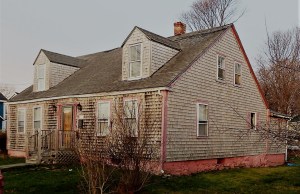
There’s a reason it’s called a Cape, or more technically, a full Cape. Here’s how ours in Eastport looks before the renovations begin. It was likely built more than a dozen years before Henry David Thoreau retreated to Walden Pond.

My wife used to gaze on the few remaining gray cabins atop the bluffs and voice a dream of living in one of them – the National Parks Service has been removing them piecemeal – noting that you wouldn’t want to have anything there you wouldn’t mind losing to a hurricane or nor’easter.

Beston’s 1928 The Outermost House tells of spending a year in just such a house only one town south of Grandpa Jim’s, and so I could envision and even smell much of what he describes.

At first, I was put off by the feathery, slightly Victorian language, as well as the affectatious British spellings rather than American, but once Beston presented some sharp, detailed observations of wave and wind motion and sound, I was captivated. His examination of waterfowl and other birds, especially, is admirable, but the range of shore and sea life he portrays is also encyclopedic.

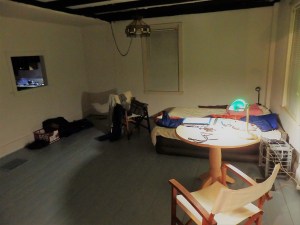
Here are my luxury accommodations the first months in town. I essentially lived in two rooms, spilling over into two more.

He writes from a time when the Cape still retained an older character that was being overlapped by newer ways that included telephones and flashlights, both unlike today’s suburban feel, and his book is credited with inspiring the creation of the Cape Cod National Seashore to protect the wildlife and geology he treasured – as many of us do today, thanks to the protections.

My reading came a few months after moving into my own equivalent of Beston’s cabin, albeit it much further up the coast and in a fishing village – still in view of the ocean.

You’ll be hearing a great deal about it through the coming year.

Are there books you’ve especially enjoyed because they’re rooted in places you know?

Back to the scene of the crime – or should I say wound?

This time of the year typically involves reflecting on the past. Part of it stems, of course, from facing a New Year and looking ahead, as well as the news from distant friends in their Christmas and Chanukah cards. Part of it also arises as we hunker down in the long nights around the solstice. It’s more than just looking back over the previous 12 months to get a sense of what we what or need to do next. Sometimes, it reaches back much farther. Or what we’ve lost.

Back on November 4, I blogged on “Returning to high school and its misery” and so much emotional baggage I thought I’d left behind 57 years ago. That post was the first time I could honestly admit that the period was essentially miserable for me – until now, I had maintained walls of denial. My elder daughter, hearing of this, was incredulous. Seems everybody her age and younger knows those years are supposed to be miserable. Eradicate any indoctrination of they’re being “the best years of your life,” unless you’ve truly been stunted.

As that post related, a recently renewed connection has led to some much deeper conversation and awareness than we ever had back then. In addition, it’s opened paths to others and glimpses into how their lives have unfolded over the decades.

Some manifest the life I’d expected to follow – should I say fulfill? – after graduation from college and returning to my hometown. Instead, my career took me in a much different and likely rockier direction. One path would have deepened friendships over the years. The other kept leaving new friendships behind in the sunset, rarely by conscious decision but rather by the practical demands of resettling in a new location.

I’ve been counseled that emotions are real and don’t die or just go away. When they’re buried, they operate out of sight, insidiously, sometimes undermining what’s happening on the surface. As I discussed some of what I’ve been experiencing in revisiting the past, my wife observed that it sounded like these are happening now, rather than back-then. She had never heard my desire to return to my hometown, almost as a mission, but rather insisted that I could wait to break loose and run away. Acknowledging that the doors to any return had closed behind me was difficult, but that’s what’s occurring as the feelings come to full light. This time, there’s no denial of being hurt or feeling reject, no suppression of the sense of failure or hurt or that as they open, however belatedly, even slow me at the moment. What’s important is just sitting with them and being honest as another step in psychological health and wisdom. There’s energy in them, once I claim them. Let me say it’s something like having bass and alto harmonies running in music. Or solving a cold-case murder or heist and seeking justice.

One photo I chanced across cut hard. The caption named someone who looked nothing like she did back then, and it hinted at difficulties. I followed it to another, of the beauty I remembered in her youth. Quite simply, I’d had a big crush on her, though she was older and, in many ways, out of my league but sometimes in a big sister sort of way. Still, the last time we had been together ended badly, or maybe off-key, from my side, at least. At the minimum, I should have phoned her afterward, no matter if it was a very difficult summer for me.

What I’m discovering now is that our lives wound up in surprisingly parallel directions, though I’m also acknowledging that no one could have accompanied me on all of the relocations I’ve made, many of them shaped by closed doors as well as openings, most of them through my years in lower-level newspaper management. What I keep finding is that the deeper thread of that zig-zag journey, with addresses in nine states, has been spiritual growth. Yes, there I was, trying to move up in a shrinking business field. Ultimately, by stepping down and earning a union card, I made it to retirement.

For now, I’m hoping she replies to my overtures, but there’s no telling whether she’s even looking at her email or Facebook these days, much less responding. There are so many questions I want to ask and details and perspectives I want to hear. And parts I want to apologize for, as well as others I wish to celebrate.

~*~

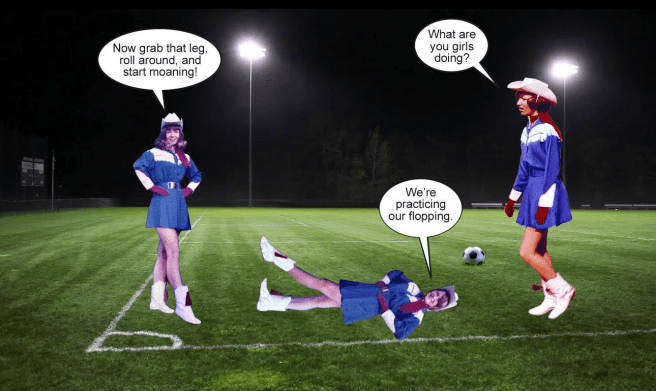
My previous post included memes from the Disillusioned Bell-Ette, an outrageously funny FB page that also blew open some of the cover I’ve been working through.

Here are a few more.

I love mountains and have, after all, lived close to the Cascade Range in Washington state and the White Mountains of New Hampshire as well as in the Poconos in Pennsylvania and the Allegany foothills of Upstate New York. Much of Downeast Maine even fits the terrain. What makes this one so funny is that the three Bell-Ettes have ventured so far from the generally flat landscape of our high school, which sat very close to the highest point in the city. Nothing like this, though. So much for the first inside joke. Add to that the directions for pizza and chocolate candy. Clifton Gorge had been a largely unknown canyon with the Little Miami River running over a waterfall that was out of reach and nearly out of sight. Now it’s better known as part of a public park, and what had been a big cliff for me is now dwarfed by the bluffs along the Atlantic around here. As for being headed in the right direction? Mine was always away.

One streak of the Disillusioned Bell-Ette postings had them going abroad in search of Enlightenment. That is, far from our high school and hometown. And here I thought I’d been the only Bison to wind up in an ashram? Not all of their encounters had them meeting gurus or holy men.

With its broad streets, Kyoto could have been the downtown of our modernized home city, except for the lettering and the mountain at the end of the street. And we never would have imagined sushi. Some of us have come far over the years.

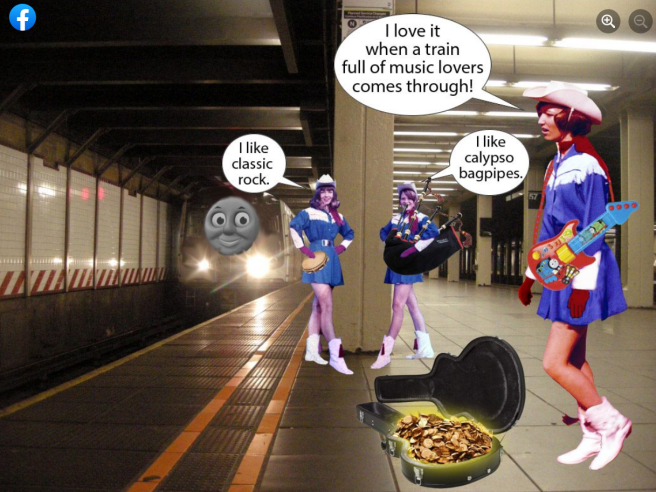
Underground public transit was another of those things that were far from us. Cincinnati, the metropolis to our south, almost had a subway, and that’s a fascinating story all its own. But considering the extent to which I fell in love with subways (yes, love does seem a strange word in this context) and even wrote a novel about the wonders, real and imagined, I was delighted to see the Bell-Ettes following up in, err, my tracks.

Manhattan, 57 Street station. I’ve been there.
Many Russian subway stations resemble palaces. My international travel has been restricted to Canada.

More to the point, I’m more fully realizing the downsides and hidden costs of what’s been an incredible life, even with its many near misses when it came to making the big time. Or maybe because I hadn’t been sucked upward in those opportunities.

Well, some of us were really green.


Returning to high school and its misery

I thought I’d left all this behind me.

After high school commencement, most of my buddies headed off to campuses elsewhere, while I was stuck living at home and attending a local commuter school while working part-time. I didn’t even have a car of my own, unlike the assumption of so many kids these days. Well, after I graduated there was a hot round of romance with someone a year behind me, but then she, too, headed off before I finally made my own escape. I’ve always missed her, though my biggest regret was in not responding to her desire for me earlier. Yes, too late, as it turns out. Always turns out?

Eventually, my zig-zag career across the continent put all of that far behind me. So I thought.

Even so, I did ponder attending the 50th anniversary reunion, maybe just to brag, but complications came up. It would have involved a long drive or costly flight, and then a bunch of embarrassing pictures with old people who were nothing like me. As well as a high probability of a fatal heart attack, as I learned later. End of the book, right?

Except that in the past year I heard from someone I’d emailed a dozen or more years ago but never heard back. Maybe a good thing, considering how gushy it likely was.

And now? It’s opened an emotional can of worms, as well as some conversations we should have had then but didn’t. Or should I say couldn’t? We were so uptight. Period.

Ours was a largely middle- and working-class, all-white, high school, and in retrospect I’ve realized how whitewashed our indoctrination was. In my innocence or ignorance, I had no sense of how many pregnancies happened, even in our college-prep circles, just for starters. Not that I had any clue how to interact with a girl or any life in the other levels of our classmates, even in our homeroom, which was never exactly homey.

The new communications have sent me back to the yearbooks, where I see half of our classmates already probably never had a chance. Let’s be honest, breeding starts to show, or maybe the dull look in front of the camera, in contrast to the good-lookin’ ones, who also have all kinds of activities behind their names. I suspect I was walking a fine line between the two camps, not really belonging to either. As for the in-crowd, we never would have gone into the secrets of their home lives, although all of that becomes more suspect today.

Naturally, you know who I avoided or maybe never, ever, really saw or considered. It was a fine line we never explored. Besides, I was being told I belonged in the big city, far from where I was growing up. Now I see that as another way of saying I didn’t fit in, not fully. Still, I tried. Oh, my, did I.

This was the main entrance to our high school. I’ll explain the rest of this in a minute. If it had happened in real life, I’m sure they would have been in detention or maybe even suspended. Oh, I wish there were another term for being kicked out of school for a short while. By the way, skateboards were still way off in the future. We didn’t even have rollerblades quite yet.

That seemingly out-of-the-blue phone call and then emails led to Facebook, a platform I usually avoid, though this time with a raft of new contacts. A blast from the past, as we would have said back then.

So this is where they are now? But where are how many others? WTF have we done with our lives? All of that, and more.

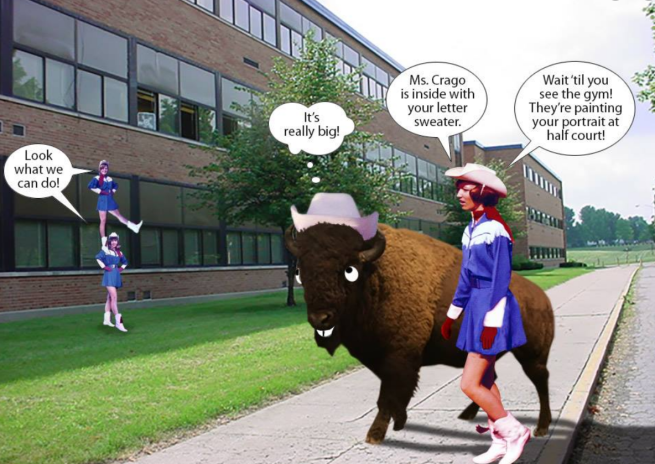
The biggest kick in the gut came from an FB public figure page called the Disillusioned Bell-Ette, outrageously funny and caustically humorous. It quickly spun me into a depression.

You have to understand that the Bell-Ettes were our high school’s elite girls, a marching corps perhaps modeled on the Rockettes in Manhattan and sexier in general than our wholesome cheerleaders, not that I would have discounted any of them. For full disclosure, I even took one to the prom.

The anonymous Disillusioned Bell-Ette displays a prodigious talent in montaging images of the corps’ members and our school mascot, a bison – here I had been wondering if it even had a nickname, though she insists it was Bucky, uh-huh. Not so sure on this end, which makes it even funnier. Especially when she has a special, uh, affinity for him. I’m impressed by the sheer labor in putting these together, as if anyone’s actually watching. Or is she venting?

Yes, we were the mighty. mighty bison. Bucky defies the image.

Beyond that, there’s the candor of being disillusioned after being at the top of the social pyramid, the destructively adolescent structure.

More to the point, what about the innuendoes regarding a faculty member’s sexual proclivities?

How provocative!

And I had already been wondering about that. Coincidence?

And I had also already been wondering about one Bell-Ette, two years older than me and the editor-in-chief of the school newspaper as well as a member of our church, who was engaged to be married after she graduated. Was she the disillusioned but very talented host of the site? For now, I’m inclined to say not. But don’t rule it out altogether.

Missing is the wonder of how we ever came to have a buffalo as a mascot in the first place or how our drill marching team came to be widely known as cowgirls. We were in an industrial city so far from the Wild West. How weird!

Our school was all about athletics and not much else. Even so, some of us managed to survive, albeit not entirely unscathed.

All of this had me recalling some dreams – literally, visions in the night – where upon awakening I imagined how I would have redone the Hilltopper, the school newspaper, to include everyone. I would have condensed the club stuff to an Eye or Ear on the Hill column, with snarky comments. And then had a focus for each edition: Food, Transportation, Personal Style, Jobs/Working, Free Time, Survival (advice to the underlings and to the future), Favorite Teachers (a sly way of suggesting who to avoid, if you could), Engaging the Arts & Entertainment, Electives, Dating & Relationships, Personal Style, Living with Siblings, Prepping for Summer, Graduation and Moving Up. That sort of thing, inviting entries for the next issue, too, open to all. The focus would have been on the whole possibility of having fun rather than trying to meet the standards imposed from elsewhere, including in the paper’s case, a remote scholastic press association and its judges, who misplaced our entries for a whole year, anyway, thus failing to give us any useful guidance or feedback along the way. So much for my failings as ed-in-chief, not that I would have had any backing in attempting such a revolution.

Oh, well, a few more missed opportunities in my life. And a few more letdowns from those who were supposed to support us.

He was obviously as clueless as I was.

More about ‘What’s Left’

No book was more of a struggle for me – or ultimately more transformative. Not that any of them came easily or quickly.

Each of them would have been much simpler if I had only hewed to a specific genre and with a particular reader in mind, but my goal was to explore a theme and see where it led rather than fill in a blueprint and hope that others would be fascinated by the discoveries. That put me in the “pantsers” end of writers, meaning seat-of-the-pants, rather than the “outliner” side, which can be paint-by-numbers rather than “painterly,” layer upon layer added or scraped away for intrigue, depth, and motion.

My earlier novels were grounded in people, places, and events I had experienced directly, which I then abstracted, of course, for a more inclusive understanding. When needed, I could turn to my journals for details and to my correspondence for dialogue or even make a few phone calls.

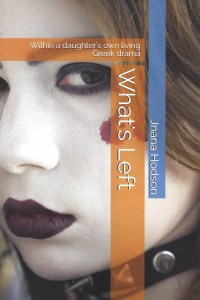
The paperback cover …

What’s Left, though, took me far beyond that. Yes, I was starting from the finale of my first published novel and trying to advance the scene by as much as a half-century, but I had no experience in a family-owned business. (I had skirted marrying into one, but I didn’t know how it would feel growing up in that situation – this was totally unlike my grandpa’s plumbing outfit, anyway.) Nor had I really worked in a restaurant. As for being part of a tight-knit extended family? Much less Greek-American? The adage, “Write about what you know,” now became, “Write about what you want to know.” More pointedly, that led me more and more into my daughters’ generation and its struggle for survival. As if anyone has answers to the big questions.

I set out thinking the story would take up the ongoing issues of the counterculture movement one by one – peace and non-violence, sexual and racial equality, the environment and ecology, natural foods and fitness, alternative education, spirituality, boho lifestyles, and so on. I had plenty of extended outtakes from the earlier books plus a set of essays that could be woven into the narrative.

But my upbeat, idealistic outlook started ringing hollow. Yes, the issues remain, even thrive, in spite of the entrenched opposition, and they need to be taken up by a younger generation. What hit me was the debris of broken dreams and promises, much of it caused by our own petite shortcomings. Yes, some of them mine as well. Broken families, too – just what is a family, anyway, especially when you examine the evidence closely, as the novel does? Where was the tight community we envisioned, much less that sense of tribe? As I looked around, I saw those who most continued in the hippie image were either bikers or what my kids would call losers. I have to say substance use or abuse has taken a heavy toll.

… and the back cover.

It’s too much to pack into a single novel, though one can touch on them. My focus slowly shifted on trying to pick up from the wreckage. That is, the place where Cassia found herself.

I was still mulling my approach when I chanced upon Jonathan Lethem’s “Dissident Garden” and was taken by its unique structure of 16 mosaic panels that could be moved about, if one wants, within its developing chronology. Lethem also had me realizing how much I needed to develop Cassia’s family’s past, with its own bohemian streams in coming to America. How many threads could I manage within this?

Voila! I had an organizing point. As poet Gary Snyder says, quoting an ancient Chinese folksong, to make a new ax handle, you use an old one as your pattern.

While I inherited the Greek-American element from an impulsive touch at the end of my first published novel, where this one picks up a generation later, I was only now piecing together how pervasive its presence in my own life without any earlier special awareness. As I’m seeing now, apart from Jeffrey Eugenides’ “Middlesex,” very little about Greek-American culture seems to exist in literature. (He nails the largely overlooked Midwest, too, by the way.) And then I started to engage it here where I live, beginning with Greek dancing and then Eastern Orthodox Christianity, so different from my own Quaker and Mennonite grounding – it’s like the difference between Zen and Tibetan Buddhism, as Snyder once quipped, two ends of a long arc.

The novel itself demanded at least a dozen major revisions, pushing it ever more toward the present, especially once Cassia found her own (snarky) voice and her brothers and cousins became vital characters. My personal genealogical research techniques also came into play as I examined her ancestry, both on her mother’s side and later, to my surprise, Cassia’s father’s.

What I really wasn’t expecting was the way she prompted me to return to my earlier fiction and severely revise it as well. In most cases, adding new characters and new scenes, cutting heavily, and renaming results. The three books about her father’s past gained a unified structure and timeline as well. So, in more ways than one, through Cassia, my novels embody what’s left.

Look for the witness in the work, too

Cinema critic Roger Ebert was talking of the importance of the witness in every movie and pointing to the places where the character appeared in the film under discussion, mostly in a lower corner. The comment flashed me to the reality of how often the hardest thing to see is what should be the most obvious. It’s not just the elephant in the room, it’s things we take for granted.

One way or another, all fiction is built on the observer, who is also to some degree an outsider or misfit, too. (If there are any exceptions, I’d love to hear them.) Four of my novels, for instance, were intuitively built around a photographer, a profession that makes Cassia’s father a well-trained witness. In turn, as she investigates his archives, she, too, becomes a witness, even before she starts commenting on his earlier life.

Of course, as a reader, you also become a witness. Or even a voyeur, as Camille Paglia has contended. It’s almost like every page is a microscope slide to be interpreted.

Curiously, I now see this also at play in a long-term non-fiction project in my life. Forty 40 years ago, seemingly by accident, I became involved in trying to uncover my father’s ancestry. I thought we were simply homogenous Midwesterners who had always been in Ohio from its beginning. What I discovered, though, was that one branch was – but German-speaking and largely akin to Amish. My name-line, however, was Quaker by way of North Carolina and its slaveholding culture. Both strands were outsiders to the larger society and also pacifist. It opened my eyes to alternative histories and to a recognition that stories don’t always have to resolve nicely – three people may record their memories quite differently, and maybe all three are true, if not factually accurate.

Oh yes, the research was often collaborative, with correspondence going and coming from others working on parts of the puzzle. It wasn’t always quite as lonely as drafting fiction or poetry.

To my surprise, as my novel What’s Left was taking shape, Cassia started assembling bits about her Greek-American grandparents, who had died before her birth, and then beyond to her great-grandparents, who brought the family to the New World. Like me, she found valuable clues in the surviving snapshots and formal portraits regarding their personalities, as she also did in the letters and other documents.

None of my ancestors came by way of Ellis Island, and on Dad’s side, they were all in this country by the time of the Revolutionary War. I once pondered doing a series of novels on them, but I’m still intimidated by the technical challenges – a realistic language they can speak and we can understand being high among them.

Witness, I might add, has an extra dimension in Quaker thinking. It’s not just what one sees or hears but how one lives. The goal is integrity, as in wholeness or consistency. Is that what others see in us or our lives and work? Or even as our goal and ideal, even when we fall short reaching for it?


The role rides on conflicted feelings

Sitting down to compose a novel requires some bravado, an assumption or presumption, even outright arrogance, that you have something important to say and an ability to do it in an interesting way.

You know, balls, swagger, mojo. Go to a writers’ group and just listen. But it’s not all sheer ego-driven. For many, at least, there’s an ongoing tension between believing in our own talents and shielding ourselves from the nagging self-doubts. Even Stephen King has them. Remember, the practice of the craft is a solitary act, not a team sport. It gets lonely, especially in the absence of feedback or fans in the stands, whether they’re cheering or jeering. Sometimes, to your surprise, harsh criticism is easier to handle than any praise.

Unless you’ve been there, you have no idea how precious a voiced reaction can be in nurturing you. Those brief reviews and star ratings are important, not just for guiding others to certain books but for guiding you as an author in your practice. An astute reader picks up important elements that have slipped right over their creator’s consciousness. Please, please, please take a few moments to weigh in when you finish a volume. We all need confirmation that we’re not wasting our time – or yours. Best of all is the epiphany when we’re left feeling that someone finally “gets it,” actually understands what we’re about. Don’t be shy.

The paperback cover …

I recall giving a friend a booklet I’d written about the Quaker metaphor of Light. (By the way, in the first two centuries of the Society of Friends, the term was always Inward Light or some variant, never the Inner Light expressed today. It’s a crucial distinction.) When he finished, he thanked me, said the text had cleared up his understanding, and then added, “You write very well.”

Even after four decades in the words-on-paper business, I was taken aback, considering that he is, by any measure, an important American literary figure and a master of the language. It was like “welcome to the club,” the exclusive one with the dark paneling and Manhattan address. It was like a cup of fresh water in a desert. Within myself, I felt freed from the “hack writer” label so often applied to journalists from Dr. Samuel Johnson on.

Later, in an aside, he told me I was more of a poet than a novelist. Knowing his fondness for poetry, I took some comfort in the perspective, as well as some umbrage about the fiction part.

On reflection, I now have to agree on his assessment, at least as my novels stood then. He certainly helped my character Cassia press her case for the reworking of all my existing novels, as I did in the aftermath of What’s Left, where she’s the star.

There’s also that frightening moment in the gap between when a book’s been accepted for publication and when it actually comes out. We’re afraid someone’s going to somehow uncover our darkest secrets or that we’ll be shamed by some indiscretion or that we’re about to make an unforgivable transgression. Again, go to a writers’ group and listen … or even ask. If you’re an author, you think you’re somehow bonkers when you feel this, not knowing how much company you actually have.

… and the back cover.

I’m of the camp that hews to Bukowski’s regime of daily “butt time” at the keyboard, day in and day out, regardless of how inspired you might be feeling. Many days it’s a dry struggle, but on others something different and amazing blossoms. From my perspective, it’s when writing becomes a kind of prayer and you find yourself in a “zone” where things come together as if by magic and characters start dictating to you, if only your fingers can keep up with what your soul is hearing. It’s a dialogue with the Other, as in Muse, and you’re the mere scribe at her service.

It’s what happened when Cassia started dictating to me.

It’s not always at the keyboard, either. Sometimes it happens while you’re in the shower or on the throne next to it or swimming laps in the pool or commuting to work.

You can’t control this. Realistically, it happens when you’re not in control.

It happened to me at the finale of “Subway Hitchhikers,” which years later became the launch pad for “What’s Left,” where I had to make sense of what I’d been given, however intuitively.

Perhaps the best, well, I just had a phone call and lost the thread of thought. Maybe it wasn’t that important.


A baroque twist runs through my distilled expression

Samuel Johnson and his baroque constructions gave a big push to my literary ambitions after high school. Let me just say I’ve loved the clarity of Mozart from my adolescence on, and Bach and Handel have risen in my estimation in the years since. The brash English master fell right into that, though I now see again just how irreverent he was, despite all of his professed orthodoxy.

What it means it that I’m comfortable reading and writing certain kinds of complex sentences that are foreign to modern readers. Perhaps I should apologize? At least it’s not the only way I put sentences in line. Still, there’s a richness that’s missing in Hemingway and his progeny.

And here I am, drilled in the newspaper journalism Papa Ernie claimed was his inspiration. Think again. (Ernie? Makes me think of Pyle, and his big desk at the Indiana Daily Student, where I once worked.)

My wife has noted the dichotomy between my fondness for many Old Ways and the rule-breaking, experimental edge of my writing and thinking. She can point, for instance, to my fascination with the fiery writings of early Quakers in the mid-1660s placed in contrast to wild hippie extremes.

Are they really that different, though? I feel they enrich and deepen each other.