After throwing myself into business crusades and tumultuous romantic relationships, I consider myself a survivor.
That’s even before we get to politics.
How about you?
You never know what we'll churn up in cleaning a stall
After throwing myself into business crusades and tumultuous romantic relationships, I consider myself a survivor.
That’s even before we get to politics.
How about you?
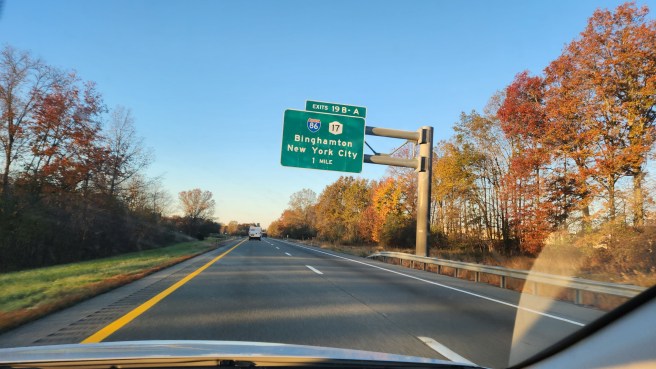 As they skirted New York City, they texted me this, not just to update their progress in traveling south but also knowing the memories it would trigger.
Back in my early days after college, this was in my circuit, even though Interstate 86 was still in the future.
Theology? It’s where science must answer what came before the Big Bang.
Can anyone even calculate how many seven days that multiplied into? Before?
Now, just look up at that Milky Way overhead, interrupted by a miniscule satellite.
The role of a writers’ group will elicit a range of responses.
Some find value in having a core circle that intensely critiques each participant’s ongoing work, while others – I’ll include myself – see that as limiting if the others are clueless about your style and vision. It’s the unpublished version of blind leading the blind.
Still, I have been greatly assisted by opportunities for weekly or monthly open reading sessions, starting with the Stoney Lonesome poets in Bloomington, Indiana, and picking up with the Café Eclipse evenings in Concord, New Hampshire; young poets who met at Barnes & Nobel in Manchester, New Hampshire; Isabel van Merlin’s Merrimack Mic coffeehouse nights in Newburyport, Massachusetts. Somehow, I didn’t feel that kinship in the Poetry Society of New Hampshire. Later, a monthly group known as Writers’ Night Out in Portsmouth, introduced a wide range of writers, both beginning amateurs and seasoned professionals, spanning fiction, non-fiction, poetry, advertising and public relations, script writing, and playwrighting. We never knew exactly what the mix would be, but it was always stimulating and we never felt a sense of competition, as far as I could tell. The tips and insights we shared could be quite useful. That’s where I first heard of Smashwords, for instance.
There were other stints where I was truly solo. I was never part of the Iron Pig group in the Mahoning Valley, for instance, though my artist then-wife had her gallery groups.
Baltimore had a large writers’ group that never quite jelled for me, though we did have a marvelous evening with Tom Clancy just before the release of his first movie. His honesty did offend some of those present, though I found it refreshing.
More recently, it’s come in the monthly open mics at the Eastport Arts Center, where spoken word usually alternates with music.
~*~
The arts center does offer inspiration on other fronts, too, including the Sunday afternoon presentations through winter, plus concerts, plays, the film society, and even contradancing.
The arts center is one reason our community stands apart from many others. We had nothing like it in Dover, nearly 30 times the size.
My original expectation of dilettantes and artist wannabes was quickly dispelled. A key post-Covid Stage East production, for instance, was two one-act plays – Beckett and Cocteau. And some of the best chamber music and jazz I’ve heard anywhere has been here. So we get a good dose of deep work.
But lately I’ve been hearing stories of some of its founders, some of whom have died since my arrival. One, for instance, had worked closely with theater great Tyron Guthrie. You get the picture.
The full history still needs to be written. Not that I’m stepping forward.
I’ve previously posted on the phenomenon of ghosts residing in homes in New England, especially, somehow, Maine.
In that vein, I’m surprised we haven’t sensed anything in the household, especially considering its age. Maybe Anna Baskerville’s good vibes should get some credit here.
But I have asked about a few of our neighbors, and they quickly told of theirs. I am surprised by the details, including a smell or two. Also, so far, they seem to be limited to one per house and do prefer to don dark clothing.
At least they seem to be benign, only sad.
Note to self: Keep asking around. It is a great conversation starter.
~*~
Here are some related facts gleaned from Harper’s Index in recent years:
It was a science fiction writer who suggested this as something the public gets nosy about. Like there’s something magical in where an author works.
Well, it can be personalized, including what’s on the wall or playing as music in the background.
Somehow, many people imagine that having an inspiring view helps, but Annie Dillard argues otherwise. In the newsrooms where I’ve worked, the executives had the windows. The workers had a sweat shop, rows of keyboards on cluttered desks, maybe even with cigarettes back in the day.
My own spaces have varied from a coffee table where I sat cross-legged at the typewriter to the upstairs bedroom I dedicated to the work when I lived at Yuppieville on the Hill before I remarried. There, I did have a commanding view over the parking lot and the water tower beyond as well as some fine sunsets. Usually, the arrangements were more of a make-do nature over the years, often in a second bedroom.
Once I remarried, I envisioned turning the top of the Red Barn into a year-round writing space, something that never materialized. Instead, it wound up being the north end of the attic, as you’ll find in many of the earlier posts here.
Now, as I’ve mentioned in reflecting on shifting from paper to digital, I’m able to work from a corner of my bedroom, where I do have a compact view of the ocean. Just enough.
~*~
Now, for a few related thoughts and reminders.
Note there’s a difference between an office and where you write.
An office may have a phone, filing cabinets, tabletops, checkbooks, mailing supplies, and so on. It’s probably where you pay your bills, too.
The writing space, as mine is at the moment, may be quite compact.
As for desktop maneuvers / chaos busters (by Jennifer Weisel, maybe from Elle, I have no idea how long ago):
The average person spends over four hours per week looking for misplaced papers, according to an Accountemps survey. Gloria Schaaf, a Manhattan-based organization consultant, offers advice on how to conquer chaos:
Make your desk command central (30 x 60 inches is the minimum size; large enough to spread out on.)
Add a “filing” folder to the front of each file drawer.
Avoid piles: Act on every piece of mail when you get to it and you won’t have to look back through mounds of paper later.
Use one planning tool for both personal and professional commitments (meetings, phone calls, errands, television programs …)
Leave time for a half-hour “recovery period” at the end of each day to organize your desk; it will be much more approachable the next morning.
TRAPS: the floor (that’s where piles begin), bulletin boards (if you must hang papers, use a one-inch cork strip, “Miscellaneous” folders, “To File” boxes.
Are you sensing how much this reflects the paper era? Like the size of that desk! Or wondering how to adapt the advice to today? The clutter hasn’t gone away, unless you left it on your last computer before the disk was wiped.
~*~
TOUCHSTONES: those items and reminders of what’s essential, the way home, the way ahead: emotional and spiritual energy points.
Does this mean I put up the cow skull I found on Rattlesnake Ridge in the Yakima Valley 45 years ago?
~*~
As for a routine that keeps you doing the work, as the artist Red Grooms insists, “It’s very bad for an artist to lay off. You get out of shape.” (Catherine Barnett interview, May 1991 on page 62 of a glossy mag. In the interim, I’ve lost the tearsheet. Maybe during one of those purges?)
~*~
So what kind of workspace do you have or aspire to for your own creative endeavors? Include the right kitchen, if you wish. A studio doesn’t have to be a private space, does it?
When I was growing up, it meant something of a Mount Olympus quality.
Not some kind of norm but an aspiration – a better person and society in the end.
Back before the very culture clash between the two concepts.
Now we add to that the concept of supremacy, not just white but European. Or perhaps, grudgingly, Chinese.
The question remains: How do we encourage excellence?
And what do we name it?
I would have said alert but she’d counter twitchy.
I would have said observant but she’d counter oblivious.
I would have said free-thinking but she’d counter too serious.
I would have said independent but she’d counter aloof.
I would have said sensitive but she’d counter nervous.
I would have said inquisitive but she’d say I rarely ask questions.
I would have said accepting but she’d counter indecisive.
I would have said nurturing but she’d counter cold.
I would have said serious but she’d counter silent.
I would have said playful but she’d counter negative.
I would have said witty but she’d counter legalistic.
I would have said intelligent but she’d counter uptight.
I would have said slightly bent but she’d counter insecure.
I would have said self-sufficient but she’d counter evasive.
I would have said caring but she’d counter mean.
I would have said spiritual but she’d ask how that makes me a better person.
I would have said spirited but she’d counter lazy.
I would have said somewhat reserved but she’d counter socially deficient.
I would have said somewhat shy but she’d counter loner.
I would have said elitist in quest of excellence and quality but she’d counter self-centered.
I would have said egalitarian in opportunity and expectation but she’d counter workaholic.
I would have said outdoorsy but she’d counter escapist.
I would have said rainbow chaser but she’d counter impractical.
I would have said aging but she’d agree.
I would have said youthful but she’d counter bald.
I would have said honest, direct but she’d counter defensive.
I would have said exploring but she’d counter unemotional.
I would have said hedonist but she’d counter fiscally irresponsible.
I would have said ascetic but she’d counter dull.
I would have said a bit gallant but she’d counter straight-laced.
I would have said organized but she’d notice I rarely dust.
I would have said self-starter but she’d counter with a list of projects.
I would have said visionary but she’d counter icy.
I would have said original but she’d counter quirky.
I would have said inventive but she’d counter weird.
I would have said creative but she’d counter unrealistic.
I would have said hopeful but she’d counter inexpressive.
I would have said responsive but she’d counter boring.
I would have said kind, gentle but she’d counter too serious.
I would have said frugal but she’d counter tight-fisted.
I would have said financially marginal but she would have countered too willing to pay full price.
~*~
Mirror, mirror, on the wall?
Remembering gazing forlornly at LS, the cheerleader of the mysterious olive skin, and dark brown eyes etc.
Jenny, a year older, at the other end of our street, too.
The ache … tongue-tied, like facing a childhood hero or famous actor or scientist …
A shadow of that looking at prime foliage.
 Jnana's Red Barn