Shakespeare as the dreaded elephant in the room

In being held aloft as the epitome of English language and arguably world theater, too, the Bard of Stratford on Avon stands as an overbearing, even oppressive, figure.

Any writer since has faced the reality that by definition no one else can measure up, period. The fact that others have managed to carve out niches in the field in the centuries since is remarkable, considering.

Still, William’s presence was the reason I didn’t major in English when I transferred to Indiana University in mid-sophomore year. The department required a Shakespeare course predicated on memorization, something that’s not high in my skillset.

Beyond that, my focus has been on contemporary literature, at the time fiction and non-fiction but soon turning to poetry as well.

As a contrarian, I see no value in iambic pentameter, which we don’t speak, OK, and when I wrote in the form, the lines were always needlessly wordy. I like tight, direct, distilled, edgy. Later, the more flexible lines on Japanese poetry fit my ear as more reflective of American speech, at least as it was being applied by some West Coast poets. Count me in.

Not to deflate the Great Bard myth, but long ago I came independently to debunk William Shakespeare’s authorship of the plays. Nobody could have such an acclaimed vocabulary, for one thing, especially in the days before a thesaurus or dictionary. As for such a wide panorama of human values and foibles? Maybe it was a committee or at least a collaboration of greats – you know, a circle of improvisers whose takes were dutifully taken down as dictation – I was willing to accept that much. Sir Walter Raleigh has his backers as the likely author, and his poetry is more vernacular than his contemporaries, more akin to what we were doing in America in the 20th century.

Emelia Bassano

Remember, though, having to memorize his plays, or at least the great moments, was the swing factor in why I majored in political science instead. Otherwise, I would have continually been trying to rewrite it. Instead, avoiding the Bard, I was still able to minor in English abetted by the Comparative Literature department.

More recently I’ve embraced the argument that Emelia Bassano Lanier was the actual playwright. From the existing evidence, she was better read and had a wider command of foreign languages. She likely had more time for composition, considering all the time Billy Boy would have been tied up as a theater manager, director, and actor. To pursue the fuller case, you can start by looking her up online.

~*~

For my own quirky entry here, I’ll remind you of my own Hamlet, a collection of poems spread over five two-scene acts with intermissions and intermezzos.

You might say it has more in common with Chaucer, though, with a rock ‘em, shock ‘em beat.

You can find it and more in the digital platform of your choice at Smashwords, the Apple Store, Barnes & Noble’s Nook, Scribd, Sony’s Kobo, and other fine ebook retailers. You can also ask your public library to obtain it.
As for my spiritual quest from yoga (or before) to here

As I reflect on the many facets of my life to this point – including the zig-zag route that has led me to here – I realize what draws them together is the two central metaphors I’ve found in the early Quaker movement: divine Light and the corresponding Seed. One, as spirit, draws forth; the other, as physical matter, responds. These two, however abstractly, are embodied in both my writing and spiritual practice.

Not that anything’s been quite that easy or direct, even before our current dark times.

At least I haven’t been alone.

~*~

In my fiction, they’re most prominent in Kenzie’s Tibetan Buddhist discoveries in the novels Pit-a-Pat High Jacks and Subway Visions and in Jaya’s practices in Yoga Bootcamp, Nearly Canaan, and the Secret Side of Jaya.

Not to be dogmatic in any of this. What I have now is what I found missing in both the Protestant circles where I grew up and the Eastern practices later. The second, as the ashram, was a step that taught me to sit in silent meditation as well as to live in community, lessons that flowered in relation to my Quaker, Mennonite, and Brethren circles that followed.

Trying to live in the “real world” of employment and a partner and family definitely thickened the plot as these have unfolded. As I’ll concede, a spiritual life needs to be grounded. That is, the gritty realities.

~*~

Trying to be faithful to the Way as it has opened before me was hardly the path I would have expected. It has, though, been blessed with mutual irradiation, in Douglas Steere’s brilliant term, including a Greek Orthodox infusion.

More recently, attempting to get back to some of the basic hatha yoga exercises, has inflicted the humbling blunt recognition of what 50 years of neglect can do to the physical body.

And cutting through the platitudes and BS of the literature remains a challenge.

~*~

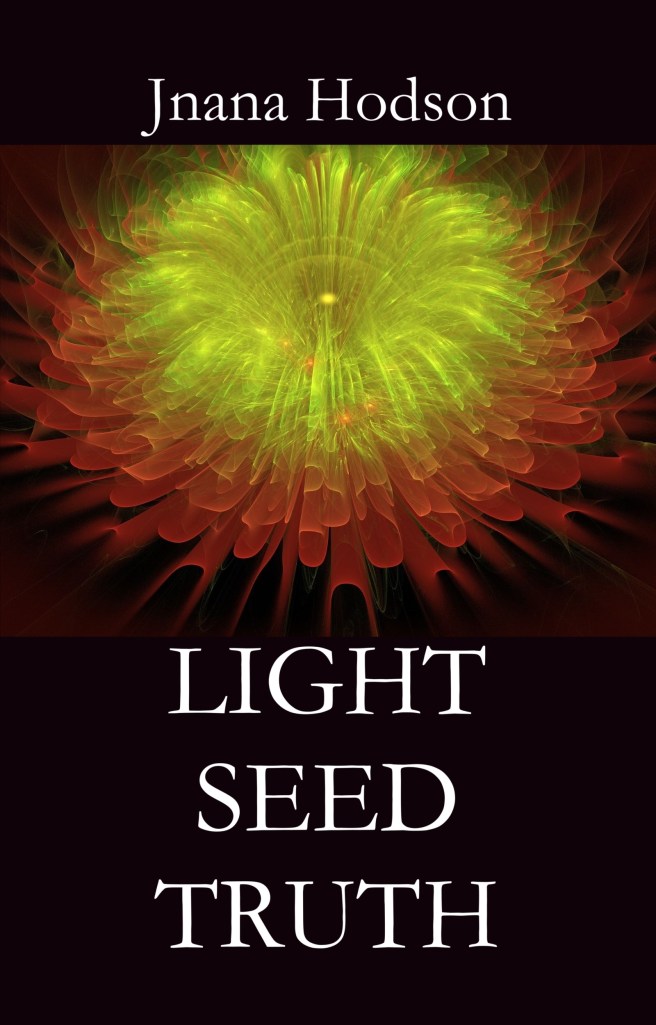
These elements drive the essays of my book Light Seed Truth, examining the three central metaphors of Quaker Christianity. It really becomes a different way of thinking.

Here are some of the things I’ve noted along the way.

I’ve been a Quaker for nearly four decades now, coming to the faith of my ancestors by chance after living and working on a yoga farm in Pennsylvania. Lately, I’ve been uncovering a revolutionary understanding of Christ and Christianity – one the early Quakers could not fully proclaim in face of the existing blasphemy laws but experiences they couched in metaphors of the Light, Seed, and Truth. As I systematically connect the dots 3½ centuries later, I’m finding a vibrant alternative to conventional religion, one full of opportunities to engage contemporary intellectual frontiers, individual spiritual practice, and societal crises. As an established writer – a professional journalist, poet, and novelist – I’ve organized these insights into a book-length manuscript. Would you like you to see it?

What I’ve found is an astonishing course of religious thought no one else has previously presented systematically. Reconstructed, their interwoven metaphors of the Light, the Seed, and the Truth provide a challenging alternative to conventional Christianity, one full of opportunities to engage current intellectual frontiers ranging from quantum physics and Asian spiritual teachings to psychology and contemporary poetry.

Embedded under the conventional interpretation of the scriptures and teachings about Jesus is an alternative definition of Christ and Christianity.

When early Quakers in mid-1600s Britain experienced this as their “primitive Christianity revived,” they were forbidden by the blasphemy laws from proclaiming their understanding openly. Instead, they couched it in overlapping metaphors of the Light, the Seed, and the Truth.

Embracing holy mystery, I’ve found the Hidden Path emerges.

Forget everything you’ve heard about Christianity. Let me show you an alternative portrait of Christ, and a much different practice that results. It can change your life. For starters, you need to realize that Christ is bigger than Jesus.

I can introduce you to the Universal Christ, which is quite distinct from Jesus. It can transform your spiritual understanding and make your life deeper and richer.

This can revolutionize your experience of Christ and what it means to be Christian.

This is not simply an intellectual exercise, but a visceral awareness

The results will startle and provoke, not just across the spectrum of today’s Society of Friends, but among Christians everywhere.

Sometimes I experience the act of writing as prayer. Neither is done for outward compensation, much less any guarantee of results, but rather to open one’s heart and mind to what is eternal and true – and attune oneself to that, regardless.

Culling my collection of photography and tearsheets, I’ve recognized I no longer desire to travel many places I haven’t been, but would rather revisit places I have. Either in person or, in the case of Tibet or Japanese temples, in my thinking and study. I also recognize that could change, given different economic circumstances and an influx of free time.

I now seethe early Quaker vagabonds were Dharma bums, too. The itinerant ministry proffers its own humor.

Quakers are still around, all right. And more relevant than ever. Just listen.

You can find it in the digital platform of your choice at Smashwords, the Apple Store, Barnes & Noble’s Nook, Scribd, Sony’s Kobo, and other fine ebook retailers. You can also ask your public library to obtain it.

How much of my story is not directly my story?

Rather, so much arises in the intersections with so many others. It’s part of the role of the artist as a witness.

We could consider the death of my ex-spouse’s second husband, for example, or the death of my current spouse’s first. Some hit closer to home than others.

Even the activities of others in our own households that aren’t exactly ours individually.

Add to that the ways others would see us, in contrast to our own versions.

These are typical of things that still impact our own individual life stories. Our lives could have led to so many other possible outcomes, after all.

Let me admit that my life is enriched by what others do around me, even when I’m not actively engaged. I want to share in their glory … or whatever. The way a sports fan does.

A writer is ultimately an observer, not just a participant.

For example, as a poet and professional journalist, I found that the police radio scanner in the newsroom more accurately reflected romantic relationships in America today than any collection of English love poems. You didn’t have to sit next to a police scanner to perceive how sexual relationships had taken a peculiar turn.

Or, from another perspective, growing up in Ohio, I had thought our family had no colorful traditions or legacy. Only after moving on to both coasts and, by chance, embracing the faith of my ancestors did I come to see how much Grandpa and Grandma were discarding the very things I was reclaiming and how thoroughly they were adapting to a changing urban environment. Despite all the time my sister and I spent with them, I came to realize I really didn’t know them, after all. Just who are grandparents, anyway? Does anyone’s fit our idealized image? Only recently, learning that Grandpa proudly advertised himself as Dayton’s Leading Republican Plumber, did I find the key to unlocking their story and its place in history.

I had no idea Grandpa’s lines had been Quaker through North Carolina, Pennsylvania, Northern Ireland, and Cumbria, England. There was nothing of the pirate attack that left an orphan to arrive in the New World, where he eventually settled on the frontier of Pennsylvania and later the Carolina Piedmont. Nothing of our gold mine or the pacifism in the face of the Confederacy, either. Grandma’s lines, meanwhile, had been Dunker – another pacifist denomination – and a pioneer family settling a corner of Montgomery County, Ohio, that up until the First World War was as Pennsylvania Dutch as the Lancaster and York counties it had left. These are not the American histories we typically see.

What kind of person would describe himself as Dayton’s Leading Republican Plumber? My grandfather did, though it was only years after his death that that tidbit finally allowed me to know who he really was. It’s really a remarkable story.

As for the others who crossed my path in college or the upheavals after?

I have no idea where most of them have gone.

Of the others, the results aren’t always what I anticipated.

I do know that none of what I see around me is being faithfully examined on television or the movies, something I’ll argue is cultural impoverishment.

In the larger span of time

Being a classical music fan induces a peculiar sense of history. If you love fine paintings or theater or literature, you may encounter something similar.

I found some of this being stirred up while sitting through a concert where Debussy was the oldest music performed. He was still considered “modern” when I began attending concerts in 1959 or so. He died in 1918, shortly before my parents were born. Not that far back, then.

For additional perspective, some major Romantic-era composers like Tchaikovsky, who died in 1893, or Saint-Saens, 1923, or Puccini, 1924, weren’t all that distant from me at the time, though it seemed they were much more ancient, say closer to Mozart. The span between them and me at the time would fit into my own life now.

I do recall hearing a live performance of the Tchaikovsky fourth symphony under Lukas Foss and the Buffalo Philharmonic and during the rapturous applause afterward have the gentleman sitting beside me lean over and say, “You should have heard it under Reiner in Cincinnati, as my wife and I did.” That would have been only 50 years after its composition, and this was 30 or so years later.

What is striking me is how much harder it’s been for new music to catch on since then. I don’t think it all has to do with the attempt to write in more original – and often strident – styles.

There’s also a looping of generations, as would happen when a ten-year-old heard something from someone who was 80 relating something he or she had heard at age ten from an 80-year-old’s encounter at age ten with an 80-year-old from age ten. It wouldn’t be hard to have two-century span at hand.

Now, as for naming compositions from the last 50 years that have entered the standard repertoire, it would be a shockingly short list.

My literature and histories are not all about ‘back then,’ exactly

If it’s not personal, what’s the point? While I am talking about writing, in particular, let’s extend that to religion and politics and life in general, wherever we can.

Please make every effort to see those points where we may connect with mutual respect if we’re to advance the human condition. Period.

~*~

I’m left with the realization that my “serious” writing, meaning literary rather than the quickly perishable daily journalism, originated as contemporary poetry and fiction but now falls into historical.

So much has changed, it’s almost hysterical.

Photography, for instance – the career of a central character in four of my novels – no longer requires film, dark rooms and developers and enlargers, or light meters and F-stops.

As for rotary-dial telephones and thick books of people and their numbers?

Instead, I’ll start with the fact that America has never come to terms with its hippie past – positive as well as negative. At least my cool end of it. I’ll let the uptight ‘Nam side defend itself. For my side, it’s like we’re scared or embarrassed of what opened our hearts and minds. While we retreated from the general effort to push the envelope, to advance to Edge City, to demolish boundaries, we also failed to examine what we learned and carry from that experience. Instead, there was a society-wide state of denial that was bound to erupt in unanticipated ways – likely, without any sustaining wisdom. I’ll insist that’s why the nation is in the state that it is now.

For now, my novels stand as a witness to that era and experience and the root of many changes for the better we take for granted today. I do wish there were more voices to tell of that revolution, thwarted as it eventually was. Histories, whether of the scholarly sort or as the art of its time, sustain societies.

~*~

To that let me note that daily fresh air essential for my well-being. The outdoors counteracts feelings of entrapment or engulfment and depression I’ve been susceptible to otherwise. I need to get a taste of wild nature – my feet on the ground, my fingers in the soil, my eyes on the horizon and sky.

It’s part of my spiritual recalibration, even when I was living in the yoga ashram in Pennsylvania’s Pocono mountains.

In this, every day counts, good weather or bad.

~*~

Personal relationships have certainly changed within my lifetime. My parents’ generation suffered many more unhappy marriages in contrast to today, though many youths at the moment have only an envy of deep connection and commitment.

My love poems of the turbulent ‘80s and ‘90s stand as witness to that transition, as do my novels Daffodil Uprising, Pit-a-Pat High Jinks, and Nearly Canaan.

~*~

I am embarrassed for Ohio and Indiana since I’ve left. They had such greatness and potential.

~*~

You’ll find my novels in the digital platform of your choice at Smashwords, the Apple Store, Barnes & Noble’s Nook, Scribd, Sony’s Kobo, and other fine ebook retailers. They’re also available in paper and Kindle at Amazon, or you can ask your local library to obtain them.

How young we were!

Fictional characters don’t come out of thin air, as far as I’ve seen. Instead, they’re prompted by real people the author has known and then, to whatever extent, abstracted. Better yet are the figures who emerge when two or more of these prototypes are crunched together.

Not uncommonly, over the years between the initial events and the revisions leading to the published book, I’ll even lose the original names (in part or in full) of individuals who prompted the eventual characters.

Still, I’ll venture that all the people in the worlds of fiction, cinema, and television were somehow inspired by real people. Forget the obligatory denial you view in the credits.

The writer’s job is to abstract that into something more universal and eternally new.

That said, I was recently startled to get a message relating that one inspiration was now 87. Here I had thought him “older” as Wes in Nearly Canaan, but now see he was in his early 40s at the time. And riding high, as I recall with admiration.

Photos of colleagues in the newsrooms that prompted Hometown News or in the Workshop in Political Theory and Policy Analysis at Indiana University – details that infuse Nearly Canaan, The Secret Side of Jaya, What’s Left, and likely more – have all elicited the shocking realization of how young we were at the time. Even our leaders.

Ditto for the ashram that inspired Yoga Bootcamp or the ghetto and hippie farm of Pit-a-Pat High Jinks.

The events that propelled the novels came in times of great upheaval in my own life. Like me, I think you would be surprised to learn that most of the Pacific Northwest is desert – that the famed rainy landscape occupies merely a narrow band around the ocean and its inlets. Yet the desert is where the apples – and much more – are grown. It’s a remarkable region, with four distinct seasons and cowboys, Indians, miners, and much more in the mix.

In the broader scene, my professional relocations meant that personal connections from one locale to the next soon ceased, meaning that individuals from one to the other became frozen in time. For me, everybody in high school was frozen in time, as were others in the later leaps.

Reconnecting with a few has felt strange and yet invigorating. As more than one has exclaimed, it’s like nothing has lessened in the gap.

~*~

You can find my novels in the digital platform of your choice at Smashwords, the Apple Store, Barnes & Noble’s Nook, Scribd, Sony’s Kobo, and other fine ebook retailers. They’re also available in paper and Kindle at Amazon, or you can ask your local library to obtain them.