A few key provisions made all the difference

I had initially dismissed them as inconsequential, but when Massachusetts annexed New Hampshire, it allowed two crucial exemptions in the Live Free or Die province.

The first let all free males vote in town affairs, not just those in good standing in the tax-supported church. And it let them hold land.

What that meant for those joining the Quaker and Baptist movements was that they wouldn’t be disenfranchised for their faith.

That wasn’t the case in the Puritan colonies of Massachusetts and Connecticut.


Massachusetts’ treasonous coins

One of the many surprises I encountered in researching my book Quaking Dover was the fact that the Puritan authorities in Boston were ready for revolution from the git-go, way before Paul Revere.

I’d like to see more of their history presented from that riotous side.

There were the cannons they set up on Boston Harbor in 1634 to fire on Royal Navy vessels, should they come to follow up on the king’s voiding their charter. As things developed, Charlie the First got distracted from his problems over here and thus those volleys were never fired.

For another example, we can look to the coins John Hull produced from 1652 plus others for the next 30 years, even though the new king, Chuck Two, soon declared the practice treasonous.

Yes, treason. Off with your head or mere imprisonment in the Tower of London, that sort of thing.

Leap ahead, I’m wondering how he would have handled credit cards and their depths of debt and to me, at least, usurious rates.

Looking at some of those figures today, is anyone ready to say “Off with their heads?”

Maybe ancient history isn’t so far back there after all.

On top of it, the colonists had no representation in Parliament. That had to chafe on their identity as Englishmen through and through.

That was compounded by the costs London imposed on the Americans in defending themselves from the attacks by the French and their Native allies in the decades of warfare prompted by petty European royal succession and alliances. The New Englanders were definitely on their own.

A big question is what made the ruling Virginia Cavaliers turn from Loyalist to revolutionaries? Plus, why did it take so long?
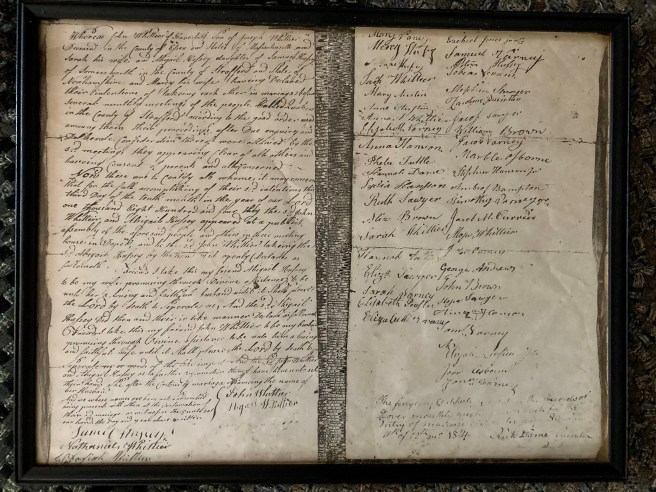
Starting with a wedding certificate

Join me online from the Whittier Birthplace Museum in Haverhill, Massachusetts, on Thursday, January 26, at 7 pm.

My presentation in their virtual lecture series via Zoom will explore the celebrated abolitionist and poet’s many connections to Dover, starting with an examination of his parents’ certificate of marriage in the Quaker meetinghouse in 1804. His mother grew up in the Dover Quaker community, and his Whittier uncle, Obadiah, was already living in town at the time of the wedding. In fact, Whittier Falls and Whittier Street weren’t named for the poet but his uncle and cousins.

There’s a lot packed into this historic document. Join me to find out.

Once we’ve gleaned insights into seemingly quaint Quaker practices of the time, we’ll turn to the signatures of the witnesses – that is, all of the Friends in attendance – and learn about some of them, too, as well as a few who weren’t present but were still members of the Meeting living in a town to the west and definitely of interest.

And then it’s your turn to ask questions or make comments.

The event does require preregistration and a suggested donation of $10 per household. Go to whittierbirthplace(dot)org and click on Events to learn more.

Here’s hoping you can make it. Putting this together has been a blast.

Was there a hidden connection in the street name?

The site in south Boston where two Quaker missionaries were hanged less than a month after visiting Dover, New Hampshire, was eventually christened – get this – Dover Street.

The street was later renamed.

Another of the four who died on the gallows there had also apparently visited Dover a year or two earlier.

Who made the decision – and why? They couldn’t be that oblivious, could they?

Once the surrounding water was filled in, the street came to have a long history of immigrants and seedy characters, perhaps doomed by its bloody past, before part of the neighborhood was razed for the urban renewal that brought the Boston Herald newspaper plant and later removed the elevated subway station after the Orange Line was rerouted to the west in 1987.

Today it’s known as East Berkeley Street, hoping for a new image.

Check out my new book, Quaking Dover, available in your choice of ebook platforms at Smashwords.com.

Reasons to like Watertown, Mass.

Greater Boston is comprised of many suburbs that were originally Colonial towns out in the country. As a result, much of the metropolitan area today retains a village feel in addition to its cosmopolitan chic.

Each town – or, in many cases, now city – is different, however subtly.

Let me illustrate with Watertown, where my choir rehearses.

  1. It’s on the Charles River, which once powered its paper mills and other factories. Today the river has lovely parks and pathways, as well as crewing teams practicing out on the water in season.
  2. The impressive Arsenal produced military armaments from 1816 through World War II. Today it’s a shopping district, and its restored antebellum commander’s mansion is a kind of museum.
  3. Settled in 1630, Watertown soon became the seat of the Whitney family of invention, investment, and horse-breeding fame.
  4. It’s largely overshadowed by neighboring Cambridge and the Harvard crowd. The famed Mount Vernon Cemetery, the first garden style burying ground in America, 1831, is usually thought of as being in Cambridge, when it fact it lies mostly in Watertown, with a who’s who of famous Americans buried in its rolling grounds.
  5. Watertown has a wide ethnic range of residents, mostly working class or professionals.
  6. The Armenian Library and Museum of America is well worth visiting for exhibits that acknowledge many genocides beyond their own. Watertown is the third largest center of the Armenian diaspora in the United States, surpassed by only two cities in California.
  7. When it comes to cheap eats, I think it definitely beats hipper Cambridge. Some of the best Chinese I’ve ever had was in a modest storefront in Watertown Square, and I’m really sold on the Iranian takeout just up the street. But we also like Wild Willy’s.
  8. The Perkins School for the Blind, founded in 1829, is the oldest such institution in the U.S. and is world famous. It manufactures its own machine to record text in braille. It moved to Watertown in 1912.
  9. I really like the public library, which even has its own coffee shop.
  10. The Gore Place is an opulent summer home built by a man who a fortune in speculating in Revolutionary War debt.


One way to summarize Ipswich, on the North Shore

Northeast of Boston, before you get to New Hampshire, is the Colonial town of Ipswich. Though it’s one of many, it still has a distinct flavor. Consider this, from the street signs:

Labor in Vain takes off from Turkey Shore Road.

How much more Puritan can you get? I just picture the blunderbuss in hand as someone in a big black hat and buckle goes out looking to bag a bird for dinner.

Or, the memories, back when we could travel …

Just a friendly reminder

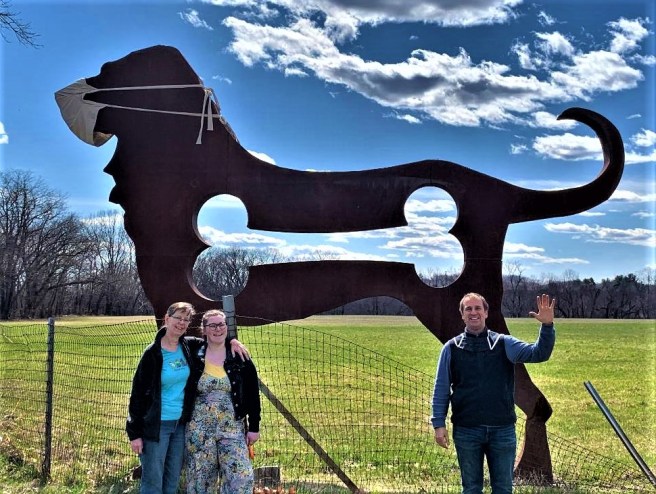
The creators of the homemade mask (at left) pose with the creator of the sculpture (right) at this landmark along Interstate 495 north of Boston.

This whimsical public sculpture in Haverhill, Massachusetts, has always brightened our trips down I-495. I don’t know why the dog-bone cutout works so well, but it does, perhaps suggesting that Rusty (or whatever its name) has happily ingested a big treat. The playful open shape even allows opportunities for seasonal additions like a row of pumpkins every October.

So I get this attachment from a favorite funnyman in my life, acknowledging that he’s not the only comedian in the family. His wife and daughter, above, have been sewing Covid masks like crazy and, as dog lovers, they got an impulse to do more.

Look at it as inspiration, either to make your own masks or to make sure you wear one in public.

Ciao and bow-wow!


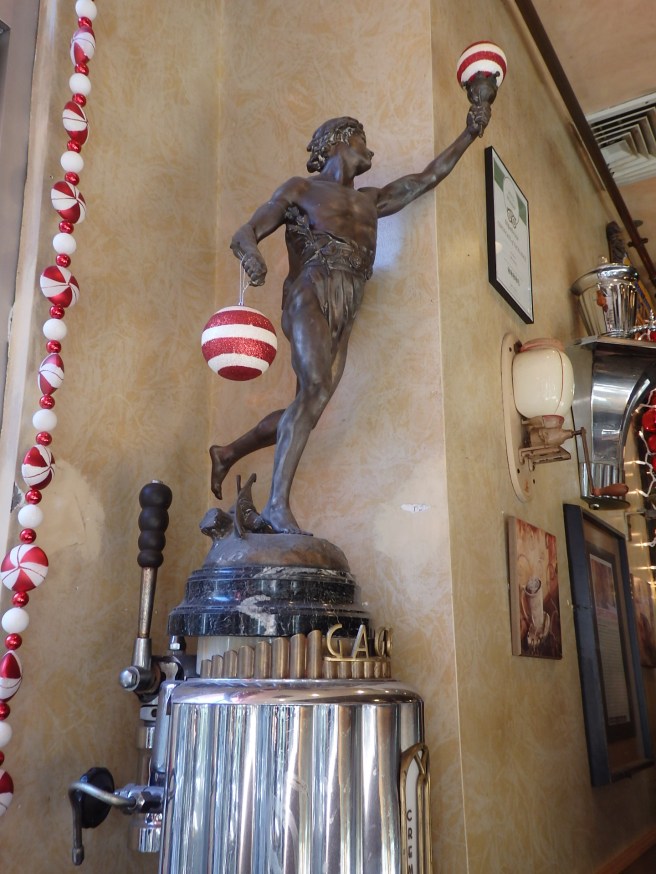
ESPRESSO FIT FOR THE GODS

With a holiday touch.

Vittorio’s in the North End is famed for its espresso and pastries. With Mercury as one of the coffee makers, you can see why the neighborhood is also renowned as Little Italy.

Boston is a rich and varied destination – the Hub of New England, or the Universe, as they used to say. Living a little more than an hour to the north, we’re well within its orb.