Looking for witches among the Quakers

One of the first things the Puritan authorities examined for after arresting women preaching the Quaker message in America was physical proof of their being witches.

I have no idea about the specifics – and am not sure I want to know. Still, their obsession with the naked bodies strikes me as creepy, even pornographic.

After publishing my book Quaking Dover, the thought struck me that the Puritans must have seen Quaker worship as some kind of séance. Not that we were trying to communicate with the dead, but rather be open to the presence of the Holy Spirit, or Christ.

Of course, that Holy Spirit was translated at the time as Holy Ghost. Yipes! Sounds like Halloween, no?

From my perspective, Ghost is way too limiting for that Spirit, especially when Christ is seen along the lines of Logos in Greek philosophy.

It’s far more revolutionary and liberating than you’d think. One way builds religion as a kind of legal system with punishments and rewards. The other builds it as a set of relationships.

Now, to stock up for those little trick-or-treaters who will be knocking on our door. I promise not to put religious tracts in their bags, tempting as the opportunity might be.


There’s much more to Salem than witch hysteria

Through much of the colonial era, Salem was one of America’s ten biggest cities. In addition, it was closer than Boston to Dover, and like Dover it was settled by West Country English fishermen before the Puritan migration flooded into New England.

Salem’s first Quakers suffered some of the most intense persecution for their faith found anywhere, and they were instrumental in bringing that faith to Dover.

What I didn’t realize was that Salem was long the only Quaker Meeting in the Massachusetts Bay colony. The other early Meetings in today’s Massachusetts were actually in the Plymouth colony.

Details on Salem Meeting’s existence were scarce until I was pointed to Carla Gardina Pestana’s Quakers and Baptists in Colonial Massachusetts.

Her study breaks off before the Salem Meeting shifts to Lynn, where it was once the largest or second largest Friends congregation in New England. And then that, too, faded from sight early in the 20th century.

Pestana’s sensitive telling of Friends through the period includes her sense of Quakers as family oriented, communal, even what she calls tribal. I would still like to see the story of what happened to Salem Friends in the industrial era, but she provided consolation for my own conclusions in Quaking Dover.

As for Salem, its unique Peabody-Essex Museum ranks in many categories in the top ten art institutions in America. It’s definitely one of our favorite destinations. Its grounds even include a reproduction of Salem’s first Quaker meetinghouse, built about the same time as Dover’s.

As if his Merrymount antics weren’t enough

Other than the broken wedding engagement, I’ve seen no hints at Thomas Morton’s sexual orientation, as if such distinctions were even worthy of notice back then in colonial New England. But, as far as I’ve found, he never did wed.

Beyond that, I’m left feeling the Puritans were afraid the Quakers would lead to something similar to Morton’s scandalous presence a few decades earlier.

His Merrymount settlement was, I’m convinced, a significant moment in early New England history that few people know about, one sharply at odds with the resulting Puritan image. It was, you know, a kind of hippie commune with friendly relationships with the Natives. Not that Friends would have engaged in dancing, much less doffing their clothes, around a maypole. As well as perhaps many of the other things that cause a lot of people to congregate on Salem, Massachusetts, this time of the year.

Let’s just say it heightened the tensions.

If you don’t know about Merrymount, my book Quaking Dover offers an introduction.


Massachusetts was primed for Revolution long before Paul Revere’s midnight ride

Quite simply, Britain betrayed the settlers in her colonies, from Ireland onward. The American plaint, “Taxation without representation,” reflected that all too succinctly. Where were the colonies’ representatives in Parliament or the House of Lords? What voice did they have?

The colonists identified as English but must have seen they were definitely second-class citizens. Or maybe third.

As I note in my book Quaking Dover, the Massachusetts Bay colony’s Calvinist intransigence had been at odds with the Crown from its inception. The first shot heard ‘round the world could have erupted at any point.

My pivotal question is just what turned the Loyalists in Virginia so far as to reject the monarchy as well and then join in taking up arms in the revolutionary cause by 1776?

The other colonies moved somewhere in between.

Not that all of this falls much within the scope of my little 400-year history volume as I try to keep a focus.

One site, three successive forts in colonial history

Coming to Colonial Pemaquid’s state-maintained historical site in Maine, I wasn’t prepared to find this.

It was far more than the wooden palisades found across much of early New England. It looked to me far more like something out of Scotland or a Monty Python movie.

This wasn’t even a reproduction of the first fort there, but rather the second.

The first was Fort Charles, built 1677 after the village had already been destroyed. That fortification was overrun and destroyed by the French and their Native allies in 1689.

Most of the usual attention to warfare between the English colonists and the Natives focuses on King Phillip’s war, which heavily impacted southern New England. Much of the heaviest toll, however, happened in the decades after that when the tribes allied with the French to the north. Those outbursts afflicted northern New England, including Dover, New Hampshire, for decades later.

That’s where Pemaquid, fortified to hold the Maine at the edge of English claims in the New World, comes into play with my story, Quaking Dover.

Dover was often on the frontier of English settlement, a thin ribbon along the coastline but barely reaching inland and thus nearly impossible to defend, at least much north of Boston.

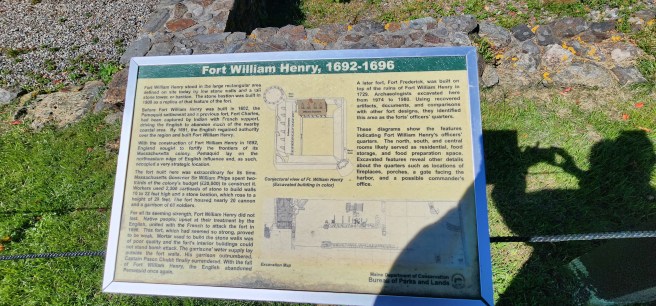
Once the English did reclaim this stretch of Maine from the French, the New Englanders built a new, second fortification, Fort William Henry, erected in the large rectangular area defined on the site today by low stone walls and a tall stone tower, or bastion. The stone bastion you see was built in 1908 as a replica of that feature of the fort.

As Maine’s online documentation explains, before the second Fort William Henry was built in 1692, the Pemaquid settlement and the previous fort had been captured by the French and their tribal allies, driving the English to abandon much of the nearby coastal area. By 1691, however, the English regained authority over the region and built Fort William Henry.

(I am fascinated by the tenacity of those who kept returning despite the costly odds.)

As you will find, with the construction of Fort William Henry in 1692, England sought to fortify the frontiers of its Massachusetts eastern district. Pemaquid lay on the northeastern edge of English influence and, as such, occupied a very strategic location.

The fort built here was extraordinary for its time. Massachusetts Governor Sir William Phips spent two-thirds of the colony’s budget (£20,000) to construct it. Workers used 2,000 cartloads of stone to build walls 10 to 22 feet high and a stone bastion, which rose to a height of 29 feet. The fort housed nearly 20 cannon and a garrison of 60 soldiers.

(Note that the costs were born by the New Englanders, not the British Crown.)

For all its seeming strength, Fort William Henry did not last. Native people, upset at their treatment by the English, united with the French to attack the fort in 1696. This fort, which had seemed so strong, proved to be weak. Mortar used to build the stone walls was of poor quality and the fort’s interior buildings could not stand bomb attack. The garrison’s water supply lay outside the fort walls. His garrison outnumbered, Captain Pasco Chubb finally surrendered. With the fall of Fort William Henry, the English abandoned Pemaquid once again.

(If this were fiction, I can’t imagine what to do with a name like Captain Pasco Chubb. Especially as an Englishman.)

Well, that’s an official account, one I for now I find no reason to quibble with. What does change my earlier perspective, however, is Fort Frederick, erected in 1729 and dismantled in 1775 to keep it out of British occupation in the Revolutionary war.

It never faced hostilities with the Natives, which seriously makes me reconsider a much earlier reoccupation of Maine by English settlers, something I had largely ruled out before 1763, the end of the French and Indian wars. Now see that’s not quite accurate, though it still seems to apply Downeast, where I now live.

So much for these confessions of an amateur historian.

The shipwreck of Angel Gabriel had a Dover angle

A monument at Colonial Pemaquid acknowledging to the 1635 tragic sinking of a ship caught me up short. I had forgotten the vessel’s impact on Dover.

As background, the ship had been commissioned for Sir Walter Raleigh’s last expedition to America in 1617 and in several subsequent incarnations been involved in some high seas adventures, staving off repeated boarding by pirates and beating off three Spanish ships. Not that I knew that in my initial research.

As the monument at the Maine historical site proclaims, the Angel Gabriel was a 250-ton galleon carrying settlers to new lives in New England in August 1635 when it anchored at the village of Pemaquid. Most of the passengers and crew got off the ship before nightfall to rest on land as guests of the villagers. That night, August 14-15, a storm later known as “The Great Colonial Hurricane” struck the area and the Angel Gabriel was torn from her anchors and destroyed.

Or maybe it had happened earlier and the ship had limped into harbor. Still, I’m quoting there, from an account that continues: “In the mid 1970s, efforts were made to locate the wreck in Pemaquid Harbor with divers and a magnatometer and sideccan sonar but no artifacts form the ship were ever located.”

For context, “The Angel Gabriel was very similar to the Mayflower but 18 feet longer and bearing four more gun ports per side.”

I am now curious to see whether the small museum displays a trunk that went down with the ship and was found floating the next day. It belonged to a passenger named John Cogswell and his descendant of the same name agreed to lend the trunk for display.

This marker, though, stirred up some memories of a section that got cut from the final version of my book Quaking Dover.

Here’s what I had:

Three Dover Combination signers shared a tragic introduction to the New World when their ship, the Angel Gabriel, broke up in the August 14 “Great Colonial Hurricane of 1635,” either in the harbor at Pemaquid, Maine, or at the Isles of Shoals.

[Note the clarification in the site of the disaster in the bronze monument.]

Twenty-one-year-old William Furber settled next to his brother-in-law, John Bickford, at Oyster River and later relocated to Bloody Point, opposite Hilton Point on Great Bay. He married Elizabeth Clarke, daughter of William Clarke and Elizabeth Quick, in 1642 in Dover.

(The Bickford family, meanwhile, has John landing at Dover in 1623 and marrying Temperance Furber in 1624 in New Hampshire. If these dates and locations can be supported, they would significantly change the early history of the Piscataqua settlement. Their son, John, though, was born in 1625 in Devon, England.)

Samuel Haines was an indentured servant or apprentice to John Cogswell, who was also aboard and survived. They were bound for Ipswich  [Massachusetts], where Haines finished his obligations the following year and may have moved at that time to Northam, as Dover was also called.

He did, however, return to England in 1638 and married Ellenor Neate within a few weeks after his arrival, suggesting they were engaged before his coming to America.

After a year-and-a-half, they set sail and established their home in Northam/Dover, where he had ten acres of land near the meetinghouse. Later, he had twenty acres on the Back River, where his neighbors were fellow Angel Gabriel survivors William Furber and John Tuttle.

He was taxed in Dover in 1648 and 1649.

In 1650 he leased Captain Francis Champernown’s Green Land farm for two years, and then secured ninety-one acres adjoining it, where he built a permanent home, and another ten acres where he eventually owned a mill. In 1653 he was one of the petitioners successfully asking the Massachusetts General Court to change the town name from Strawbery Banke to Portsmouth. That year he began the first of ten successive years as a town selectman. In 1666 he helped run the town line between Portsmouth and Hampton.

He was also the first deacon at the formal organization of the first church in Portsmouth in 1671.

At much of this time, the population of what now constitutes New Castle, Portsmouth, Greenland, and Newington was only fifty to sixty families.

Much less is known about survivor John Tuttle, who was about seventeen years old at the time of the disaster. After their rescue, he arrived in Chebasco (in Essex or Ispwich, Massachusetts). His age and destination suggest his situation may have been similar to Haines’. By 1638 Tuttle settled in Dover, where he was known as Shipwreck John and had a farm on today’s Bellamy River – one that grew into what was long known as America’s oldest family-owned and operated enterprise. (Never mind that Thomas Roberts’ heirs nearby would have a longer claim.) Tuttle’s son Thomas was killed by a falling tree while still a young teenager, leaving John Jr. to continue the family name.

~*~

Successive Tuttles became prominent Quakers. And, as I inserted, the monument is more specific about the scene of the disaster than I’d previously found.

There’s a good reason Dover Friends didn’t have a meetinghouse before 1680

Or keep minutes, that we know of.

The Quaker Meetings in Salem, Hampton, and Dover were all in Puritan-governed colonies, and thus officially illegal at the time. Religious toleration around 1680 came with a change New England governance and a royal governorship in Massachusetts.

With it, Salem has claimed to have the first Friends meetinghouse in America, though it was built about the same time as the one on Dover Neck, just south of today’s St. Thomas Aquinas high school. And Third Haven on Maryland’s Eastern Shore may be a tad older than either one.

Now, if we only had documentation, we might find the honor of being first in New England belongs instead to Dover.

The persecution wasn’t consistent

Had the Puritan persecution of dissidents been consistent, the Quakers and Baptists likely wouldn’t have survived. Instead, it came in waves aimed more at the traveling missionaries as well as to constrain the political and business prowess of resident Friends.

Further, there were relatively few congregations or ministers in New England. Despite required attendance at worship on the Sabbath, the buildings couldn’t hold them all, had they showed up.

Who was keeping attendance rolls, anyway?

Under its stern exterior, Puritan polity was fragile in nature

No, I didn’t expect to be feeling some sympathy for the Puritan authorities in America.

In fact, I had assumed they were a pretty formidable front.

But then, in researching my new book, Quaking Dover, I was rather amazed by the range of developments they faced in the 1630s, their first decade in the New World. It’s like they were being hit on all sides.

In addition, they had no direct representation in Parliament. And they didn’t necessarily represent the majority of the residents in their own towns.

In their tribulations with the Crown, the place was ripe for Revolution from the very beginning, rather than having to wait for Paul Revere’s midnight ride.

The Quaker challenge of the late 1650s hit at some intrinsic flaws in the Puritan mindset. As one challenge voiced it, the flaws were essentially theological rather than focusing on the unfolding news events. The title of the pamphlet?

An examination of the grounds or causes which are said to induce the Court of Boston in New England to make an order or law of banishment, upon pain of death, against the Quakers

As also

Of the grounds and considerations by them produced, to manifest the warrantableness and justness both by their making and executing the same; which they now stand deeply engaged to defend, having already put two of them to death

As also

Of some further grounds for justifying the same, in an appendix to John Norton’s book (which was printed after the book itself, yet part thereof); whereof he is said to be appointed by the General Court

And likewise the Arguments briefly hinted, in that which is called, “A true Relation of the Proceedings against the Quakers, &c.”

Whereunto somewhat is added about the Authority and Government Christ excluded out of his church; which occasioneth somewhat his true Church-Government

By Isaac Penington, the Younger

[1660]

~*~

It’s a remarkable document, actually, well worth reading, even in light of the headlines and news flashes we encounter. It argued, essentially, that the Puritans were falling far short of their true goals and potential.

As for the full title?

It would never sell today.

The Puritans do get a bad rap

Oh, it’s hard for me to admit that, at least in light of the early persecution of Friends. I started out with my new book, Quaking Dover, assuming the Puritans were a monolithic opponent of religious liberty for others.

I did know, however, they weren’t always as uptight as they’ve been portrayed. In some ways they were liberal, with high literacy rates for men and women. Startlingly, a woman could divorce her husband if he didn’t sexually satisfy her. Besides, in England their Parliamentarian armies were the vanguard of the radical World Turned Upside Down that toppled the king. And they did love their beer.

As I researched my book, I began to sense that the old adage about coming to America for religious freedom but not extending it to others wasn’t exactly on target, nor was the part about neighboring colonies like New Hampshire being founded purely for monetary gain. As for Rhode Island? You see, it complicates.

For starters, the Puritans’ Massachusetts Bay charter was a commercial document, like the one for the East India Company, with their brilliance coming in immediately moving the annual stockholders meeting to the New World rather than London, under the King’s eyes.

The Pilgrims at Plymouth, too, had come under a commercial charter, one that left them strained by heavy debt. The majority of the first settlers at Plymouth weren’t even fellow Separatists in faith, but here for economic opportunity.

What the Puritans envisioned was a utopia, one within an economic, political, and religious worldview. While it’s sometimes described as a theocracy, ministers were banned from town office – not so elsewhere in the colonies.

Two of New Hampshire’s first four towns, meanwhile, were founded by ministers fleeing Massachusetts. That’s Hampton and Exeter.

And then, the Puritan fundamentalism somehow evolved into a liberal Unitarian strand and more mainstream Congregational wing, now part of the United Church of Christ denomination.

I’ve previously noted an essay by Marilynne Robinson in the August 2022 Harper’s Magazine, delineating ways Massachusetts was far more liberal than Virginia or the Carolinas when it came to religion and liberty in general. In early Virginia, for instance, missing church three times or speaking ill of the King merited a death sentence. Let it be noted, too, that Puritans, along with Presbyterians, Baptists, Quakers, and Roman Catholics, were unable to gain much of a foothold anywhere in colonial Virginia, with its ruthless Anglican state denomination.

There are even arguments that the persecution of the upstart Quakers in both New England and the southern colonies was based more on political and monetary motivations than religion.

The historian at First Parish church in Dover had me seeing that the opposition in New England wasn’t nearly as monolithic as I’d assumed, and then that New Hampshire’s four local congregations had somewhat different characters from those in Massachusetts.

More recently, I’m facing Carla Gardina Pestana’s contention in Quakers and Baptists in Colonial Massachusetts that Friends went out of their way looking for trouble. It does rather thicken the plot. The Baptists somehow found ways to fit in more agreeably.

Considering current attacks on freedom of speech (and printing), some of it under the guise of religion, I do wonder about the status of the separation of church and state.

Sometimes history isn’t so far back there as we’d like to suppose.