ABOUT THOSE ROMANTIC MOONLIGHT WALKS ON THE BEACH

If we can believe their proclamations, two things single women in this part of the country typically seek with a partner are romantic candlelight dinners and long strolls on a moonlit beach.

The dinners, we can suppose, are either at elegant restaurants or in his dwelling (where he displays his gourmet cooking skills to her fullest appreciation), either way with suitable wine in sparkling stemware. Let’s just hope he remembers to ask her beforehand if she enjoys his signature dishes. (Mea culpa, on my end.) I don’t think hamburger and fries, by the way, go with her candlelit setting.

From observation, let me add that the restaurants often wind up as intimidating experiences for the would-be couple. When my wife and I go out, we expect to laugh, to banter with the wait staff, to be entertained by the possibilities of food and ambiance. When we were reviewing dining spots, even the disasters turned into fun-filled adventures – OK, if we’d been paying full fare, we would have been justifiably miffed. As columnists, though, we got our revenge.

The nighttime beach, though, is another matter. Having had opportunities to spend time approaching midnight on local beaches, I can tell you few couples are found strolling there, much less romantically. Except for a few nights in prime summer – the days hovering around the century mark, the night’s nippy and windy. The moon, for its part, is in its fullest stages only a few nights each summer, and many of those are cloudy. Without a bright moon, it’s impossibly dark near the water – even spooky, with or without sea fog rolling in.

You can come to love the ocean that way, but it’s a stark environment.

For romance, though, I think you need a driftwood fire. Plus the right wine and a corkscrew.

Wine? It’s the one thing both events seem to have in common.
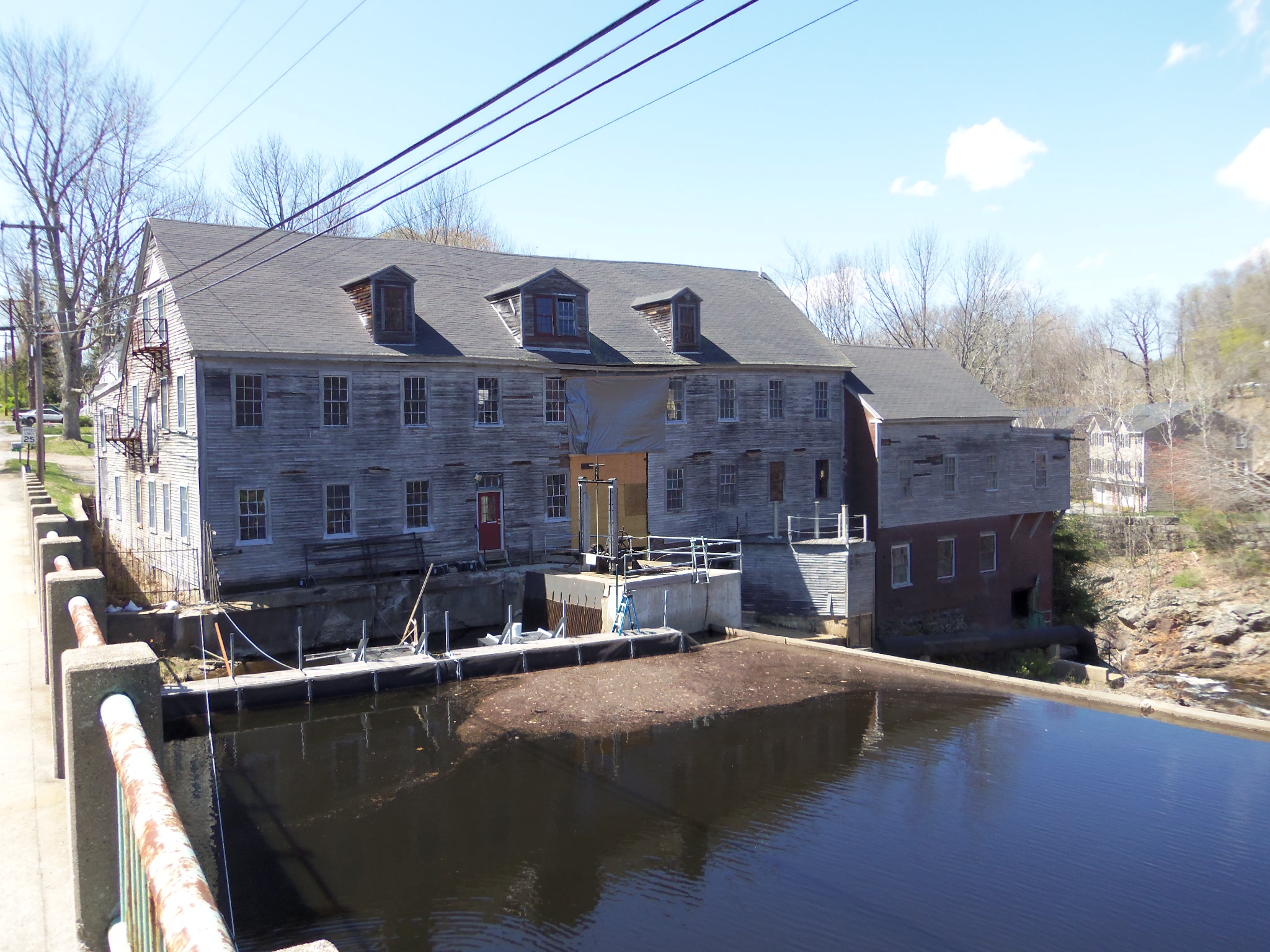
SPRING MILL

kodak1 022

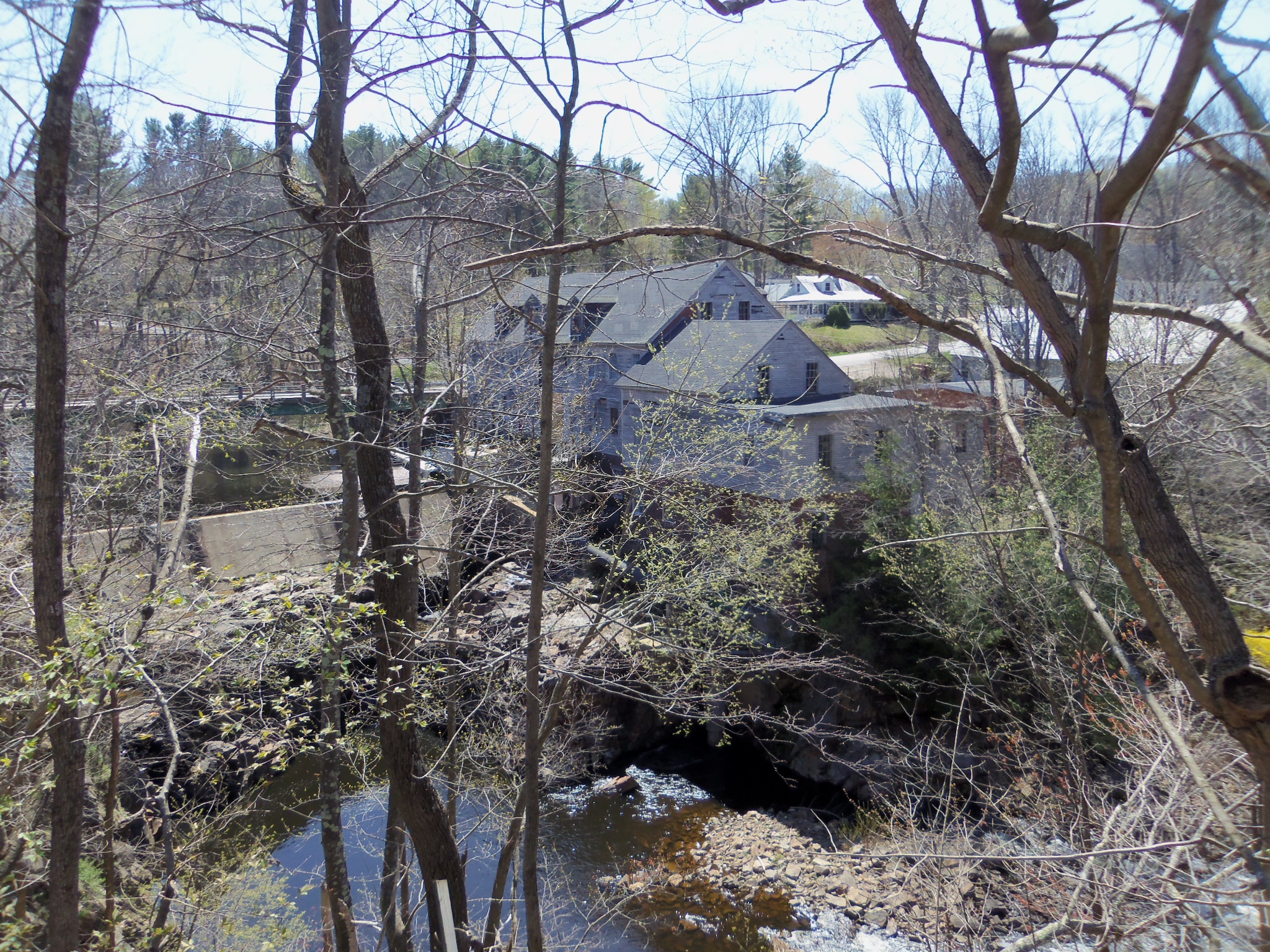
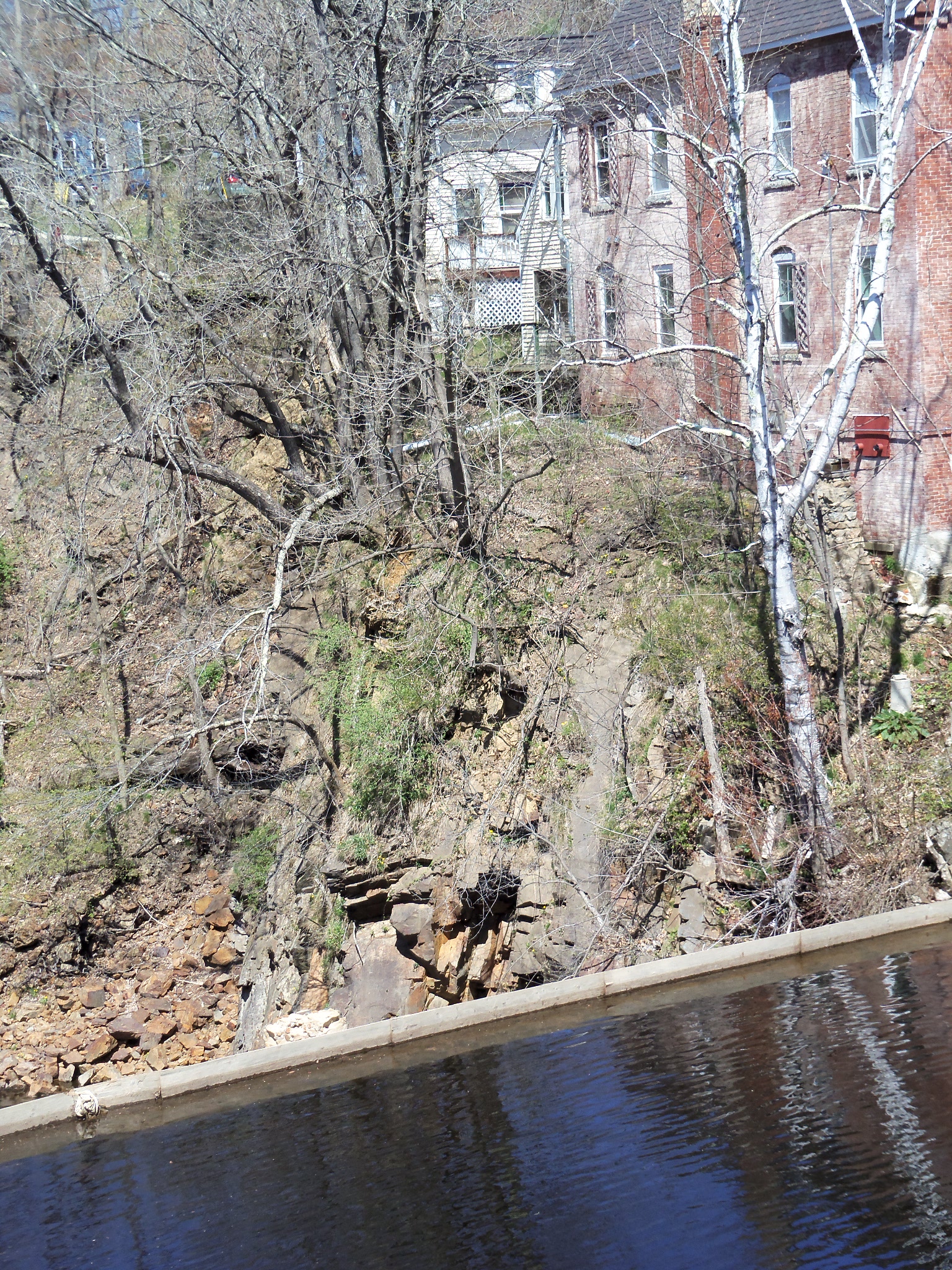
Streams that could be harnessed for water power were prized in earlier periods of American history, perhaps nowhere more than in New England. Here are views of a mill on the Great Works River (fittingly named by Quakers) in South Berwick, Maine.

The leafing trees will soon obstruct this view of the mill perched on the edge of the falling water.
Houses, too, perch at the edge of the drop-off.

GARRISON HOUSE

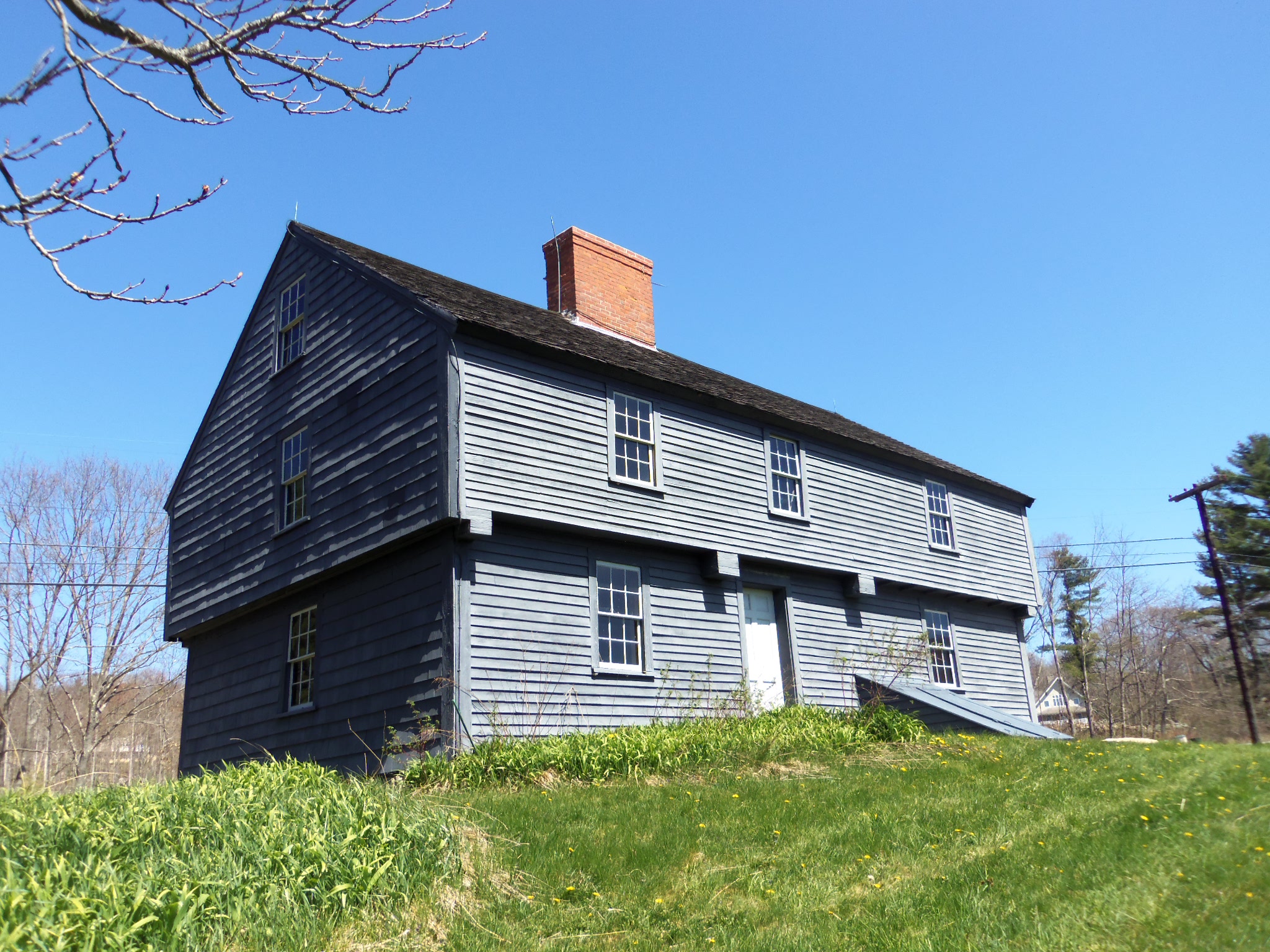
The distinctive overhang design allowed for self-defense from within.

From the outbreak of King Philip’s War in 1675 until the conclusion of the French and Indian War in 1763, much of northern New England was under an ongoing threat of violence along its frontier. Nearly all of the English settlement in Maine was pushed back to a few towns nearest New Hampshire, and many villages, including Dover, suffered devastation and massacre.

Indeed, officials ordered many residents to construct fortified garrison houses, like this reproduction along Cider Hill Road in York, Maine, where families could retreat for armed protection when an alarm was sounded.

The site overlooks the inland tidal salt marshes that give rise to the York River. The hay from such spots was prized, even though feeding it to cows would produce a distinctively salty milk.
Also on the site is a more traditional New England style of construction -- shingle siding that weathers to gray.
Also on the site is a more traditional New England style of construction — shingle siding that weathers to gray.

AN UPDATE, OF SORTS

The world of fellow bloggers keeps reminding me how far behind the curve our northern New England calendar can be when it comes to springtime. We still have snow in parts of the yard, for one thing. Yet since we’re near the ocean, our weather is a week ahead of places only a few miles inland, meaning to our west or our north.

Still, there’s been a definite change in the air. A very welcome change. And even a few signs of green, in addition to the final gray puffing of the pussy willow stalks.

Let’s not neglect those gardening bloggers in the Southern Hemisphere, either, reminding us of their approaching autumn.

For many of us, then, it never lets up. Plug on as we will!

~*~

Although I’ve posted in previous seasons on our use of seaweed as a mulch for our garden, I don’t think I reported on the results. Yes, many things get lost in the cracks of daily living.

The short answer is that I’ve been returning to the beach lately to load up on more. A lot more. Since the master gardener in our household can’t seem to get enough of this magical mixture, I fill black plastic bags and tote them home in the trunk as I can. So far, that’s been five trips.

While last year’s weather wasn’t exactly typical, meaning we can’t factor out its impact cleanly, we can say that we had our best garden yet – and the seaweed appeared to play a big role.

Since our soil is largely clay-based, we’re usually plagued with garden slugs, but last year they were at a minimum. Apparently, the slugs don’t like the salty mineral nature of the mulch when it’s fresh, and they don’t like its prickly nature when it’s dry. On top of it all, the plants love the mineral nutrients. And so I’m trying to load up between the end of the frozen weather and mid-May, when the town down the road in Maine closes its beach parking to non-residents like me.

~*~

While I’m still thinking about the snowfall, I can say our seasonal total unofficially came to a hair under 80 inches. (Yes, we can still get more, but it will melt quickly.) We’ve had more, but this just felt onerous. At least we didn’t get any storms that dropped two or three feet in one swoop to push the season’s total into three figures.

Where we live, harsh winters come in one of two varieties: either unusually cold and dry or else with a heavier than normal snow total. This year we had both rolled into one. Four months of snow cover and all those near-zero lows (or below) have taken a toll on even the heartiest among us.

And, yes, the black flies and weeds are already appearing. Mud season is upon us, after all.

OUR LADY OF THE ICE

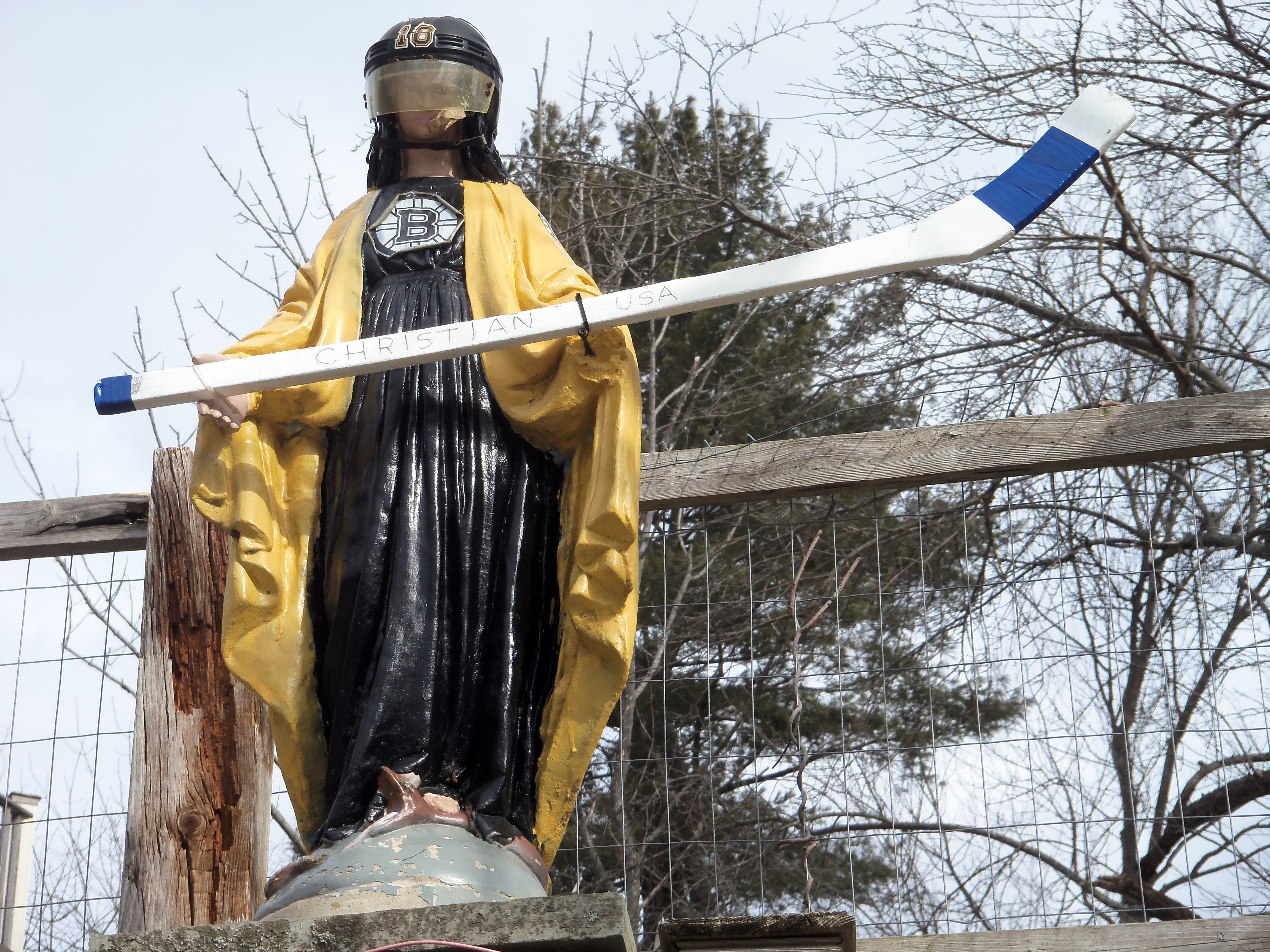
Always ready for a miracle.

Or is it Our Lady of the Puck?

New England is hockey country, and Boston Bruins fans are legion. Rest assured, Bobby Orr would no doubt lead their pantheon of saints.

While statues of Mary are common across the country, I know of no others like this. Behind the mask, the face looks feminine. This repurposed icon icon overlooks Chauncey Creek Road in Kittery, Maine.

WEATHER REPORT UPDATE

Noticed a few months ago I wasn’t checking the weather forecast as much as I did when gainfully employed.

Back then, I faced an hour-long commute each way and knowing the outlook might prompt me to leave earlier or take a less vulnerable route. Trying to navigate a downhill curve in a freezing rain was one experience I never wish to repeat, and I’ve seen enough vehicles slide off the road while trying to go faster than the nasty conditions allowed, well, to keep me from trying to press my luck. Arriving early might also help, since we’d often be handed an early lockup on the first edition of the newspaper to give the delivery crew an extra edge, and anything to lessen the deadline pressure on all of us would be a blessing. A storm might even mean packing for an overnight at the office, as some of my colleagues did during one really big blizzard. The forecast could even prepare me for changing my plans at home beforehand when shoveling out the driveway would take priority.

This time of year, flash flooding, sleet, fallen limbs, or power outages can also be a problem.

This is northern New England, after all.

Now that I’m retired, the commute’s no longer an issue, except for my weekly trip to choir practice in Boston – and if the weather’s treacherous, I have the option of staying home, which was never the case with my job. Since we rarely need both cars on conflicting schedules, it’s much easier to leave them at the end of the driveway to cut down on the snow shoveling. Our biggest weather concern is frost at crucial times in the garden. Or, during the summer, the Atlantic water temperatures when I’m considering a swim at the beach.

This winter, though, has rekindled some of the obsession. We’ve had far more single-digit and zero-degree nights than usual, plus a constant snow covering with more than six feet total by the beginning of March, even as most of the storms have veered south of us. My fascination has come in tracking four different online forecasts and seeing how far off target they’ve been. As for agreement, forget it. You could just as easily toss a coin. (And that percentage thing they throw at us? A 60 percent chance of snow in practical terms means nothing: either it snows or it doesn’t. In other words, it’s all or nothing.)

Considering everything, though, it’s rather nice to not be complaining about the weather itself. I can more or less take it as it comes, thank you, with all of my sympathy to those who must venture forth, regardless. At the moment, I think I’ll put another log on the fire.

BOBHOUSES

100_6739

Alton Bay on Lake Winnipesaukee is a popular site for bobhouses each winter.

When they lived way up in Maine, with a large lake just down their road, I remember hearing Eric tell about the morning he looked out the window and saw a traffic jam. Miles and miles from the nearest traffic light, here were bumper to bumper pickup trucks heading to and from the lake. Soon, he realized they were removing their bobhouses before the ice melted.

Bobhouses, of course, are part of the male culture of northern New England and many other frozen parts of the world. Since I don’t fish, no matter how much I admire fly fishermen and their skills, I really don’t appreciate the special savvy of landing one’s meal from under the ice. You can do it, of course, by drilling a hole in the thickness underfoot and then sitting or standing out in the cold. But the really serious guys build or buy their own little houses for the tradition – some are quite basic, while others, I’m told, come with TVs and Web connections. Still, I’m curious about what draws men from their warm homes to spend long days or evenings in a very cold environment. One of the answers is that it’s an excuse to drink with your buddies. Another is that it’s just to get away from the women. Except that it turns out some very adventurous women join in on the expedition. Are the fresh fish really worth this much effort?

Even so, that afternoon, Eric looked out again and saw another traffic jam, this time with trailers hauling their boats to the water. Presumably for more fishing.

How did they know this was the day the ice would go? What clues am I missing?

FROM BISHOP SPONG TO LIGHTHOUSES

Continuing this month’s survey of Books Read, here are a few more entries:

  • John Shelby Spong: Liberating the Gospels: Reading the Bible with Jewish Eyes. Or, as the paperback cover also proclaims, “Freeing Jesus from 2,000 years of misunderstanding.” Here the then-Episcopal Bishop of Newark, New Jersey, advances scholarship that argues the Synoptic gospels and Book of Acts were intended to be read aloud in the synagogue and early church as parallel texts to the day’s Pentateuch (Torah) portion. Rather than being accurate biography or history, then, he contends that they were essentially a midrash voicing something of the intensity of the early “followers of the Way,” theologically but not factually true. Crucial to his rational is an awareness of the major Hebrew holidays of the time, and placing the Christian teachings within them – that is, also within a lunar calendar. Thus, instead of a chronological history of Jesus’ working with the disciples over a three-year period, or more, the Synoptic texts compress their presentation into a one-year framework. In the final sections of the book he deconstructs the Nativity and the Resurrection, as well as many of the teachings attributed to Jesus, yet leaves a strong case that what was being demanded was an experience of the Spirit/Holy Spirit, rather than Jesus.
  • Patricia Lynn Reilly: A God Who Looks Like Me: Discovering a Woman-Affirming Spirituality. Essentially a self-help workbook for women to work through, either individually or in “circles of support,” this 1995 publication is now a generation old and no doubt surpassed by more comprehensive volumes. It does included reference to El Shaddai as “breast” even though it’s often translated in its other meaning, “high places.” She also includes a list of alternative images to use in place of masculine terms, including Womb of Compassion, Nurturer, Seeker of the Lost, Source of All Life, Faithful Mother, Shekhinah, Healer, Sophia, Queen of Heaven, Gathering Mother Hen, and so on. She makes a strong case for the negative outlook on female functions, including birth, as unclean, and curiously the lack of an infant rite equal to circumcision. She also makes a claim for the decreased value of woman as they age. I like her suggestion to record reactions to her exercises using one’s non-dominant hand, and wonder if this might help me get deeper into my own repressed layers.
  • Harold Loukes: Friends and Their Children. This 1958 British publication comes from another era as it attempts to steer a third way between those parents who would insist on a dogmatic training for their children and those who would offer them none. He does follow the cycle through infancy, the first years at school, adolescence, and so on. I wonder if any of it would have helped, back when.
  • Eugene Ehrlich and David H. Scott: Mene, Mene, Tekel: A lively lexicon of words and phrases from the Bible. Despite William Safire’s praises in the New York Times, I find little reason to continue keeping it on my bookshelves, not when I have Strong’s concordance.
  • Jessamyn West: Except for Me and Thee. A charming novel of a Midwestern Quaker couple and their family roughly covering the years 1810-1875. Some of it I would question against the cultural history, but for the most part, I think she gets it right. In some ways, it dovetails in nicely with MFK Fisher’s outsider look at small-town California Friends only decades later.
  • Sarah C. Gleason: Kindly Lights: A History of the Lighthouses of Southern New England. While my focus is on the lighthouses of New Hampshire, Maine, and Cape Cod, this volume goes far beyond its Southern New England catalog. Gleason provides a detailed history of the origins of the American lighthouse system, including a timeless examination of the true costs of a bureaucracy that for too long concentrated on a lowest-bidder mentality.
  • Jared Diamond: Why Is Sex Fun? The Evolution of Human Sexuality. Despite the title, this is a rather pedestrian dynamic based on the need for childcare within the tribe.

100_6842

FROM THE BEGINNING OF THE OBAMA ERA TO ETHICS

Continuing this month’s survey of Books Read, here are a few more entries:

  • Vanity Fair, March 2009. The annual Hollywood issue is supplemented with “The Obama Era Begins” – and “Historic Portraits of Washington’s New Establishment” by Annie Leibowitz.
  • Money, Special Report: Rescue Your Retirement. Too little, too late. They’re talking about people who make hundreds of thousands a year – and can put like sums aside.
  • Terry Eagleton: After Theory. I’m not quite sure what to make of this one, an office freebie. I was expecting something related to literary theory, rather than an attack on “cultural theory” and “postmodernism.” Still, working from a Marxist perspective, he crosses over into theological and philosophical issues, so it fits into that stream of thought in this mini-sabbatical.
  • Jonathan B. Tucker: Scourge: The Once and Future Threat of Smallpox. Jonathan, of course, stayed with us for a week of the Obama primary campaign. Very well written, especially considering its technical nature.
  • Carlos Baker: Emerson Among the Eccentrics: A Group Portrait. Jessica’s copy, at her insistence. A good follow to Ives’ admiration. Am especially intrigued by what might have developed had Emerson linked his sense of overarching Reason with Logos and then Christ, rather than simply a universal goodness that instead evolved (the Unitarian evolution).

Curious bits with local twists for me: Father Samuel Moody, Emerson’s great-great-grandfather, famous preacher of Mount Agamenticus, Maine.

The Wesleyan Academy at Newmarket NH.

Indian name for Mount Washington was Agiocochook, as used by Thoreau.

“The God who made New Hampshire / Taunted the lofty land with little men” – Thoreau, “Ode Inscribed to W.H. Channing.”

The Old Man, the Great Stone Face, “that grave old Sphinx” (Thoreau).

Emerson: “I acknowledge (with surprise that I could never forget) the debt of myself and my brothers to that old religion which in those years, still dwelt like a Sabbath peace in the country population of New England, which taught privation, self-denial, and sorrow.” (on the death of Dr. Ezra Ripley)

Passenger rail service to Concord, Mass., began June 17, 1844.

Emerson was irritated by Shaker “dunce-dance,” “with buildings ostentatiously neat,” as if entering a “hospital ward of invalids afflicted with priapism.”

“… our Concord River which is narrow and slow and shallow.”

Emerson had always shown a fondness for Maine, even including the snowbank near Berwick into which his sleigh-stage had inadvertently dumped its passengers back in 1842.

Department of Interior Secretary James Harlan, “a grim Iowa Methodist” according to Walt Whitman. (Harlans originally a Quaker family connected to my own ancestors.)

In 1852, John Albee, a 19-year-old senior at Phillips Andover Academy, came to Concord to interview Emerson and met a man whose name sounded like Thorough or Thurro. (Note the accented syllable, being the first.)

  • Samuel Butler: Erewhon. A satire of the assumptions of civilized society – especially Victorian England and its established church – as well as those of Utopian enterprises, this slow-moving narrative was an amusing read. Consider its Musical Bank (echoing both the Church of England and the chambers of high finance) or the College of Unreason as two examples. (Another of my college-era collection, this time passed on to Jessica.)
  •  G.E. Moore: Principia Ethica. “What is GOOD?” is the premise for this work from my college-assignment collection. We never discussed it, though, and I never took the ethics course. Perhaps inadvertently, the definition of the Highest Good works best in theological terms.

January3 027

FOND MEMORIES OF FORE STREET

My wife is a great cook. And so are the kids. This means that when we dine out, the meal often fails to live up to what we can have at home. The chain restaurants strike us as formulaic or bland. In many, there’s much that’s mostly show with little substance, or pretentious and pricy, or simply uninspired. It’s easy to feel we wasted our money.

On the other hand, we’ve also found some marvelous meals at bargain prices in humble places. including some that folks might describe as sketchy. At least until you take the first bite.  I could mention my favorite Vietnamese restaurants in Worcester, Massachusetts, and Hartford, Connecticut, for starters. Or my regular Greek restaurant in Watertown, Massachusetts. Or our favorite summer hangout for seafood and live oldies in York, Maine. Or dim sum in Boston’s Chinatown. Or Latin American highlighting different countries on different days in Dayton, Ohio.

Of course, when we find a truly authoritative operation – one that sets standards for presentation, skill, creativity, and downright pleasure – we treasure the experience. Our favorite is run by two women in South Berwick, Maine. Whenever we’re ready to spring for a great celebration, that’s our first choice and we’re always delighted.

Once my wife and I got away for a weekend stay in Portland, Maine, and the centerpiece of the trip was a dinner at the famed Fore Street Restaurant, which is set in a kind of William Morris former foundry a couple of blocks from the harbor. She can tell you every glowing detail of our meal, including the local sourcing of ingredients. The wait staff was attentive without being overwhelming or stuffy. And most impressive, a sauvignon blanc was suggested to pair with that evening’s selections – and management priced it close to retail, rather than charging the industry standard of three or four times that figure. It was incredible – the word “stony” fits perfectly – and we’ve never found another that approaches this bottle, not even from the same South African winery.

Well, Fore Street was named No. 16 in Gourmet magazine’s list of top 50 restaurants in the U.S. in 2002.

More recently, I’m so glad one of our regular mechanics and his wife were impressed with their big celebration dinner there a few months ago. And we’re so happy to hear the tradition continues.