
You never know what we'll churn up in cleaning a stall
Many folks won’t swim in the Gulf of Maine even in the height of summer. It’s just too cold, they say.
I can sympathize, though some perspective helps. Rarely is the Atlantic around here warm enough before the Fourth of July. Oh, there may be a few rare days, but nothing dependable. We’ve found that anything below 57 F is foolish – even when the air temp’s over a hundred.
Yup, 57. That’s the blue-toe limit: edge into the surf bit by bit. First, the toes. Then out. Back again, top of the foot. Out again. Back again, to the ankles. You get the idea. If you actually make it to total submersion, you come out fast. Like a bullet.
Over time swimming here, you might even get to the point where you can guess within a degree or two. Sixty’s about my bottom line for swimming. Sixty-five is where the water starts to get comfortable. And 70, a rare delight, is heavenly.
For reference, I’ve come to rely on the NOAA Northeast USA Recent Marine Data Web page, which includes readings from buoys. Lately, as the water temps have been edging 50 F – finally even a tad over before ebbing – it’s become a topic of conversation.
Which prompted this response the other day: Ever hear of the 50-50-50 Rule?
Eh?
Fifty minutes in 50-degree water gives you a 50 percent chance of drowning. (Or 50 percent chance of surviving, depending on your outlook on life.)
In light of the blue-toe limit, I had no idea the odds could be that favorable. Not that I ever intend to press them.

The sign at roadside yesterday still has us wondering:
WE ACCEPT
WHIPLASH
INJURIES
~*~


Way back in my senior year of high school, I remember a moment when our English teacher invoked the dictum that all fiction requires conflict – and my immediate contrarian reaction blurted out, “No, it doesn’t!” My objections were gut-level rather than coolly reasoned and certainly wouldn’t have held up to the novels that were capturing my attention at the time – Brave New World, 1984, and Animal Farm. Yet seeded somewhere in my aesthetic, the low-key, nonviolent approach to a story lingers. Few of us, after all, are parties to a murder, which is a key component of so much fiction. And Kurt Vonnegut’s advice to take a nice character and inflict the worst possible calamities on the poor soul still offends my spiritual proclivities, never mind so many passages in the Bible. Yes, I’ll now admit that true character can be shaped and revealed in intense confrontations and struggles. That is, conflict.
Still, my own entries to date have focused on day-to-day realities drawn from my own observations – attempts to comprehend contemporary social interactions, even if they appear to be history by the time the words finally appear in public.
~*~
In retrospect, my admiration of so much of Richard Brautigan’s output probably arises in the laid-back meandering of his hippie-era characters and their encounters. Think of Trout Fishing in America for starters.
~*~
More recently, Nicholson Baker has emerged as my favorite embodiment of the nonviolent sensibility. You could argue that nothing happens in the first 50 pages of The Incredible Story of Nory, and yet the tension is already mounting. To construct a successful novel on a father’s bottle-feeding session of an infant (Room Temperature) or a short escalator ride (The Mezzanine) is artistically courageous. Book of Matches, meanwhile, takes off on the simple premise of sitting by a fire in the predawn hours of deep winter – it could almost be blogging.
His latest volume, Traveling Sprinkler, pretty much slipped under the radar, yet impresses me as a nearly perfect example of the no-major-conflict novel. His main character, the minor-league poet and anthologist Paul Chowder, faces nothing more challenging than the question of whether his ex-girlfriend will return to him as he muddles through middle age. Yet along the way, Baker weaves in ruminations about the American health system and public education, the advantages of rhyming in song lyrics in contrast to poems, aspects of recording technology, basics of bassoon performance, collectors’ perspectives on lawn sprinklers and related outdoors gear, experiences of Quaker worship, and some travel pointers for Portsmouth, New Hampshire. Billed as a sequel to The Anthologist, it stands well on its own as a rich and deeply personal tapestry. What could be better? Even without a slew of dead bodies?




This “dower house,” a Georgian gem built in 1760 by the newly-widowed Lady Mary Hirst Pepperell, sits at a sharp turn in the road a mile from Pepperell Cove in Kittery, Maine. Through her Bostonian roots and marriage, she was one of the richest, most powerful women in New England.
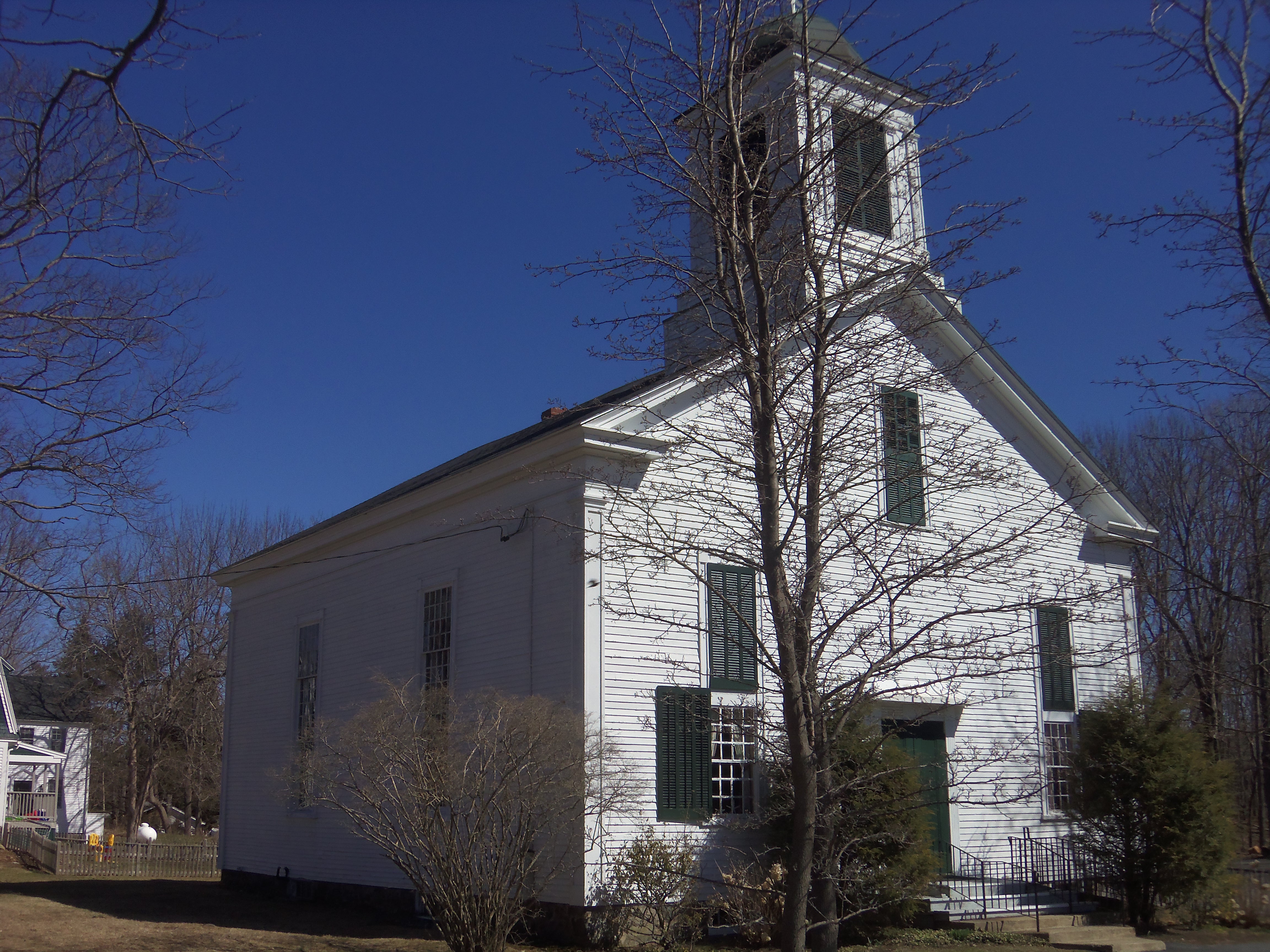
The mansion faces a Congregational church built in 1732, the oldest house of worship still in use in Maine.
 Jnana's Red Barn