
Just down the road from the birthplace of the U.S. Navy, the decommissioned Bucks Harbor Naval Radar station has an otherworldly presence, as if everyone had been taken away to another planet in the middle of the night.
You never know what we'll churn up in cleaning a stall

Just down the road from the birthplace of the U.S. Navy, the decommissioned Bucks Harbor Naval Radar station has an otherworldly presence, as if everyone had been taken away to another planet in the middle of the night.
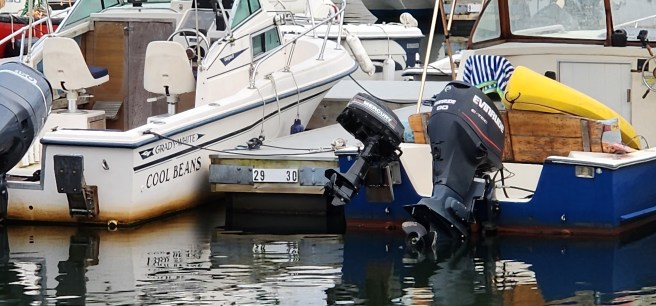
Pleasure boats are everywhere in Camden Harbor at the height of summer. It’s iconic Maine, after all. This detail was noted aboard the historic schooner Louis R. French last summer as we set out for five days of prime sailing.
For more schooner sailing experiences, take a look at my Under Sail photo album at Thistle Finch editions.

Officially, Treat Island is part of the city of Eastport, Maine, and once had its own thriving fishing village, school, and post office.
Today, though, nobody lives there. Instead, it’s one of the many preservations of the state’s coastline now held by the Maine Coastal Heritage Trust.
At low tide, it’s connected by a rocky breakwater to Dudley Island, which is officially in the town of Lubec.
The only way to get there, do note, is by water.
To take a quick tour upon landing, including its 7,000 feet of shoreline at the mouth of Cobscook Bay, check out the free photo album at my Thistle Finch blog.
On a clear day, the North Atlantic turns this incredible blue color.
This was seen aboard the historic schooner Louis R. French last summer while plying Maine’s Penobscot Bay.
For more schooner sailing experiences, take a look at my Under Sail photo album at Thistle Finch editions. You won’t get wet.
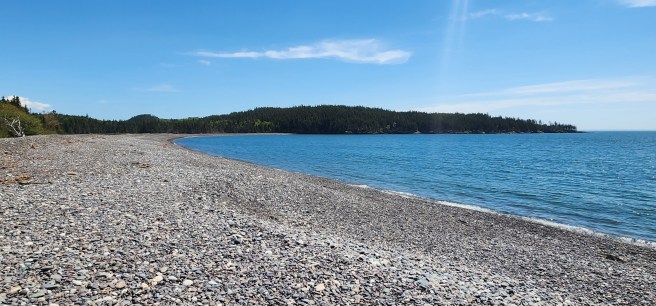
This cobble dune is much taller than you expect, and it is a natural wonder. In this photo, the sitting sunbather looks like one more small stone. Welcome to Jasper Beach in Machiasport, Maine.
To explore related free photo albums, visit my Thistle Finch blog.
After running across his name repeatedly while researching the history of our old house, I decided to look him up. Lorenzo Sabine turns out to have been a remarkable character. Best known today for his two-volume, provocative 1864 book Loyalists of the American Revolution, his adulthood included an influential span in Eastport.
Here are some highlights.
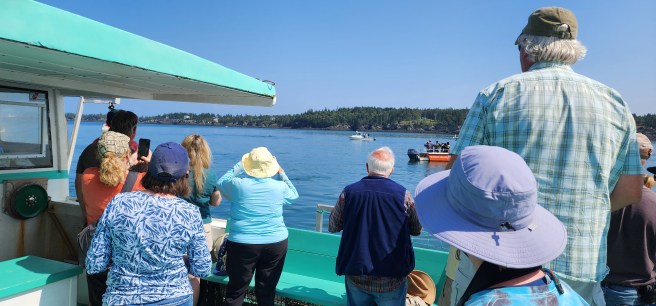
Everybody on board the Eastport Windjammers’ Ocean Obsession was engaged in looking for the next whale to appear, as were a few other vessels beside Campobello Island in New Brunswick, Canada.
We did observe humpbacks, finbacks, and minkes on the outing, but the rare right whales are less frequently seen.
For more whale-watching experiences, take a look at my Lolling with Whales photo album at Thistle Finch editions.

A longstanding highlight of Eastport’s annual Old Home Week and Fourth of July festivities is a U.S. naval ship visit. Here is the destroyer DDG 98 Forrest Sherman from last year’s edition as illuminated in glowing late-afternoon sunlight.
To explore related free photo albums, visit my Thistle Finch blog.

Think of Maine and you’ll probably envision lobster fishing as part of the scene. This crowded pier is in Kittery at the westernmost stretch of the state’s long coastline.
In my research for the book that became Quaking Dover, I became more knowledgeable about what emerged as northern New England.
There was the attempted English settlement, Popham, at the mouth of the Kennebec River in 1607-1608, of course, which had a direct line to the project that settled Dover in 1623.
But the French also had their own perspectives and influences on the region, as is seen in the English raids on the village of Norridgewock upstream. Because the Jesuit missionary Sebastian Rale had established a Roman Catholic church, the French considered the settlement a French village on par with places like Castine, even though apart from Rale, the inhabitants were Abenaki.
That settlement was destroyed in 1705 by 275 New England militiamen headed by New Hampshire’s Winthrop Hilton, the second son of Dover founder Edward Hilton. This was during what the English called Queen Anne’s War, which the French termed the Second Intercolonial War.
It was attacked and destroyed again in 1724, leaving Rale among the slain, as part of Dummer’s or Father Rale’s War, as the English called it. From the French point of view, he was a martyr. The English colonists saw him as a villain who had led deadly raids further to the south.
Both events happened during what we are more likely to know as the French and Indian wars, not that the French or the Natives used that label.
~*~
More recently I came across a long letter from the French Jesuit Pierre Biard in Port Royal in today’s Nova Scotia to his superior in Paris in 1612.
Here are some highlights related to what would emerge as Maine.
~*~
And in truth it would be much better if we were more earnest workers here for Our Lord, since sailors, who form the greater part of our parishioners are ordinarily quite deficient in any spiritual feeling, having no sign of religion except in their oaths and blasphemies, nor any knowledge of God beyond the simplest conceptions which they bring with them from France, clouded with licentiousness and the cavilings and revilings of heretics. Hence it can be seen what hope there is of establishing a flourishing Christian church by such evangelists. The first things the poor Savages learn are oaths and vile and insulting words; and you will often hear the women Savages (who otherwise are very timid and modest), hurl vulgar, vile, and shameless epithets at our people, in the French language; not that they know the meaning of them, but only because they see that when such words are used there is generally a great deal of laughter and amusement. And what remedy can there be for this evil in men whose abandonment to evil-speaking (or cursing) is as great as or greater than their insolence in showing their contempt?
~*~
At these Christian services which we conduct here at the settlement, the savages are occasionally present, when some of them happen to be at the port. I say, occasionally, inasmuch as they are but little trained in the principles of the faith — those who have been baptized, no more than the heathen; the former, from lack of instruction, knowing but little more than the latter. This was why we resolved, at the time of our arrival, not to baptize any adults unless they were previously well catechized. Now in order to catechize we must first know the language [Algonquin]. …
Rude and untutored as they are, all their conceptions are limited to sensible and material things; there is nothing abstract, internal, spiritual, or distinct. … And as to all the virtues you may enumerate to them, wisdom, fidelity, justice, mercy, gratitude, piety, and others, these are not found among them at all except as expressed in the words happy, tender love, good heart. Likewise, they will name to you a wolf, a fox, a squirrel, a moose, and so on to every kind of animal they have, all of which are wild, except the dog; but as to words expressing universal and generic ideas, such as beast, animal, body, substance, and the like, these are altogether too learned for them.
~*~
[Regarding one convert:] Even before his conversion he never cared to have more than one living wife, which is wonderful, as the great sagamores of this country maintain a numerous seraglio, no more through licentiousness than through ambition, glory and necessity; for ambition, to the end that they may have many children, wherein lies their power; for fame and necessity, since they have no other artisans, agents, servants, purveyors or slaves than the women; they bear all the burdens and toil of life.
~*~
All night there was continual haranguing, singing and dancing, for such is the kind of life all these people lead when they are together. Now as we supposed that probably their songs and dances were invocations to the devil, to oppose the power of this cursed tyrant, I had our people sing some sacred hymns, as the Salve, the Ave Maris Stella, and others. But when they once got into the way of singing, the spiritual songs being exhausted, they took up others with which they were familiar.
~*~
Then our people were sure they were captured, and there was nothing but cries and confusion. Monsieur de Biancourt has often said and said again, that several times he had raised his arm and opened his mouth to strike the first blow and to cry out, “Kill, kill,” but that somehow the one consideration that restrained him was that I was outside, and if they came to blows, I was lost. God rewarded him for his good-will by saving not only me but also the whole crew. For, as all readily acknowledge at this hour, if any foolish act had been committed, none of them would ever have escaped, and the French would have been condemned forever all along the coast.
~*~
At the confluence of these two rivers [today’s Castine], there was the finest assemblage of savages that I have yet seen. There were 80 canoes and a boat, 18 wigwams, and about 300 people.
~*~
Do note that in most accounts I’ve encountered, the French are seen as far more sympathetic to the Indigenous peoples than were the English.