It’s like a state fair in the hippie, organic, granola-mind reality. There’s no midway with carnival rides, for sure, but for truly inquiring-minds folk, it’s an autumn equinox slash harvest-time celebration.
Yes, let’s declare a true Thanksgiving, minus turkeys.
Shortened in its post-Covid resurrection, this year’s gathering in Unity, Maine, is the premiere event of the Maine Organic Farmers and Gardeners Association (MOFGA), and runs Sept. 23 through 25.
Now that we’re living in Maine, we can identify as members and look forward to attending, even though in New Hampshire we were surrounded by devotees. Yes, it’s that boffo.
As an aside, I can attest to enjoying my best-ever souvlaki ever, from a wood stove, no less, at an earlier fair. Gee, and I hate standing in line. It was worth it.
This is definitely a hippie-vision positive manifestation of the radical mindset of nirvana. And there’s no honky-tonk.
This year’s poster will no doubt be displayed on a wall of our new abode.
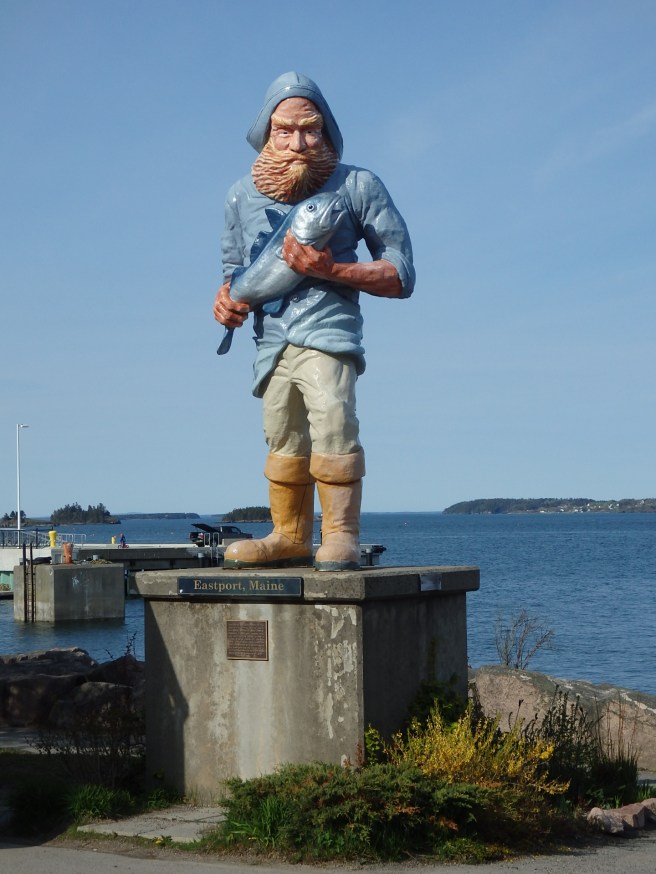
I thought the guy was kidding when he pulled up in town and confided that he was going to repaint Eastport’s iconic waterfront fisherman statue, changing the blue coat to a yellow slicker. I was sworn to secrecy at the time, but the next day, there he was, in full light, doing the deed.
The somewhat surreal, but shall we say fiberglass de facto emblem of the city, really got a fashion update. Or upgrade, in my opinion. Seems I’m not alone. Yes, that yellow slicker fits much better.
Just look.
My kudos to Patrick Keough of Seward, Nebraska, for something that even included an imaginative eyepatch.
Some folks, however, are seeing a similarity with the Gorton’s guy down in Gloucester on Cape Ann, Massachusetts.
I think they have that backwards.
Well, here’s how he looked before. The figure was a leftover from a television series set in the town.
Eastport’s tap water last summer took on a greenish color and a definite off-taste. It got to the point that we started running everything we’d be drinking or using for cooking through an activated charcoal filter.
The explanation was that the supply came from a large but shallow lake a dozen miles away and that every summer the algae bloomed. The private company that provides water to the city then had to heighten its use of chemicals for treatment, resulting in the offensive character.
Water to the Sipayik reservation also came from the same source but was delivered via a different pipeline and was, by reports, much more troubling.
In its attempts to redress the issue, the company announced it would be using an alternative to treat the water, and I have to say we haven’t noticed the off-taste or discoloration this year. We haven’t yet seen a chemical analysis yet, however, or heard about the current situation on the reservation.
Still, public water quality is something most Americans take for granted.
Funny how often we overlook a problem, even when it has, as I hope, been clearing up.
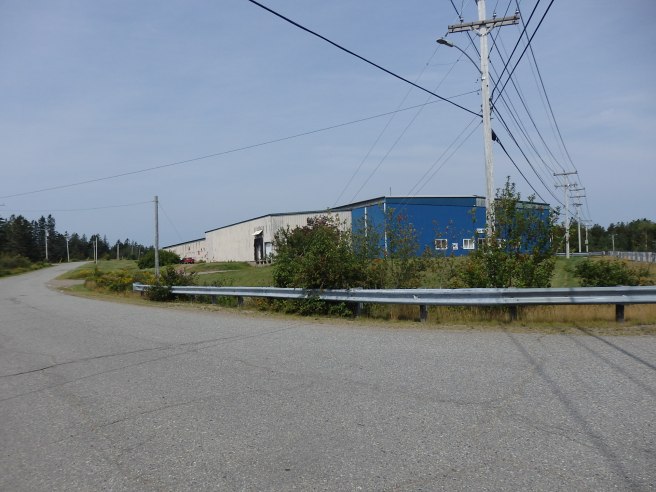
Most of Eastport’s small population resides in a semicircle around the Breakwater downtown. Quoddy Village stands apart, separated by a narrow neck around Carrying Place Cove. It also fronts Half Moon Cove, with a dead-end road to the former toll-bridge to the mainland. The place feels like an island of its own and is easily overlooked when you drive into town. The highway skirts it, and what you see is mostly former industrial, rusty, and all that.
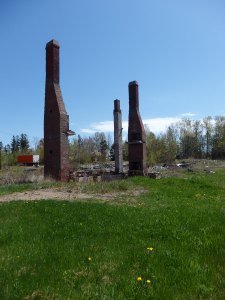
A former factory looking for new uses gives no clue to passers-by of the residential neighborhood behind it.Chimneys are all that remain of the administrative headquarters and even a school that supported a federal project in the 1930s.
Until 1935, this was farmland, but then an ambitious but ecologically disastrous public works project took off, one to dam up most of Passamaquoddy and Cobscook bays to transform their vast tidal energy into electricity. A large but confusing working model of the engineering proposal can be viewed at the historical society’s gift shop in downtown Eastport. (The room-size three-dimensional map is water in and water out, mostly. If you don’t already know the area, it’s baffling – and the presentation is aimed at today’s tourists. I still think it would make for a really interesting model railroad layout.) The short-lived boondoggle’s most lasting contribution, apparently, was the causeway connecting Eastport to the mainland by filling in a former railroad line. No more toll bridge and longer loop. Oh, yes, and it also had a noticeable negative impact on the Old Sow, the world’s second-largest whirlpool, perhaps even pushing it more into Canada.
Significantly, the project needed housing for its estimated 5,000 workers, and that led to the construction of Quoddy Village.
Even though the plug was pulled a year later on what would have been the world’s largest tidal dam – it did require Canadian cooperation, among other things – 128 single-family, two-family, and four-family houses had been constructed, along with three large dormitories with dining rooms for single workers, plus a fire station, a hospital, a heating plant, a school, a large mess hall, and a large administration building that included a theatre, library, and sub post office. In other words, a small city unto itself. Even though the homes had been designed as temporary, many of them are still occupied today. Still, for a brief time, the village was home to a thousand people.
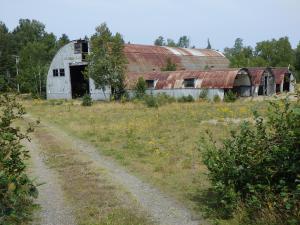
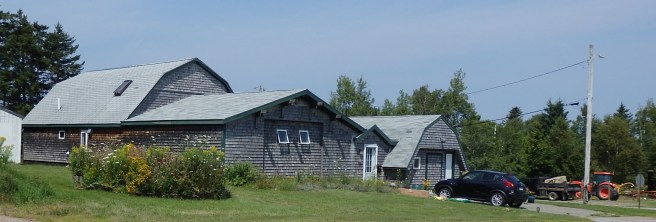
More evidence of abandoned projects, also seen from the state highway.
From 1938 to 1943 the National Youth Administration used Quoddy to train 800 city youth a year in vocational trades. It was also a Navy Sea Bee base named Camp Lee-Stephenson during World War II.
And then? It morphed into a residential neighborhood.
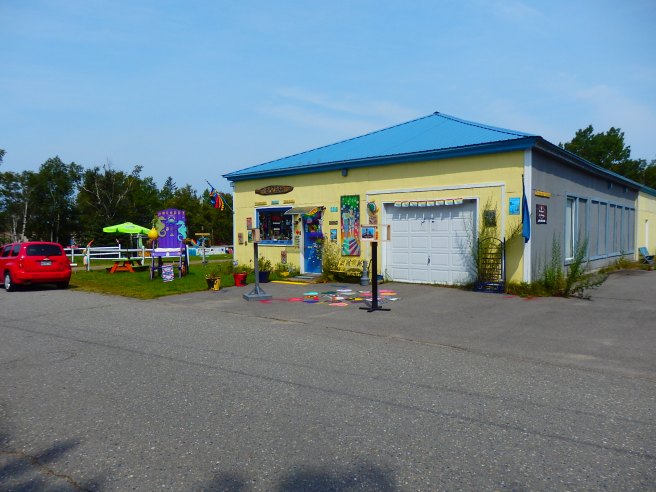
Its best-known attraction today is David Oja’s colorful and eccentric Bazaar, a gift shop that includes what’s arguably the best gourmet wine and cheese selection in Washington County. Think of it as a blast of Puerto Rico, Brooklyn, and Provincetown rolled into one. Who knows what the original function of the building was, we can be sure it was not nearly anything like this.
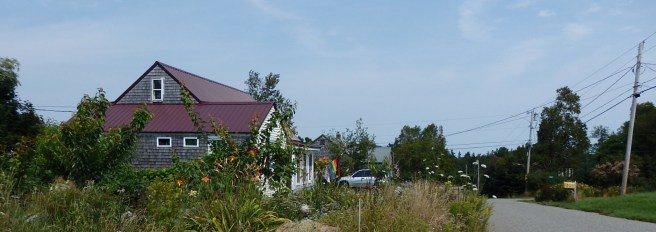
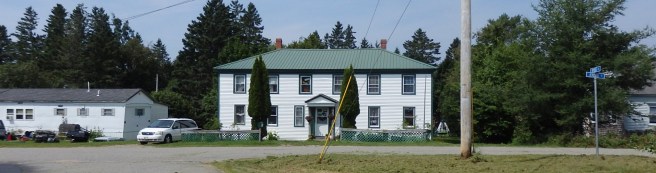
The one-of-a-kind Bazaar, seemingly out in the middle of nowhere.Today it’s mostly residential. I think of it as a small suburb.Anyone else see potential here?Yes, there’s a mix of housing, some of it from the ’30s.Much of it is also a working neighborhood. I’m all in favor of working from home, when you can.
To one side of Eastport’s Quoddy Village is Rossport by the Sea, a remarkable – and reasonably priced – 80-plus acre family-friendly retreat created in 1987 by Ross Furman when he purchased the dilapidated and vacant 1790 Captain Jacob Lincoln farmhouse.
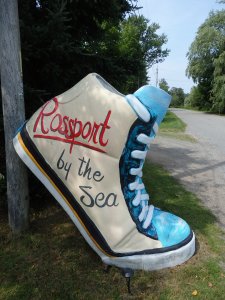
This is your greeting from the old Toll Bridge Road.
It’s definitely not your average motel, hotel, or cabins and campground, either.
The resort’s 32 bedrooms in 12 private sites have access to more than a mile and a half of shoreline and seemingly endless views. There’s also an organic farm working part of the grounds.
If you’re thinking of a visit to Eastport, I’d suggest booking there first, May through October. Not that there aren’t some other good options. Or maybe I’m just being envious.
Still, just walking around the grounds is delightful.
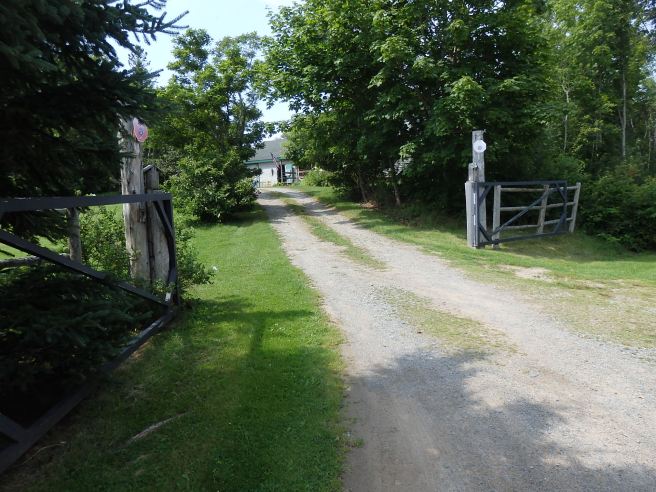
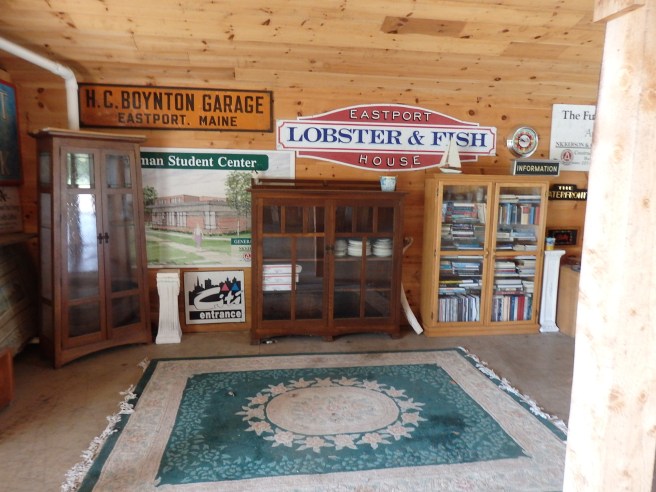
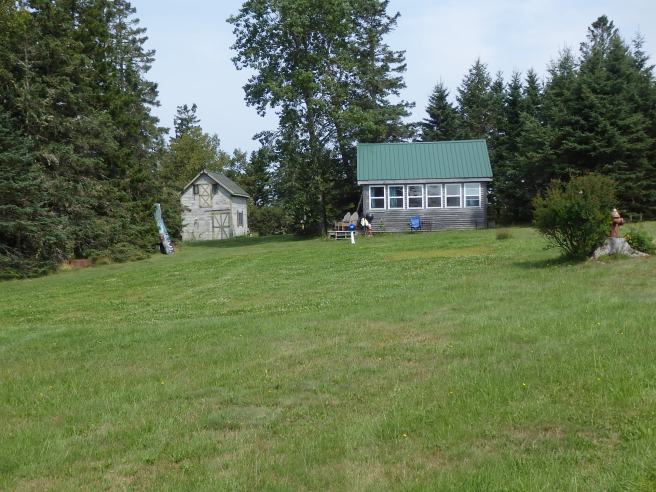
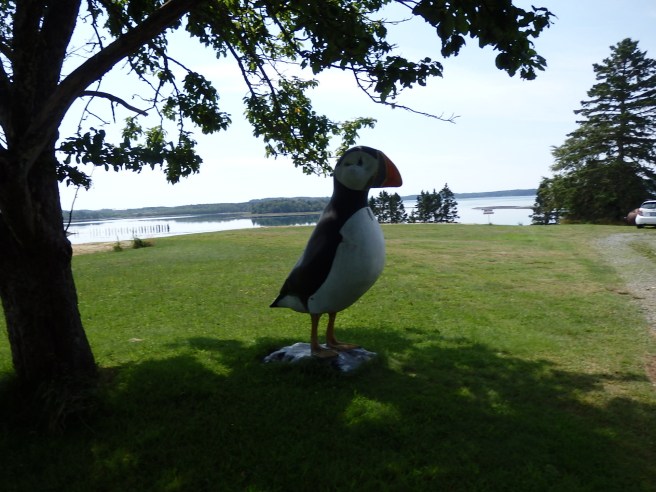
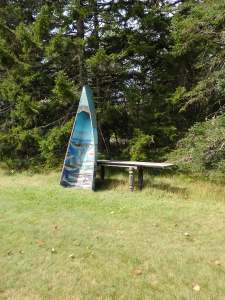
This lane leads into the grounds.Here’s what you’ll find in one of the barns.Here’s one of the cabins available for rent. The lawn leads down to the ocean.A whale vertebra sits on the deck of one of the cabins.I love the quirkiness of sculpture like this puffin.How about a decorated canoe? Go ahead, click on it for the inside view. I hope.
That said, you may want to put it on your list of vacation destinations to consider for next year and then make your reservations early, should you desire.
What distinct accommodations would you suggest for a traveler?
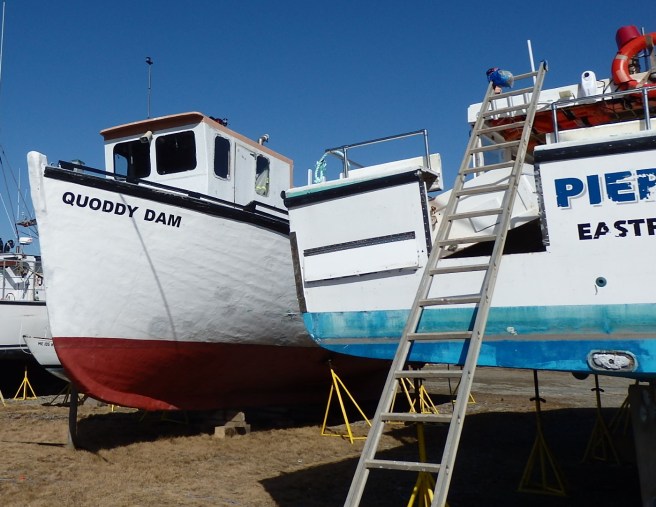
The Quoddy Dam has been used as a passenger ferry between Eastport and Lubec. It’s named as a joke regarding the 1930s public works project to dam up most of Passamaquoddy Bay and more. The Pier Pressure, meanwhile, has served whale watches.These two take some serious sails.
Considering that all but one member of my Hodgson family crossing the Atlantic in 1710 was decimated by French privateers, I find nothing romantic about pirates.
Even with legal sanction, as privateers were, they remained thieves and brutes of the seas. Well, though, there were apparently a number of unwritten understandings. Or else someone walks the plank. Or, in our case, died of maltreatment.
That said, one of Eastport’s two biggest events of the year comes the weekend after Labor Day, when everyone celebrates the city’s Pirate Festival. Yes, those black flags with the white skull and crossbones fly everywhere, even on seagoing fishing boats and the passenger ferry. And many folks dress the part to the hilt, even with what sometimes looks like a kilt. Some of the costumes are quite exquisite in their detailing, while others are pretty loose, like the guy in Hawaiian shirt and a pirate vest and hat.
It really does start to feel like a step back in time.
For the record, the port was once abuzz with smuggling to and from neighboring Canada.
History aside, I can’t complain about the special events and its welcome crowd that extend the summer season, even if I had thought it would mean I’d have to keep my mouth closed.
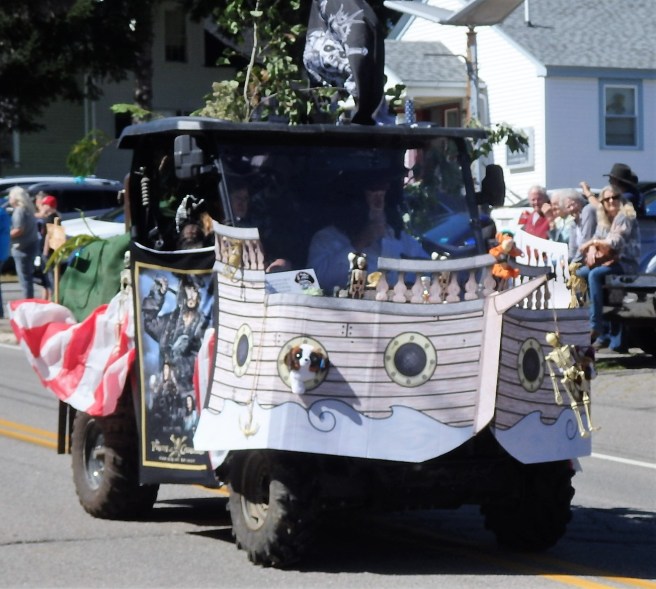
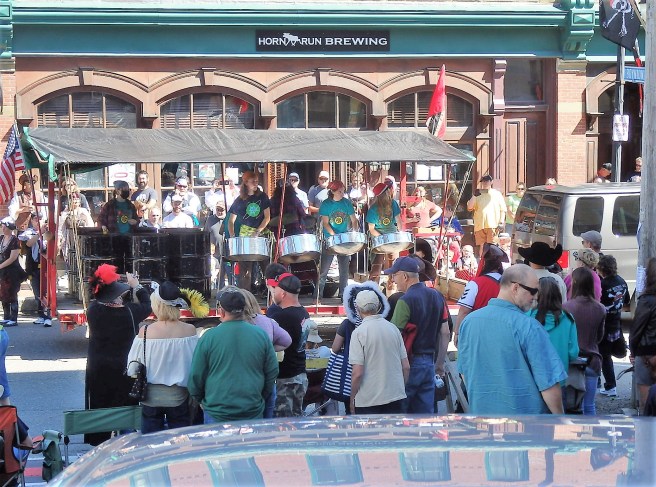
The big small-town parade includes a raft of family ATVs decked out for the occasion.And an ambulance with its own sense of gallows humor.And my own favorite, a float with a Jamaican steel drum band.
What we have is essentially a seafaring blast, with people strolling the street in period garb and canes. Some of them cross over into steampunk, which also fits the later steamship period, I suppose, and I do love watching for the anachronisms, like the cell phones and plastic water bottles in hand.
There’s plenty of up-to-snuff music-making, street dances, magicians and Punch-and-Judy presentations, a barrel relay race, even cutlass instruction for children armed with foam noodles.
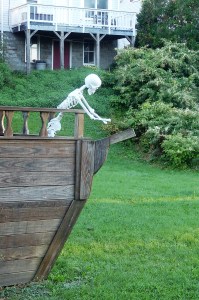
Of special note are the flaming dance performances by Ravenbane’s Firecraft and the Saturday night fireworks at the Fish Pier.There are decorations everywhere.
It’s like trick-or-treat nearly two months early, and the decorations can stay up till Halloween. I’ve been surprised at the light-hearted air of the celebration, one without the demonic undertow of Salem, Massachusetts, approaching November.
I do appreciate the appearance of parrots on some costumes, so much so I keep calling this our Parrot Festival.
As a footnote, last year’s attendance was curbed by the Canadian border closures due to Covid. Community here extends on both sides of the international boundary.
Just what is it about pirates that captures people’s imagination?
We’ll be back in rehearsals starting Monday night, and it’s looking exciting.
Quoddy Voices will be preparing Henry Purcell’s “Ode to St. Cecilia’s Day” and works by Florence Price, Randall Thompson, and John Rutter, among others, for a program to be performed twice at the Eastport Arts Center before Thanksgiving.
Excuse me while I start vocalizing. Don’t want to sound rusty.






 Jnana's Red Barn