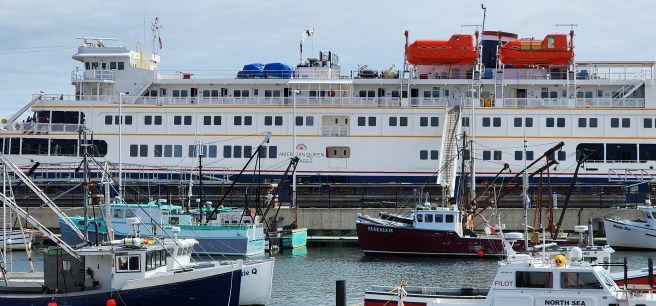
The Ocean Navigator, a 216-passenger cruise ship, has been docked at Eastport’s Breakwater pier while preparing for its sailing season, which starts Wednesday in Portland, Maine, and ventures north into the St. Lawrence River and Great Lakes for much of the summer.
You can get an idea of our local tides by comparing the photo above, at high tide, with the one below. Note the difference in the angle of the gangway for an idea of how much the elevation can rise or fall in four hours or so.
Or for a similar comparison, take the two shots below.
In the fall its itinerary shifts to Fundy Bay and New England.
With the Red Barn’s focus lately on two communities a state apart – Dover and Eastport – I’m also getting a sense of people who have two or more homes and locales.
Eastport, after all, has a large number of Summer People, some of them quite active in community affairs when they’re here. Maybe some of them can explain to me how they manage.
You know, all the extra costs and responsibilities. How many possessions do you have to duplicate, and how many others need to be packed and repacked for each shift?
And then there are all of the people’s names and faces to remember.
Join me via Zoom at 6 pm Tuesday when I look at Dover Friends’ influence in Maine – along with other surprises. We’ll start with sections of my book Quaking Dover and move on from there. (May I admit that preparing these PowerPoint presentations turns into a lot of fun?)
Yes, this garage. The Asa Allen farmhouse is to the right.
One of the lingering questions about Dover Friends is what happened to our first meetinghouse after it was moved across the river to Eliot, Maine, in 1769.
It originally sat next to today’s Pinkham cemetery just south of St. Thomas Aquinas high school and was used there from the 1680s until the current meetinghouse was built in 1768.
Quaker history buff Silas Weeks was long puzzled about its destiny, relating that it had been moved again and incorporated into a neighboring garage, but he got no further than that. When we looked about, nothing resembled what we would have expected as a Quaker meetinghouse.
As he related in his comprehensive 2001 book, New England Quaker Meetinghouses: Past and Present, a bronze plaque at the corner of State Route 103 and River Road in Eliot marks the site of the first Quaker Meeting in Maine and is affixed to what is said to have been a carriage stone used as a horse block for dismounting.
When I was back in Dover last month to do a presentation at the public library, I decided to swing by the Shapleigh manor grounds to take a few additional photos for my history project. I missed the turnoff and was surprised when I came upon the Eliot Quaker site instead. I pulled over to get fresh photos of the small burial ground and, on impulse, decided to take some shots of a 1950s’ red garage sitting nearby.
As I was doing that, a woman came out from a house behind it and called out, “Are you from the town?” The tone was accusing, but I explained who I was and why I was interested. That’s when things got interesting.
She mentioned that the building had been used as a garage for at least a century and that the planks in the flooring upstairs were quite wide – something that often indicates a very old structure, as well as the King’s Pine restrictions.
As we looked about, some other things began to click.
The building is square – a nonconforming size in the town’s current zoning rules – 24 or 25 feet on each side. It would have allowed for separate men’s and women’s sides with a divider down the middle, one that could be opened or closed as needed. When I saw one side, I recalled seeing something similar a few years earlier in Fort Fairfield, Maine, where the sides and back of the meetinghouse had been left untouched when a steeple and stained-glass windows were installed on the front. The footprint of the two meetinghouses, I now see, is about the same.
It’s not uncommon for old buildings in New England to undergo huge changes over the years. Adding the garage doors where the men’s and women’s entrances were would make sense, then, as did the dormer upstairs and a back entry. A cement floor and foundation would have been reasonable changes, too. Who knows if the original even had flooring or what remodeling occurred when the house was relocated to Maine. Bigger windows, including the one upstairs on the front, would have been a no-brainer. It’s not uncommon to hear of old houses that have barely a stick of the original wood remaining.
The fact remains that when Dover Friends built their first meetinghouse, there was no tradition to adhere to. One in Third Haven, Maryland, may have been earlier. Dover’s may have predated the one in Salem, Massachusetts – a replica of that structure sits on the grounds of the Peabody-Essex Museum and looks quite different from this but of roughly similar size.
The low pitch of the roof of the Eliot garage was a concern for me, but I now see it matches Henniker’s 1790 meetinghouse in New Hampshire.
The garage and burial ground are on what had been the extensive Asa Allen farm, a surname common in Dover Quaker records. I am inclined to go along with the view that the cemetery was the Allen family’s, rather than the Meeting’s. Once gravestones were allowed, the ones that were erected adhere to common dating rather than the traditional Plain designations.
The dormer is an example of how a building can grow over the years. Neighbor Stephanie Mask has long been fascinated by the Allen family legacy.
The garage, meanwhile, appears doomed for demolition as a new generation takes ownership. The Eliot Historical Society’s website suggests that the meetinghouse was torn down in the [late?] 1800s, but even if that were the case, portions may have still been used in the garage across River Road.
As for my assumption that this was a 1950’s garage? Back to the proverbial drawing board.












 Jnana's Red Barn