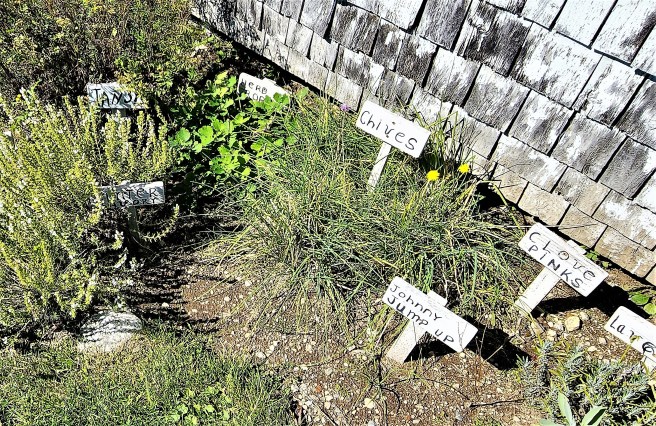
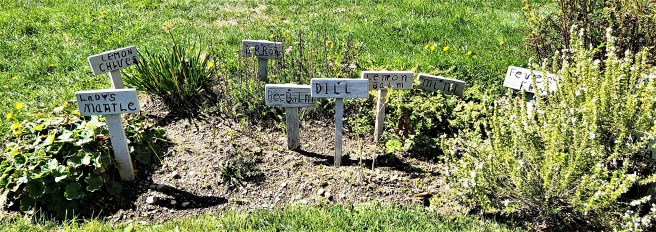
The English colonists knew their herbs and spices, as shown in the Pemaquid state historical site’s garden. The selection includes bee balm, betony (lamb’s ear), celandine, chamomile, chives, clove pink, crane’s bill, dill, evening primrose, feverfew, Johnny jump up, lady’s mantle, lavender, lemon balm, mint, parsley, sage, savory, tansy, tarragon, thyme, and yarrow. Many of these were grown for their medicinal applications.
We never had much more than salt and pepper back in the ‘50s, at least as I recall as a kid.
We’re feeling sorry for vacationers to our end of Maine the past two weeks. Especially those with children in tow.
It’s been cold – our furnace is still on – and very foggy and damp, accompanied by showers and thunderstorms.
It’s not what you’d want to run into on your well-earned summer getaway.
At least we’re getting a break, however brief.
Today’s forecast is for mostly cloudy, followed by two partly cloudy days. And then another solid streak of rainy days resumes.
Glimpses of real sunlight and blue sky will lift spirits, no doubt. I might even stop reminding folks of six straight months or so of this for people living in Seattle. (You know, it could be worse. We might even have to start watching movies in German.)
One thing you can also anticipate is the sound of lawnmowers the moment the grass dries sufficiently. Otherwise, a failure to mow in time can lead to an impossible task, as I remember when I had to learn to scythe back in Dover … and my vow to myself never to do that again.
For us, it also means doing laundry. We have a washer here but not a dryer. So we’re anticipating hanging wet clothes and linens out on the line to dry. There is a backlog to address.
Another must-do is a big round of grilling. Maybe even dining al fresco, if the temperature cooperates.
Well, as we’ve been saying all along, this too will pass.
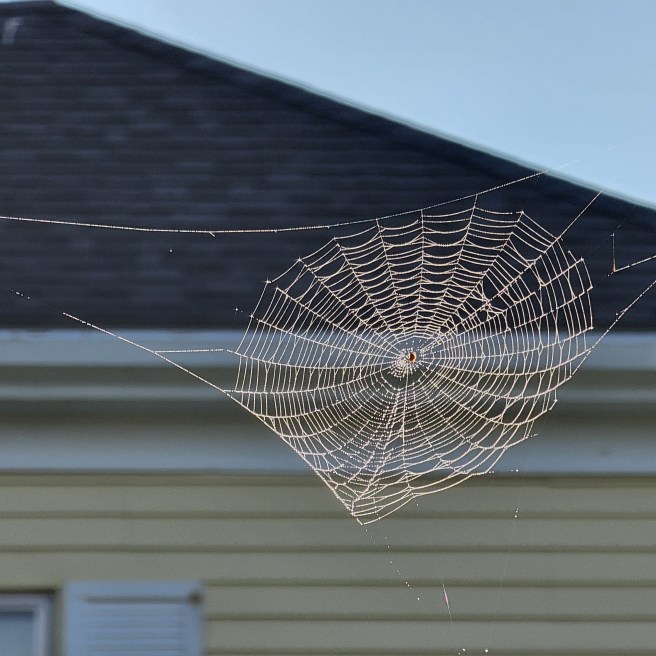
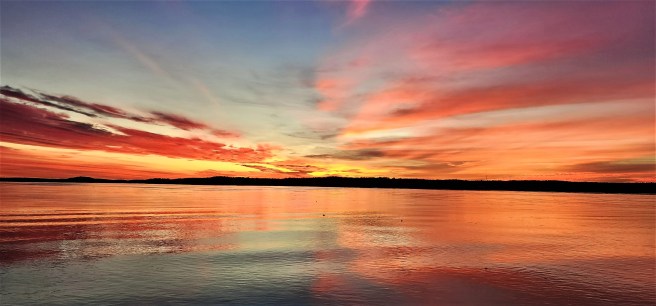
Good morning! This is another example of our dawns around here, just not during our current two weeks of heavy fog, rain, and occasional thunderstorms. It is a welcome reminder, though.
Dover’s second minister, the Rev. George Burdet, made a quick exit from town amid scandals, quickly followed by more in York, Maine. He had even briefly been “governor,” or the agent in charge of the New Hampshire province, making him in charge of both its religion and politics. Or, as historian George Wadleigh quipped, a wannabe pope.
Beyond that, as I observed in Quaking Dover, Burdet “was obviously on a downward spiral, as Thomas Gorges wrote to John Winthrop in 1641, noting that Burdet was at Pemaquid and ‘is grown to that height of sin that it is to [be] feared he is given over. His time he spends in drinking, dancing, singing scurrilous songs, and for his companions he selects the wretchedest people of the country. At the spring I hear he is for England.’ Later that year, the younger Gorges added of Burdet, ‘the dishonor of his profession and monster of nature, is now gone for England by way of Spain.’ That description of drinking, dancing, and singing rather seals the Robert Dover connection for me, even if Merrymount’s Thomas Morton, the more obvious reveling partner, wouldn’t return to Maine for another year or two.”
I do have to wonder where the wild tavern sat in the early Maine settlement here.
So here’s where he spent that wild binge – 110 miles or so from Dover, or a two-hour drive away today.
Recent research has come up with a site for the jail. I do have to wonder if the Rev. Burdet ever served time therein.
As for Robert Dover, who gave Burdet the inspiration for naming the New Hampshire settlement? He was an anti-Puritan wit and attorney. That, in contrast to the South English port famed for its white cliffs.
Reports of the cleric’s subsequent movements vary, possibly ending in Ireland, “where he was named chancellor and dean of a diocese. He died in Ireland in 1671, ‘after founding a much respected county family.’ Had he reunited with the wife and children he’d left behind?” As I say in my book, “Or was he, in fact, a bigamist? Also, there’s no mention of prison.”
Turn to Quaking Dover for the details.
What my Pemaquid visit made me realize is how little history of early Maine I had encountered in drafting my book, and how tenuous so much of it I’ve found since remains. Yes, the early settlements, including Pemaquid, were obliterated and abandoned during the decades of warfare with the French and their Native allies, but there had been significant settlement before that, something that kept getting swept away.


 Jnana's Red Barn