New Englanders sometimes joke that a town name will be found repeated in five of the six states of the region. It can be confusing. You know, people moving from one place to a new one but keeping the town name.
Maine, however, has its own twist, since much of the settlement occurred after the American Revolution, especially in the early 1800s, when “singing schools” became a popular community activity. Many of these were related to church life and the spread of four-part harmony hymn singing. So what if someone else had claimed the town name you had hoped to repeat, here was a fresh source.
Today many songs in a hymnal carry a title reflecting the words, but in earlier times the name identified the music itself – many of their lyrics can be transported from one composition to other scores within a given syllable-count system anyway.
That older tradition is continued today in a style of a four-part cappella singing called Sacred Harp, reflecting the title of the hymnal of shape notes that it used. Shape notes, should you ask, are not all of the round kind you see in most musical scores. Instead, some are little flags called fa; others are little boxes called la; or diamonds called me but spelled mi; and the round notes are called so. And there are no instruments, not even harps, much less pianos or organs, in this often rowdy tradition.
So much for that arcane sidetrack. Back to the song names.
I had assumed that the composers applied them to honor where they were written or some such. “Detroit” is one that always makes me smile.
At any rate, during a sacred-harp singing session a while back, it was mentioned that some Maine towns were actually named for the tunes, rather than the other way around.
Bangor was one. Though not in the Sacred Harp collection, the tune was written in 1734, “Oh very God of very God,” and influential. The Maine city was incorporated in 1834 from what had been known as Sunbury or Kenduskeag Plantation. The name “Bangor” is said to have been taken from a Welsh tune. Voila!
Now, for ten examples drawn from the shape-note collection. The name of each tune and town is followed by its date of composition and then the first line of the text it accompanies in the Sacred Harp collection, the date of the founding of the town, and then by something about the Maine community.
- Chester: 1770, “Let the high heav’ns your song invite”; settled in 1823, the town north of Bangor had 201 households in the most recent tally. The name, however, came from an arrival from Chester, New Hampshire. No dice for the hymn, then.
- China: 1801, “Why do we mourn departing friends”; 1774, with the name being chosen by Japheth Washburn. He wanted to call the town Bloomville, but people from a town of that name objected, saying that the similarity could cause confusion. Washburn then settled on the “China” because it was the name of one of his favorite hymns. Today, the summer youth camp of New England Yearly Meeting of Friends (Quaker) is on the town’s China Lake.
- Enfield: 1785, “Before the rosy dawn of day”; about 1820, originally called Cold Stream. A third of the town is occupied by Cold Stream Lake. A possibility.
- Liberty: 1800, “No more beneath th’ oppressive hand”; incorporated in 1827. Another possibility.
- Milford: 1760, “If angels sung as Savior’s rest”; incorporated in 1833 from what had been known as the Sunkhaze plantation. Milford is a town name found across New England.
- Newburgh: 1798, “Let ev’ry creature join to praise”; settled about 1794 and incorporated in 1819, it is spelled like the town along the Hudson River in New York, which probably influenced the naming of both the hymn and the Maine town.
- Northfield: 1800, “How long, dear Savior, o how long”; the town was settled about 1825 and incorporated in 1838. Thus, a possibility.
- Oxford: I’m not sure about the hymn’s date, “Shepherds rejoice, lift up your eyes,” though when the town incorporated in 1829, the honor went to the university town in England. Well, that left the other famed university town, which also has a hymn title in the Sacred Harp collection, “The Lord will happiness divine.” In the second case, the name came up at a town meeting when the community was preparing to be set off from Ripley. The 11-year-old daughter of the household where the discussion took place was asked to suggest a name for the new town. She proposed the name Cambridge, from the English town of the same name about which she had just been reading. It was applied in 1834.
- Poland: 1785, “God of my life, look gently down”; when the town was incorporated in 1795 from Bakerstown Plantation, early resident Moses Emery was given the privilege of naming the town. He had always been fond of an old melody called “Poland,” found in most of the collections of ancient psalmody, as the history goes. Today the place is best known for the Poland Springs bottled water brand.
- Portland: 1802, “Sweet is the day of sacred rest”; the Maine city was set off as a town in 1786, named after an isle off the coast of Dorset, England. Alas for the influence of the hymn, though it may have been the other way around. The city in Oregon, should you wonder, was named in honor of the one in Maine in an 1844 toss of a coin. Otherwise, the Pacific Northwest city would have been Boston, which somehow doesn’t seem to be a tune name.
There are arguments that some of the hymns were named after Maine towns. Just consider Mars Hill, 1959, or Mount Desert, 1985.
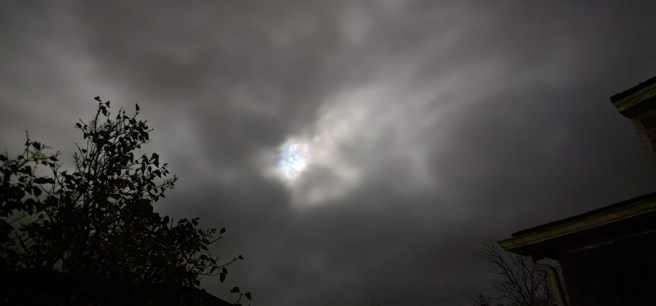 Playing around with the night setting on my Galaxy cell phone has produced some surprises, beginning with the aurora borealis.
 Yes, autumn is in the air.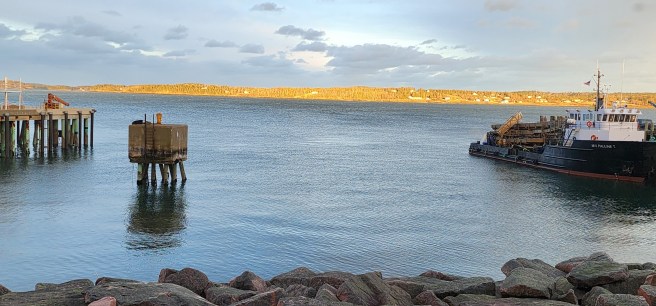




 A Penobscot Bay windjammer cruise typically includes a lobster bake, though technically the crustaceans are boiled or steamed with corn on the cob. The event takes place on any of a number of uninhabited islands along the way.

 Jnana's Red Barn