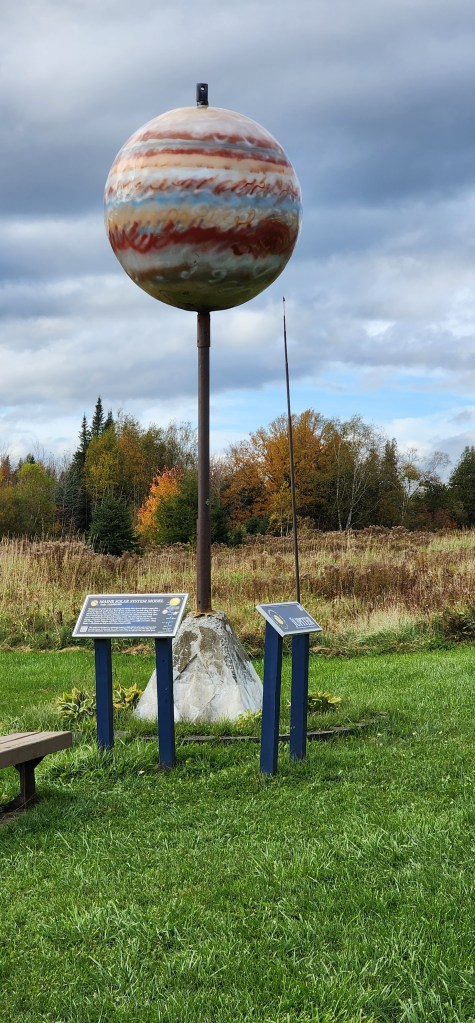
Jupiter, by Jove

The largest planet in our solar system represents a gap between the cluster of planets closest to the sun and those beyond. At 5.2 miles from our model sun on our astro-scavenger hunt, we’re finally getting some size. This one’s a bit wider than a five-foot arm span – it’s 61.4 inches – like a really big beach ball. And its four largest moons are Io, 1.6 inches; Europa, 1.3; Ganymede, 2.3; and Callisto, 2.1.

Remember, this is a scale of one to 93 million. As inconceivable as that seems.

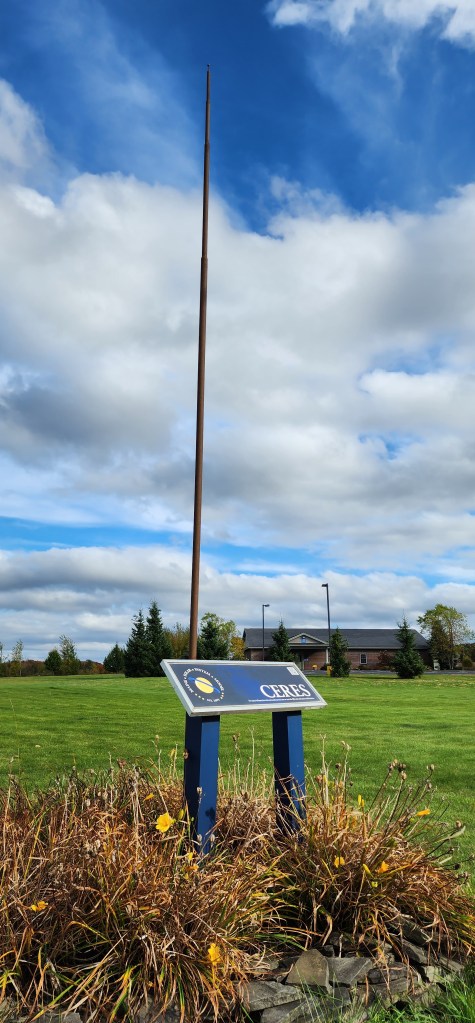
Ceres, as a surprise

At 3/8 of an inch in the scaled solar system – that is, a steel ball bearing – this is the largest object in an asteroid belt between Mars and Jupiter.

The model was erected after the rest of the Aroostook system was in place.

Did you even know about this body? Hate to admit, but I didn’t.


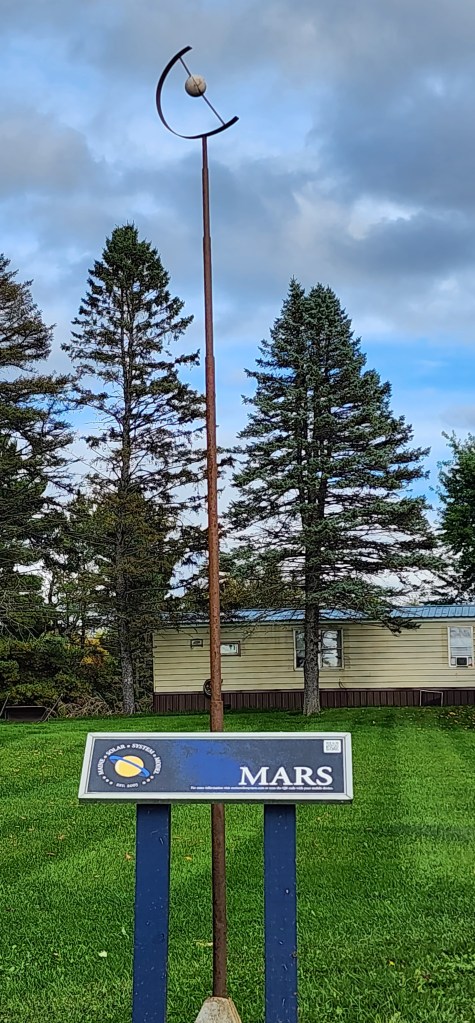
Mars without Martians

At 1.4 miles from the sun in our scale, Mars is about half the size of Earth and has two moons that are too small to be presented in this display.

The angled post in the crescent, as we were learning, represents the planet’s tilt in its orbit, the major factor that gives us our seasons.

By this point in our drive, we were beginning to catch on to what we were looking before rather than passing by and having to circle about. The game now became who would spot the next stop first.

And our moon

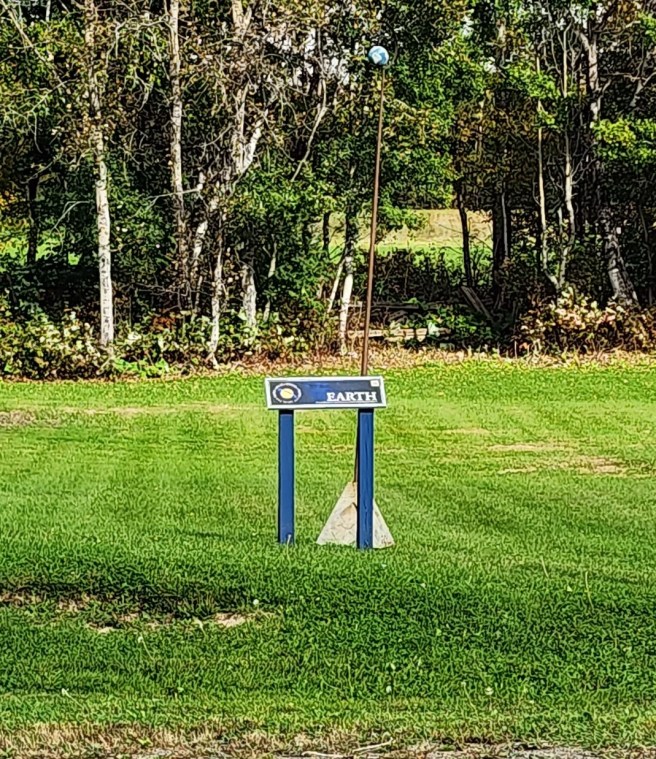
In our eyes, in the perspective of gazing from Earth, the sun and full moon appear roughly the same size.

Not so in an actual size comparison.

The model, 1½ inches in diameter, is a fiberglass covered golf ball. Remember how big the sun was, back in the science building?

My, what the miles can do.


Mercury, not to be confused with an auto brand

Our next stop was within sight of the college, about three-tenths of a mile away.

The brochure said the planet was to be found at the Honda dealer, but we couldn’t find it. This was not a Ford-Lincoln product, after all.

This time, after a laugh, I was pointed across the street.

Here’s how big the little planet appears in relation to the sun we’d just met earlier. While the sun was built with a 598-inch diameter, Mercury weighs in at a mere 1.1 inches.