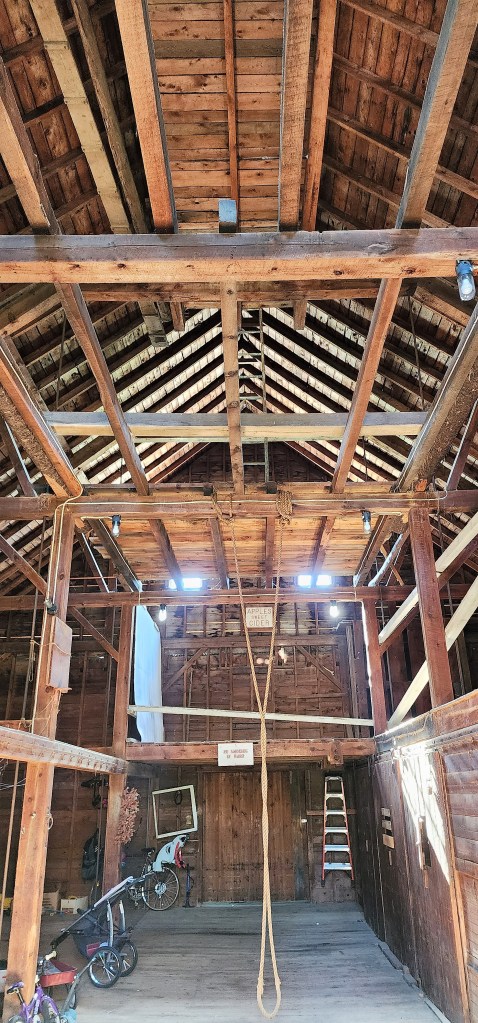
This one is far more spacious and majestic than mine was. Oh, yes, and much less packed.
You never know what we'll churn up in cleaning a stall
This one is far more spacious and majestic than mine was. Oh, yes, and much less packed.

The volunteer-run Belfast & Moosehead Lake Railroad can be an adventurous ride. Here are its tracks in Thorndyke, Maine, as seen from a passenger car door.
just passed an old sardine carrier
turned private yacht
Local traffic
sardines as a reminder of where I’ve settled
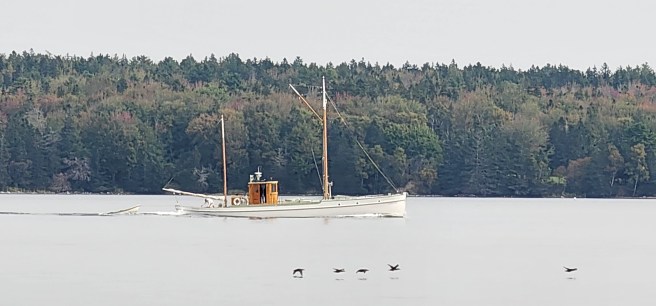
when the Louis R. French was based out of Lubec
and owned by American Can in Eastport
she had an engine and no masts
faring something like this
While we wait for the continuing renovations to catch up with these weekly reports, let’s change the focus to the history of this old house itself. Give us a better idea of what we’re working with, too.
When we bought our full Cape at the end of 2020, the real estate listing dated its origin in the 1860s. As we became familiar with the home’s bones, we saw details suggesting construction as early as the 1830s. While the pedigrees of a few neighboring houses have been catalogued by local historians, ours was not one of them. The dwelling did appear more modest in comparison.
We did have to wonder if the dwelling had been rebuilt after one of the catastrophic fires swept the downtown and its fringes in 1886, 1864, and 1839. Some of our stone foundation is 18 or more inches thick.

The house did appear on a widely reproduced 1879 map of Eastport, one that gave a birds-eye view of the city. The two dormers may have come later – it’s hard to tell from the map.

An earlier historic map of 1855 not only had a house fitting the footprint of ours on the lot, but with two wings, accompanied by an identifying script “Shackford Est.” The difficulty came in trying to figure out which Shackford that would have been — the family was prominent and prolific.
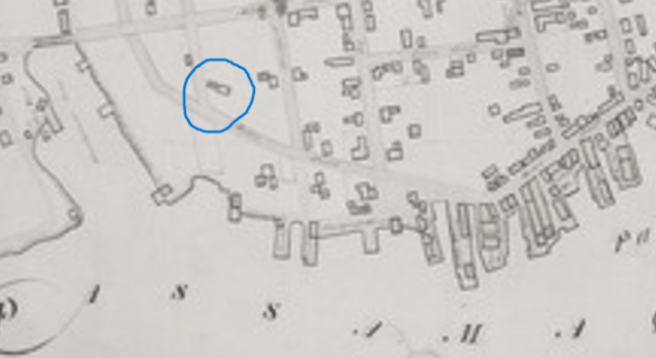
An earlier Plan of the Village of Eastport, 1835, by William Anson presented rough designations of the structures in town, including a house where ours is and only a few others in the blocks around.
Thus, we do know the house was here before 1886, as the charred rafters affirm, reflecting the great fire that destroyed the downtown. Local history dean Ruth “Ruthy” McInnis, owner of the Todd House bed and breakfast, had primed us to look for that detail when we were considering whether to bid on the place. Other dwellings, as we’re learning, share similar damage.
What I’ve uncovered is that this house is even older than we suspected, and more historic. In many ways, it tells the story of the town, too.
I’ve been caught off-guard several times while wearing my gray Louis R. French historic schooner hoodie around Eastport. (Well, one of them. I now have three, but that’s another story.)
The first encounter was at the county courthouse in Machias while researching the deeds to our home. A registrar asked what I knew about the boat and I started replying with the history. She smiled and said, “My dad worked aboard it,” back when it was a sardine carrier based in Lubec, the town just south of Eastport. During that stretch, the masts were removed and the vessel was powered by an inboard motor.
The second time was when a friend, a legendary ship pilot, smiled and said he rode many times aboard it as a kid. Bob did correct me, saying the French wasn’t a sardine carrier but a freighter carrying cat food to Canada. (“Cat food to Canada?” Sounds like a title to me.) His family did own canneries in Lubec, Eastport, Portland, and a few other places. That’s yet another history to consider.
The next incident came while leaving my dentist’s office and his wife ( a.k.a. center of operations) Mary, blurted out, “Lewis R. French? That was my family’s boat.” For 50-some years, in fact, or the time it was based on our waters, when her Burpee and Vose families possessed the vessel. From her I learned that during the Prohibition, the French was an active rum-runner. Sardine carrier? Huh? The missions do get more interesting, no?
She also said something about ghosts. Well, if they could talk.
She does have the book published later, but I do suspect some of those details are missing.
The most recent account came while watching a big cruise ship come into Eastport. A woman standing nearby saw my hoodie and then told me she used to work in the office when the French belonged to Seaport Navigation. (She confirmed that my dentist’s wife’s families were among the owners). The headquarters was on the second floor of a waterfront building that she pointed to, one where friends of ours have their gallery and apartment, and said she never got tired of the view. She remembered typing up many documents regarding deliveries of canned sardines to the railroad line in St. Andrews, New Brunswick. Shipping them from there rather than by truck from Maine was much cheaper. By this point, the French was Seaport’s backup ship.
So sardines were still part of the story.
Do we really have to wait another year for the new Interstate 395 leg from Maine Route 9 to I-95 itself to open?
It’s only a few miles and minutes but eliminates a lot of aggravation in getting from here at the eastern edge of the country to most of the rest of the USA. That half-hour of narrow roadway competing with Canadian tractor-trailers on icy pavement plus small-town radar speed traps is an aggravating bottleneck, believe me, even before you factor in all of the Acadia National Park seasonal crush. The new route will ultimately get us around Bangor/Brewer more swiftly and maybe save us ten minutes or so at most, but on a five-hour drive that can be huge.
As it is falls back into a Trump-era vision of what’s supposed to be good at least as the fireworks and firearms retailers along the way declare.
What’s the biggest traffic hang-up you hate?

Vassalboro,
how many times I’ve driven an hour to worship,
even my own home Meeting
sunflowers outside the window
a gray morning
ten of us, now eleven
so many of the surnames from Dover
arrived here and abouts
edgewalkers
part of a message
the Zoom view of the Meeting room
shows only me
surrounded by white walls
“green walling,” a term I just learned
no, a green washing
by conniving corporations
a carpenter tells me of working on the renovations
of the schooner American Eagle
all new to me
but not for long
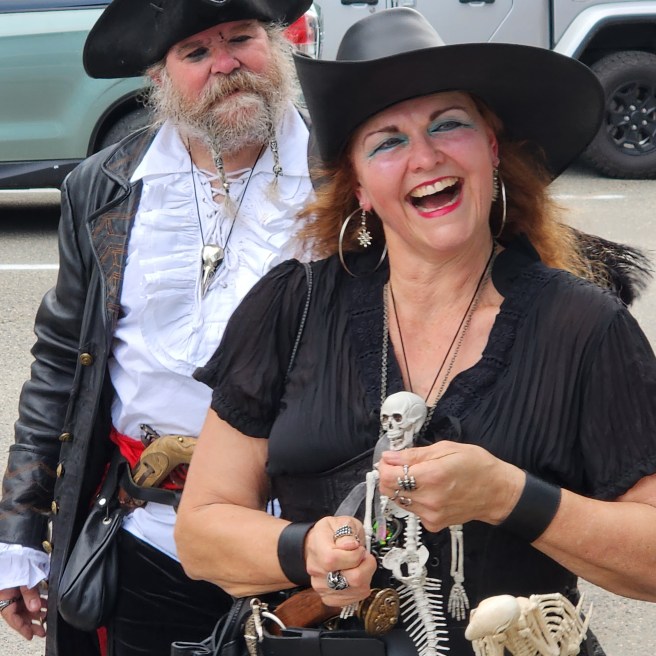
The weekend after Labor Day is observed around here as the Pirate Festival. It’s even a prelude to Halloween.
I’m turned about so much
we don’t connect to the guidebook
in my hand
across from Brooklin
on Blue Hill peninsula
wooden boat school renown
and the magazine
I’m so turned around
the overnight air was humid
we thought the early morning sun
was the moon
we could look at straight
like the nearly full moon
 Jnana's Red Barn