
Whiting, Maine
You never know what we'll churn up in cleaning a stall
Whiting, Maine
We get our share of lousy weather. Or may everyone’s, according to one Navy Chief Officer.

Okay, he was talking only about fog.

Wild apples, Whiting, Maine
Eggemoggin Reach
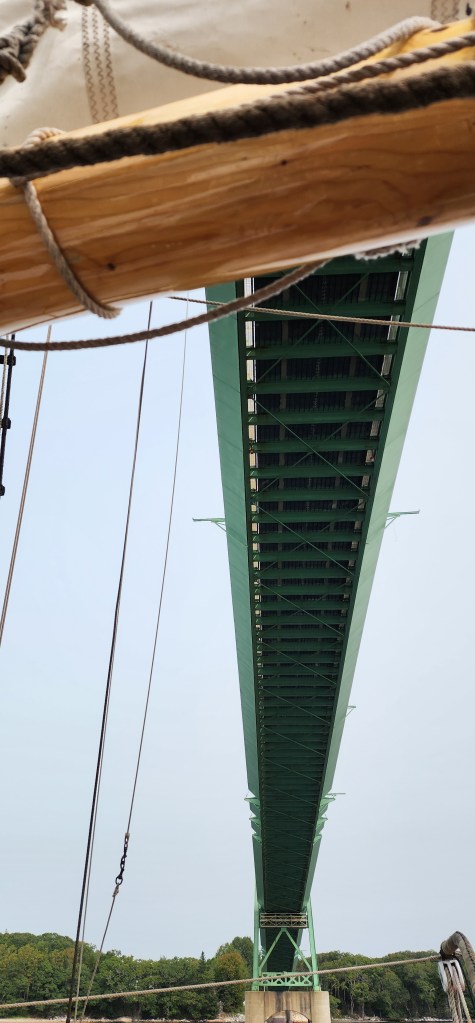
the Deer Isle bridge ahead
we’ll barely clear
six inches or sixty feet, what’s the difference?
other than a margin of error
the electronic gizmo’s
soundings in feet
at mean lower low water
I got to steer today
a feel of command
aiming for the arch of the bridge

Taking forever to get to the span
Deer Isle Bridge, as seen by vehicular traffic
Eggemoggen Reach Bridge from the water
a fixed bridge meaning
it doesn’t draw open
one more detail on the chart
(see Note B)
which I can’t find anywhere
until it’s pointed out in the margin,
same color type as the notice
we’re pushed by Greyhound
the inboard yawl
the motor behind me as a drone note
humming above lapping water
people bundled up this morning muted sun water depth 64
just gone to 72
Eggemoggen Reach broader
than Friar’s Road
where I live
Working the line of our old house downward quickly led to a tangle. You’ve been following what I uncovered at the Washington County courthouse, but at this point, an earlier reference was not recorded in the transaction at hand. Zip, zero, nada. Without that, I was stuck at 1975, well within my own lifetime, not exactly historic in my viewpoint.
The sale to the Greenlaws, according to the record, involved Oscar L. Whalen, executor for estate of Arline F. Vaughn, of New York, and someone named Rose Lee. But there was no Book and Page mention to lead me to the next entry.
The best I could do was to try working from the earliest residents and hope to build a line to 1975.

Since the 1855 map labeled our house “Shackford Est,” looking at the Shackford family made sense. Maybe Arlene was one of them.
Revisiting the Tides Institute and Museum of Art’s online survey of the homes of Eastport, I found that they had added a notation to their photo of our house. They quoted the weekly Eastport Sentinel account of U.S. Navy Commander Albert Buck returning home after World War II. Home, of course, is the one where we’re now living.
Buck? That gave me another family to start investigating, especially since they were living across the street in the 1855 map.

Also known as tamarack and hackmatack around here. It’s a conifer that loses its needles each fall.
this lapping water is a nagging unease
so far from a destination
you can address

do I walk as fast as we’re sailing?
a fathom is essentially an arm span
how far the sound carries
that lawnmower
I think we’re heading the wrong direction
with someone new at the helm
how can they see ahead
from way back there?

I’m freezing
ready on the down haul
island hopping
today’s cold
except in the galley
The Milanos were also short-term owners of our house. They sold the property in June 1978 to Dora and Merrill Lank junior. He was an Eastport native who served a stint as a city police officer and also enjoyed making wreaths. Both of them had grown up in Eastport — he in the north end and she in the south — and had children.
When the Lanks took ownership, our house had a slate roof, one with a pink scalloped pattern worked it. It was sided it what Dora has called ugly blue asphalt shingles. They divided the two big rooms upstairs into four, added the closets at the top of the stairs, and installed the casement window over the kitchen sink and the pass-through to the front parlor before moving in with her mother a few blocks away.
The house was then rented to Mel Soctomah, newly retired from the U.S. Army. He was Passamaquoddy in his late 40s and moved in with his wife, three children, and a dog. At liberty to make renovations, he installed the big wood and oil-fired cook stove that occupied the kitchen when we arrived. He recalled that the flue drew well, an important consideration in a place as windy as Eastport. They then left for a stint in Florida before returning to Eastport and neighboring Sipayik for good.
Dora and Merrill divorced, though, and complications emerged after she moved on. There was a sale from Bangor Savings Bank to the U.S. Department of Housing and Urban Development on October 8, 1982, with a supplementary entry on August 5, 1983. This was during a national recession that included a depressed real estate market and foreclosures. Somehow, Gordon Greenlaw reappears in this sale.
Sometime during this period and the one that followed, puzzling rough-sawn dark ceiling beams were erected in the two front parlors — “pseudo-rustic pop 1970’s kitsch,” in the words of one current resident, or “ye old Lion’s Den tavern,” in the mind of another. Those ceiling beams are distinctive, in that love- it-or-hate-it kind of way. For us, our reaction often depends on the day you might be asking. Looking closer, touches appeared in the kitchen, like the Montgomery Ward electric stovetop that came with the house when we bought it. Monkey Ward, for the record, went out of business in 2000 and probably had no outlet anywhere near Eastport well before that. I am wondering about some of the shelves, though, and considering them her Calla’s. Or now, maybe Mel’s. Nice work, either way. Particle board cabinets that also arrived at now scheduled for replacement, as are the triple-track storm windows.
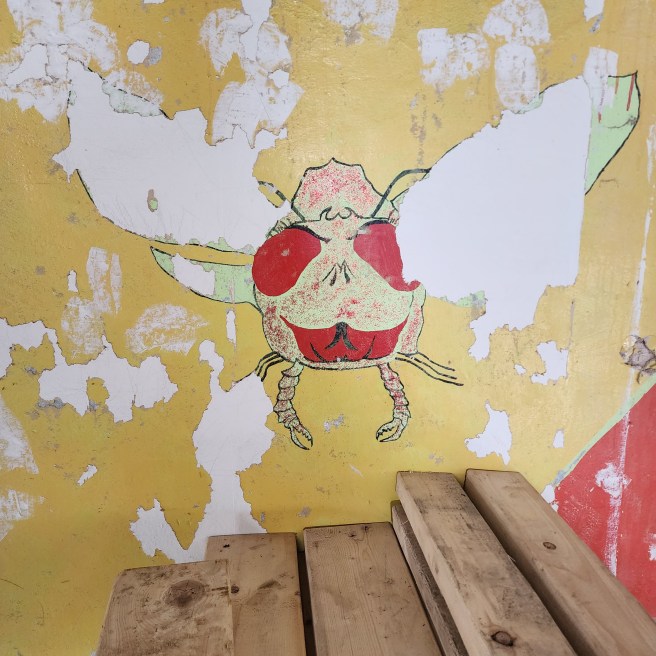
We can still ask who added the knee walls or the cosmic crab wall painting we found under the wallpaper upstairs.

To put the jack-o’-lanterns in context, let’s take a step back.


 Jnana's Red Barn