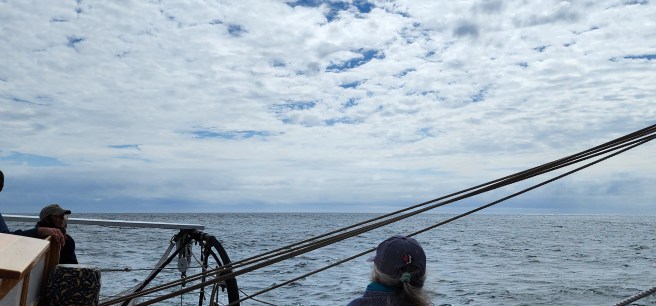
Sailors learn to observe the clouds for clues about changes in the weather. The conditions can be especially crucial to vessels that rely on their sails.
This was one of those moments aboard the historic schooner Louis R. French last summer.
You never know what we'll churn up in cleaning a stall
Sailors learn to observe the clouds for clues about changes in the weather. The conditions can be especially crucial to vessels that rely on their sails.
This was one of those moments aboard the historic schooner Louis R. French last summer.
Among the many vessels in Eastport by the 1820s, according to historian Jonathan D. Weston, John Shackford senior was one of possibly two residents owning ships of “suitable size and equipment to perform voyages at a distance.”
Captain John’s schooner was the Delesdernier, named after an Eastport family owning the tract just south of his own.
Lewis Frederick Delesdernier was the town’s first customs officer, in fact, and Weston’s grandfather. Note the “D” for the middle name.
Was the naming of the ship an inside joke? I’ll take it that way. He may have also been an investor in shares, another common practice.
The remaining ships of note in Eastport, incidentally, were “owned by inhabitants of other parts of the country.”
All of it, of course, has relevance on the house we bought.
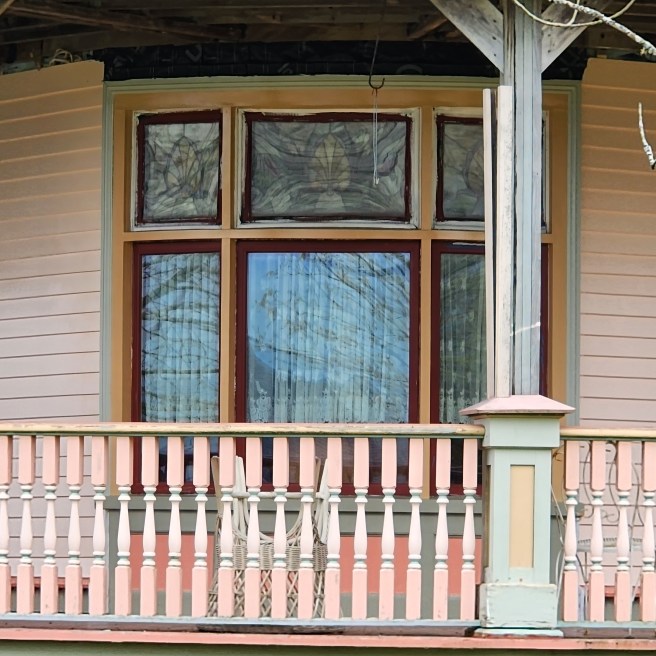
Do people really sit here, watching the passing view in warm weather? Did they ever?
Somehow, it’s still commanding, all these years later.
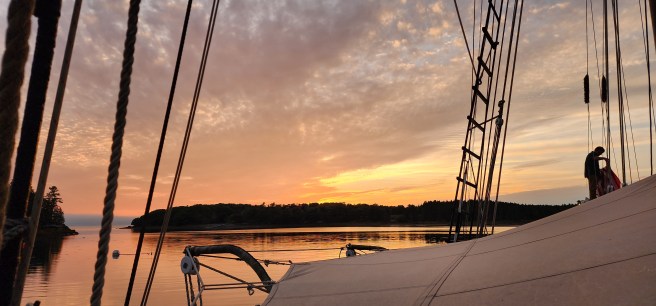
This one’s from to our west, in this case Penobscot Bay during my cruise last summer on the schooner the Louis R. French. You’ll be seeing more images from that week as this year progresses. And, yes, I’m already signed up for another week of cruising.
While Eastport had a twisting trail into the village, the first real road was Water Street, laid out in October 1803, “from Mr. Todd’s house to Mr. Shackford’s.”
The Todd house, most recently known as a bed and breakfast inn, is believed to be the oldest surviving dwelling in Eastport. It was built around 1781 — some say as early as 1775 as a cabin – by John C. Todd and has early additions. Unlike ours, it had a large central chimney with multiple fireplaces, a colonial New England architectural signature. Ours had two smaller chimneys, including a precariously collapsing brick arch in the cellar when we bid on the place. That had to go before the rest of the bricks caved in.
When I began this investigation, I didn’t feel our house goes back quite that far, though I’m now convinced that Captain John had some residence on our lot by the time Water Street came along. For now, let me simply say the plot has thickened. No pun intended.
As historian Jonathan D. Weston describes,
“Water Street was laid out, 24 feet wide, after opposition by those who contended that 18 feet was ample width as it would allow two wheel-barrows to get by each other with room to spare, and, at the suggestion that it would be too narrow for horses and carriages to pass, scouted the idea that the idea that strange curiosities would ever be seen on Moose Island.”
That does explain the traffic congestion downtown today, long after horses and carriages yielded to automobiles and delivery trucks.
Key Street, bordering Shackford’s northern property line, came along in 1805, and then Shackford Street. Third, meanwhile, appears to the third east-west street in the Shackford tract. It is the only numeral street in the city.
Do note that Water Street was interrupted by gates and bars until 1808, when the town ordered their removal.
Up to 1820, as Weston observed, the town had only four public ways and no suitable places of worship. The annual town meeting was conducted in a small meetinghouse on today’s Clark Street..

The 1855 and 1879 Eastport maps show the main section of the house situated as ours is on this property. In the 1855 map, above, there were two ells but only one, larger than the current mudroom, in the 1879 map. Thus, for a time, a small courtyard existed, a common feature of the period. We have no way of knowing their use, for now. Sheds for horses or firewood are possibilities, as are a kitchen and common room.
The cellar, though, has thick stone walls, a serious undertaking.
As our renovations work has confirmed, the house is timber framed — what you may think of as post and beam, except that pegs were used rather than metal brackets and bolts. The nails, by the way, were hand cut.
That rules out Weston’s mention of the second framed house in town being built shortly after 1812 by John Shackford but removed shortly before 1888, perhaps the one John junior had a block further south on Water Street. (It may have been moved across the street sometime after 1835, if we go by the maps.)
Other evidence of an early origin of the house are the hand-split oak lathing, found in the ceiling. and the hand-cut nails. Those lathes disappeared from common usage by 1830, or so we were told.
All of it, of course, has relevance on the house we bought.

As glimpsed at the mostly takeout Vietnamese restaurant in Bangor, Maine, the token offerings to Buddha and his buddies are a reassuring nod in many Asian food retailers.
Jesus and all the saints, on the other hand, are typically left in fasting mode, East or West.
As Bar Harbor, at the gateway to Acadia National Park, tries to limit the number of cruise ships coming to town, tiny Eastport has been reaping benefits.
For the past two autumns, as some of the ships have ventured our way, we’ve welcomed their arrival at our downtown Breakwater pier. As I’ve previously posted, they’ve extended our brief retailing season and brought delighted walkers to our byways, shops, eateries, and galleries.
Supporters point out that these guests and supporting staff don’t add traffic congestion to our narrow roadways, and their arrivals can be spaced to avoid times of busy events. The town is also limiting arrivals to one ship per day, unlike Bar Harbor or Portland.
It’s still early in the planning for the upcoming travel season, and things can change rapidly, but here’s what’s already slated.
At his point, we’re expecting ten ships to come calling, 23 arrivals in all and up to 55,000 day-visitors. A few are spread out over the summer, too.
Three of them are too long to dock at the pier. Instead, they’ll anchor in the channel and relay passengers and crew to and from the dock.
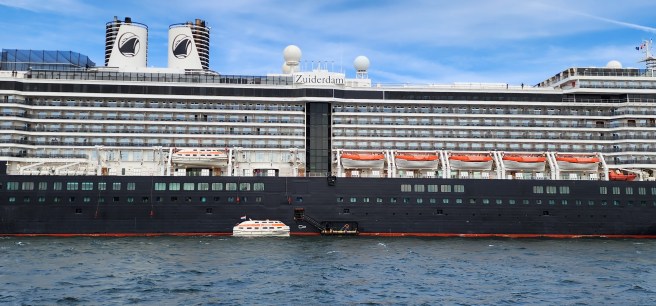
The Zuiderdam, seen here in Rockland Harbor last year, will be making two visits. You can see one of its tenders in the water, conveying passengers to the town and back.
Once the war was over and Eastport returned to the United States in 1818, the Shackford family thrived anew.
The heart of his activity seems to have been an old log store built at what would become Steamboat Wharf. Described as being at the foot of Shackford Street, it would more accurately be placed right below our house. When the store was constructed, the Customs Office was south of Shackford Cove, rather than to the north of the eventual downtown and its docks. That first store was standing as late as 1840 but being used as a stable.
Its replacement, the so-called Red Store, was removed from the waterfront around 1833 by John Shackford junior and still exists within the main part of the residence at the south-west corner of Third and Middle streets, an elaborate mansard house best known as master shipbuilder Caleb S. Huston’s residence.
Another portion of the old building went into a small, two-story frame house, “situated on the windmill lot” on Water Street, at the foot of Third Street — diagonally across the corner intersection from us. I’m told that the windmill foundation sits in the cellar of that house.
Windmill, you ask?

Captain John junior is also credited with building a windmill upon the bluff at the entrance of Shackford’s Cove, one that “proved faulty in construction and was of no practical value, but remained standing on the bluff for many years as a conspicuous landmark.”
The small Cape at the left in the painting would be our house.
In the Kilby history, Samuel Shackford recalled, “The windmill which stood upon the bluff at the entrance of Shackford’s Cove for a generation or more was built for him,” John Shackford junior, “but, on account of location or fault of construction, proved a failure. In a moderate breeze, like a balky horse, it would not go, and in a gale of wind nothing could stop it until the wind abated. The old mill, after it had become dilapidated by wind and weather, was a picturesque object in approaching the town from the sea. It was taken down by its owner about forty years ago, much to the regret of the public.”
That is, dismantled around 1848.
~*~
But that leaps ahead.
All of it, of course, has relevance on the house we bought.

It’s not quite like the Victorian mansion with the witch-hat tower that I envisioned in my novel What’s Left. This one sits along U.S. 1 in Milbridge, Maine, rather than near the university campus in the fictional town of Daffodil, Indiana.
Dig back in the archives on this blog and you’ll find dozens of other examples, usually in other colors, unlike Big Pink in the book.
I didn’t ask if a multigenerational Greek-American family lives here.

This happens when the air temperature approaches zero Fahrenheit, well below that of the Atlantic.
 Jnana's Red Barn