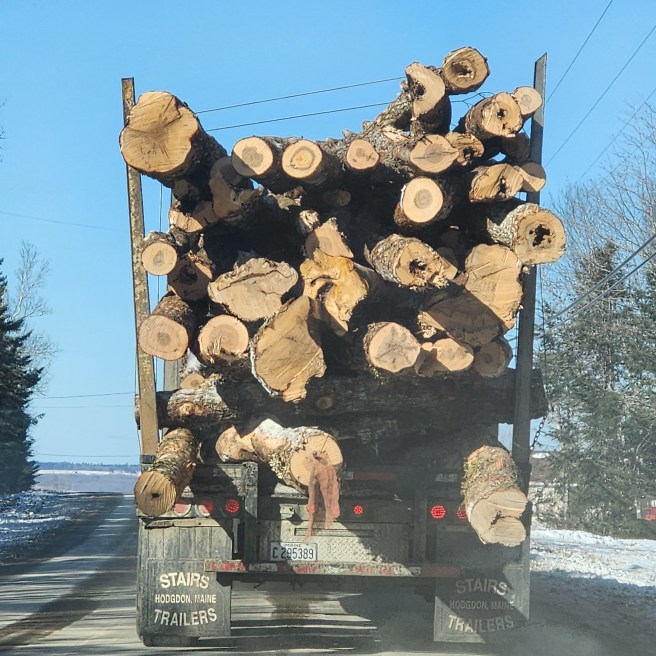
Winter is when lumber is cut in the forests. The ground is frozen solid and there are no bugs in the air. Load up the trucks, then, and head off to the nearest sawmill.
You never know what we'll churn up in cleaning a stall
Winter is when lumber is cut in the forests. The ground is frozen solid and there are no bugs in the air. Load up the trucks, then, and head off to the nearest sawmill.
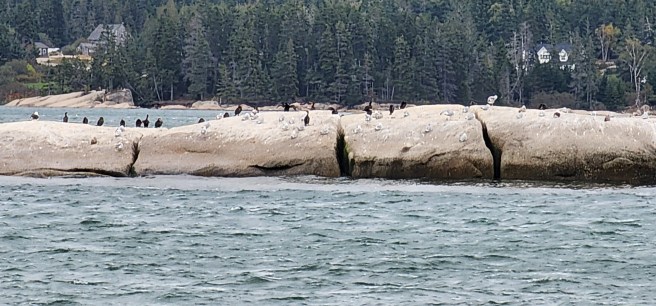
Unlike most other waterfowl, they need to dry their wings. This was near Stonington, Maine, as seen from a cruise aboard the historic schooner Louis R. French last summer.
Courthouse records go only so far in piecing together a story like this. But the names I had found did give me enough to start turning to online genealogies, Find-a-Grave posts, and related histories to augment the investigation, often including the exasperating process of eliminating possibilities before chancing upon nuggets.
A conventional telling I found repeated contained this: “Captain John Shackford died at his home in Eastport, Maine, on Christmas day, 1840, having attained the eighty-seventh year of his age, and his widow obtained a pension from the U.S. government by reason of his service in the American revolution.”
Christmas, by the way, was not observed in Massachusetts, and likely not Maine at the time, even now that it was an independent state. As many journals of the time noted, “It was an ordinary day.”
The quick mention of his widow slid by almost unnoticed. It seemed to be an error, no, considering that Esther had died a decade earlier?
My big “ah-hah!” moment came in coming across a free ebook copy of the 1888 Eastport and Passamaquoddy, a Compilation of Historical and Biographical Sketches compiled by William Henry Kilby. Of special interest was in the 506-page book was a chapter, “Captain John Shackford and His Family,” by his grandson Samuel Shackford, living in Chicago. I’ve already referred to it, but the most crucial part for me was this: “After his decease, his second wife, who was widow Elise Olmstead, obtained a pension from the United States government for his services in the Revolution.” The crucial points were that Captain John had married a second time, something not obvious elsewhere, and even better, I now had a name to focus on.
As I soon found, her name was Elsie, though it also appears as Elise, Elsa, and Eliza. She was the widow of Darius Olmstead.
~*~
The September 27, 1831, Eastport Sentinel reported the marriage of Elsie and John Shackford senior, with the Reverend Bonds officiating. In the Sentinel, her name was Mrs. Elsa, widow of the late Darius Olmstead.
Captain John would have been 77 or 78. Elsie, around 52.
She was born around 1779 in Chatham, England, to James Haddon and a presently unknown wife. He then then brought the family to Saint John, New Brunswick.
Elsie’s first husband, Darius Olmstead, was a merchant, “copartners in trade under the firm D&E Olmstead, with his brother Ethel. Between 1822 and 1825 they purchased sections of Central Wharf in Eastport from James Olmstead.
Darius died July 13, 1825, age 48.
He descended from a well-known and prolific colonial family in Connecticut., one that becomes difficult to follow in its many repetitions of Darius and Ethel across generations and geography.
In the instance at hand, Darius was born in 1776 to Aaron and Hannah Peat Olmstead.
His brother Ethel married Nancy Ann Haddon, presumably Elsie’s sister.
While Olmsteads appeared in historic roles during the American Revolution, Aaron was of the Loyalist faction and relocated to Saint John, New Brunswick, at the end of that war.
Partisan alliances aside, the border between the United States and Canada was loosely enforced. In 1798, Aaron drowned in the harbor at Eastport.
Among the children born to Darius and Elsie Haddon Olmstead was son Ethel (a name also spelled Ethal and Ethell in the records). He was born in 1814 in Eastport. Another son was named Darius.
In 1826, Eliza Olmstead, widow, and Ann Olmstead, wife of Ethel, sold a property on Key Street that Darius had purchased from John Shackford in 1810.
With the widow’s remarriage, her son Ethel, around age 16, would have become Captain John Shackford senior’s stepson.
I have nothing more on his brother.
All of it, of course, has relevance on the house we bought.
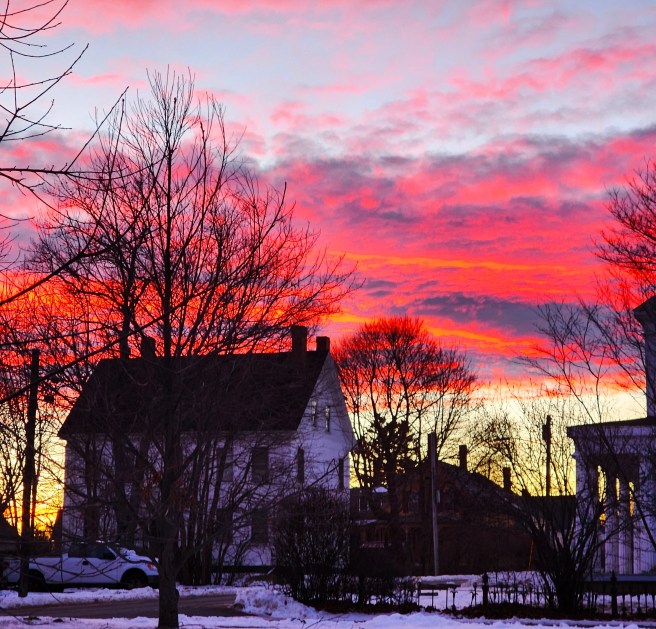
Our dawns aren’t the only big sky display that can be naturally dramatic around here. We do get what some folks call weather.
 One afternoon while anchored at Holbrook Island during a cruise aboard the historic schooner Louis R. French last summer.
Captain John and Esther’s adult children eventually built their own homes more or less within a half-moon crescent about a block away in each direction around our house.
John Shackford junior built on the southeast corner of what’s now Water and Middle streets. He married Elizabeth Batson (1790-1830), and probably remarried another Elizabeth afterward.
William built at the southwest corner of Shackford and Middle streets — just beyond the diagonal edge of our block. He married his sister-in-law, Sarah Ann Batson (1788-1837) in 1807, and then Mary Cutter Lincoln, who survived him. She was the daughter of Captain Jacob Lincoln, whose 1790 farm is now the Rossport by the Sea resort in Eastport’s Quoddy Village neighborhood.
Jacob Shackford, meanwhile, built at the southwest corner of Water and Key streets. He married Eliza D. Pearce/Pierce (1794-1869). She was the sister of Darius, husband of Jacob’s sister Hannah. Eliza was born in Rhode Island, like her brother, and died barely a month after her husband’s passing.
Samuel, probably the first male child born in Eastport, died in 1820 of yellow fever at Demerare, South America. He had married Elizabeth, daughter of Otis and Elizabeth Lincoln of Perry, before the Shackford siblings divided the holdings. His son Samuel received a half-share in Captain John’s will. More on him later. Elizabeth, meanwhile, is the Mrs. Eliza Shackford who married Captain Silvanus Appleby on October 16, 1825, officiated by Charles Morgridge.
The repeated surnames among the spouses continues over the next generation or two. Finding siblings in one family marrying another set of siblings is not uncommon in the period.
Darius Hannah and her husband, Captain Darius Pearce/Pierce, built at 9 Shackford Street, a block northeast of our house. Born in Rhode Island to a prominent family, he came to Eastport and, after marrying, was a surveyor by 1833, the customs inspector in Eastport by 1841, and a merchant.
Daughter Esther and her husband, Joshua Hinckley, lived on Key Street, just to the west of Jacob. She died, 1880, in Dennysville. Joshua’s father, Matthew, had died at sea in 1809 near Sulawesi Tengah, Indonesia; he was born in 1752 in Georgetown, Maine. (Also born in Georgetown and living in Eastport was John Hinkley (1764-after 1850), son of John Hinkley. Cousins?) The Hinkleys, we should note, were among the early returnees to Maine amid the devastating travails of the French and Indian wars. Joshua and his wife, Esther, were living in Portland in 1823 and relocated to Eastport shortly afterward.
Sarah M. “Sally” and her husband, Captain John Lincoln, remain largely nebulous. I had even wondered if they died at sea. Many captains’ wives accompanied their husbands on long voyages, typically serving as navigators as their children grew up aboard ships. What I did eventually find was a real estate transfer dated October 15, 1832, where “Sarah Lincoln, widow of John Lincoln, shipmaster” sold her one-sixth share in the 1826 land purchase to her brothers William and Jacob and brother-in-law Darius Pearce/Pierce for $150. She was born in 1795 and died in 1846.
The Lincolns, who originate in Hingham, Massachusetts, include a branch that came north after Benjamin Lincoln, a celebrated Revolutionary War General, and two others purchased 10,000 acres in to Washington County. His son Theodore arrived to oversee those holdings and, in establishing a related timber industry, was an original settler of Dennysville. Other portions of the tract extended into what would become the towns of Pembroke and Perry. His brother Jacob, came to Moose Island, as noted. And their cousin Otis was an early settler of Perry. They’re the source where the Shackford marriages fit in. Another branch led from Hingham to the 16th president of the United States, should you be asking.
Even before getting to John and Esther’s grandchildren and beyond, I had many loose ends of potential owners of our house who may have led to Lucy M. Hooper of Boston and Brooklyn, New York, and also Anne Dodge and Mary Roberts, both of Boston, the ones who sold the house in July 1875. Trying to run the deeds from them and down to the Shackfords had me stonewalled.
Who were they and how did they come into its ownership?
All of it, of course, has relevance on the house we bought.
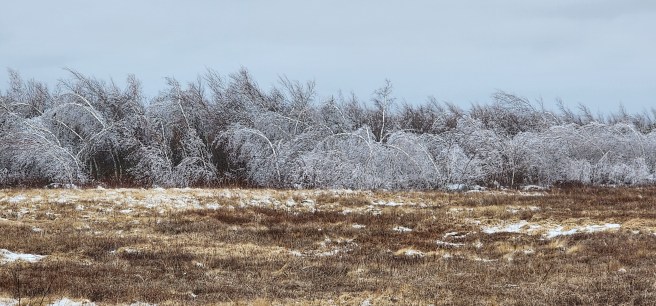
Along State Route 9 (the Air Line Highway) in Wesley, Maine.
The rugged, sparsely populated town does sustain some impressive weather, not always off the Atlantic.
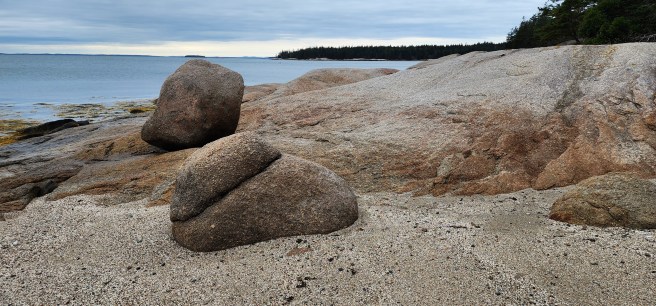 There are times when we could use a geologist on our explorations. At others, perhaps a Zen Buddhist master would be more appropriate.
This shot was taken during a shore visit from a cruise aboard the historic schooner Louis R. French last summer.
As the growing village took shape, John senior had his tract surveyed by Benjamin R. Jones, resulting in Shackford’s Plan of lots. A copy of that would help make sense of the wheeling and dealing that followed. Many of the purchasers were by John’s own children, individually or in combinations of partnership often formalizing land they had already “improved” and buildings they had constructed or sites where they would. Others went to Eastport’s new merchants and tradesmen. In all, I find 73 transactions, most of them as a grantor, or seller, recorded at the Washington County courthouse in Machias. I’ve probably missed a few, so take that as a rough figure.
It wasn’t just housing lots, either. Captain John’s waterfront properties were valuable sites for wharves, docks, and storehouses. He was even selling sites between the high and low tide lines. I’ll spare you the tensions between low tide mark claims today.
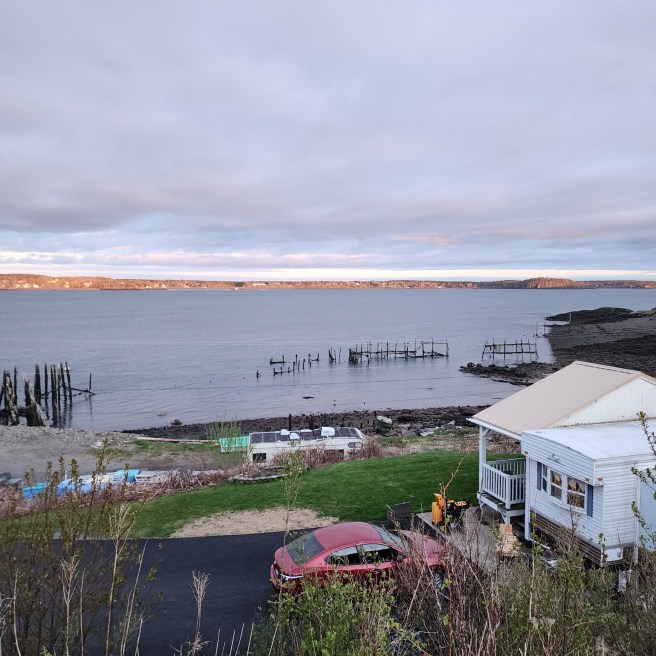
The one transaction I haven’t been able to track down is his title to Shackford Head. Was it simply overlooked by the indexers?
A significant deal took place on April 14, 1826, when his surviving offspring, all in adulthood, paid him $3,000 for the land between High (also known as Back) Street and County Road. And here I thought he had given it to them. Where did I get that idea? That was a huge figure for the time, by the way.
Was he a Scrooge with his offspring? Or merely cunning?
He still had plenty of lots left to sell.
Esther died on June 21, 1830, age 76.
All of it, of course, has relevance on the house we bought.
 This was an accidental shot in the Vietnamese restaurant in Bangor, Maine, and no, my feet were actually on the floor. But somehow this does look like a rice-paper wall in a classic Japanese home. I’d definitely enjoy dining there, too, maybe even with my feet up.
 Jnana's Red Barn