Dreaming of literary success versus the reality

Working in the thralls of daily newspaper journalism in the heartland was not my dream. Literary fame was. Of the critically acclaimed sort, as if bestseller status would follow.

Whoa, expressing that so boldly feels harsh, yet true. Even so, I did plod away on both fronts.

And now? I’m a survivor wondering what would have resulted if I had narrowed my focus.

I had no idea how crassly market-driven the shrinking book-publishing world was. So much for idealism.

~*~

Still, I pursued, working on my own into the wee hours.

These days, I have the luxury of revisiting my earlier work and wondering just who wrote it. The pages are so unlike what I’d venture today – wilder, for sure, and more profuse, often leading to an Oh-Wow! of admiration. The dross, fortunately, has been stripped away.

That’s been my reaction in presentations at our monthly open mic night here in town even when I’ve veered toward the edge of embarrassment yet still being warmly applauded.

Passages in both my prose and poetry make references I no longer understand but trust to leave untouched, perhaps for others to reconnect.

Writing? It’s like talking to yourself, ‘cept sometimes you have to get up to allow the rest of you to reply.

~*~

Another recent experience has come in assisting a friend to create a remarkable novel, one he finally presented to a literary agent whose thoughtful response seemed quaint, actually – the perspectives of three people in the agency, even though no. Somebody actually has time these days for such reflection?

It really did feel like an earlier era. I was rather envious.

~*~

I’m also recalling another experience after I had returned “back east” and was reading an essay about Snyder, Whalen, and Kerouac in the North Cascades, I felt sharp pain, knowing the lookout stations and High Cascades were so far behind me and the rest of my generation.

~*~

Add to that the fear of being discovered once your early book approaches publication. How strong are you in its potential storm?

Except, that you instead encounter indifference.

~*~

It can lead to bitterness, considering all the years and lost potential.

As for inscriptions at book signings?

Keep the faith!

Share your Light, too!

Like a boat, a book is launched

That image seems especially appropriate as we celebrate the appearance today of my newest collection of poems, Ocean Motion, now available in the ebook platform of your choice. Yes, let’s envision a book floating on the water like a boat.

For much of the first half of my life, the concept of an ocean was incomprehensible, even more so than mountains.

As I’ve noted earlier, I grew up far from the seashore or even craggy ranges like the Rockies or Alps. The Great Smokey and other Southern Appalachian glories were a bit closer. I didn’t encounter the ocean until I’d reached adolescence and we visited Florida on a camping trip with some of Dad’s old Army Air Force buddies. I next saw surf my senior year of college, with my then-girlfriend and her parents. From there, my encounters went to a few times on the Staten Island ferry or other points in New York City or Long Island, and then the ferry rides in Washington state, a few days camping along the Pacific (recorded in my American Olympus book), a jaunt along the Oregon coast, and then Maryland, New Jersey, and ultimately New England, plus a few returns to the Gulf Coast of Florida.

In all of those, I faced an enigma, a recognition that I didn’t quite grasp its appeal. Something was missing. It was like a gray Lake Erie looming with whitecaps I had seen around age seven, except that there was something else called tides. It was water with nothing else but sky on the horizon.

The pace of my encounters picked up, especially once I moved to New England, nearly half of my life ago now. Having a boss who owned a 32-foot sailboat fostered some of that, especially when we ventured forth once or twice each summer from Newburyport, Massachusetts, or once from Portsmouth, New Hampshire – both notoriously treacherous harbors.

As I describe in one poem, my first time of being in a sailboat was also my first time out on the Atlantic and my first time of seeing whales (including a minke that surfaced only feet away from me) and my first time of setting foot on an island, one that was now a Unitarian and Congregationalist churches summer retreat.

Those experiences all infuse these poems.

Moving to Dover, as I remarried, picked up the pace. The tides reached downtown, after all, and Great Bay along one side. Plus, with the kids, we got to visit Maine beaches and Cape Cod at their grandfather’s. And later, picking up one after her work at a coastal motel, I had repeated exposures to the ocean at midnight, another world altogether. I wouldn’t say it was romantic, even with a full moon.

The resulting poems eventually appeared in small-press literary venues around the globe as well as a series of PDF chapbooks at Thistle Finch editions.

As these poems demonstrate, the more I’ve gotten to know ocean as the North Atlantic along New England, the more in awe I am. Other writers can express the ocean from their own locale and nuances.

Still, I have come to love lighthouses and do treasure opportunities to climb up within them to savor the view from the top. But don’t get too romantic, it was a harsh, often dangerous, life for the keeper and his family. I hope these poems reflect that reality and more.

Do note that New England thrived on seafaring, designing and building distinguished vessels along its forested shores and sailing them around the globe to Asia and elsewhere and then back or out to hunt whales. The memories are imprinted in the muscle and soul of its people.

Remember, tides rise and fall dramatically in New England. You learn to be alert, even wary. And, do note, I’ve learned so much more since I first expressed that.

One of the ocean chapbooks included in the final collection was titled “Land Overlaps Sea,” an outlook that still impresses me, considering that it’s actually the other way around. The poems in the collection reflect places close to where I lived at the time and ways they interact with the Atlantic. It has been quite instructive over the years, even for an old landlubber like me.

Meanwhile, bits of sea shanties – the chanted or sung work ditties of sailors over the years – muffled and muted by the wind, flit through background, even if you don’t quite catch their words.

While the poems reflect a period of my life before moving to a remote fishing village at the far end of Maine, what I’ve encountered since confirms my impressions.

Maritime historian and sea chanter Stephen Sanfilippo and his wife, Susan, have definitely added much to my comprehension, as have my new friend, Captain Robert J. Peacock, and my times out on the waters, especially week-long cruises aboard the historic schooner Lewis R. French, as you’ve been seeing here.

~*~

So here we are, with my thought that each new volume is akin to the space within a vessel:

a book launch
rather than release

BOOK
BOAT

the connection floats for me
my experience on the water flows everywhere

For my poems of the sea, check out Ocean Motion at Smashwords.com. You can find also find it at the Apple Store, Barnes & Noble’s Nook, Scribd, Sony’s Kobo, and other fine ebook retailers. Or ask your public library to obtain it.

So why did I write poetry?

A poetry editor a decade or two ago asked why I write poems, and in response I came up with this:

I’ve been writing poetry and fiction for so long the questions of “how” and even “when” and “where” arise long before any consideration of “why.” That is, the practice quickly turns directly to “just sit down, start keyboarding, and see where it goes.” Even so, my “why” quickly turns to a succession of motivations within an evolving exploration that continued to present itself as poetry. So here are some of my primary Whys along the way:

  • Because it sustains expansive dimensions of language and thinking that have been precluded from my employment as a newspaper (and, briefly, social sciences) editor, where expression is intended to convey a single layer of factual presentation.
  • Because it allows me to pursue wordplay, surrealism, ambiguity, innuendo, absurdities, but especially my own emotions and experiences that are forbidden in objective third-person writing. (Intentionally or otherwise, my literary endeavors have worked as a reaction against and counterweight to the strictures of professional journalism, the way a pianist might balance classical and jazz or country-western performance.)
  • Because it has kept my skills as a headline writer sharp and pliant.
  • Because it collects and distills the seemingly random wanderings of my Aquarian mind and my often-obscured impressions and feelings.
  • Because it reflects the intuition and clarity that arise in my practice of meditation.
  • Because revision, a crucial element of writing poetry, pushes me beyond linear narrative to a more mysterious matrix as I looking between the cracks and broken syntax to admit other voices to appear.
  • Because it allows me mythologies for exploring and celebrating places I’ve lived and people I’ve known along the way. (If I’d taken more photos during all those years, would the drive have been lessened?)
  • Because it immerses me in a long stream of poets, troubadours, singers, storytellers, mystics, prophets, and shamans before me.
  • Because it’s a kind of prayer.
  • Because it keeps me looking at the world around me with an awareness of gratitude and wonder.

Well, that’s what I wrote at the time, and the editor fired back with a round of questions I didn’t have time to answer. Way back then. I have no idea how I would answer now. I do hope it would be less ethereal.

What is poetry, anyway?

After a couple dozen or so years that have been focused largely in the revision of fiction and then the roots of Dover Quaker Friends Meeting, itself a challenge to conventional New England history, I’ve found myself revisiting my trove of poetry.

It’s part of a big cleanup project that’s accompanying our downsizing move from New Hampshire to the far end of Maine, and I’m at a point of trying to discard everything I no longer need and put in order anything else I feel is of value.

As a result, several central full-length collections that had been presented piecemeal as chapbooks at my Thistle Finch editions blog are now released as ebooks at Smashwords.com and its affiliated digital bookstores. You’ll be hearing more about those as the year progresses.

In their place in the Thistle Finch lineup are new chapbooks of sets of my more recent poems, meaning ones from this century, though their origins go back further.

The task has come as a revelation, watching the evolution in my style and underlying voice. Each stage, reflecting geographical moves in my life and the upheavals of my closest relationships, edged me away from narrative-driven content to increasingly image and confetti centered clusters. Don’t ask me to explain them, they just are, whatever.

For me, poetry is a kind of mysticism – one foot in the inexplicable wondrous, the other in everyday life. Prose, of course, is more secular.

My newly released chapbook Aquarian Leap leads off the new run at Thistle Finch. Frankly, looking back over these, I’m not sure what to make of them other than the wild energy they inhabit. I certainly wouldn’t – or couldn’t – draft them today.

These poems, in some manner, still reflect the working of my multi-layered, mercurial thought process. (Never mind my heart, all the more elusive and often contradictory!) I love those lucid moments – sharp, brief – when everything, including thought and emotion, is centered, full, and stilled. Rarely, however, does my intellect flow in such a focused narrative. That requires more effort.

More typically, it flashes on something and then leaps to another, seemingly miles away. Some say this is characteristic of my natal sun sign. That is to say, the typical Aquarian will hear one subject and shuffle through fifty-two logical connections in a flash, and then blurt out something that will leave everyone else in the room wondering, “Just where did that come from?” (Except, perhaps, for another Aquarian, to whom it will seem perfectly logical.)

Often, my writing was constructed and amplified and then distilled from notes, many of them scratched out on a daily commute or on a hike in the woods, or sometimes even a twist while journaling. Curiously, when I assembled these into collage-poems, I was conscious of an underlying logic. That is, many snippets did not fit the emerging sense and must be laid aside. But a few others did, leading to what I hope is an internal thesis/antithesis/synthesis that’s ultimately beyond any surface or attempted cleverness. I prefer for my work to discover and uncover rather than invent.

The result in this set and a few ahead feels more like confetti. So there!

Something similar happens in disciplined meditation, such as traditional Quaker worship, where routine thoughts are patiently laid aside while one’s awareness clears and sinks to a more intuitive and integrated state. Perhaps some of that also infects these pieces.

I should confess to a few works by two poets, G.P. Scratz and Aram Saroyan, I’ve long admired, poems that defy explication or understanding yet spring from the intuitive burst that takes us beyond apparent meaning – and closer to a jewel-like condition.

Or even the freedom of dancing, which I find in a similar vein in the work of Philip Whalen, especially.

Consider the linguist’s Wolves and Consonants. (My reading of “Vowels” in a book title my elder daughter was reading.)

The growling of wolves adds a whole new way of following the Voice here.

As for any effort to define poetry itself? I guess I prefer the wilder side. Go figure.

You can find Aquarian Leap at Thistle Finch editions.

On to the Pacific Northwest via the prairie and Ozarks

My second brace of fiction, ultimately three books in all, addressed the dozen years in the aftermath of the hippie outbreak, though I’ve tried to fudge the era precisely. I do think much of it is continuing.

Naturally, for me, they were semi-autobiographical, even though the protagonist is now a woman named Jaya who winds up with a much younger lover who becomes her husband.

The pivotal piece is Yoga Bootcamp, with her now as a central character, along with the guru they sometimes called Elvis or Big Pumpkin. My residency in the ashram was a transformative period in my life, even in the face of details I’ve since learned. We were a rogue outfit in the period when yoga took root in America. This down-to-earth story will probably scandalize your local yoga studio instructor, but the experience did reshape many of our lives, hopefully for the better. I’ve certainly carried many of its lessons far through some other faith traditions.

The central piece is now compressed into Nearly Canaan, originally an ambitious triptych that comprised the hefty novels Promise, Peel: As in Apple, and With St. Helens in the Mix. At the outset, a sense of place was central as Jaya relocated from a small town on the prairie in the American Midwest to the hardscrabble Ozarks to the apple orchard country in the desert of the Pacific Northwest, but the central theme now condenses as the question of how much influence one person can extend over others, hopefully for the better. I can ask now whether it would have been more compelling if she’d been conniving and manipulative.

The third book, The Secret Side of Jaya, is a set of three novellas, each one set in the places she lived after leaving the ashram. Each one, quite different, is premised on hearing and seeing figures in a locale that others don’t. Maybe you encounter them, too, where you are.

You can find these books in the digital platform of your choice at Smashwords, the Apple Store, Barnes & Noble’s Nook, Scribd, Sony’s Kobo, and other fine ebook retailers. They’re also available in paper and Kindle at Amazon, or you can ask your local library to obtain them.
No, I’m not going swimming nude in a group at a summer lake any more

As I’ve previously mentioned, for much of my adult life, I’ve thought of myself as a retired hippie. Or I’ve simply been called one by others. One of millions and, unlike many, one who’s not embarrassed to admit it, that was a time to remember, no matter how short we’ve fallen from its promise and potential, even though I’m not so sure how much I’d want to go skinny-dipping with others these days or even sleep on the ground or a mattress on the floor.

That said, I’ll also admit that much of my first year after graduation from college in the height of the hippie movement was deep misery and loneliness punctuated by playful discoveries. The writing of Richard Brautigan definitely fits in here.

What’s often overlooked in the era is that the central element was the hippie chick. Plus, personally, I was without one, since mine had moved on and left me stranded. (Oh, misery, oh, woe, I am sounding pathetic, but let’s move ahead.) My novel, Hippie Farm, celebrated her in her many guises, even if you can’t even use the term “chick” anymore without being corrected. At the time, though, it was a badge of honor and invitation – one leading, in this case, to that rundown farmhouse in the mountains outside a college town I definitely restructured in terms of fiction.

A second novel, Hippie Love, retold the same plot line from a different perspective, one more of a what-if optimism. I would love to have heard that story retold from their impressions. Ouch? Were they as lost as I was? One I’ve been in contact with all these years has shared her insights, helpfully, and another, reconnecting much later, barely remembered who I was. And here I had thought she might be The One. Oh, my.

In the light of the publication of What’s Left, those two books were then greatly revised and newly released as a single volume, Pit-a-Pat High Jinks. Compressing the two was a major effort, but ultimately satisfying, at least for me. So much happened personally within that short span.

The inspirations cover quite a cross-section of people, with one becoming a United Way executive, another a U.S. Attorney, yet another one an OBGYN physician. Not that you would have guessed it at the time. As for most of the rest, I have no clue. Some were real losers, likely lost to drugs now. Others, tragically damaged. Being hippie wasn’t always a quest for enlightenment, justice, and equality. And when it was, it was countered by powerfully invested self-interests. Sometimes I’m surprised any of us survived, even before we look at the Vietnam veterans on the other side and their continuing traumas. Not all addicts, by the way, were hippies.

Flash ahead, then, and I don’t see youths today finding community anywhere, much less a shared cause. This is supposed to be an improvement?

Contrary to many people who lived through the era, I saw much that happened needs to be remembered and often cherished, even comically. It’s a place where people can begin rebuilding. I’m holding on, then, in my Quaker Meeting as one root to be grafted.

Look closely at the women, especially, and see how much of the legacy continues in spite of everything. (The kids today have it right, their perception of hippie as a girl thing.) Or, as they say. We’ve come a long way, Baby.

Yet that hippie label, I should add, has undergone its own transformation, rarely positive. Alas. Especially for us males.

Most of them, I hope, come across better in the book.

Still, it’s an account of history as we encountered it.

You can find Pit-a-Pat High Jinks in the digital platform of your choice at Smashwords, the Apple Store, Barnes & Noble’s Nook, Scribd, Sony’s Kobo, and other fine ebook retailers. It’s also available in paper and Kindle at Amazon, or you can ask your local library to obtain it.

For better or for verse, here are more lodes I’ve also mined  

By the standards of many, I’ve been a prolific poet, though if you consider that just one new poem a week would come to more than three thousand now.

Sounds about right, even with the arduous revisions they underwent, pressing the original inspiration into something quite different, always in an “experimental” rather than traditional vein. Add in all the hours of submitting the results to journals and small press openings, and all the rejection slips that followed, it was an obsessive amount of time – I had been warned that even “successful” poets averaged 20 rejections for every published poem. And beyond that, simply preparing a “clean” page for those submissions back in the days of typewriters pressed the limits of patience.

Still, poetry could be done in shorter spurts than fiction in my free days and nights while I was engaged working fulltime in a newsroom. As a minus, it did divert my attention from the local news scene and related gossip, but it did sharpen my editing and writing skills, both of which chafed at the limitations of newspaper style.

Many of my early poems sprang from my journals, something that changed over the years, especially as I got into Deep Image and related techniques. While more than a thousand of my poems were published in journals around the globe, book-length collections remained elusive. Now, however, some are available as ebooks, allowing you a chance to sample my evolution over six decades.

Here’s a lineup:

American Olympus: This longpoem is also a mythopoem set in a single week of camping on the Olympic Peninsula of Washington state. The book came close to being published by a prestigious letterpress imprint but fate intervened, sending me spiraling back eastward. Many other nature and landscape poems reflecting my experiences from one end of the continent to the other and back in my early adult years await full collection. Please stay tuned for future appearances of those works.

The volume has a new cover, one that’s a departure from my usual design style. I do find the leap rather exciting, and suitably unconventional.

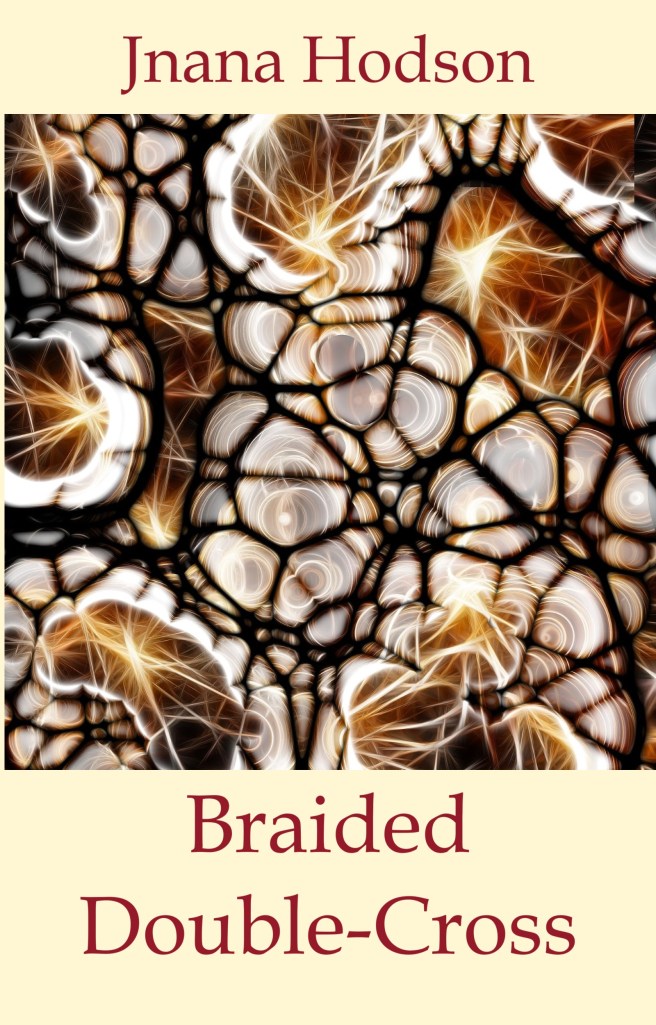
Braided Double-Cross: Intense attraction, sexual ecstasy, and long-term dreams ignite this set of contemporary American love sonnets that reflect the conflicting emotions and unspoken expectations that surface in the eruption of breakdown and breakup. The set, my first run of poems composed as a series, explores passions that sugarcoat realities and betrayals. Sometimes something so truly hot leaves a lover branded for life.

Blue Rock: Continuing in the conflicted passions line, these poems reflect attraction, romance, and the aftermath in today’s society. Just groove to their beat.

Trumpet of the Coming Storm: Admittedly polemic, these are brimming with buried anger erupting at last. Sometimes you just can’t ignore politics, even in a historical perspective.

Hamlet, a Village of Gargoyles: This playful investigation of human identities alternates between gossipy and confessional, set within the context of close community. The collection now hits me as somehow prescient, considering that I’m now living in a real village with characters I hadn’t considered. The tone is contemporary with nods to Shakespeare and Chaucer.

Ebook formatting does limit the visual array of what you would otherwise find on a defined page of paper, but it does make my daring work available inexpensively around the world. I can live with that and so can you, especially if you’re reading on a smart phone.

I promise, there will be more.

You can find these in the digital platform of your choice at Smashwords, the Apple Store, Barnes & Noble’s Nook, Scribd, Sony’s Kobo, and other fine ebook retailers. Or you can ask your local library to obtain them.

On my own, I was writing contemporary literature, except that it turned into underground history

When I was starting out in my career and sitting at the edge of the semi-circular copy desk, one broad story I kept seeing in the headlines didn’t reflect what I was finding in daily life. It was the hippie experience, told one the public side as drug busts, antiwar protests, and rock concerts, while the personal side I sensed something much broader and transformative, which was largely ignored.

Tom Wolfe, who had come to prominence as a newspaper columnist, was right in saying that the great hippie-era novel needed to be written, though he was wrong in thinking a single book could cover it.

From my perspective, a traditional facts-and-quotes approach couldn’t touch the emotional reality, pro or con. Interviewing celebrities posing as leaders wouldn’t work, either – they largely betrayed us, maybe like never-a-hippie Trump would do later. Hippie was a grassroots movement on many fronts, many of them outside of the big media headquarters in the biggest cities.

In previous Red Barn posts, I’ve touched on many of the hippie movement’s continuing influences, things our kids and grandkids take for granted, but so much – especially of the broadest nature – remains to be examined and presented. I’ll leave that to someone else who can give it full and fresh attention.

For my part, I leave four novels as foundations for others to build on.

I’ve looked hard for work by others but found little yet faithfully left reviews online where I’ve could. Those works are, alas, slowly vanishing. Yes, we are passing.

I am haunted by a definitely hippie copy editor from the year I interned as what we called the rim, but he was gone when I returned a year later, perhaps after pressing for union organization. A lot had changed in those nine months. I wish I knew more about him, other than the ticket for Woodstock that I couldn’t accept, considering the scheduling and my bicycle as my only transportation.

~*~

The core of my perceptions remains in four novels to my credit.

 Daffodil Uprising: I was on campus when the repressive constraints of institutional America blew apart in the late 1960s. Crucially, many of the radical currents emerging on both coasts began connecting in academic nerve centers in the Midwest – places like Daffodil, Indiana, where furious confrontations exposed positions that later generations now take for granted. My novel revisits the upheaval and challenge, both personal and public, triumphant and tragic. As I still humbly proclaim.

Pit-a-Pat High Jinks: The hippie movement that is usually thought of as the Sixties actually appeared most fully during the Nixon administration, 1969-74, and brought changes that younger generations now take for granted. Yes, the ‘70s. In my case, that was Upstate New York where I lived in bohemian circles near the downtown and then on a rundown farm out in the hills where a grubby assembly split the rent and a bit more. My, we were so green and so wild-eyed.

Subway Visions: There were good reasons so many of my freaky housemates and new friends came from the Big Apple. My jaunts to The City, as they called it, provided high-voltage flashes of inspiration that ranged from grubby to psychedelic. It was a whole new world to me, even as a frequent visitor.

What’s Left: So much remained unvoiced and unexamined in the aftermath. I drafted a series of essays that came together as a creative non-fiction volume, but that went nowhere. But then I had the flash to reshape it from the encounters of the hippie protagonist of the previous three books but explored by his curious and snarky daughter. My intention for a big book about the revolution of peace and love turned into one asking what is family, primarily. Hers was quite the colorful circus.

~*~

I still believe there’s much in these that’s “still news” despite the dated surfaces that usually pass for the era.

This year, though, I’m finally saying good-bye to maintaining an effort to engage in an awareness. It’s ultimately in others’ hands.

You can find my novels in the digital platform of your choice at Smashwords, the Apple Store, Barnes & Noble’s Nook, Scribd, Sony’s Kobo, and other fine ebook retailers. They’re also available in paper and Kindle at Amazon, or you can ask your local library to obtain them.

If only I could have come out as a bloody liberal

Or maybe that should be, “bloodied.” The experience has been bruising, even without physical violence.

For the record, half of the newspapers where I worked had Republican identities on the editorial page. Of the remainder, one was liberal, one was neutral, and two did not endorse political candidates, period. And in the ‘80s, when I was presenting editors with a range of political columnists, the only ones that sold were conservative.

Early on in my career, I learned that as a true journalist I had to put personal feelings aside and attempt to listen to both sides of an issue. Much later, in Quaker decision-making I saw how that could lead to a third, and much better, solution to a problem before us, not that the general public seems open to that these days.

As for critical neutrality, the critical lesson came the time I was an intern and wore a Nelson Rockefeller button sticker into the newsroom after our paper endorsed him for president. I was told to remove it, and I did. Remember, he was a Republican and this was a Republican newspaper in a town that still had two – the other one was pro-labor and Democratic and had the bigger circulation. And this was during the period presented in the TV series Mad Men. My daughters are still aghast and intrigued by the outrages and great fashion style of that period the series presented. They’re still appalled by the hippie influences that followed, the very ones I found liberating.

As a journalist, the point I learned was that to listen to people, I had to be neutral, all ears. Unlike Fox TV, still far off in the future. It’s still not news in any vein I respect. But I come from a camp that abhors sleeping with your sources, OK?

Apart from that, the reporters and editors I knew weren’t paid enough to identify with the rich? Our incomes were an embarrassment, even to the local Catholic priest the first time I married. As well as my-then wife’s uncle. If we identified with the poor at a gut level, we had good reason. And, across the nation, most of our newsrooms were non-union – trying to organize in the face of national conglomerates was suicidal, since they could outsource at a moment’s notice. Do note the party divide here.

For much of my career, newspapers were incredibly lucrative. Period. Not that pay levels reflected that. But then the business model, sustained by advertising far surpassing the newsstand or subscription price, came crashing down. Somebody has to pay the bills of covering a community. Walmart definitely wasn’t, nor were the other Big Box stores and their colorful inserts didn’t match the rates of those local ads abutting the news.

So, even apart from that, I’m not surprised American newspapers are in crisis. In my four decades as a professional journalist, I saw news coverage under attack – not just from the outside, but more crucially from owners who first bled billions from its renewed growth and vitality and then started giving the product away online without a viable business model in sight. My novel, Hometown News, paid homage to the battle and what could have been, along with journalists’ role in the survival of communities across the continent and democracy itself. In the book, it was like Richard Brautigan and Molly Ivins met Dilbert and Kafka in an industrial city vaguely in the Midwest, even when their names, sex, and races were changed.

My career as a journalist placed me in enough decaying Rust Belt industrial cities to shape one novel of high-level global investor intrigue, though it will likely remain in unpublished draft. It definitely rambles.

What is available for you to read begins as a factual distillation of some of the communities and newsrooms where I labored, but it soon turns surreal in the face of corporate management (make that mismanagement) and global conglomerates that step-by-step decimate the local economy and very existence.

While the initial draft of the book was completed in the mid-80s, revisions took time, and the work failed into fall into a marketable genre. Publishers saw it as too much of a risk and then, as newspapers lost their power and prestige on the public stage, reader interest in what really happens in newspapers dropped sharply. We are in trouble.

Let me emphasize, though, I never saw political arguments sway the development or placement of developing news stories. The decisions were made on other factors, like is it interesting? Does it have impact? Oh, really?

If we true journalists do have a bias, it’s for factual truth. We hate being lied to or being used as unwitting dupes. The consequences to that, unfortunately, have been diluted under the right-wing deluge.

For local perspective, let me recall a candidate for the board of education telling me point blank, for the record, that he wouldn’t be moving away after winning reelection and renewing the contract of a controversial school superintendent – and then he did precisely that, It still leaves a dirty taste in my mouth, may he rot in hell, no matter his professions. We ran his quote, that much was exactly what he said. But he lied, on behalf of a Republican majority on the board. Would that affect how I saw the rest of them? You betcha. And it wasn’t the first time, even back then.

But they would still get a fair hearing, even if I hadn’t moved on.

Something similar went on elsewhere with a maverick sheriff who got elected to Congress as a Democrat while being investigated for Mob connections and a host of corruption charges. Somehow I’m recalling that an undercover agent fell from above the ceiling and onto the restaurant booth table where our suspect was dining – or whatever. We pursued that story and more, not that it didn’t keep him from winning and being reelected. For details, look up Jim Traficant’s wild record.

For that matter, he could have been an inspiration for Trump.

~*~

Leap ahead to the current polarization in the political spectrum. My decision to subtitle the novel “Reports from Trump Country,” seems prescient, given the array of Blue states as metropolitan centers with a sense of vibrancy and a future – largely on the East and West coasts – while the Red states are more rural and stagnant in between.

The hometown in my novel wound up on the rocks and, from what I’ve seen since, that hasn’t changed.

What I am finding disturbing is the rampant spread of patently false stories. It appears that way too many people don’t want to face verifiable facts, like half-empty arenas. As journalists, we knew all too well that some seemingly great stories proved baseless once we made “one phone call to many.” Do note the unsupported delusions being repeated by people with very definite biases.

Maybe I’m shouting in vain to the wind, but I’ll leave that up to you to determine.

You can find Hometown News in the digital platform of your choice at Smashwords, the Apple Store, Barnes & Noble’s Nook, Scribd, Sony’s Kobo, and other fine ebook retailers. It’s also available in paper and Kindle at Amazon, or you can ask your local library to obtain it.

Is anyone reflecting you or those you know?

Look in the public media around you and tell me where you see your life presented. Is there anywhere in TV shows, movies, advertising, magazines, newspapers, or novels that reflects life as you know it? Beyond that, is there anywhere that voices your aspirations and values? You know, where you want to be?

Writing this is a painful admission, but true. Somehow, though, I don’t picture myself in a typical suburban strip mall, either, no matter how often I’ve wound up there or been stuck in associated traffic.

What I do see, though, points to the reality that so much of what’s being presented and ingested is an escape from the daily grind. I don’t intend this as a judgmental stand, though I would counter it with the spiritual approach of trying to live in harmony with life as we encounter it in a specific place. Still, what I’m seeing generally rings hollow.

I’d issue a call for revolt but doubt that anyone would follow. Oh, well.

My, I didn’t expect to be hitting at the psychological malaise in the national soul, definitely not this quickly, but here we are. Just don’t hand me a cape and expect me to save anyone. I’m just a lowly writer, remember? Well, you could hand me a very dry martini (gin with an olive), but that would be my own favorite escape.

Now, to return more or less to the topic.

During my stint as a field representative for a major media syndicate, I called on newspaper editors in communities across 14 states. What struck me was how little sense their papers gave me of a unique local identity. There was rarely a distinctive voice in the generic mix. Maybe I’ll wax on some outstanding exceptions as a future post. I did try, mind you, to accomplish some of that where I was as an editor.

~*~

When I entered the workaday world, it was in the height of the hippie explosion, as well as the Vietnam quagmire and the first moonwalk and civil rights and, well, you could say generally everything was in flux and has remained so.

The pace of daily journalism, however, left me feeling there was so much change in the works that we were overlooking, especially in any in-depth way. For me, my impressions became fodder for fiction, which would allow me some leeway and definitely free me from footnotes and fact-checkers, not that I’ve veered from relating what I witnessed or even imagined as truthfully as I could, even with a degree of inventiveness and aspiration.

In that journey I wound up living in places that were outside of the big media spotlight, and what I faced ultimately differed from what was coming out of New York, Washington, Los Angeles, Chicago, San Francisco, or similar backdrops. My record reflected, I hope, just everyday folks who had to muddle on, best we could, in irreplicable circumstances of human progress or tragedy.

Ultimately, I tried to distill what I experienced from these unique viewpoints into novels that originated as “contemporary fiction,” though I’ve come to see the paradox of the label. Even without the scheduling conflicts of working a “day job,” I was caught in a time-delay of drafting and revising, even before trying to find publication. At the least, that would be a two- or three-year gap before a piece became public. Tastes and trends drastically change in that span. And here I am, shrinking from the crap shoot of fashion.

Or, now we are, decades later, perhaps trying to make sense of it all.

Not that I was alone. Every book author was running behind the frontlines where even the boldest got shot down, should they make it that far.

The consequence, quite simply, is that too much has gone unexamined beneath the superficial rush of what we once Baby Boomers and now creaky seniors and perhaps great-grandparents lived through, individually and jointly, from Watergate to today. No wonder things are such a mess. Look, kiddos, it wasn’t all our fault. Do note, I’m among those who wants to lend you a hand.

Mea culpa, then, though I’ve left some evidence of sorts to build on. Please stay in touch. That matter of “Don’t trust anyone over 30” was a brilliant slogan but ultimately BS.

As I’ve noted, we definitely needed elders. And so do you, on the frontlines now.

You can find my ebooks in the digital platform of your choice at Smashwords, the Apple Store, Barnes & Noble’s Nook, Scribd, Sony’s Kobo, and other fine ebook retailers. They’re also available in paper and Kindle at Amazon, or you can ask your local library to obtain them.