Looking afresh at a personal foundation of reading

Living in the family I do, my TBR stack of books is well larded with Christmas and birthday presents – things others think I’ll like or should at least tackle, as well as volumes they’ve already enjoyed and wish to tempt me. I’m not complaining, mind you, though I can be perplexed by their choices, at least until I’m moved to open the cover and dig in.

Sometimes it takes me several years to get around to that, which was the case with The Fellowship: The Literary Lives of the Inklings, by Philip Zaleski and Carol Zaleski.

The tome surveys the Inklings, a literary circle established at Oxford University by the likes of J.R.R. Tolkien and C.S. Lewis, an affiliation that lasted their lifetimes and paralleled the more progressive Bloomsbury elite.

As I read of the budding authors’ early years and passions, my eyes were opened to how different their reading habits and expectations were from mine. They were steeped in a desire to recover a mythos of elves and other realms arising in ancient Britain but lost over time to the teachings from the Continent. There was also a fascination with invented alphabets and languages and secret communications. In contrast, apart from an early round of Tom Sawyer and English shipwrecks, my tastes ran to non-fiction – biographies, histories, and science, especially – and to visual arts and classical music. I still love to read maps, by the way. As for language, English still holds plenty of room for exploration, and Spanish and French are challenging enough.

Fiction returned to my lineup my senior year of high school via an essentially political route – Animal Farm, Brave New World, and 1984 on the leading edge. Besides, that was the time when I was finally getting serious about writing and editing, too.

In short, I read to learn things, and still do, for that matter. Rarely would I admit to reading for pleasure, as such.

But the first years after graduating brought a change, including The Lord of the Rings (which struck me as a rehashing of Wagner’s Ring Cycle material), Samuel Johnson, and Virginia Woolf before getting to Tom Wolfe, Vonnegut, and Kerouac and, after college, Brautigan.

My preference soon settled on contemporary and American, here and now, even if I have a fondness for baroque twists and long sentences.

I have to admit having little in common with the Inklings. Even our religious leanings veer in opposite directions – their thick Catholic and Anglican wrappings versus my Zen and Quaker ascetic.

~*~

At that point, while cleaning a very dusty bookshelf, I chanced upon Becky Gould Gibson’s Need-Fire, a poetry chapbook elaborating the life of Hild, a 7th century abbess who founded a monastery for men and women in Whitby, North Yorkshire but at the time Northumberland. It was a time when some women had more authority in the Catholic church than would be the case later. That, in turn, led me to learn more of the history of Britain in that period, including the reality that much of the land was openly pagan perhaps into the 9th century, much later than I’d assumed.

With another leap of thought, I realized that much of what I’ve found puzzling in the English folksongs, mummers’ plays, and the Abbots Bromley and Morris dances  I’ve encountered through Boston Revels is thinly veiled pagan tradition living on, part of the deeper culture of the land and its earlier peoples.

Well, as we say, the plot thickens.

My next question returns to these shores and an awareness of what this land means to its inhabitants. For me, that’s a blending of science, economics in the broadest sense, spiritual awareness, and the arts.

So how would you define the grounding of your own reading habits and interests? Has it changed over time?

You don’t have to take it as gospel

Despite of having read all of the Bible – and wrestled with many of its passages – I had never read it straight through until a few years ago. (Rather, it had been piecemeal. Seeing it in the larger structure presents some unique hurdles and troubling assumptions, as well as an evolving comprehension of the Holy One and faithfulness. )

Since the beginning of the year, I’ve been retracing that experience with a new post each week at my As Light Is Sown blog. My reflections, as you might expect, are quite unorthodox, and in the books of the Hebrew Bible (aka Old Testament), they’ve been augmented by heartfelt insights and confessions by some wonderful Jewish poets and novelists – not  the stuff commonly encountered in Christian circles. You don’t have to be a believer to be engage with these stories. Think of them like Shakespearean or Greek drama, if you will, filled with human drama.

It’s a much different approach than reading it as law, one filled with more punishments than rewards. No, this is essentially about life itself.

I’d love for you to join in the series – and look forward, especially, to your reactions and comments.

About that feminine point of view in my novels

Why a young female as my protagonist? Fair question. Since my novel What’s Left began as an attempt to answer a younger generation’s questions about the hippie movement, I felt a girl would be more receptive to its issues and sensations. Many girls have, after all, continued the identity, while it appears that boys have largely become more militant or even sullen.

As the novel developed, Cassia’s parents and their values retreated into the background. Far more compelling is Cassia’s own identity, development, and confrontations. Hope you agree.

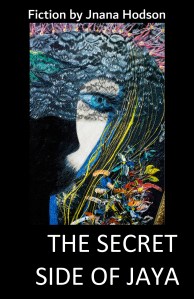
My new series focuses on Jaya and her evolving awareness. Yoga is part of it, along with career issues and close relationships. She has a richer encounter with the events, I’d say, than Joshua does – there are many points where he’s largely a reactive or passive presence. Ultimately, The Secret Side of Jaya has no parallel in his more limited vision or imagination.

I have to confess the story didn’t start out to be told from her side, but it does feel much more fitting this way.

But I am speaking as the author. Readers and critics are open to their own takes.

Care to weigh in?

The Secret Side of Jaya

I’m owning up to fantasy and the paranormal

Never thought I’d be writing a ghost story, but that’s what happened in a chapter toward the end of What’s Left. Actually, it kinda dictated itself.

In retrospect, it looks pretty natural, considering that Cassia’s trying to recover her deceased father. What happens along the way, though, is that she uncovers a lot about her other ancestors, too, and from there she begins realizing the crucial impact many people, past and present, have in shaping her future.

The ghost story wasn’t all my idea. I was inspired by one in the novel whose structure I was adapting. The two chapters, for what it’s worth, are quite different.

The poet Gary Snyder, quoting an ancient Chinese folk song, has noted that the traditional way of making an ax handle was to take another one and use it as the model in making a copy. Likewise, I wanted something other than the usual 20- to 24-chapter novel and, as it turned out, the structural model for the new story remained intact. It didn’t quite hold for Daffodil Uprising, but it was still useful. The model also had me looking at each chapter as a panel or tile that might be moved around independently, a concept that didn’t entirely remain in what emerged.

As for the ghost story?

Remember, I’m coming from a “just the facts, ma’am,” career in daily journalism. Verifiable facts. Cold, hard facts. As for emotions? In fiction, I might stretch that to reporting what individuals say they’re feeling, but beyond that? Well, as I’m learning, fiction allows me to record how something feels, rather than how it empirically is. A lot of that awareness, by the way, came about for me in my revisions with Cassia.

Still, when it comes to ghosts, remember – little of my writing is conventional. So my ghost story winds up being humorous, rather than scary. Got a problem with that?

I might add that living in New England, I’ve become aware of how many people admit having ghosts in their houses. Even highly educated, otherwise rational folks. As far as I know, mine’s an exception, unless the specters inhabit that room we still haven’t discovered after 19 years here – the one housing all of the things that have gone awol, one by one.

~*~

I’ve previously posted on my aversion to genre, and that includes fantasy, especially of a paranormal sort.

But Cassia had me reconsidering that. I mean, I loved the Hobbit epic back in college. And what do I make of my appreciation for mythology or even Wagner’s Ring Cycle? Where is the line drawn?

So as I ventured on to revise the novels dealing with Cassia’s father (remember, she was nowhere on the horizon of my radar at the time they were written and published), I felt a new liberty. Why not employ elements of fantasy and paranormal, especially, in addressing the ’60s? They really do seem to fit the story.

I’ve long had a fondness for surrealism, which was a central strand of my subway novel. But my new thinking about fantasy now infused the revisions there, too. The second half of Subway Visions is livelier that way. The book is no longer an image in search of a narrative.

My novella With a Passing Freight Train of 119 Cars and Twin Cabooses also was framed on a surrealistic leap. The characters, though drawn from different points in history, were never ghosts, but seeing them from a fantasy perspective certainly made the revision easier as I realized it could fit into the third book of Tender Connections, my series about Jaya.

A related novella, Kokopelli’s Hornpipe, likewise benefitted. Its basis was mythology. What, a flute-playing giant cricket couldn’t also be fantasy?

To pull the two novellas together as a single book, I really needed a third novella, and Miller at the Springs emerged to sit between them. It easily slipped over the limits of hard-and-fast for me and was a delight to write, even when I had no idea where it was headed.

The three now fit neatly, I think, into The Secret Side of Jaya. Let me know what you think.

Gee, I wonder if I’ll ever have a place to include dragons? Or …

~*~

Don’t forget: You better be good to toads!
Could genius hide out in an out-of-the-way crossroads?

When biblical translator and subversive revolutionary John Wycliffe (born 1384) meets up with the psychedelic painter Hieronymous Bosch ( born 1450) in a railroad-siding town on the Great Plains, who knows what will erupt. Especially when modern dance genius Isadora Duncan (born 1877) joins the action. Who says great genius doesn’t continue, even in the most out-of-the-way places?

That’s the premise of my novella, With a Passing Freight Train of 119 Cars and Twin Cabooses, which has become part of my new book, The Secret Side of Jaya, now that she’s entered the fray. Jaya has, after all, shown up in town as a do-gooder social activist. How else is she supposed to keep her sanity in relative isolation?

Well, there is the Laundromat plus a subversive operation from an old warehouse owned by Virgil and Homer, as in Latin and Greek classics, erupting in my wildest prose to date. The original work bitterly split one competition jury that awarded publication honors to another author. So be warned, you’ll either hate or love it.

But it’s only part of the resulting new collection.

Uncovering alternative takes on real history

Textbook versions of history gloss over a lot of details, especially when it comes to the lives of common people rather than the powerful and rich. The biographies of great figures add to that top-down perspective.

One of the things I love about genealogy, especially in nonconformist traditions or ethnic subcultures, is the way it opens alternative understandings of the hopes, dreams, and struggles of life outside of the spotlight.

I look for it in fiction, too, as well as poetry.

My own novel What’s Left springs from that kind of investigation from a Greek-American experience. My new The Secret Side of Jaya adds three other takes from the agricultural prairie, the Ozarks, and finally Native American strands.

Maybe histories aren’t always told by the victors. Not if you look closer or take a longer timespan.

Maybe this is backwards, but the cover can change the story

This self-publishing field means an author is typically deeply involved in all parts of the project rather than just the writing itself.

In my Smashwords releases, I initially hired a book designer to do the covers, but my current releases have all been created by me. (Someday, I really would like to have an artist design the front, but for now, I’m sticking to photos or existing stock artwork. We’re on a strict budget.)

Still, finding an appropriate image can be a challenge.

Has anyone else had this experience? You come across a picture that clicks and select it – and then you go back into your manuscript to make the visual fit better with the text?

For me, that happened with the portrait I settled on for Promise – the model gave me a clearer vision of my character Jaya. (That novel’s now part of Nearly Canaan.)

More recently, with Yoga Bootcamp, the handstand dog reminded me to keep the story lighthearted and humorous in my final revision. Did my decision to nickname the swami Big Pumpkin and Elvis come after the pooch was on board? I don’t recall now, but it certainly wouldn’t surprise me.

Do tell me about your favorite book cover. Does it influence how you see the story? If you’re a writer, has the art on your book led to revisions?

~*~

By the way, I do hate it when the character on the cover is shown, say, as a blonde but is described in the story as a brunette. That sort of thing.

And don’t forget: You better be good to toads!

Are you an ebook reader?

Now that I’ve been posting about some of the ebooks I’ve been reading, I’d like to hear about your experiences in digital browsing.

Are you among those who are books sold in digital formats, which now fill a fifth of the market?

What platform do you use? Kindle, I assume, is most likely, but there are more? What do you like or dislike about the various platforms?

What are your reasons for going digital?

I have to admit I still love paper and typography, but the economy and lack of clutter in ebooks have their appeal. So, yes, how about you?

I’m still fascinated by the potential of stories that come out of subways

Millions of people ride the subways each day, and many of them read English. In fact, you’ll see many of them are deep into books as they’re transported. Yet I’m surprised how little writing reflects this experience. Where else can you see so much humanity sitting right in front of you or dashing past?

Well, my Subway Visions tries to convey my experiences, real and imagined.

Two significant nonfiction books are Jennifer Toth’s 1993 The Mole People, based on her year of reporting on the plight of the homeless people who took to living in the tunnels under Manhattan in the Reagan years, and Jacqueline Cangro’s The Subway Chronicles, a collection of essays by the likes of Jonathan Lethem, Francine Prose, Calvin Trillin, and Lawrence Block. By the way, Block admits a fondness for including subway scenes in his prolific output of novels.

My survey of ebooks at Smashwords has added others to the list, not all of them in New York City. One tells of a year playing music in New York’s stations. Another of collecting umbrellas in Tokyo. There is a fondness for seeing the underground as the gates of hell, with one volume in particular standing out as a masterful fantasy that’s meticulously researched.

To see what I’ve found and my reactions, go to the reviews at my Jnana Hodson at Smashwords page.

Got any related transportation books to recommend? Trains, buses, airplanes? Other?