A multi-generational family tale like the one in my novel What’s Left can lead to a lot of characters, and keeping them all straight can be a problem.
My plot line takes a few twists that minimize their numbers, but when you get four generations over time, it’s bound to create a challenge, no matter how hard you try. Sometimes it helps to stick with somebody who knows everybody, when you’re circulating through the crowd.
When reading a big book, do you have tricks for keeping track of the individuals? Anything you’d like to share?
One test of a poem (for me, at least) is based on the qualities of good vocal ministry arising in the traditional quiet worship of Quakers: incantatory language and prophetic whirlwind. Unlike “slow prose” as a kind of sermon.
In vocal ministry, how often the message comes from within our current conflict or personal struggle!
Yes, we wrestle with God.
Poems and prayers you feel in your hands more than bounce around ‘tween your ears.
John Wycliffe, who introduced the Bible into English back in the 14th century, shows up as a major character in the opening novella in my book, The Secret Side of Jaya, only he’s taking refuge out on the American prairie.
And a century-and-a-half later, William Tyndale picked up the mission in England, though he didn’t move on to my fiction.
Could they be the most important translators in history? Apart, maybe, from Martin Luther, who could be the basis of his own Tendril, one with 95 points rather than ten, and his German rather than English?
Here, then, we go.
Wycliffe (1328-1384) was a dissident priest highly critical of the Papacy and much of Catholic teaching and practice. With his emphasis on scriptural authority, he is now seen as an important predecessor to Protestantism.
He translated at least all four gospels and perhaps the entire New Testament from the Latin Vulgate into Middle English, while associates translated the Old Testament into what became known as Wycliffe’s Bible.
His followers, known as Lollards, were a major underground radical movement leading up to the Protestant Reformation, despite being highly persecuted.
His writings in Latin highly influenced Czech reformer Jan Hus, whose execution in 1415 sparked the bloody Hussite Wars.
Wycliffe was declared a heretic and his books, burned. His corpse was later exhumed and burned, and the ashes, thrown in a river.
About 150 manuscript copies, in part or complete, survive.
William Tyndale (1494-1536) was a scholar influenced by Erasmus and Martin Luther.
In translating the Bible, he drew directly on Hebrew and Greek texts. He was the first to rely on them in translating to English, and his was the first English translation to make use of the printing press. He introduced the word Jehovah in English.
Many consider him the father of modern English, more than Shakespeare a generation later. His translations were widely plagiarized by others, including the committee of scholars who composed their authorized version for King James, where perhaps 83 percent of the New Testament and 76 percent of the Old Testament are lifted from Tyndale. The Bible was certainly much more widely heard and read throughout Britain than was the Bard.
He was convicted of heresy and burned at the stake in Belgium after his criticism of King Henry VIII in divorce matters only aggravated the situation.
~*~
There we go, politics AND religion. In this case, both of a radical nature.
In past years, we’ve had Chinese college students stay with us during their term breaks. They were in Dover and nearby communities to work volunteer internships, usually a month long, and the New Hampshire Children’s Museum was a popular choice.
They would often bring a gift, typically fine green tea, but this one initially perplexed me until it was pointed out that it’s a holding cup for things like pens and pencils and is inscribed with four popular poems.
Cynthia later transcribed them, with translations in English.
She had no idea I am a poet, or that her gift would be so appropriate.
With the Chinese New Year on Friday, we’ll be thinking of her and the others who have brightened our household.
Here’s what she wrote out:
Page OnePage TwoPage ThreePage FourAnd the cup itself, all forming a kind of scroll here.
Let me express my own everlasting gratitude for Glenn Thompson and his eye for talent, in my case after my letter to the editor and then his offer of an internship, later followed by a full summer. In a seemingly casual interview, he urged me to keep a personal journal, which I actually have. And then came the job offer. Without him (and so many others), my life would have taken a different direction. Gee, indirectly he even led to my first lover. (Look for Mitch in Daffodil Uprising, who’d been a copy boy I met thanks to Glenn’s support. Mitch was the catalyst to the crucial introduction. That dimension, in itself, could be a novel.)
Glenn was the editor-in-chief of the morning newspaper in Dayton, Ohio, and in his own way, a visionary. Behind the scenes, he even brought together the first university I attended, Wright State. And also, through him, I became a professional journalist, even while still in college. Another long story.
The paperback cover …
And he asked questions no one had prodded me with before. How would I change the world? What issues could I raise and address? At first, I was speechless. We were so green, and within a year, everything would look different. The biggest item on the agenda was the Establishment, not even its war in ‘Nam. Civil rights issues were a distant second.
The next summer I was a hundred miles up the road from Woodstock, working for a publisher who totally ignored me and editors who kept their heads down. But a new direction was taking shape for me.
Alas, as I’m also seeing, mine are steps youth today cannot follow. The pathways simply no longer exist, to the larger society’s impoverishment.
As I describe in my novel Hometown News, American journalism has long been based on a precarious business model. News itself is a byproduct of trying to attract customers for advertisers, and many publishers considered news gathering mostly as a costly nuisance. Successful newspapers were defined mostly by their obscene profits, and the pay levels for reporters and editors were often at the bottom of pay scales for professionals. As a priest reminded me before my first marriage, we might as well have been bound by vows of poverty. Oh, yes, and some of the highest quality papers – the kind I aspired to – were fighting for their very survival. We can now add to the toll of the role of the Internet.
So it’s all in flux now.
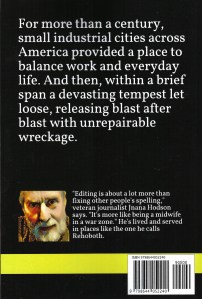
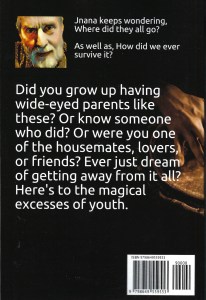
… and the back cover.
Still, newspapers show up in the majority of my novels, though in Nearly Canaan the field turned from journalism into non-profit organizations where the long, odd hours, public service, and stress nevertheless remained.
As I look back on my own years of being on the management track in a shrinking business, I see how I started out a hot-shot who thought the New York Herald Tribune in its last years was the best newspaper ever – led by an editor who later admitted in a letter to me he seemed to have become a specialist in trying to recover dying papers. Even then, I would have loved to have worked for him.
Despite my own honors, I had some crucial near misses. For one, I wound up in the final 24 for a dozen summer internships at the Washington Post but failed to make the final cut. The next summer, the Wall Street Journal was laying off staff rather than hiring, so their interest evaporated. Ten years later, something similar happened with timing for a high-level spot at the Detroit Free Press. And so my career veered away from the big cities where I had dreamed of living and from the big time, maybe for the best for me personally and ultimately professionally.
Somehow, this also has me thinking back to the lost hippie wannabes at the corner of Third and Main in Dayton during the summer of ’68. Theirs was a story I had hoped to write, but I couldn’t ask the right questions, I was too green myself. But, more honestly, maybe I just wasn’t cold-hearted enough to cut through to the real hurt and relate it without concern for the consequences.
While walking down the street after finishing a revision of my novel What’s Left, I noticed a vanity license plate with five letters, PAPOU. I smiled, recognizing the Greek for “grandpa.” The car was parked in front of the Orthodox church. Wonder if I know him.
Do you have a similar affectionate term for your grandparents?
While my novel What’s Left picks up a generation after the final events in my Subway Visions tale, I found myself needing a better understanding of the five siblings’ roots. That meant going back not just one generation but two in this case.
Have you ever done genealogy or looked into your family’s history? Are there stories you feel would make for good fiction? How about the characters, too?
~*~
Here’s how her ancestry might have looked back in the Old World.
I wish there were a better label than “hippie” to apply to the counterculture explosion that swept the world in the late ’60s and early ’70s. Contrary to popular assumptions, there was no standard-issue hippie, male or female. Not everyone did pot or ventured into acid and beyond, nor did everyone participate in a protest march or have long hair or have sex every night or at least on the weekend. We all came in various degrees of separation from general society yet, somehow, we also recognized a kinship with each other.
The paperback cover …
“Are you sure you were a hippie,” my wife sometimes asks. So what if I didn’t like rock? Many of my friends had been at Woodstock just down the highway from the milieu I describe in Pit-a-Pat High Jinks. No, we didn’t recite a credo, you dig what I mean?
The only other flash in history I can see similar to this was the mid-1600s in England, with its World Turned Upside Down before the restoration of the monarchy – stresses that would fester until the American Revolution a century later. What we shared was a vision of a more just, equal, and caring society. We didn’t have standard-issue, card-carrying members. Alas, we didn’t have elders or cohesive discipline, either. And the breakdown that followed can’t be blamed entirely on a youth movement crossing over into the dreaded age 30. (Oh, how I’d love to be back there, if only I wouldn’t have to figure out how to survive in the current economy.)
Tom Wolfe, author of “The Electric Kool-Aid Acid Test,” pointedly asked why there wasn’t the big hippie novel, overlooking a few notable entries like Gurney Norman’s “Divine Right’s Trip.” The problem, as I see it, is that the scope of the events was too big and too fuzzy to be encapsulated in a single volume. You had the activist side, from civil rights and draft resistance to pacifism, feminism, and the environment, for starters. Add to that sexual revolution. And then drug use, abuse, and visions, as well as new spiritual teachings and practices. All before we even get to the music and its scene. How could you possibly wrap all of that, plus more, into a single volume?
… and the back cover.
Believe me, I’ve tried with my own Daffodil Uprising and its companion “Pit-a-Pat High Jinks.” Hate to admit there’s so much more that could be added to the, uh, pot. Make that “pan.”
By the way, I think there are worthy nominations in each of the subcategories I’ve just mentioned. I’d love to hear more.
Frankly, I think we, as a nation, have been in a state of denial about the era, with its tension between the war in ‘Nam and the Establishment supporting it, on one side, and the opposition on multiple grounds, on the other. Those rifts in the soul of the nation have never been adequately examined and addressed from either side, much less healed. We could start with the MIA-POW myth, for one, or the ways we might have failed to answer our kids’ questions about pot use, for another. They are definitely exploding in our face now.
Meanwhile, Cassia, in What’s Left, has come along to try to make her own way out of the debris.
And so I humbly or brashly offer my own novels for discussion.




 Jnana's Red Barn