In my novel What’s Left, Cassia’s aunt Nita continues her ongoing role of knowing just about everyone and what they’re up too. It’s a vital social role that a few rare individuals seem naturally inclined to fill, as my novels Daffodil Uprising and Hometown News demonstrate.
Tell us about somebody you know who serves as the “switchboard operator” in your circles.
Lawrence Durrell’s “Justine.” Henry Miller’s “Nexus”; Gabriel Garcia Marquez’ “In Evil Hour”; Jack Kerouac’s “Desolation Angels”; Kurt Vonnegut’s “Deadeye Dick” and “Galapagos”; Richard Brautigan’s “So the Wind Won’t Blow It All Away”; Carol Rakoski’s “Ere-Voice”; Anne Tyler’s “Accidental Traveler” and “Earthly Possessions”; Hugh Nissenson’s “The Tree of Life” (interesting use of pioneer Ohio historical materials); Grace Paley’s “Later the Same Day” short stories; Italo Calvino’s “If on a Winter Night a Traveler” (this time, rather fascinating seems I’m finally able to read styles quite unlike my own part of that cleaning out I’m in); William Kennedy’s “Ironweed”; Laurence Sterne’s “Tristram Shandy”; Ray Bradbury’s “Dandelion Wine”; Hugh Prather’s “Notes to Myself” (late Sixties classic that seems so superficial these days); Marilyn French’s “The Women’s Room” (blames men for every problem, including mothers); Nena and George O’Neill’s “Open Marriage” (my wife had wanted me to be influenced by this what I see is that we HAD an open marriage, which is why it failed); Merle Shain’s “Some Men Are More Perfect Than Others” (more blame, this time from an upscale pre-Yuppie bubblehead); Paul Wellman’s “The Indian Wars of the West” (one of my ex’s left-behinds); “The Solution as Part of the Problem” (superficial Sixties Leftist education propaganda); Saul Alinsky’s “Rules for Radicals” what else?
In my novel, What’s Left, Cassia becomes a rising executive with half of the country as her territory. The experience of growing up in the family restaurant gives her a head start over her colleagues, but she’s also much more vulnerable in a highly competitive, often hostile, financial world, than she’d ever been back home.
What are the biggest threats in being a woman in management? How would you avoid them?
Cinema critic Roger Ebert was talking of the importance of the witness in every movie and pointing to the places where the character appeared in the film under discussion, mostly in a lower corner. The comment flashed me to the reality of how often the hardest thing to see is what should be the most obvious. It’s not just the elephant in the room, it’s things we take for granted.
One way or another, all fiction is built on the observer, who is also to some degree an outsider or misfit, too. (If there are any exceptions, I’d love to hear them.) Four of my novels, for instance, were intuitively built around a photographer, a profession that makes Cassia’s father a well-trained witness. In turn, as she investigates his archives, she, too, becomes a witness, even before she starts commenting on his earlier life.
Of course, as a reader, you also become a witness. Or even a voyeur, as Camille Paglia has contended. It’s almost like every page is a microscope slide to be interpreted.
Curiously, I now see this also at play in a long-term non-fiction project in my life. Forty 40 years ago, seemingly by accident, I became involved in trying to uncover my father’s ancestry. I thought we were simply homogenous Midwesterners who had always been in Ohio from its beginning. What I discovered, though, was that one branch was – but German-speaking and largely akin to Amish. My name-line, however, was Quaker by way of North Carolina and its slaveholding culture. Both strands were outsiders to the larger society and also pacifist. It opened my eyes to alternative histories and to a recognition that stories don’t always have to resolve nicely – three people may record their memories quite differently, and maybe all three are true, if not factually accurate.
Oh yes, the research was often collaborative, with correspondence going and coming from others working on parts of the puzzle. It wasn’t always quite as lonely as drafting fiction or poetry.
To my surprise, as my novel What’s Left was taking shape, Cassia started assembling bits about her Greek-American grandparents, who had died before her birth, and then beyond to her great-grandparents, who brought the family to the New World. Like me, she found valuable clues in the surviving snapshots and formal portraits regarding their personalities, as she also did in the letters and other documents.
None of my ancestors came by way of Ellis Island, and on Dad’s side, they were all in this country by the time of the Revolutionary War. I once pondered doing a series of novels on them, but I’m still intimidated by the technical challenges – a realistic language they can speak and we can understand being high among them.
Witness, I might add, has an extra dimension in Quaker thinking. It’s not just what one sees or hears but how one lives. The goal is integrity, as in wholeness or consistency. Is that what others see in us or our lives and work? Or even as our goal and ideal, even when we fall short reaching for it?
Sitting down to compose a novel requires some bravado, an assumption or presumption, even outright arrogance, that you have something important to say and an ability to do it in an interesting way.
You know, balls, swagger, mojo. Go to a writers’ group and just listen. But it’s not all sheer ego-driven. For many, at least, there’s an ongoing tension between believing in our own talents and shielding ourselves from the nagging self-doubts. Even Stephen King has them. Remember, the practice of the craft is a solitary act, not a team sport. It gets lonely, especially in the absence of feedback or fans in the stands, whether they’re cheering or jeering. Sometimes, to your surprise, harsh criticism is easier to handle than any praise.
Unless you’ve been there, you have no idea how precious a voiced reaction can be in nurturing you. Those brief reviews and star ratings are important, not just for guiding others to certain books but for guiding you as an author in your practice. An astute reader picks up important elements that have slipped right over their creator’s consciousness. Please, please, please take a few moments to weigh in when you finish a volume. We all need confirmation that we’re not wasting our time – or yours. Best of all is the epiphany when we’re left feeling that someone finally “gets it,” actually understands what we’re about. Don’t be shy.
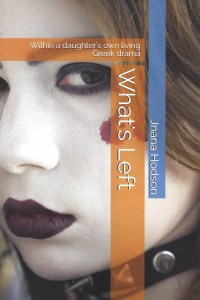
The paperback cover …
I recall giving a friend a booklet I’d written about the Quaker metaphor of Light. (By the way, in the first two centuries of the Society of Friends, the term was always Inward Light or some variant, never the Inner Light expressed today. It’s a crucial distinction.) When he finished, he thanked me, said the text had cleared up his understanding, and then added, “You write very well.”
Even after four decades in the words-on-paper business, I was taken aback, considering that he is, by any measure, an important American literary figure and a master of the language. It was like “welcome to the club,” the exclusive one with the dark paneling and Manhattan address. It was like a cup of fresh water in a desert. Within myself, I felt freed from the “hack writer” label so often applied to journalists from Dr. Samuel Johnson on.
Later, in an aside, he told me I was more of a poet than a novelist. Knowing his fondness for poetry, I took some comfort in the perspective, as well as some umbrage about the fiction part.
On reflection, I now have to agree on his assessment, at least as my novels stood then. He certainly helped my character Cassia press her case for the reworking of all my existing novels, as I did in the aftermath of What’s Left, where she’s the star.
There’s also that frightening moment in the gap between when a book’s been accepted for publication and when it actually comes out. We’re afraid someone’s going to somehow uncover our darkest secrets or that we’ll be shamed by some indiscretion or that we’re about to make an unforgivable transgression. Again, go to a writers’ group and listen … or even ask. If you’re an author, you think you’re somehow bonkers when you feel this, not knowing how much company you actually have.
… and the back cover.
I’m of the camp that hews to Bukowski’s regime of daily “butt time” at the keyboard, day in and day out, regardless of how inspired you might be feeling. Many days it’s a dry struggle, but on others something different and amazing blossoms. From my perspective, it’s when writing becomes a kind of prayer and you find yourself in a “zone” where things come together as if by magic and characters start dictating to you, if only your fingers can keep up with what your soul is hearing. It’s a dialogue with the Other, as in Muse, and you’re the mere scribe at her service.
It’s what happened when Cassia started dictating to me.
It’s not always at the keyboard, either. Sometimes it happens while you’re in the shower or on the throne next to it or swimming laps in the pool or commuting to work.
You can’t control this. Realistically, it happens when you’re not in control.
It happened to me at the finale of “Subway Hitchhikers,” which years later became the launch pad for “What’s Left,” where I had to make sense of what I’d been given, however intuitively.
Perhaps the best, well, I just had a phone call and lost the thread of thought. Maybe it wasn’t that important.
Like most of us, Cassia finds herself carrying a host of identities. She’s Greek-American, on one side, and Midwestern WASP, on the other. She’s been raised with both Tibetan Buddhist and Greek Orthodox religious influences. She’s a female, of course, and an entrepreneur. She’s part of a large extended family, a Hoosier, a bohemian, a college graduate, a devoted sister, a daughter. And that’s just for starters.
What are your most prominent identities? How do they shape your life?
These days some of my favorite daily encounters come at our city’s indoor pool, where I swim laps. In addition to the familiar faces of fellow swimmers, there are the interactions with the lifeguards, many of them still in high school. When they’re not actively watching us in the water, they have rounds manning the front desk, where they might also be doing their physics homework or working on a paper. In other words, they were the right age to help me with my novel What’s Left, not that I’m ever that direct. No, just a wild question or subtle ear’s enough to keep me grounded in their direction.
In revising a manuscript, I sometimes chance upon a “zipper” that seems to run along the entire piece and releases something trapped within it. Tugging along page after page is an amazing experience, when it happens, which is not nearly as often as I’d hope. Mercifully, that’s what’s happened in the ninth revision of What’s Left, my novel thanks to comments from some of the early readers. The key this round came in having her talking to her father throughout, at least in her head and often in the midst of other people, rather than simply about him. It gives the work a whole new dimension and makes the story far more intimate, especially when she makes irrational leaps that match her emotions.
This, in turn, allowed her to relate much of her investigation as it happened as a young teen, rather than looking back on it from her early twenties, and had her aunt Nita and her best friend, cousin Sandra, present as co-conspirators.
Note that none of these revisions changed the way I saw the novel as an author — I knew how it begins, develops, and ends — but they change it entirely for the reader.
Yes, the changes were extensive. When one of the lifeguards remarked, “What? You’re not done yet?” I came back the next week with two pages from the hardcopy I was working from — half of the sentences containing crossed-out words and phrases, several moved to new locations, and a taped-on flap of new notes to add in, all needing to be keyboarded. It’s typical professional work, as you’ll discover reading the Paris Review or any number of writer-oriented magazines.
Still, they were astonished. I doubt they’ll look at a 500-word assignment quite the same again.
The point is that all of these changes are for the reader. Curiously, the very shift of having Cassia speak directly to her father throughout soon has the reader stepping into his shoes, hearing through his ears in a new intimacy.
And now I trust the story’s ready for you, as its reader.
~*~
It’s not always simply a coincidence, is it?
Have you ever started out on your way to one place and wound up somewhere quite different? Somewhere that turned out to be right? Tell us about what happened.
~*~
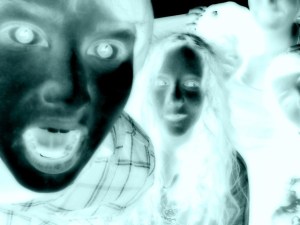
Working with photographic film, as Cassia learns to do with her father’s archives, means learning to “read” negatives like this one by Yuukikatrarra. She’s good.


 Jnana's Red Barn