Why is writing so slow?
You know, take so long to do, good or bad?
Reading, on the other hand, runs much faster than talk.
That’s why you don’t get much news in a newscast.
Just sayin’ …
You never know what we'll churn up in cleaning a stall
Why is writing so slow?
You know, take so long to do, good or bad?
Reading, on the other hand, runs much faster than talk.
That’s why you don’t get much news in a newscast.
Just sayin’ …
I don’t mean broadcasters or newspapers reissuing their material online, nor do I mean Facebook or Twitter snapshots and quips. Blogging, as you know, is more varied, personal, and I’d say engaged than that. It requires a special focus.
At the moment I’m finding it difficult to locate anyone else posting anywhere in the Pine Tree State, apart from gloating visitors and a few writers sharing a site based elsewhere.
It’s not that folks hereabouts are aloof, not by any means, as I’m discovering in my new locale. I’m fascinated by the stories they tell as well as the unique landscape we share, but I’m still new on the scene.

The literary great Samuel Johnson once quipped, “No man but a blockhead ever wrote except for money,” but he also ascribed to the pejorative term of “hack writer” for those who set down words as an income. It makes for an impossible bind. After all, he was a stickler for quality literature.
That perspective could generate guilt among some of us who did our best to defend the language in what Johnson would have considered grub work – in my case, daily journalism, with its effort at an anonymous style and universal voice. And yet, for me, at least, there remained an aspiration for something loftier, more lasting, more artistically and intellectually demanding but which, as I’ve found, had no monetary value.
Do I regret the effort? Not when I sit down and reread the published but largely neglected fiction and poetry. Pointedly, it has come at a heavy personal cost in time and foreclosed opportunities, no matter any satisfaction I feel.
CURIOUSLY, I DOUBT that anyone has felt the pain of this dichotomy more than novelist Stephen King, even though I’m certain he’s never heard of me. He has, though, articulated the gap between the writing for wide readership and for critical acclaim better than anyone else. Writing under pseudonyms, he has demonstrated a mastery of the craft, and under his own name, some deep insights into the art of crafting a novel. He deserves great credit for getting a public reading books, against all odds.
MY CURRENT QUANDARY comes in trying to decide which course to take regarding my latest – and likely last – manuscript. I’ve found researching it to be exciting; my findings, provocative and original; and the current voice that’s resulted, lively and entertaining. I get animated just talking about its content, and the listeners catch on. The problem is that it’s still a niche product, as far as marketing goes.
I mean, a history of the Quaker Meeting in Dover, New Hampshire?
Yes, it has the freaky potential to break out, but that’s a gamble.
The book moves novelistically. There are some big villains, a contrarian take on New England itself, a long period of frontier violence, historical surprises, a look at a subculture something like today’s Amish, and political dissent. What a volatile mix!
I’ve approached a couple of regional publishers but heard nothing from one. Not that I’m surprised. They survive by being conservative and cautious. Still, it would relieve me of a lot of effort in production and distribution that I just don’t feel up for. I’m more optimistic, cautiously, about the other. As I posted earlier, I’m ready for a break. Let them keep some of the change.
Plan two would be to issue it as an ebook, like my novels, and via Amazon’s KDP, where it would also be available as a print-on-demand paperback. I’m not sure how to include the maps in those formats, though, and the work wouldn’t be available in bookstores. Much of the sales of the paper edition would be, as they say, from the trunk of my car – after readings and talks, essentially. As for libraries? Marketing of an ebook remains, from my experience, very difficult. People want something physical to examine, even if they buy otherwise.
The third option is through one of several self-publishing programs that distribute to bookstores. (The stores won’t touch the Amazon editions, since they would have to sell at a higher price to cover their added costs.) For reviewers, it’s more respectable than Amazon. You might even pick up some book clubs. The bigger problem is that this route would require me to invest some big bucks. At this time, I have no way of knowing whether the investment would be offset by sales in bookstores, mostly in New England. Or, put another way, I’m feeling way out of my league or field of expertise. Yes, I would have a product I could feel proud of. But could I make the numbers add up? My wife advises me to consider it like joining a country club. Hmm. One involves dropping balls into holes.
A fourth alternative is to shelve it altogether, maybe even taking the money I would have spent and finally traveling off to Europe. Let myself be content with the overview I’m presenting in weekly installments here at the Barn.
One thing I’m not doing here, contrary to Johnson, is being mercenary.
What course would you suggest pursuing?
It used to be said that every newspaperman had a novel inside him, waiting for release. (Yes, male. Women reporters and editors were a definite minority. My, how times have changed!)
Frankly, I rarely saw any literary ambition around me. Few in the business read fiction of a serious sort, much less poetry. There were, though, a couple of playwrights. More recently, however, I know of two colleagues who have self-published – one a mystery, the other a political intrigue.
Yes, we’ve had notable exceptions, with Edna Buchanan, Ernest Hebert, Carl Hiassen, and Tony Hillerman topping my list. (Hemingway wasn’t considered much of a reporter in his six-month stint in Kansas City, and earlier giants often cited reflect a much different kind of journalism than what’s been practiced from the rise of the last century.) The crush of daily deadlines is exhausting, and fiction requires an entirely different approach and sensibility to the telling of a story. Journalists are conditioned to put facts first, usually without any concern for feeling, and to be professionally neutral, reflecting the quest of objectivity. These stances place the reporter at a distance from the subject, no matter how fascinating. Journalists also tend to put action ahead of the actors. Most of the resulting novels leaned toward the crusading reformer slant of the Front Page tradition – Down with corruption! – or maybe sports, either way, with the emphasis on the game more than the inner mindset of the players.
Well, there was also one editor-in-chief who took a popular genre novel and did a paint-by-numbers kind of rewrite over it. I think it was a Western, but I’m no longer sure. His connections got it published, and his success led to a half-dozen more. He was sheepish about the whole thing, though. It was more like a game, I suppose.
I wasn’t typical. My first love was the fine arts beat, for one thing. Since jobs there were scarce, I wound up on the copy desk. No matter how much I love politics, I find meetings boring. Press conferences, even more so. My most satisfying post was heading up lifestyles sections. Long story, as you’ll see in Hometown News. Maybe I was mostly a misfit who happened to do some things extremely well.
News writing, for the most part, is supposed to sound anonymous. Short sentences, limited vocabulary, a structure with the most important details at the top and the rest in descending order. As a writer or editor, your craft can soon become dulled. As an editor, one of my skills went to headlines, trying to relate a story in as few as four or five words. I’ve written hundreds of thousands of them, and I can see the distillation as an element of poetry. In my personal writing, I often reacted against the broader restrictions – I wanted a richer range of diction, more accurate language, more varied sentence structure (yes, I love long threads that work), and often more background on the story itself.
Turning to fiction, I’ve learned the importance of withholding details until later in the tale, things like not including first name, middle initial, and last name when introducing a character, much less his or her age and address. As for my poetry, I’ve preferred experimental and edgy, where the image or fractured expression might open into its own ambiguity and potential.
I do remember the first time a poetry publisher reacted to my submission by saying how delighted he was that my work wasn’t what he expected from a journalist. He had received enough to develop a negative opinion, one I fortunately didn’t fit.
My novel “Hometown News” was drafted during my third break from the news biz, when I was approaching 40 and gave myself a sabbatical after two years calling on editors in 14 Northeastern states as field salesman for a major newspaper syndicate. Driving between my calls on the local papers and seeing their newsrooms from the other side of the desk, so to speak, gave me plenty of time to reflect on the industry and then augment what I had collected in my own career. At many papers, as I saw, the managing editor or his equivalent was gone in a year, and with each one, I’d have to start grooming a new connection all over again. Many of them had telling histories of their own. Many of their towns looked like bombed out shells after World War II, their industrial might boarded up or rusting. I kept notes. Many of their skirmishes reflected my own.
Later, developing my novel in a series of routine days set months apart, “Hometown News” gave me an opportunity to see what I could do with creating a computer-generated novel. I set a framework for the day and randomly inserted 80 to 120 markers I could hit with search-and-replace items for each round. There were many other places that had to be manipulated manually, but it the attempt was fascinating, the way working a thousand-piece jigsaw puzzle is.
The result was something like a Jackson Pollock painting, a theme-and-variations curiosity but not compelling reading. Through a series of revisions, I kept the bones but layer by layer added flesh and muscle to bring certain characters to the fore while the dystopian theme deepened.
Thirty-four years after starting out on the work, and seven years after its publication, I am struck by the story’s prescient warning of the collapse of a once very profitable business for the dominant voices, not that our salaries reflected that. What I saw was entire communities under attack, and they still are – not just their daily mirror.
The newsroom I present is a blend of five I’ve worked in over the years – another one was much smaller, and the remaining one was simply different. When you get a group of news folk together and we start talking what one spouse called Bodoni-Bodoni, after the typeface used for many headlines, we all have insider war stories. I hope “Hometown News” gives you an idea how ours translate.
I stepped out of my journalism career three times in my life before retiring for good. The first was when I decided to move to the ashram where I could immerse myself in yoga philosophy and practice. Responding to Swami’s invitation to settle into her rural setup was something I did slowly and deliberately, with a large degree of trepidation. As I relate in my Yoga Bootcamp novel, the daily life was intense and evolving. Leaving the ashram was a different matter, with others largely resolving the outcome – out you go. For weeks afterward, I felt myself falling helplessly through space. Eventually, I reestablished my feet on the ground and then headed off for a new life in a town I call Prairie Depot.
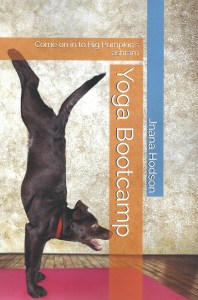
What happened for me during my residency was life-changing. I regard it as my master’s degree and my introduction to psychotherapy of an amateur sort. Among other things, it led me to the Society of Friends, or Quakers, which turned out to be the faith of my Hodgson ancestors from the 1660s down through my great-grandfather.
In the novel, I chose to confine the structure to a single day, in part because I had so many lingering questions I could not answer. Yes, within that day individuals could look back on their previous history, but the focus was on the NOW. And a lot could happen there in a 24-hour span. Besides, as I later learned through some candid discussions with a former Episcopal nun, monastic life has some commonalities of its own. As she said, some of the most intense interactions came in trying to choose the flavor of ice cream when the rare opportunity arose. I’ll argue you’re the most human under such rarified circumstances.
On top of everything, when I was drafting the book, I was out of contact with the place and its people. Critically, I had refused an order to return to the ashram after I’d married and moved to Washington state and a follow-up stipulation of heavy financial support was out of the question. A half-dozen years later, back on the East Coast, I had an opportunity to stop by but was not admitted into the house. I did learn that Swami had died and I sat by her grave. So much for making amends.

Since then, I’ve reconnected through social media with some of the key players and had a few assumptions, not in the story, deflated. In addition, Devan Malore’s “The Churning” reflects life there a few years after I’d moved on.
The story itself could have gone another way, if I hadn’t wanted to present the ideals that drew us together and kept us going. Especially the humor and playfulness.
More compelling for many readers would have been a more sordid tale of just one more “new religion” outfit run into scandal of a sexual or financial sort, preferably both. There were enough elements for that, as I’ve since learned.
The story first came out as a pioneering ebook in PDF format only and was later updated to Smashwords and its affiliated partners. A more recent, quite thorough recasting (again, blame the influence of Cassia in “What’s Left”) changed Swami from female to male and introduced Jaya as one of the eight resident yogis, thus linking her to the heftier Nearly Canaan novel. Besides, the transformation made Swami more acceptable to the expectations of many readers and allowed the Big Pumpkin and Elvis dimensions. The role was already unconventional enough, and this was more fun.
Am I still doing yoga? If you mean hatha, the physical exercises, let me say rarely and embarrassingly, at that. As exercise, I’ll substitute my daily laps in the swimming pool, and as meditation, my weekly Quaker meeting for worship. And no, I’m no longer vegetarian, other than when I voluntarily follow the Greek Orthodox “fasting” of Advent and Great Lent (again, blame Cassia), though I also eat much less flesh than most Americans. Actually, in these seasons, the Eastern Orthodox Christians are stricter than we yogis were.
I do wish there were a similar haven for youth today, one freed from the burden of student college debt. I’ll let “Yoga Bootcamp” stand where it does.
What is life without memories?
The most tragic part of Alzheimer’s is what happens when one crosses that threshold and leaves the connecting memories behind.
Quite simply, stories – and storytelling, one way or another – are essential. Stories are, after all, ultimately memories within human existence, no matter how fanciful or mythical.
How else do we remember where we are in the universe? Or even why?
There are good reasons we swap stories, from pillow talk on.
Throughout my novel What’s Left, Cassia seeks to learn more about her father’s pilgrimage to the Himalayas.
If you could ask someone in your ancestry to answer a particular mystery about their life, who would it be – and what would you ask?
In my novel What’s Left, Cassia’s great-grandfather and his brother marry two sisters. One is named Diana. As is her granddaughter, Cassia’s mother.
How did your grandparents meet? Were they childhood neighbors?
Fellow workers in the field know the practice is not easy. They notice movements and deft accomplishments as well as slips and defects the wider public doesn’t. They’re also rarely moved by easy though flashy flourishes and scorn the con-artist and cheat.
I’m not referring solely to other writers or artists, either. Watch a gymnast evaluate a meet or a figure-skater a competition. Even a software writer or electrician. Or a surgical nurse.
That said, when I’m drafting and revising intensely, I’m also more appreciative of qualities in the writing of others. At the best is an admiration of something I lack, a time for humility and gratitude rather than jealousy or envy.
It’s work, after all. Which is why published pages are called “works.”
Given a choice, the rational decision would be to browse through great pages already given to us by others. Browse, as sheep or cattle – OK, I joke, but the fact is I seldom find what most calls me.
Writing is work, especially when you’re already working a regular full-time job somewhere else. Why else where there those periods in my life where I rose at four a.m. to write and revise before going in to the office? How many others do likewise? At what personal cost to their lives and growth?
Real work, I’ll contend, is the practice of being fully alive. Aware. Totally there, at times.
Some people charge up and then release it in an extended explosion, as Kerouac did in his fiction.
I, in contrast, see it as a balance, between inspiration – breath within – and exhalation – the atmosphere without.
Creativity? No, God creates.
Man discovers, cultivates, nurtures, at best.
Practicing an art (and likely much more) means wrestling with power – including, in the Apostle Paul’s phrase, the “powers and principalities.” Powers of destruction, on one hand, and sustenance, on the other. Destruction that can, as seen too many times, include the artist. Hence, the fascination with Faust. With madness. Alcoholism. And on.
Self-absorption and inflated self-importance. We hazard much, often without the slightest awareness of the risks afoot. In Satan’s dominion over “the world,” which is the realm of the arts, or in Eastern thought, the traps of Maya, that spider web of worldly attraction and deadly illusion. Either way, cause to be wary.
~*~
Self-discipline, route to true freedom, strips away false attachments, barriers, chaff.
Writing involves observing my own shifting mind while opening to manifold living energies around me. It means simplifying, following unexpected leadings and openings, sometimes to dead ends, other times to unanticipated ranges.
~*~
Some of my fellowship at the time would have argued that’s not where I should be. Some were praying for me through this period. The kind of work that once would have had me read out of Meeting. Is this acceptable activity for a free Gospel minister? All I can do is explore the Truth given to me.
“We Quakers read only true things.” Distractions from worship? Traps of the flesh? So where does fiction fall?
The piece goes its own way: a living organism: readers, editors see it differently from you. What you would cut they love. What you love they see as sore thumb.
Versus becoming so rarified we lose all sense of joy and delight. The danger of Plainness or strictness, that it suffocates personality, makes us so humiliated we cannot move forward in the Holy Spirit to perform bold action.
~*~
My poetry has been influenced by the craft of headline writing and news reporting more than I care to admit. The trade paid the rent, provided a point of resistance in my personal endeavors. The Political Science Fiction I once envisioned has since come together in real history as a horrid reality.
Not that we’re anywhere near done yet.
My first published novel ends as the protagonist joins with five hippie siblings who run a restaurant they’ve just inherited.
My novel What’s Left returns to the scene, to find the family’s prospered under the alternative approach.
Do you know any “retired hippies” who did quite well professionally? Tell us about one.
~*~

 Jnana's Red Barn