What do you mean, how do I write?

Isn’t it obvious, one word at a time? Except it’s more complicated than that, and every writer approaches the deed differently.

I would like to approach a writing project the way Neal Welliver did his large-scale paintings, starting in the upper left-hand corner and finishing in the lower right. He worked with a tightly defined palate, too. Instead, I wind up more like Mark Rothko, painting over earlier parts, adding or scraping off layers – what’s known as “painterly.”

For novelists, the difference is posed as “outliner,” meaning someone who starts out with an outline and pretty much sticks with it, versus a “pantser,” going by the seat-of-the-pants with perhaps a vague sense of a destination, which may very well change en route.

You can guess which camp I’m in. As another artist put it, what’s the point of putting all that work in if you already know the ending?

For the record, I hated outlining when it was assigned as school homework. It seemed redundant.

~*~

I don’t like formal prompts, by the way. Instead, I often start with something that keeps nagging at me, the way the flash of a trackside worker in Brooklyn – a gandy dancer – turned into a subway line hitchhiker. (Maybe that third element, the unique word, turned the trick.)

As a project percolates, so do related ideas during the rest of my day, leading to piles of scribbled notes to weave in. When I lived in New Hampshire’s seacoast region and worked in Manchester, I had an hour commute in each direction, largely through rural country. I kept a notebook and pen at hand as I drove. Likewise, some of my favorite lines in What’s Left came to mind while swimming laps in the city’s indoor pool. As soon as I was back in the locker room, I was scribbling. Getting up from the keyboard every hour or so, sometimes adding a short walk, also works wonders. As a journalist, some of my best headlines came on my way to the men’s room or back.

Much of my writing then becomes the way of connecting two thoughts or flashes.

Outtakes from other projects also get recycled, though they rarely wind up quite how they began. I’ve drawn heavily from correspondence, maps, and photos as well, as well as silent meditation. As has been said, some of the best barns in New England were designed in Quaker Meeting, and it is amazing how many problems get worked out by stepping away from them.

~*~

As much as I’ve longed for an editor or a partner truly in sync with what I’m about, that hasn’t been the case, not since my first lover, back in college. Instead, I’ve been a lone ranger. It’s meant putting big projects aside for several months or even years before coming back to them afresh.

~*~

There are also the epiphanies when a character starts dictating the story, as well as the times of slogging through mud.

I should also mention learning from other writers, especially by example.

~*~

Determining when a work is finished is usually a mystery. My high school art teacher used to say I either stopped too so or else overworked a piece. I’d prefer too soon, since my usual taste leans toward austere. Think Quaker, Shaker, or Zen.

Another answer would be that I stop when I have nothing more to say on the project, for now. Or, as I’ve heard elsewhere, when the writer just gets tired of it.

As a newsman, a more common answer was the arrival of a deadline.

In making public presentations about my book

I came to love the question-and-answer period, but there would typically be one that threw me for a loop. Yes, the ones I wish I had answered better.

For example:

How could you sleep after writing some of the sections?

I did quip that a martini before bedtime helped. I could have mentioned the realities of working as a newspaper editor and having to face daily atrocities abroad and close at hand.

You developed ways of putting it behind a plexiglass shield, so to speak. Not that it always worked.

What was it about Quakers coming back for more trouble?

They had a lot more in common with the Puritans than we’d like to admit and no doubt saw them as falling far short of the goal they proclaimed.

The Puritans of Massachusetts Bay and Connecticut weren’t the worst, by the way. Historian John Carroll suggests colonial Virginia may have been even more severe but undocumented.

I wish I had mentioned that the concept of a loyal opposition springs from the Quaker Peace Testimony, and that the two-party system originated in Pennsylvania.

Do you need to be a protester to be a Quaker?

Nope.

Acid test poet and essayist: Gary Snyder (1930- )

It’s pure coincidence that he should appear in this series on Earth Day, but it’s totally fitting.

The tumultuous spring of 1970, when the first Earth Day was observed, was also when I first saw someone sitting in deep meditation. The figure was in lotus position under a beech tree totally motionless for perhaps a half hour while I waited for my girlfriend at the street corner nearby. My inner reaction was hostile, wondering how anybody could withdraw from the world amid all of the conflict around us at the time. Only later did I put the events together – Gary Snyder, just back from years of Zen practice in Japan, was giving a reading on campus. I even admired some of his calligraphy in a display in the Student Union. And, as I would discover, he was a leading activist on progressive fronts.

About a year later, when I took up yoga and its meditation, I had already begun reading his poetry and was struck by what seemed wild construction. What I eventually detected was how precisely it fit an American voice yet moved on Asian meters with utmost economy and, in his case, clarity.

About a year later, I was living in a yoga ashram, a monastic community not that different from the Zen monasteries he had known in Japan. In addition, one of his essays told of visiting the ashram of our teacher’s teacher in India. It was perhaps the best portrayal of Sivananda I’ve yet read, free of the usual guru adoration.

Similar flashes continued as I returned to Indiana, where he had done graduate studies, and then on to his native Washington state, where he had long been a much better mountaineer than I ever would be. Still, the high country he celebrated was both real and transcendental, even in my briefer experiences. His familiarity with Indigenous tribes also informed my own encounters while living at the edge of the Yakama reservation.

I relate more of this in a poem in my Elders Hold chapbook, should you be interested.

Or, for a thinly veiled biography of him before he left for Japan, there’s Japhy Ryder in Jack Kerouac’s Dharma Bums.

Much of my writing, poetry and fiction, has concentrated on place itself, and that’s been something Snyder, too, has done. While I have moved independently of his example, I have been indebted and inspired.

Hari Om Tat Sat!

Why do people want to know about writer’s workroom?

Is it even a sanctuary? I call mine a studio, while my spouse refers to it as my lair.

In my first four apartments, mine was in a corner of a room, including three where I sat cross-legged. (Not an option any more, thanks to aging. The sitting on the floor, I mean.) The fourth had a circular utility spool on its side as a table and some kind of chair. If you don’t remember that piece of hippie furniture, just ask.

In later moves, I rented apartments having a second bedroom I could dedicate to the Real Work.

The most impressive was in the small townhouse, where my dream studio occupied the only bedroom upstairs. With its hanging ferns, it looked pretty impressive – from the street, especially, I configured the downstairs into a comfy studio apartment.

There’s the question about sitting in front of a window, providing some kind of view. Annie Dillard, for one, has weighed in totally against that, preferring concrete blocks. At the other extreme, I remember overhearing one wannabe writer detailing to her husband all of the remodeling that was to be done to their house so she could take up writing the novel she planned.

I’ve had both. My office chair in the townhouse gave me a commanding view of the parking lot and water tower beyond. Well, the arrangement gave me a feeling of command, period. In my second apartment in Baltimore, my studio overlooked a set of AM radio towers but my desk stared straight into a wall. The first had looked down on some small urban backyards and an A&P grocery beyond an alley.

Once I moved to Dover and remarried, I wound up in the north half of the third floor, under the eaves, as you can see in previous posts here at the Red Barn.

At the moment, I’m in a corner of my bedroom, in front of a window and our backyard. Once our renovations are finished, I’ll be upstairs but with the window further above me.

Since I’m pretty much paper-free these days, I need far less tabletop and filing cabinets – remember those? You can’t even give them away any more. They’re rather like used pianos.

Well, one friend gets a new chair for each new book, sometimes nothing more than an aluminum lawn chair, and he’s done quite well, getting reviewed in both the New York Times and its Sunday book section or magazine and sometimes showing up on the bestseller list.

What’s usually overlooked is the supporting space – filing cabinets (yes, a few remain), bookshelves, tables, additional seating, even a daybed or couch, perhaps. Dillard, I recall, had some kind of cube. I think fondly of a Mainer who had the top half of a small barn remodeled for his library and cozy reading and writing space – it was the inspiration of what I hoped to do to our red barn, a dream that never quite materialized.

One big transformation for me has been the shift from paper to digital. I mean, I rarely print out anything anymore. For a while, I didn’t even have a printer. And, when I was up on the third floor, our printer was down on the main floor, accessible to the rest of the family. That wireless connection was a huge advance over the proprietary cord attachment.

I require far less room now than I did when I dreamed of converting the top of my red barn into a studio and library. My, that was grandiose! I hate to think what the heating bill would have been, just for starters. And besides, once we went from five to two in the household, the entire equation changed.

~*~

Equally fascinating is a writer’s use of time.

Charles Bukowski insisted on daily “butt time” at the keyboard, while Jack Kerouac would charge up for a two-week mostly sleepless typing orgy every six months or more.

I’ve known both but lean more these days toward Bukowski.

For much of my adult life, I felt guilty for the reality that writing took away from so many other things I “should” be doing. It was somehow selfish. One summer, though, at a Quaker gathering on the Bowdoin College campus in Maine, I was in a workshop on prayer. The facilitator handed us each a card and told us to write a prayer request – for something for ourselves. For most of the circle, maybe all, this came as a shock. We were prepared to pray for world peace or people we knew, but not ourselves.

So we broke out into groups of three or four, and prayed for each other’s requests. To my surprise, I felt liberated. One participant told my writing was my gift and to respect that. It made it much easier for me to dedicate one day a week to my writing efforts – I was on a four-day workweek at the time, but managed to continue that focus after going back to the traditional five.

~*~

My productive time in college was after midnight. After living in the ashram, that shifted to dawn. During my sabbatical, it was two stretches – one roughly 10 am to 2 pm and then after 10 pm to whenever.

I had big daily and weekly schedule plans for my retirement years, but now that I’m there, those are either amusing or embarrassing. I spend way too much of my life at this laptop, let’s simply say.

Remember, Internet and blogging weren’t a factor back when I was dreaming of being free of the daily office.

Earlier in this series I touched on authors who said they wrote only two or four hours a day and my shock that it wasn’t more.

Now, though, I’m seeing that in a different light. In my time with the newspaper syndicate, my “productive” time was a mere hour-and-a-half to two hours a day when I called on editors in person. The rest of the time was travel, preparing for the sales call, following up with phone calls and letters, filing expense and mileage reports along with reactions – what I term infrastructure. It’s a pattern I see as more common than the assembly line productivity that’s somehow instilled in me. You know, the reaction when you see a Road Work sign and then see three guys doing nothing more than smoking a cigarette.

Or, as I realized when I was stationed in the composing room on a Saturday night and moving pages for the Sunday editions, I more than earned my week’s pay in an hour-and-a-half as we raced to meet deadline. It was a furious crush. If those papers weren’t in supermarkets or readers’ homes across the state on time, we’d lose sales and subscribers.

In other words, you can’t go by assembly-line wage thinking.

Acid test poet: Frederico Garcia Lorca (1898-1936)

When surrealism hits the mark for me, there’s something natural rather than forced about it. The juxtaposition of images connects organically, without need for the intervening steps.

That’s why Lorca is among the writers who serve as a touchstone for me. Besides, I can more or less follow his Spanish in the original, not a given with other Spanish masters I’ve admired and enjoyed – Jorge Borges, Garbriel Marquez Garcia, Pablo Neruda, Octavio Paz, for instance. His volumes are the first I pull from the shelf in that direction.

I love the way he saw New York, by the way – did it influence my novel Subway Visions?

Add to that the tragedy of his life being cut short by Nationalists at the outbreak of the Spanish civil war.

Wandering through a personal wilderness without Moses or Miriam

Nothing was holding me Baltimore, as much as I loved it. And so, getting back into the American workforce in my mid-30s, I wound up in New Hampshire with the equivalent of a basket of wet literary laundry on those 5¼-inch floppy diskettes.

Although I had called on newspaper editors throughout the region, New England was largely unfamiliar to me. Apart from one couple in Boston, I knew no one. Beyond that, my love life was in ashes.

Thus, I unpacked in a new life along the Merrimack River in New Hampshire, the first of three addresses I would have in the state, fully intent on revising the lode I had mined and finding a literary agent or publisher once I got settled into my new job on the night shift.

What intrigues me looking back is that nothing in my life after my move to Baltimore prompted new fiction. Some details got woven into the revisions, but my literary output during the next three decades was mostly poetry, a more manageable format considering my hours of paid labor. Writing fiction demands the luxury of immersing yourself fully in the lives of your characters. It takes more than a full day once a week.

Besides, unlike my previous settings, New England has been thoroughly mined as far as fiction goes. What could I add to the picture? It had more layers and nuances than my previous locations, and many of them remained cryptic. Besides, I had enough to contend with in my existing manuscripts and the rapidly changing, increasingly confounding, commercial book world. Fewer publishers were accepting fiction, and those that did kept merging. More ominously, they weren’t nurturing promising authors with the hopes of getting a hit five books down the road but rather expected a blockbuster right out of the starting gate – if you could get in. It felt a lot like I had encountered as a newspaper syndicate field representative.

I was, however, appearing widely in the small-press literary scene, mostly with poetry but also chapter excerpts from the lingering novels. It kept me going.

~*~

My persistence finally paid off. After collecting the proverbial stack of rejections and a more widespread snubbing in which agents didn’t even bother to return the self-addressed-stamped-envelope, I finally got a nibble to co-publish with a Santa Barbara press of some distinction. Three years after my move to New England, Subway Hitchhikers appeared in print, right into what became the worst bookselling season in memory, thanks to the First Iraq War. Just my luck.

I did get one extended – and favorable – review, but that was it, no matter how much I pushed the self-promotion. My job schedule, which included a double-shift on Saturday, didn’t help. I couldn’t go to book fairs or author workshops.

My copies to sell appeared shortly after I had moved to a small townhouse atop the highest point in town. Moving them into the hands of readers and reviewers was the next challenge. As I said about the book market?

What did change was my self-image. Publication, for me, was the equivalent of a Master’s degree. I had something to show for my work. People respected that, even if they didn’t buy a copy. As for my personal life? There was a second Summer of Love! I was back in the euphoria of the early ‘70s, only better.

The swirl also had me thinking I could solve the tangle of my Pacific Northwest tale, so I kept revising, usually on a vacation week or holiday weekend.

And then, in 2005, Adventures on a Yoga Farm was published – as a pioneering ebook at PulpBits in Vermont. Again, it went nowhere as far as recognition, though several incarnations later, it’s Yoga Bootcamp and a much better book. As for timing? The yoga movement hadn’t yet rebounded and PDF books never really caught on. There I was ahead of the curve.

Somewhere in that stretch, my PC’s green screen went dead, already obsolete, meaning forget finding a replacement. Instead, the option was to upgrade to a new computer, one with a hard disk and telephone access to an online browser. Email was still somewhere off in the future. And I had to convert all of my keyboarded material from WordPerfect 4.1 to Microsoft’s Word. I wasn’t happy.

Are you one of the folks who recognizes these steps? Or are they all way before you came along?

And who sez the writing life is glamorous or that it runs along the lines of the movie plot were you’re suddenly rich and famous?

As I look back on this period, I see myself in a kind of wandering in the Sinai without a Moses or his sister Miriam to guide me. At least I developed an active social life, largely through contradancing and Quakers, and I was regularly riding Boston’s Green Line in underground tunnels.

Acid test translator: Everett Fox (1947- )

His gorgeous large volume, The Five Books of Moses, leaves the reader agog that the Hebrew Bible wasn’t written in King James English. Fox’s rendering instead sticks close to the original tongue and has a rough-edged, field-research vividness where many of the characters come in unfamiliar names – Ish  and Isha for Adam and Eve, for starters. Familiar quotations sometimes differ so sharply that they pass unrecognized.

The translation evokes the sounds of reading the text aloud and hews to puns, word play, word repetition, and alliteration – with detailed notes and footnotes, as needed – that give a sense of what’s been stripped away in conventional translations that polish and soften the action.

It’s my go-to version these days, augmented by others to context to my earlier readings. I wish we had more of the Bible rendered along the lines Fox pursues.

Was avoiding a genre a mistake?

Introduced to contemporary Inuit art by professor who had been in Alaska as a consultant for the drafting of state constitution, I was told of one artist who never did a similar piece twice. If he carved an image of a standing bear, that was it – not even a painting or print would follow in that vein.

Apart from working in a series, which feels more like developing a single long piece, I’ve tried to avoid any sense of getting stuck in a vein of seeming repetition. I mean, if I do another bear, it’s going to be sitting or stretched out or even nursing cubs.

I have taken the thought to heart. I’ve wanted each of my books to be distinctly different.

Most readers, though, are different. Not just from me, but from art collectors, too. When these readers enter a bookstore, they want to know which way to head and then which shelves are most likely to produce pay dirt. In addition, publishers want to invest in sure-fire hits, even of a modest sort. Beyond that, librarians and literature teachers want to have labels to ease the handling of authors and new books.

And that’s why genres proliferate.

My, how naïve I was, setting out to write fiction. What’s the story? How well is it told? What’s it’s style?

First off, I don’t read in a genre. I’m not shopping for sci fi, per se, or romance or mystery or detective or fantasy or historical of any kind or young adult or even erotica aka pornography. And bestseller status means nothing for me, a veteran of the small-press scene. Nope, I’m fishing in what’s now called literary fiction, especially of the contemporary vein.

And, as I’ve learned, that label can be the kiss of death.

~*~

I object to genre mostly because it leads to stale, cliché ridden cookie-cutter commodities produced for mass consumption. I find them too predictable, formulaic, and jargon-filled. A genre comes with the requisite tropes, after all.

I write and read to discover, to make sense of life as I’ve known it, especially, no matter how far afield that goes. Haven’t I wandered across the Arctic or Sahara in some form, after all? I don’t need to go into interstellar space or an alternate reality to get away from everything. In fact, I doubt I can go anywhere without taking my personal baggage along. How about you?

 ~*~

As for conflict?

When Mrs. Hines, my senior-year high school English teacher, said that all fiction is based on conflict, I piped up, contrarian that I am, “Oh, no it’s not!” To some degree, I’ve been trying to prove my case.

Nor would anything I’ve done fit Kurt Vonnegut’s advice, “Be a sadist. No matter how sweet and innocent your leading characters, make awful things happen to them – in order that the reader may see what they are made of.”

There are no murders or bear attacks or invading armies in my stories. Well, maybe off somewhere in the distance. They never get personal. think most of my characters are nice folks.  Daffodil Uprising and Hometown News have the most outward conflict, I’d say, while Subway Visions has almost none. The most recent revisions have added some layers of darkness but not enough to alter the overall direction.

Stepping back, though, I see something that surprises me alone these lines. Almost all of my novels are countercultural, by definition in conflict with the surrounding society. In addition, the central conflicts are usually internal or small scale. In the Secret Side of Jaya, she sees and hears things others don’t. Tell me that’s not a conflict. Nearly Canaan examines the consequences of times and places a promise falls short, one after another, in the characters’ lives.

~*~

Still, I have to ask if my resistance against genre or commercial publishing has really been another fatal flaw in my ambitions. Would Subway Visions been more successful if I’d recast it as fantasy, for instance?

Was it foolish of me to avoid genre?

My genre, such as it is? Experimental fiction? It fits me but does little to attract a book buyer.

How about “contemporary history,” which is not an oxymoron. So much that’s happened in my lifetime is ancient history to the majority of the population. My daughters listen amazed at the era – did this or that really happen? Yes, I reply, and you take it all for granted. (Or granite, as I prefer.) So much of it runs counter to the mass-media stereotypes. Yes, my focus has been counterculture, as I’ve encountered it.

~*~

I do like the term genre-bending, which I’ve recently encountered. It’s something I was already exploring in the final round of revisions, especially once Cassia went goth.

Acid test novelist: Ernest Callenbach (1929-2012)

I’m not big on sci-fi, but the 1975 utopian novel Ecotopia looks rather prescient in that vein considering so much that’s happened in the years since.

The book came out just before I relocated to the Pacific Northwest for what turned out to be four years, but it springs from a recognition of how much the region stands apart from the rest of the nation. It’s a state of mind as much as watersheds and mountain ranges.

As an expression of hippie mindset, I find it more expansive than, say, Zen and the Art of Motorcycle Maintenance.

Haunted by a big bad Wolfe in a white suit

“You’ll be the next Tom Wolfe,” one creative writing prof promised me. I loved the guy’s flashy writing and, for the most part, his subject matter.

Where he eventually rubbed me wrong was his consternation that no big novel of the hippie era had appeared. There, he kept ringing as a prompt for me.

Part of his hook for me was the fact that my dream job in the newspaper world would have been as a columnist, especially one like Hub Meeker’s State of the Arts in the Dayton Journal Herald. Arts journalism was, alas, a shrinking field, along with the more general community columnist, like that paper’s Marj Heydock or Binghamton’s Tom Cawley.

Wolfe had briefly been one of those, at the New York Herald Tribune.

The bigger part, of course, was about that novel. He was dismissing Richard Brautigan’s unique voice altogether and others, like Gurney Norman, John Nichols, Tom Robbins, who rode the vibe.

Wolfe was also snidely suggesting that he had been the one exception, with his Electric Acid Kool-Aid Test, which really wasn’t a novel and predated the blossoming of the hippie movement.

His idea of the Big Hippie Novel reeked of the misguided quest for a Great American Novel.

Quite simply, there were too many strands of the movement to fit into a single book. Political or social action, anti-war witness, civil rights, gender equality, environmental awareness, organic and vegetarian foods, intentional community, group housing, alternative education were all part of it, even before the sex, drugs, rock’n’roll, hair, fashion, or slang.

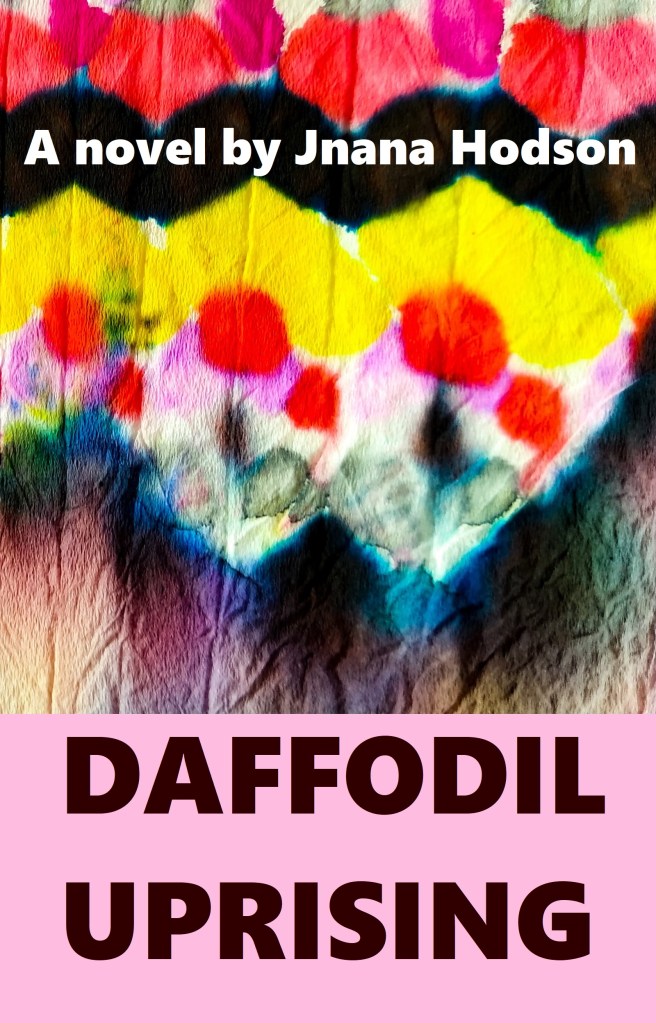
These other factors would come more fully into play when I revised Daffodil Sunrise into Daffodil Uprising, and Hippie Drum and Hippie Love into Pit-a-Pat High Jinks.

I’d like to think of those books as nominees for the Big Hippie Novel distinction.

Wolfe’s charge also overlooks the outstanding nonfiction books that reflected the experience, such as Zen and the Art of Motorcycle Maintenance.

Moreover, I still feel that many of the difficulties in the current political scene arise from a failure to clearly understand the demons raging from the Vietnam conflict, both for those who fought in the army and those who fought the unjustified war itself.

So here we were, struggling through disco without having faced the lessons of either the hippie outbreak or the Vietnam disease. Hippie had become a dirty word, and many who had been happy to be one were no in psychological denial. It was something nobody wanted to relive either, apart from maybe Woodstock.

As others have observed, an ignorance of history carries a heavy price.