Take a look at tricksters

They cross boundaries and break rules but have strong intellects. You need them but also need to be wary of them, especially when it comes to your wife or daughter.

In mythology, they appear across cultures, and not always as an animal or immortal. And we’re not talking about trick-or-treat night.

Take a look, here are ten.

  1. Coyote, largely among western Native cultures in North America, has been at the forefront of a new consciousness about tricksters. His tales were recorded by early ethnologists, who shifted to Latin when the stories turned randy.
  2. Kokopelli, the hunchback piper from the American Southwest, has become especially popular as an image, though not yet his stories.
  3. The rabbit or hare in West Africa and its transport into the Americas via the slave trade. Leads us to Br’er Rabbit.
  4. The spider. Just don’t get caught in the web.
  5. Froggy the gremlin on the early TV show “Andy’s Gang.” Not that we got it as kids, Froggy was just weird. And maybe perverted.
  6. The clown as an archetype. Well, I do know a professional firefighter who’s frightened of them.
  7. A figure in fairy tales who tests the status quo. He frequently changes hats. Or even genders.
  8. The fairy Puck. Or a leprechaun. Or even Robin Hood.
  9. Lilith, in Babylonian cultures.
  10. Jesus.

When an author listens to the characters

The ending of my novel What’s Left, is not the one I anticipated. Rather, it’s the one Cassia dictated to me as I was drafting. Believe me, it came as a surprise, but I trust her. It really feels fitting, from my perspective.

Up to that point I’d been thinking of swapping the placement of the last two chapters, ending with Rinpoche, the Tibetan teacher, telling Cassia of her father’s last moments and maybe setting her on a new lifetime pathway. Instead, her story concludes on a rainy Saturday morning as she converses with her best friend forever, her cousin Sandra.

Not that this should be a spoiler for you.

If you’ve ever lived in Indiana, you know how commonplace the rain is, especially on Saturdays, or so I remember. But this one is truly special.

~*~

It’s one thing to be writing and other to be reading or watching.

In reading a novel or watching a movie, have you ever felt a character wanted to go in an independent direction from the one the plot follows? Can you say why or which way you’d go?

~*~

My novel is available at the Apple Store, Barnes & Noble’s Nook, Scribd, Smashwords, Sony’s Kobo, and other fine ebook distributors and at Amazon in both Kindle and paperback.

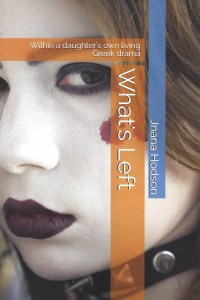
The paperback cover …

Among my most treasured possessions

Yes, I’ve always had a penchant for history.

  1. A hand-scrawled letter by my great-grandfather on scratch paper. (You can view it and my analysis on my Orphan George blog.) And the small autograph book he carried in Indiana his first years after leaving North Carolina. (Again, see the blog.)
  2. A stone breastplate pendant from an ancient burial mound in northwest Ohio. Plus, flint arrowheads.
  3. My Eagle Scout award, reflecting lessons in self-reliance, natural wonder, wilderness, and the outdoors in general.
  4. My Max Rudolf LPs. Working largely out of the spotlight, the conductor shaped the Cincinnati Symphony into a precise, glowing musical machine. Each performance was a revelation.
  5. James Nayler’s collected works, the second-oldest of the books in my personal library. Warped and hard to use as it is, with the ink bleeding through on many pages, it was published in 1829 in Cincinnati. He’s still my favorite writer from the emerging Quaker period. Also on my shelf are John Gough’s History of the People Called Quakers, in a four-volume set published in 1790 in Dublin. And then there’s Fernando G. Cartland’s Southern Heroes or The Friends in a Time of War (1897, Poukeepsie, New York), which details many of the travails of my ancestors under the repressive Confederate regime.
  6. A bone-handled antique fork, which I often used when visiting my grandparents. I wonder how far back in the family it really goes, but it’s still quite elegant in its primitive simplicity.
  7. An 1840s cherry table made in Ohio. Wobbly and warped, the wood itself is gorgeous.
  8. My journals, now numbering around 200 volumes. It’s what I often have rather than photos as a prompt to my memories. For the most part, I’d say the pages are more an outline of what happened, rarely of my inner thoughts and feelings, often tedious in their surface reporting, but they can still take me deeper into so much that’s otherwise slipped from my mind.
  9. Our copper cod weather vane. The one on the roof of the barn.
  10. A perfect trilobite, collected as a young rock hound in southwest Ohio.

~*~

Tellingly, many of these items are irreplaceable, unlike many other treasures that would still have replacements.

Which of your possessions do you most treasure?


One coot to another

As a preamble to a friend’s retirement, “Congratulations” doesn’t seem quite in order, other than, “Wow, you’ve survived!” Or “Hallelujah,” in a minor key full of wonder. Like making it to the end of a gauntlet.

Chronology doesn’t matter in these matters, older as I am but less mature, the eternal 17-year-old emotionally.

I still have no idea of how it feels to “be retired,” other than there seems to be a bit more space to savor what we’re doing or eating, if we want or can remember to do so. Golf? Tennis? Who has time? And yes, after all those years in the newsroom, I’m still “on the clock,” even when sleeping. Tick-tick-tick, only now there’s more of an urgency of mortality. Well, at least so much of my literary writing doesn’t feel like acts of graffiti.

Continue reading “One coot to another”

Aloha, Wade

here we go again, vantage point, take stock and calibrate to relate general pleasures, though not of the dramatic variety, this insight is this what being adult is about, this always being behind at least never ahead of the pile of things to do, chores, goals, activities? responsible, even, for what we haven’t done? all this ecological preservation yielding dividends tying knots in the air, so how’s the fishing?


What I’ve learned about the ocean

We’re talking North Atlantic, though I had earlier exposure to the North Pacific in Washington state as well as the Atlantic in Florida, Maryland, New Jersey, and Long Island.

New England really is different. Here’s why.

  1. The water’s always restless, don’t be fooled. Those slow swells can get you seasick, too.
  2. The current in the water can push you one direction while the wind twists you toward the other. As I learned the first time I took the helm of a sailboat and tried to steer by the compass.
  3. Tidepooling presents an amazing crystalline world of miniature color in its unique range of flora and fauna. It’s well worth exploring in the rockweed at low tide.
  4. At night, the ocean can be terrifying. It’s utterly dark, surrounded by swirling and slapping sounds in unseen places. The stars – and distant beacons – are icy comfort.
  5. As for those romantic walks along the beach in moonlight? Most nights of the year are too cloudy and too cold. Maybe you need to book a flight to a Caribbean island.
  6. It’s dangerous. You think you’re standing sufficiently far back on a rock outcropping overlooking the water, but don’t be surprised if a big wave somehow crashes up behind you, threatening to sweep you out to sea. January and March add their own complications.
  7. I love bodysurfing in some big waves, come summer, meaning after the Fourth of July. Here we go! Whee!
  8. Whales! The tour captains know where to find them. But their blow spray stinks. Meaning the big leviathans, not the skippers, as far as I know.
  9. And seals! (And sharks, which go after them at Chatham, down on the Cape.) And lighthouses!
  10. The tides themselves are heightened here because of a fluke in the global streaming. They’re really impressive up in Fundy Bay and the easternmost flank of Maine. (Twenty-five feet change every six hours at Eastport, Maine, for example. It’s like draining and quickly refilling a lake.) Less than half of that where I live in New Hampshire, but still impressive.
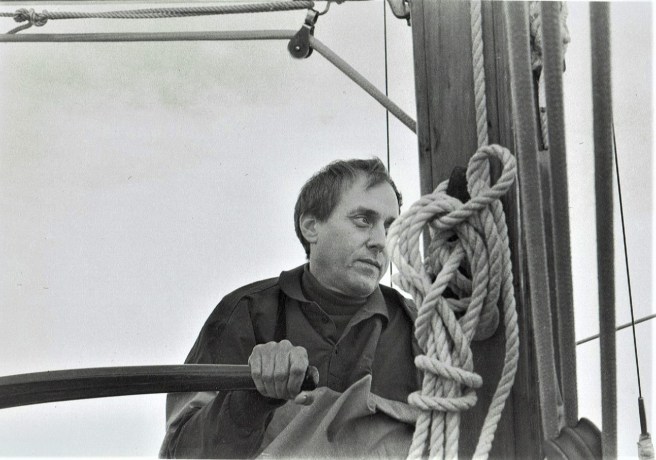
Me at the helm of a 32-foot sailboat back in the late ’80s. It didn’t want to go where we were supposed to be headed, and I was worried the wind might tip us over.   

As a footnote, there are only a few places you can swim in Chesapeake Bay without being stung by jellyfish.

And I love the way you really can see the curvature of the earth when you get an open panorama.

She’s so unlike the author

Maybe it’s a fair question, asking where an author stands in the story. Sometimes it’s pretty autobiographical. With my novel What’s Left, I can safely say I’m nothing like the narrator, Cassia. We don’t even like the same music.

And let’s say her father’s been a much better parent than me. Add to that the fact he’s traveled widely, has mountaineering skills, can translate Tibetan, finds true love not long after college, is able to call one place home the rest of his life. Well, let me add he shares a lot good traits with one very talented photojournalist I worked alongside all too many years ago now.

I will admit a flash of envy seeing the warm guidance he receives in the development of his talent and the freedom he has in pursuing it.

So there’s my disclaimer.

As for Cassia? I’m beginning to think of her as a daughter. She might even fit in with one of my own, though I think there’d be friction with at least one of the others.

~*~

Well, thinking of where we stand in a story, how about this?

What do you see in your baby pictures?

~*~

Who on earth can eat just one “stick” of souvlaki? Besides, where’s the salad or Greek potatoes? Besides, kabobs remind me of winter camp outs as a Boy Scout, cooking in the snow and using green twigs for skewers, long before I’d ever tasted lamb. Oh, my!


And you wonder how I work?

When I was employed full-time at the newspaper, I read interviews with successful authors who boasted they actively wrote two hours a day. Yes, boasted! As if two hours was such incredible labor! My reaction was, “What shirkers! What slackers!” And then, during my sabbatical, I typically spent eight to ten hours a day composing, though admittedly I did have a backlog of raw material to work down. And toward the end, I realized I was going at an unsustainable pace.

Besides, my two years on the road calling on newspaper editors for the media syndicate had convinced me that in a typical workday two hours of actually productive time was the optimum you could count on. In my case, it was the time spent in front of editors pitching our new goods and defending the ones they were already buying. The rest of my daily hours were preparation and cleaning up afterward and a host of other things I label as “infrastructure.”

You follow that? You still have to talk to the boss, do your research, keep in touch with colleagues, that sort of thing. And then there are doctor’s appointments and oil changes for the car. Welcome to the real world. It’s not an assembly line. Or maybe what lawyers would call billable time.

At the paper, I might now consider those two hours as actual keyboarding time. The rest would have included phone calls to interview subjects, plus background reading of the clips and even pondering what questions needed to be asked.

When I was employed, my literary world occurred in my off-the-clock hours. Much of it happened like graffiti, even notes jotted down while driving to the office or after. Flashes I might expand later in something that felt like jazz improv.

Two back-to-back Paris Review interviews in the late ’60s added perspective. The first was Jack Kerouac, with his two-week bursts of hammering away uncorrected on long rolls of teletype paper (like the ends I later used from the newsrooms where I worked – it’s the experience we now have on computers, where we don’t have to pause to insert a new sheet of paper page after page). Voila! He had a novel! Let the editors fix it, if they dare. The other was with Nabokov, the Russian émigré, who polished each sentence in English on a large index card his wife would later copy into a typescript.

I suspect no two writers work quite the same. Unlike one friend, who requires a new chair for each new work he tackles, I’ve been in the same one for 25 years or so now. I can’t imagine keyboarding in an aluminum fold-up lawn seat as he once did. Ahem.

Nor am I a Mozart, able to compose effortlessly on a stagecoach or in the middle of a loud party. I need my own Fortress of Solitude, currently in a corner of our attic though a treehouse might also be tempting.

When it comes to writing, my real work comes in the revisions, with all of the reflections and corrections and distillations and insertions. Initially, I found this oppressive. Something like our warmup exercises in choir, actually, though I really miss them when they don’t happen.

As a journalist, my dream was to have been like Hub Meeker at the Dayton Journal Herald with his State of the Arts column, though my own Corinthian Column at the Indiana Daily Student during my senior year of college at the height of the hippie upheaval did come close, only taking the larger counterculture as its vague subject. By the way, whatever happened to the Washington Post’s Nicolas von Hoffman, from that same frothy upheaval? A column, bang it out and you’re done. On to the next.

Poems and novels rarely happen like that. Still, they require daily “butt time,” in Bukowski’s term. That I finally understand and embrace.

As I’ve revised what I considered “experimental” novels, my emphasis has shifted from the events to the characters. Sometimes even the genders have shifted, adding new nuances. Yes, there are scenes that never happened to me personally, not that I would have resisted. They happened to somebody.

More recently, my now-wife has shown me instances in cooking where I bring in a big batch of something from the garden, say a basket of kale or tomatoes, and watch it cook down to almost nothing. A very, very tasty essence.

So you wonder about what writing’s like? Please pass me the pepper grinder, a lemon, and a stick of butter.

Funny, how that points me toward Cassia and her family in What’s Left.
Ways to define a family

It’s a major theme in my novel What’s Left, not that these are the answers there.

  1. Husband, wife, and kids under one roof. Often traditionally recast as a breadwinner and dependents.
  2. A mother and all who turn to her.
  3. Two romantic partners in their own place, with or without other relations nearby.
  4. Those connected by genetics and blood line. Say siblings or cousins.
  5. A shared last name. Or address.
  6. Those who join together as in-laws through brothers and sisters and so on.
  7. Grandparents and grandchildren.
  8. Inheritance.
  9. Memories, good or bad.
  10. Home of last resort.

~*~

In the novel, there’s also a shared business and an ethnic identity.

How else do you see a family in real practice? Or even as an ideal?