In my novel Nearly Canaan, Joshua and Jaya settle into a place unlike anything they would have imagined. It’s desert, for one thing, where nearly everything has to be irrigated, for another. Quite simply, it’s a lot like Yakima, in the middle of Washington state.
Dungeness crab. I really miss this. It doesn’t travel well. You have to go to the source. Someplace like Ivar’s on the waterfront in Seattle. One crab per person is fine.
Salmon. How many varieties do you know? Sport fishermen will tell you their favorite.
Tillamook cheddar. An Oregon coop.
Beer. Must be all those local hops and barley. My favorite was Rainier.
Geoducks. (Pronounced gooey-ducks). A large razor clam species.
Those chewy apple, peach, or ‘cot bars. A sweet and chewy candy. Used to get ’em up around Wenatchee. Wish I could remember the brand name.
Rainier cherries. Definitely distinctive.
Chanterelle mushrooms. Had ’em once, and it was a treat. You really have to trust your source when it comes to picking wild ‘shrooms.
Elk. Helps if you know someone who wins a license in the annual hunting lottery. Seriously.
Walla Walla onions. OK, I hate onions. Or they hate me. So I’m just passing this along, based on the praise by cooks I respect.
~*~
What food is special where you live?
Dungeness crab, a specialty in the Pacific Northwest.
Many would consider Cassia’s family wealthy, but a close look would find that their money is tied up, mostly in real estate and the restaurant – investments that allow the family to be its own boss in working together and serving the surrounding community.
Imagine yourself with a million dollars. Where would you put it to do the most good?
My wife brought in a big green caterpillar, fatter than my thumb and longer than a finger, then asked if I knew what it was.
Nope.
Then she informed me it’s a hornworm, our first one she’s found on our tomato plants in the two decades we’ve lived here. And she was terrified. Said they can devour not just whole tomatoes but the plant too, as well as peppers, eggplants, potato plants. Well, it’s a long list and if you find one of the goliaths, there are bound to be more.
That stirred up memories of the three little woodchucks that showed up one July and reduced our six thriving Brussels sprouts plants to sticks. The very thought of something like that recurring still strikes terror.
summer begins by one system, but remains Midsummer by the other wherein May Day, August 2, and Halloween initiate the change of seasons and Christmas then falls in the middle right up to the vernal equinox or well beyond as far as sunlight falling on the Earth is concerned winter’s over on Depression-era linoleum encircled by tuxedos and stovepipe hats
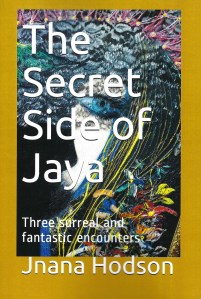
Once I had gone back to better unify the stories of Cassia, the basis of What’s Left, and her father, I then saw a possibility of pulling two existing and somewhat problematic novellas into an overall more unified volume. (Yes, I’ll argue that what I have is something other than a conventional series, even when some of the characters appear in multiple novels.) And, I should emphasize, Cassia is far from the scene in the pieces I’m addressing, the ones that now involve Jaya, the center of Nearly Canaan, in a capstone work.
By weaving Jaya into the two novellas, I could pull them together. And since “Nearly Canaan” was set in three distinct parts of the country – Great Plains, the South, and Pacific Northwest – reflecting places where she had lived with Schuwa, a third section was required, one reflecting their interlude in the Ozarks.
Here, my imagination took over, along with some elaboration of earlier research. I might add that the Hodgson Mill cornmeal found on many supermarket and kitchen shelves has a personal connection – its founders were distant kin from North Carolina who spelled their name like mine at one stage in their migration to Missouri. I have to admit that “Miller at the Springs” is especially satisfying for me.
Together, the three form The Secret Side of Jaya, plus a little more.
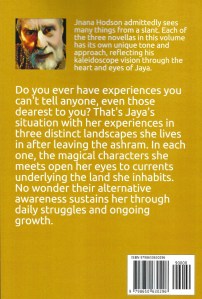
… and the back cover.
I must admit the collection is deeply personal for me and leave it at that. I offer it to you, all the same.
While we’re at it and geography’s on my mind, I should also confess that in “What’s Left” and Daffodil Uprising, when I recast the town of Daffodil by moving it to the Ohio River and throwing in a touch of Dubuque, Iowa, from the Upper Mississippi, I was acknowledging a sense that southern Indiana gravitates toward the big river along its southern border, even though no place along the waterway is only an hour from Indianapolis. Poetic license, then. The Hoosier state was settled largely from the south – in 1850, nearly half of the households had roots in North Carolina, where many Quakers had fled because of the slaveholding culture. And then recasting that Indiana into the Ozarks, I turned heavily toward the use of photos and related documents, somewhat the same way I did in another series about what you don’t know when I tackled my Mediterranean poems.
And I’m somehow surprised that Baltimore, as beloved as it was in my residence later, has never come up in my fiction. And it won’t. The personal drama was mostly banal or I just never got to know the place well enough to go more than skin-deep.
Readers of Vanity Fair magazine may be catching a similarity between its back-of-the-issue Proust Questionnaire each month and many of my Tendrils postings this year. One difference is that when interviewing a chosen celebrity figure, each question gets a single answer, while Tendrils, with its listings of ten items, demands a full count on both hands, one-two-three on to one-zero.
The questionnaire itself, attributed to French author Marcel Proust (1871-1922), became a popular “confession album,” a kind of Victorian parlor game. When published by his son-in-law, the French president, it was subtitled “an album to record thoughts, feelings, etc.”
Frankly, they’re usually difficult for me to tackle. More personal than I usually navigate. But doing them as an exercise for Tendrils has had me reviewing much of my life from a fresh perspective, and maybe also is giving you a better idea of what makes me tick.
Still, some of them haven’t prompted a full ten responses from me. Here are some examples.
What do you consider the lowest depth of misery? Being utterly alone. Quite distinct from blessed solitude.
When and where were you happiest? Meeting Lady R and courting her.
Where would you like to live? Where I am now, though we’re also dreaming of moving up the coast, soon as we can.
What is your favorite occupation? Writing.
What are your most marked characteristics? Let’s start with quirkiness.
If you were to die and come back as a person or thing, what do you think it would be? I’ve long admired hawks, but now eagles and osprey, more so.
What do you most value in your friends? Reliability.
If you could change one thing about your family, what would it be? They’re incredible. If I could, I’d leave each of them with a billion to do with as they wish. The world would be much better for it.
How would you like to die? With the least inconvenience to those around me.
On what occasions do you lie? Half-truths, since I’m conflict-averse. That is, omissions, rather than commissions
remember after two months racing highway construction crew deadlines your Indian dig crew unearthed an infant’s grave that justified the stall but nightfall forced departure and returning the next morning, you discovered the skull smashed, bones scattered across drunken greed, ignorance, or hatred that strikes repeatedly, yes, the repeated sound, as you relay it Take care

 Jnana's Red Barn