Popular fish caught around Eastport

And not all of it’s meant for human consumption. Some of it’s used for bait, usually for lobsters.

  1. Along the coast we have mackerel. It’s a small fish and oily, one that doesn’t keep well, but cooked promptly or smoked for storing, it’s a lot like salmon. For sports fishing here, seems everybody’s catching ‘em, sometimes six on a line. Some folks even trade buckets of them for lobster.
  2. Alewife. Migrates from the sea late every spring. Another small fish that needs to be cooked promptly or pickled for canning. Also used as prime lobster bait.
  3. Herring. A century ago, these were the basis of Maine’s sardine industry.
  4. Smelt. They’re small, often dip-netted, and can be pan fried and eaten whole. Pacific Northwest Natives called them candlefish, for their oil. Around here, they often show up on the line when casting for mackerel.
  5. Flounder. The species includes fluke, and they like to hang out around pilings and docks – the kinds of places where many folks fish.
  6. Halibut. Now we’re getting to the kinds of fish you might recognize on a restaurant menu or at the grocery.
  7. Haddock. Ditto.
  8. Turning to freshwater, we have several species of trout.
  9. And bass. or perch.
  10. Plus landlocked salmon. Migratory salmon are off-limits, however.

Clamming is also big when the tide’s out. Not that they’re actually fish.

Witch and all these smile from my wall

beginning sabbatical read and sun with nature study scripture prayer and meditation to catch up and travel, minister, restore ‘ships and then put off hiking, avoid making to-do lists yet indulge that minor weekend correspondence just seems too much to handle again too long under that ambitious frustration by necessity what has always remained two-thirds unfinished dancing after all the floating deliberation now hard-working on this May your clean bean, dearly

There are times it’s taking me all day to write three sentences

That’s not the way it used to be, not when I was younger and could dash things off in the flush of inspiration, but it is what I’ve encountered revising my last two books.

It’s not even Wes McNair’s advice to write 400 good words every day. Not unless one of those sentences is an over-the-top wonder of 250 to 300 words.

The turtle pace here seems to arise when I’m trying to weave some new material into an existing draft, making it connect on two sides seamlessly. It’s not just the craft of fine writing, actually, but also the thinking more deeply about the unseen significance of the subject at hand.  What, exactly, is beneath the surface before us?

Of course, as a writer, this pace also has me wondering if I’ve simply used up all the easy stuff and left the bigger challenges for my senior years.

Any suggestions?

Some common fears

  1. Intimacy. Oh, my, this could lead to another Tendrils. You know, the ways we feel vulnerable.
  2. Poverty. This one even gets twisted up in white superiority and racism, if you look really closely.
  3. Being pulled over while driving. Though it’s unlikely to be a death sentence for me.
  4. Lawsuits. Which can lead to poverty, above.
  5. Being held up or robbed. Well, that can be like a lawsuit plus potential violence.
  6. Rejection. Which also leads back to intimacy, above.
  7. Shame. Well, usually shame is linked to something you’re born with, but it still connects with fear, along with its first-cousin, guilt – arising from something you did bad, really bad.
  8. Hunger. Not that most Americans actually go without food long, but just watch their reactions when they have to fast or go more than two or three hours without a nibble.
  9. Debilitating illness or physical handicap. Blindness, deafness, dementia, for starters. Or falling off a ladder at my age.
  10. Dying as a failure. You know, without achieving something big to advance mankind. Or just plain going to Hell.

Do these all involve pain?

What would you add to the list?

Dear Ab’gail

there’ll be no gardening to ground down to the end of this place bitterly eliminating so much accumulation before swimming through the cloudy first day at liberty disregarding temptation right off the bat to say nothing of ferocious loving What discipline will emerge? except in the leaves of greenhorn pages there’s work awaiting, oh boy, I bought this overnight woods heavy and wet but daily shaving’s a pain so perhaps by the time thee sees me again I’ll be scraggly not paying bills is hardly superfluous still wish you were here on the trail

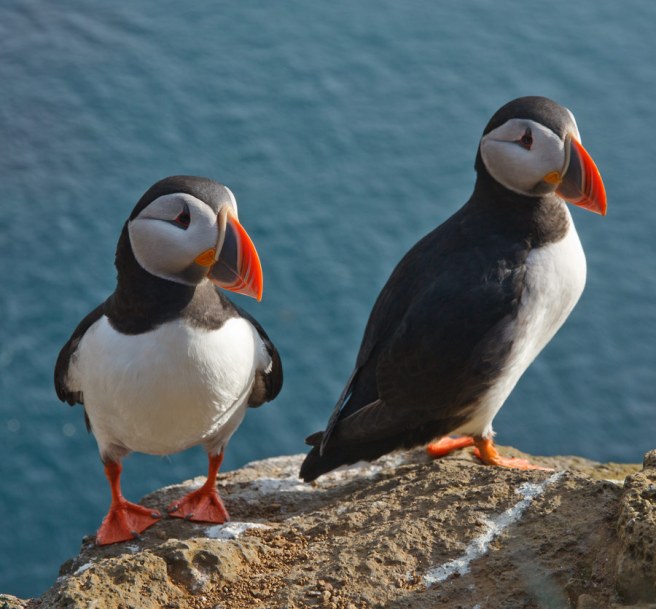
Regarding those photogenic cute puffins

Photo by OscarV055 via Wikimedia Commons

The distinctive seafaring bird is on any serious bird-watcher’s bucket list. Here are some things to know.

  1. They don’t make muffins, contrary to the children’s ditty.
  2. Apart from their nesting time on North Atlantic or Pacific cliffs, they spend all their life at sea, resting on the waves when they’re not flying. They’re essentially an arctic bird, though they come south to breed. Considering where I’m living, maybe I’ll take the boat tour and see some, too, if the outings aren’t already booked solid.
  3. These birds can dive underwater for a full minute and are fabulous swimmers.
  4. As a group, they’re a colony, a puffinry, a circus, a burrow, a gathering, or – get this – an improbability.
  5. They’re quite social, with one colony in Iceland reported to have more than a million nests.
  6. They can flap their wings in a blur of 400 times a minute, reaching a flying speed of 55 miles an hour. At least they’ll evade cops with radar guns.
  7. Two opponents in flight can lock beaks and then beat at each other with their wings and feet. OK, that’s ugly but still impressive.
  8. They generally stay with the same mate for life, returning to the same burrow nest.
  9. Sometimes they’re called Sea Parrots or Clowns of the Sea.
  10. A puffin’s beak changes color during the year.


At low tide, you can walk out to Matthews Island

The population of Eastport lives mostly on Moose Island, with a few more on Carlow. Both are connected to the mainland by a 1930s’ causeway running to the Passamaquoddy’s Pleasant Point Reservation in the township of Sipayak. Before that, the connection was a toll bridge to Perry.

But these aren’t the only islands within the city limits.

Treat Island is within Eastport’s city limits but you can get there only by boat. And nobody lives there anymore.

The Maine Trust Heritage Trust includes Treat Island among its preserves open to the public. Settled in 1784 at the juncture of Passamaquoddy and Cobscook bays, it became home to a fishing hamlet of 50 or so families and then a Civil War artillery battery before being acquired by 1935 for a tidal power project that was later abandoned. Treat’s open meadows, cobble beaches, trails, and spectacular views are, however, accessible only by boat – and kayakers are advised to hire a local guide before venturing out on the challenging tidal currents.

Eastport also includes small Dog Island, which once had a lighthouse, but is tucked away in a tony part of town. Again, you get there only by boat.

But you can walk to smaller Matthews Island if you time the tides right.

Fourteen-acre Matthews Island, however, sits along Carrying Place Cove and Cobscook Bay, not far from the municipal airport. And you can walk there, if you time it right, while the tide’s out. Just make sure you don’t get stuck by the incoming tide. Another of the Maine Coast Heritage Trust preserves, it’s accessed through a right of way on private property and then an exposed bar.

In the early 1800s, Capt. Charles Matthews raised his eight children here. Today, eagles are raising their own on the north side of the island.

Matthews has some stunning views of Cobscook Bay as well as berry-picking and nesting eagles.

My dream routine? Pre-Internet?

For decades, I dreamed of getting free from the demands of the newsroom – meaning any paying 9-to-5 job – so I could concentrate on what poet Gary Snyder aptly dubbed the Real Work.

That goal entailed something resembling financial independence, which was hardly likely on a journalism income.

As for 9-to-5? It never fit the places I was employed, sometimes straight salary for 60- to 70-hour weeks, and even when I’d left management and joined the union, it was typically nights and holidays or a double-shift on Saturdays.

I had hoped for a breakout via a bestseller book, and some of my non-fiction projects might have turned the trick, though I found it difficult to respond rapidly when I was tied down by other time-consuming obligations.

The closest I did come in those years was a year’s sabbatical I gave myself between jobs back in the mid-‘80s, when I submerged myself in drafting what later emerged as my novels, after much revision and the openings finally provided by ebook publication.

One thing I learned from that experiment was that I couldn’t continue at that pace – I required more balance in my life. My bank account wasn’t the only thing that was depleted.

One of my annual exercises after that involved setting goals for the year ahead, usually by season. The categories included things like Home, Relationships, Creative Projects, and Quaker Practice – I’m starting to see a forerunner of the Red Barn, eerily – but also had me thinking about how my daily life might look if I ever “made it” as an independent writer.

Part of the impetus was a fear of letting my life just kind of ooze away. I suppose it goes back to some of the sermons heard in my youth, the ones about time being God’s gift to us.

In response, how much could I rely on a tight daily routine, starting with an early morning rise for meditation and then hatha yoga before a light brunch and maybe an hour with the Boston Globe and the local paper followed by a big block for writing and supporting activities?

That thinking was countered by a recognition that I couldn’t fit everything I desired into straight days, so I also played with chunks of time staggered through the week – Topic A on Mondays and Wednesdays, for example, with Project K late on Wednesday.

And then, I still couldn’t fit everything in.

After I’d remarried, my wife caught one sight of one of my schemata and reacted with scorn. She saw so much daily reality I wasn’t including, such as cooking, cleaning, gardening, time for others, and even myself.

Now that retirement has finally provided the independence I sought, I’m having to admit I still haven’t achieved that ideal, intentional scheduling. Instead, so much has revolved around big projects like the novels and random to-do lists.

Still, it built upon the bones of daily Spanish lessons and half-mile swimming and a weekly commute to Boston for choir practice, in addition to Quaker worship and committee work.

But then Covid hit, followed by the move to Maine.

Quite simply, I still haven’t hit on the balanced pace. Maybe now, that the last book’s in place? Or maybe after I stop blogging intensely?

The biggest surprise for me in all of this is how much the Internet has changed the picture. I want the early quiet of those early hours for my writing and revising. What happened to the meditation? As for regular exercise? The nearest indoor pool is in Canada. Or for spreading out with a newspaper? I do most of my reading online, even books, no matter how much I love ink on paper. Even interacting with others occurs largely via email.

One thing I don’t feel is “retired,” but I will say in all of this I feel more engaged than ever.

Naturally, that won’t stop me from tinkering with a routine. I’m sure whatever I come up with will be far superior than what the nursing home would arrange.

How do you arrange your days and weeks? Any secrets to share?
 

Third Haven, New Haven, White Haven nexus

wouldja guess Maryland’s official sport is? jousting! (no, I wasn’t jesting, ’tis truly) these tabs from Fitzwilly’s and the Whitby Winery Uncle Charlie! what on earth’s on the radio? maps of New Haven and Providence sorry, such minutia, leisurely spans the Eastern Seaboard only to realize what had been removed to Tampa whoa! Prairie Home Companion it ain’t present background noise, roll the dial this rumbling would appreciate new Verdi’s Falstaff any better? reminded to pay bills, catch up hardly boring and ask how many of them practice, whatever . blessings, stick to it