A few things Mainely about lobsters

Somehow, lobsters have become identified with Maine the way maple syrup has stuck to Vermont, even though both are found abundantly in neighboring states and provinces. I won’t even get into moose in this discussion.

Here are some talking points.

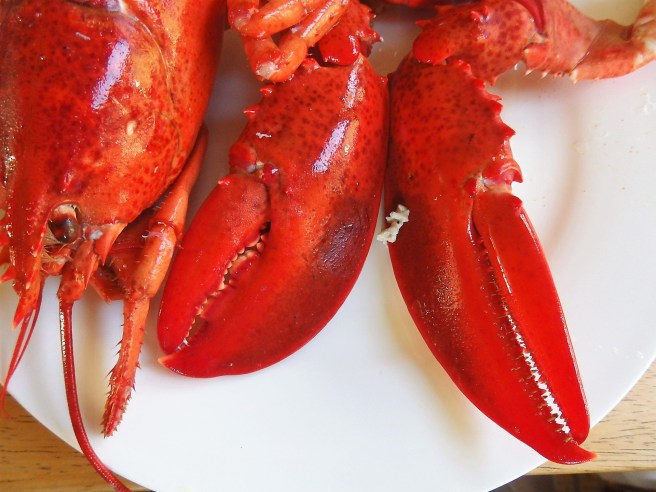
  1. Unlike other varieties, ours are distinguished by having large claws. One claw, the crusher, is larger than the pincher.
  2. They have clear blood.
  3. They smell with their eight legs but have poor vision. Their four antennae help them locate food. They can also swim backward.
  4. They chew with their stomachs, which are located right behind their eyes. They lack teeth but have a “gastric mill” that reduces their prey.
  5. They live on the ocean floor and never stop growing, which they accomplish by molting. Some are known to be more than a hundred years old. In fact, they show no signs of aging and almost universally die of external factors.
  6. It was once a poor-man’s dish, typically fed to servants. Impoverished families sent their children to school with lobster in their lunch buckets and an envy of the richer kids’ roast beef or chicken.
  7. Lobster comprises 75 percent of Maine’s commercial fishery value. In 2016, a banner year, the state’s 6,000 lobster-fishers landed more than 130 million pounds worth more than $533 million.
  8. A traditional lobster pot or trap has two sections – a “parlor,” where they enter, and the “kitchen” behind it. But for much of the region’s history, they were more likely to be harvested by hand along the shore and tide pools, where they washed up after storms.
  9. Most lobsters are caught in the summer months, before the shellfish trot off to deeper waters where they’re harder to harvest. In Eastport, many of the lobster boats do double-duty each winter, rigged to drag the bay bottoms for scallops. A few even go after urchins.
  10. Maine commercial lobstering is tightly regulated – more than in neighboring Canada – and licensing involves a long waiting list. You’d better apply well before your twenty-third birthday if you’re interested. Even if your dad still has his boat.
America’s largest cities in 1820

Shifts in the nation’s economy are reflected in the 1820 Census, where Missouri and Maine are about to be admitted as states. The major population centers, however, are still seaports.

  1. New York (123,706), making it the first American city to surpass 100,000 population.
  2. Philadelphia (63,802). If the two suburbs, below, were included, it would approach that 100k threshold.
  3. Baltimore (62,738). The port has leapt to third place and is nearly as big as Philadelphia City. While
  4. Boston (43,298) has fallen way behind.
  5. New Orleans (27,176). The biggest city west of the Appalachian Mountains, it’s still smaller than today’s Dover, New Hampshire. In other words, most of these cities weren’t really big.
  6. Charleston, South Carolina (24,780). It’s the center of urban life in the South. But from everything I’ve heard, it was largely of a small-town flavor.
  7. Northern Liberties, Pennsylvania (19,678). Now a neighborhood of Philadelphia.
  8. Southwark, Pennsylvania (14,713). Now a neighborhood in South Philadelphia.
  9. Washington, District of Columbia (13,247). First appearance of the new capital in the Top Ten, where it wouldn’t appear again until 1950.
  10. Salem, Massachusetts (12,731). New England is losing its edge in the American scene, relatively.

Precocious precious Elise

back to drive across mountains and plains how well I remember unanticipated letters in my post box before phone calls from a colleague fed up with working in a field of little growth but with no desire to return to the daily buzzard “from what I’ve seen, for what’s demanded, our managers are far under-compensated” within major cities parallel to something I’ve been preaching the last thirty years amen hope you find welcome me too wishing upon that star

Why Maine’s blueberries are special

Across the country, pumpkin flavoring seems to infuse about everything on the menu come October, and something similar happens every summer in Maine with blueberries. The tourists and summer people, especially, seem to eat it right up. (Err, couldn’t help myself there.) So it’s not just lobster they come to devour.

Here are some facts about Maine’s in relation to the rest of the nation and world,  mostly.

  1. The local brewpub calls its obligatory blueberry ale Skul Clothes. The name puzzled me until I was told that’s how kids traditionally earned the money for their school clothes each year, at least before mechanized machines took over most of the patches. “It’s hard work, down on your hands and knees,” as one recent high school graduate told me. “But the pay’s good.” After that, I could tell the locals who walked in for the first time, looked at the offerings on the chalkboard, and broke out in a grin. They’d all done it.
  2. Ours are lowbush, wild, unlike the highbush varieties cultivated elsewhere. We lead the world in lowbush production, though it’s a drop in the bucket compared to the highbush harvests of British Columbia, Oregon, or Washington state. While Atlantic Canada produces half of the world’s wild blueberry tally, that covers more than a single province – Nova Scotia is the leader there.
  3. Lowbush berries are smaller but more flavorful, in our humble opinion.
  4. They’re also preferred in making blueberry wine.
  5. Blueberries are one of the few commercially-available fruits native to North America. The First Nations, some of whom called them star-berries for their blossoms and the tiny ring at their base, have been eating them for at least 13,000 years
  6. They top the list as an antioxidant and are rich in Vitamin C and even manganese.
  7. Wild blueberry patches are burned every two years.
  8. Wild blueberries freeze in just four minutes.
  9. Some research indicates they counter memory loss in aging. I’ll have to remember that. They’re also good for the heart, cancer-risk reduction, and lowering blood pressure.
  10. I like mine fresh, with yogurt or cream. Pancakes, muffins, jams and jellies come next.

We have some huge tides and treacherous currents

Listen to me, like I’m an expert.

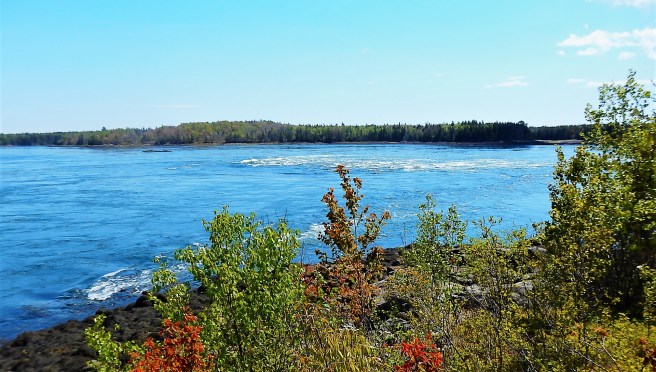
Still, the Old Sow can be seen about a mile away from Eastport if you time it right, about three hours before high tide on the biggest days of the month. The Western Hemisphere’s biggest whirlpool not only swirls but also shoots spouts into the air. As if I could capture that flash with my camera.

The current, though, often runs at seven knots, faster than an Olympic champion swimmer could manage in even a very short burst. It’s also treacherous for Scuba divers, waders, and sailors alike.

It’s by no means the only place to be mesmerized while watching the charge.

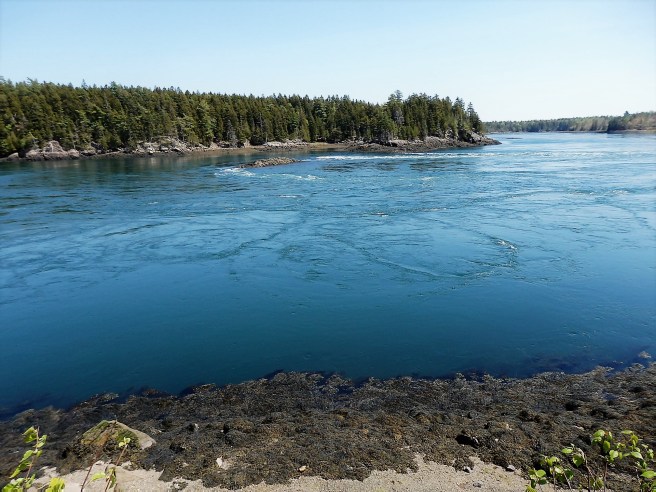
Tide pressing from the Atlantic into Dennys and Whiting Bays churns and ripples.

Another impressive sight is the Reversing Falls in Pembroke, though “rapids” would be a more accurate term. The sounds of the waters rushing from one bay to another are as mesmerizing as any waterfall, though.

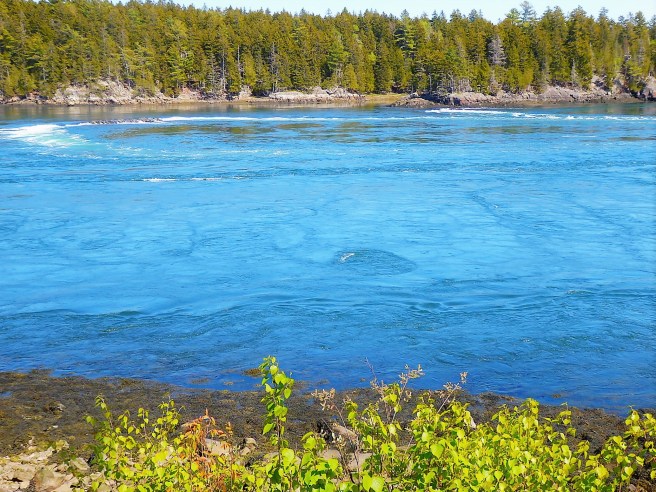
As the level intensifies, a large whirlpool with a concave depression forms behind the rock ledge, setting off smaller whirlpools around it.
The major action is a set of rapids I’d hesitate to call “falls,” though they’re just as noisy. Once the tide comes in, it has to go out, keeping the action going endlessly. As I was shooting this, a pair of seals lolled in the whitewater wings, diving and coming up with fish in their mouths. 

Zap, zap squared

whatever abundance before the eye rests under that spirit of being guided through the wall after waiting through dry periods when you’ve voiced those personal, esoteric why must it be myself or the other when feeling a drawing away to that which I alone happen to sense when working and nodded without anticipating any fulfillment except in so many conjectures now absolutely engaged in the hand of accomplishment you definitely pursue now so romantic exciting perhaps with some overlap perhaps you too understand

About the Wabanaki

In writing my history of Dover, I had to face up to the problems of the word “Indian,” which can refer to someone from the Asian subcontinent as much as it does to an Indigenous person of North America. In the end I decided to avoid it altogether unless it was part of a direct quotation or traditional title.

The fact is, the Native tribes themselves can differ widely in their language, customs, and culture, so a generalized label can be downright misleading. And in a particular place, the same people may have been referred to by different labels, depending. You know, the way a Daytonian was also an Ohioan, Midwesterner, or even Buckeye, though not necessarily an Ohio State football fan.

In addition, the tribes themselves may have been much more fluid in their associations than the English and American authorities could comprehend, insisting instead on a more rigid classification.

That was the case with the Passamaquoddy and Penobscots in Maine.

In the Dover history, I ran up against that when some sources called the local Natives Abenaki, while others called them Cochecho or Penacook or something else.

As the Wabanaki Confederacy explains, though, all Abanaki are Wabanaki, but not all Wabanaki are Abanaki.

That said, let’s take a quick look at the Wabanaki.

  1. It’s not a tribe. Rather, the confederacy today is an official alliance of four East Algonquian nations remaining in Maine – Mi’kmaq, Maliseet, Penobscot, and Passamaquoddy.
  2. Historically, it was a looser alliance of tribes stretching from Newfoundland and Prince Edward across Nova Scotia, Cape Breton Island, New Brunswick, and part of Quebec in Canada on to the Western Wabanaki in the Merrimack Valley of New Hampshire and Massachusetts and perhaps beyond into Vermont.
  3. Native names for the affiliation included “convention council” or “orator council,” “be related to one another,” “those united into one,” and “completely united.”
  4. The tribes formed their council after a rise in raids by their ancient enemy the Iroquois League, especially the Mohawks.
  5. In the colonial era, many members aligned with the French, who called the region of Maine the Wabanaki inhabited “Acadia.” Many of the Natives converted to Roman Catholic faith. The defeat of the French in 1763 proved costly for the tribes.
  6. For thousands of years, Mount Desert Island – in today’s Acadia National Park – was a summer gathering place, where they arrived by seaworthy birchbark canoes.
  7. They didn’t live in tepees. They lived in small round bark-covered buildings called wigwams.
  8. Most of them grew squash, beans, and corn, and also harvested berries and other wild fruit.
  9. They didn’t dress like the High Plains Natives out west. They had their own distinctive style.
  10. They loved storytelling and legends. Mount Katahdin, for instance, was inhabited by a half-human, half-bird winged spirit called Pamola who could make the night wind blow or generate snowstorms. And the Maliseet had tales about the little people, who were like brownies or leprechauns.

Quoting from a master of secret teachings

here you perceive it’s not within my nature to offer any spoken contention in the row of bricks other craftsmen would so often enwrap in false modesty if you can tolerate canned soup or a vulcanized cheese omelet, well, then you’ll also observe how turning together after so many years  maybe occupied with survival in the rarified air the conundrum by God becomes devotion

About the Passamaquoddy

Getting to or from Eastport means driving through the Passamaquoddy’s Pleasant Point Reservation. And yes, I dutifully observe the 35 mile an hour speed limit. I also gladly pay the voluntary “toll” that helps fund the fireworks for the tribe’s annual festival. Besides, it’s a better bargain than a movie and, anyway, we’re all invited.

Having lived previously at the edge of the Yakama reservation in Washington state, I appreciate having an Indigenous population so close at hand.

Here are some things I’ve learned.

  1. The first time I heard of the tribe was through a traditional healer and his apprentice who were our house guests maybe a dozen years ago back in Dover. And ever since, thanks to his warning, I never disrespect a mockingbird. Could that be why I’m still here?
  2. The tribe generally proclaims itself as “people of the dawn” or even “keepers of the dawn.” I’ve already posted that the dawns around here – the first light in the USA – are unique and full of wonder. But the tribal name’s root reflects the importance of fishing in their culture – “pollock-spearer” or “those of the place where pollock are plentiful.”
  3. Traditionally, for most of their 10,000 or more years, they summered in settled villages around the coasts and tributaries on both sides of the St. Croix River, where they harvested shellfish and worked the deep waters. In winter they dispersed inland, where they hunted large game.
  4. Today their centers are Sipayak (the Pleasant Point Reservation adjoining Eastport), where 2,005 members are enrolled; Motahkomikuk (Indian Township an hour to the north), 1,364 members; and Qonasqamkuk in New Brunswick, 206. There are also uninhabited tribal tracts inland.
  5. Economically, on-reservation families have a much higher poverty-income rate compared to Maine overall. The tribe is making efforts to improve income. A blueberry enterprise, a maple-syrup operation, and vacation sites are among its new directions.
  6. About 500 people speak its Algonquian dialect. After a steep decline in numbers over recent decades, efforts to preserve and reclaim its use are under way. It is being taught in the elementary schools.
  7. They’ve long been considered first-class loggers and woodworkers, as well as excellent basketry artists.
  8. In 1993 the state banned the use of the word “Passamaquoddy” by businesses, products, and activities without the written authorization of the tribe. Those using it before that date, however, were exempted.
  9. The tribe is one of four comprising the Wabanaki Confederacy today.
  10. Joe Clabby’s two excellent histories about Eastport and the Passamaquoddy vicinity delineate seemingly endless governmental mismanagement, mistreatment, and betrayal of the tribe and others in Maine and the nation – even when its members have served with honor in the world wars. One entry, relatively minor in comparison, hits home for me. In 1950, longtime “Indian agent … Hiram Hall allowed the state to charge the Passamaquoddy Fund $8,000 per home for home construction (the homes are worth only $2,500.)” Not that it ended his career.