Mysteries were lurking behind the walls and above the ceiling

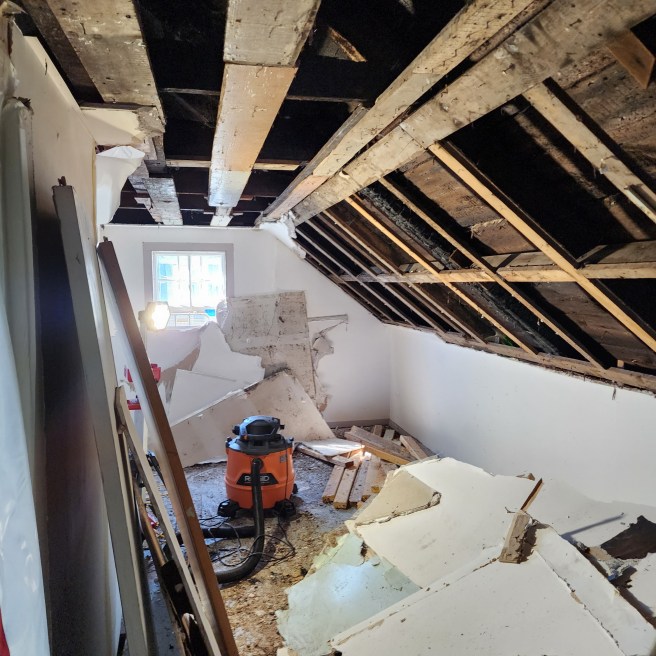
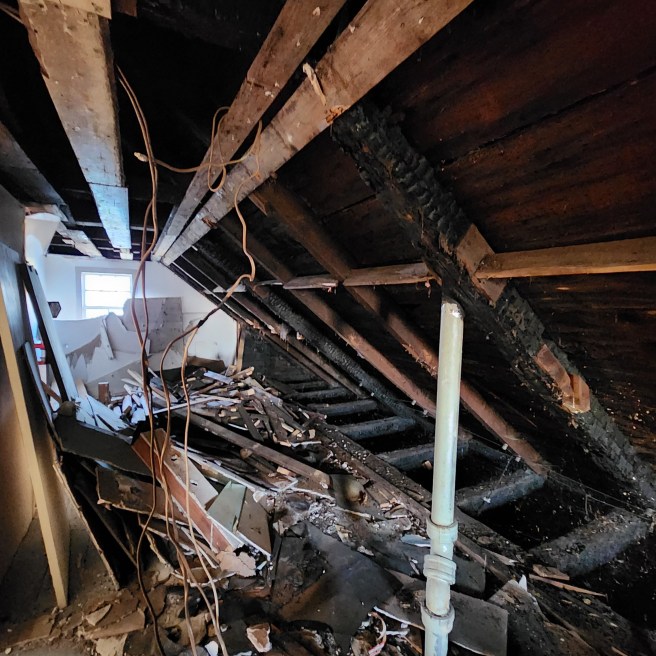
When Adam set about ripping out the drywall upstairs – and immediately filling his first dumpster in the process – the emerging picture soon presented a number of challenging hurdles. I’ve mentioned the lack of a ridge pole and matters regarding rafters, plus the wiring situation. This wasn’t going to be nearly as straightforward a project as I hoped.
The dumpster, by the way, was a new step for me. Back in New Hampshire, our carpenter hauled the debris to the transfer station in his pickup – or I burned what I could in the side yard. We even used a lot of the ripped-out sheetrock and plaster to “sweeten” our garden pH. How much would the alternative cost us, anyway?

I’ll say it was a bargain, especially considering the time that would be lost if Adam were driving that to the trash transfer station an hour away.

Adam’s selective demolition led to a small collections of old wallpaper examples. Meanwhile, a hippie-dippy yellow crab painted under some of the later wallpaper, alas, couldn’t be preserved, not that I quite wanted that. Mine was the minority vote. Still, we’d love to know the story of its creator – a kid? – and its inspiration.

More puzzling were the broken bricks in the walls and joists away from the chimneys. Huh?

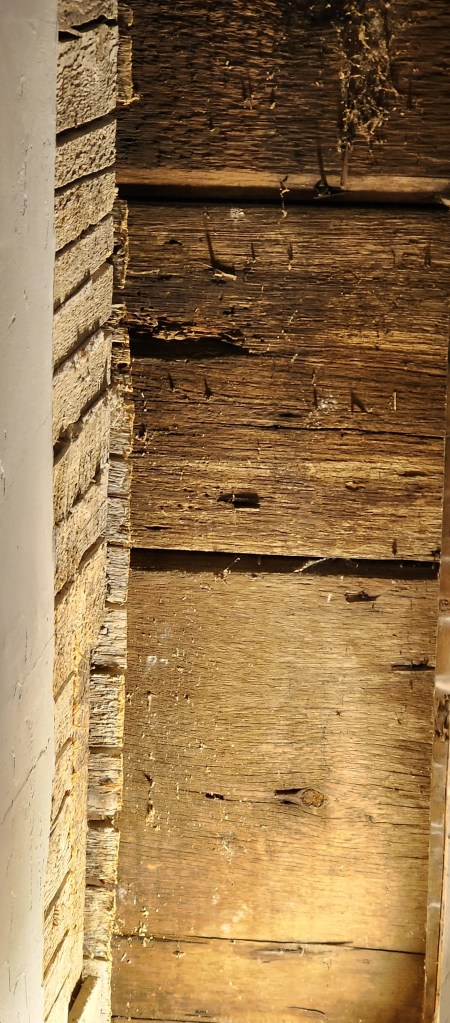
Or, more impressive, finding some of the exterior sheathing is more than 18 inches wide. Try buying that today.
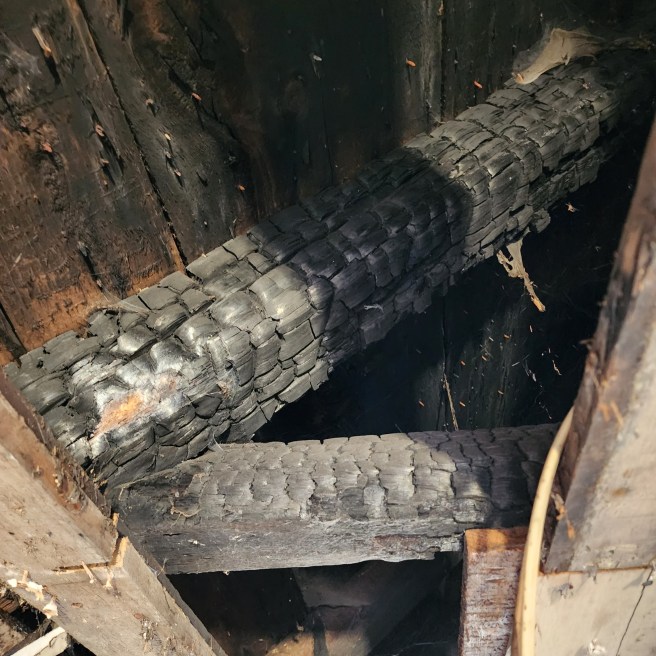
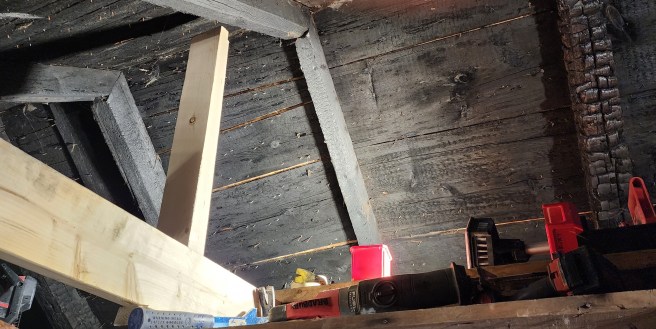
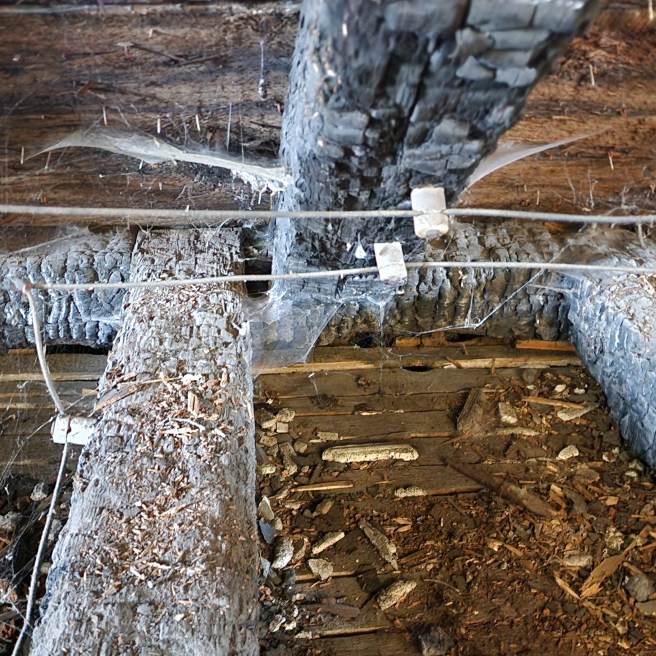
The fire damage was more extensive than we had imagined. Not just the historic downtown fire of 1886, charring our rafters but not setting them ablaze, but also a later chimney fire that charred the insulation off electrical wiring that we were still using.

What if the char damage on the beams and rafters wasn’t superficial but went deeper into what we assumed was still solid wood? (We were relieved to find out just how much good lumber remained inside.)

We’re left wondering. Did a fire originate in one of two wings once attached to the house and then spread to the roof? Sounds like an archaeology problem to tackle sometime ahead.

In addition, earlier carpenters here didn’t seem to do much measuring. I had to ask Adam, “So how does it feel to be correcting 200-year-old work?”

He gave me a look.

As I said, Adam set to work with determination and within a day filled the first dumpster.

Beyond the fire damage, he uncovered more knob-and-tube wiring to contend with than we had wished.

But to our surprise, Adam is not only a master carpenter but also a licensed electrician. This was sounding too good to be true.
Love life ups and downs

I promised my first lover I’d never write about her, meaning in my books. And I promised another that no matter what, I’d always leave the door open.

So while neither of them is outwardly present, my novels originate in heartbreak. There, I’ve said it. And also in hope.

Yes, I promised her I would never write about her, even though I’m pretty sure she’s never read anything I’ve written in the past 54 years.

It’s not that she didn’t cast a shadow over the story, but rather that her spot on the stage is abstracted into a more universal figure, perhaps even an archetype. Details from later lovers have also been woven in to the point a composite female emerges.

How could I deny the passionate devotion or yearning? Like so much else of the hippie outbreak, it could be embarrassing today.

I did ceremonially burn the letters I had kept until moving to Dover. It was a long fire.

~*~

It’s unlikely that my life would have gone in the direction it did if she hadn’t appeared in my life.

The hippie side, definitely.

And my yoga, while she veered off with the Sufis.

I didn’t realize just how rich they were or how much of my ancestral farmland they were buying up. Her parents were still quite supportive of me, anyway.

I still needed someone to fill her place in my novel Daffodil Uprising.

~*~

Much of what followed turns up in Pit-a-Pat High Jinks, including my first Summer of Love.

I’m curious to hear their side of the story. Most likely, I was pretty pathetic. I certainly was naïve and not the most savvy romantic. Like what did I really have to offer anyone? In my revisions, I was able to include details from twenty-some years later, my second Summer of Love, but Peace and Love had more grittier aspects than the dippy love songs present. Let’s turn to the blues.

For me, at least, the experiences turned out to be very confusing.

At one stage in the later drafts, as I tried to come to grips with the conflicting accounts of one character’s past she had revealed to me (the real-life person, not the abstracted figure in the story), I actually broke down weeping as I sensed she had been a victim of sexual abuse from at least several directions. No wonder her accounts to me hadn’t added up.

We did reconnect online, but I didn’t dare broach the possibility. Was she even aware of them or was she still in denial. There was no way to ask, though. Besides, she barely recalled me, though she had been a big thing for me.

~*~

The love life definitely came into play with Nearly Canaan, though the abstraction underwent greater transposition. Ages and genders changed, for one thing. Tracking real life, the relationship turned into marriage now mirrored in the marriages around the central couple.

I was really dashed when one literary agent said she didn’t like the character based on my now ex-wife, someone I still saw on a pedestal. Back to the drawing board, along with some therapy sessions for a clearer understanding. My remarriage helped me recast much of this, too.

If only I could have kept this within the bounds of a Romance genre, I might have had a bestseller. Right?

Some things ‘Quaking Dover’ has in common with my novels

Not that I really noticed the parallels until now.

  1. Counterculture is central, leading to an awareness of an underground community or at least kindred spirits.
  2. Both have meant learning to write differently than my neutral third-person journalism. Emotion, for instance, over fact, is the rule in the fiction. And the history opened a similar vein as creative nonfiction.
  3. The role of a narrator in both. In the history, that meant developing the gently laughing curmudgeon as he pored over historical data. In four of the hippie novels, it was the snarky daughter reviewing her late daddy’s hippie experiences.
  4. Both veins are self-published, falling under the shadow of being “not commercially viable” by publishing houses. That places an additional burden on the author.
  5. Marketing is a huge challenge. Apart from Subway Visions, none of my stories take place in a big city or address a big audience. How many hippie novels can you name, anyway. As for Quakers?
  6. Spirituality and religion run through all of them. In the novels, it’s often yoga, though Hometown News runs up against a puzzling array of churches. In Quaking Dover, though, it’s often the clash between the upstart Friends and what I first saw as rigid Puritans before both traditions begin to, uh, mellow.
  7. There’s a strong sense of place, even if these locations are far from the mass-media spotlight.
  8. I go for the big picture. I really would like to have a simple book – something, as Steven King advises, having only one big idea – but that’s not how my mind works.
  9. They’ve all undergone deep revision. Much of the fiction actually got new titles and new characters after their original publication.
  10. They were all labors of love.

We weren’t exactly living in a war zone

Starting this project was like being buckled into a big roller coaster, say the legendary Son of Beast just north of Cincinnati, or finding yourself pregnant, or so I’ll presume, either way resigning yourself to going along for the ride, wherever. Well, in either of those examples there is a destination, and we’re assuming there’s a fine outcome here, too.

I had no idea how much I didn’t know the morning Adam showed up with his tools.

Let me relate how relieved I was to learn that we could still live in our house during the renovations. Stories circulated of people who not only arranged for accommodations where their crew could live during big renovation projects but also had to clear out themselves for the duration.

Look, our financial pockets aren’t deep. We’re addressing my lifetime savings, unless my novels somehow turn out to become blockbuster bestsellers, even at this late date.

Taking more than a few deep breaths, then?

Adam hit the ground running.

At the end of Day One.

And Day Two.

Once we were underway, I was impressed by the measures that were taken to minimalize the spread of dust and debris and I would like to acknowledge those.

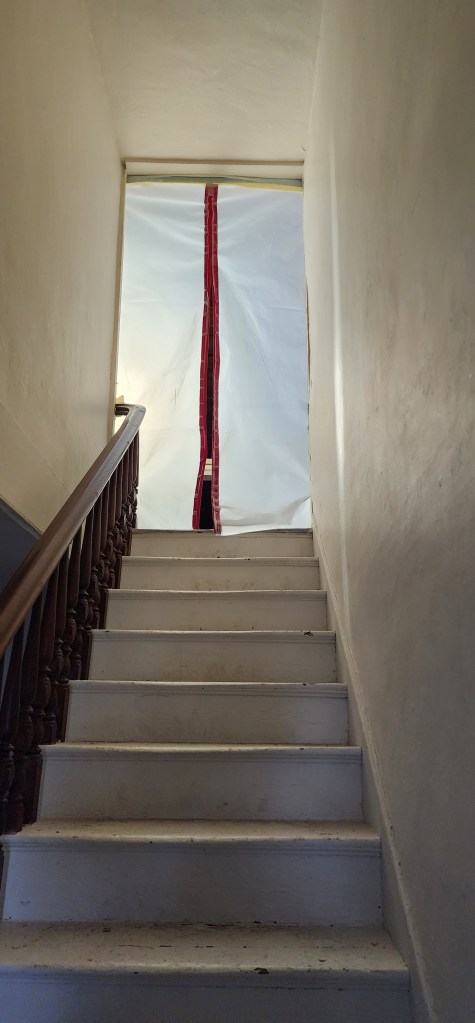
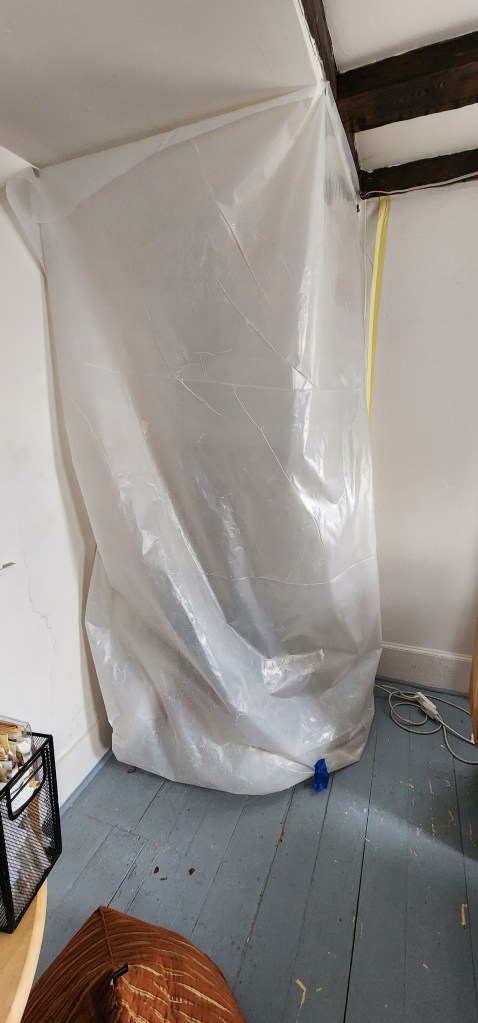
The zipper doorway to the second floor was the first step. And when working on the main floor, Adam erected clear-plastic envelopes he could work within. Made me think of the so-called “state rooms” on the historic schooner I sailed on last summer, where every inch was treasured. Adam’s power vac became a familiar sound.

It wasn’t the only place he was fastidious. I would never get my sawing accurate to 1/16 of an inch, especially not when dealing with an old beam underneath that was a half-inch shorter on one side.

Do note, a lot of unsung artistry goes on in projects like this. As well as a lot of weird shit, done by rank amateurs, those whose weird decisions you discover along the way. Long ago, on projects on our little city farm back in Dover, we realized there are many, many very good reasons for modern building codes and for the inspectors who ensure they’re followed.

Also appreciated were the health measures of venting the upstairs or wearing earplugs and a face mask. Our previous carpenter, back in Dover, discovered the hard way about the alternative, hearing loss, and maybe the lungs, too. I don’t know what to advise about plumber’s knees, either.

By being able to be present when all this was happening, I did get to follow the action. I’ll hope you, too, finding that entertaining.

Here these go again

The random notes in no particular order continue:

  1. Did college recruiters ever come to my high school? We weren’t elite and we weren’t any of the other demographics they were hot for. How about yours?
  2. Our high school guidance counselors did little more than sign you up for a draft card, as far as I can see.
  3. Genji was a definite historical character.
  4. Argentata chard … doesn’t taste like chard … hardier and cleaner than spinach.
  5. Gentrification versus decay.
  6. An inept lover, too charming by his very incompetence, unintentionally funky, nothing more than some everyday world seen through myopia. So why am I bothered?
  7. I love some of the drone videos filmed around here. But definitely not all.
  8. And then we learn that the mayor’s involved. As we said in the news biz, this story has legs.
  9. Yes, I remember Hudson, it’s up in the Cuyahoga Valley, a lovely New England style village not far from the Cleveland Orchestra’s summer home.
  10. Some writers place most or all of their plots in a particular locale, usually a big city or perhaps a state. Just never mine.


Hard to believe, but it’s really happening

With a sense of despair regarding the roof project and our lack of a contractor on the horizon, we went ahead and set about erecting raised garden beds for what would be my third summer of dwelling here. We would try to leave some space for a contractor to get at the house, should we ever, ever, find someone.

During one of the inevitable conversations with passers-by while installing the garden and its fencing, a trusted neighbor mentioned that she had just had some carpentry done by a former student, someone who had returned home after living and working away. She gave us his name and phone number, and an introductory conversation followed.

Yes, he could do the project, and he thought in could start at the end of August. I was startled when he said that was the upcoming August, not a year off. Could it truly be?

Naturally, there were delays while he wrapped up some other commitments, but we did find ourselves in a stunned state of disbelief when work finally began in earnest at the beginning of this past October. We finally had a contractor who not only showed up on the morning he promised, but also on the dot of the hour.

He hit the ground running, methodically, precisely.

At the heart of our big project is a new roof on the house. Not just the asphalt shingling, which itself has needed replacement – we could have found someone to do that – but the actual shape of the supporting rafters themselves. To gain much-needed interior space, the walls on the second floor are being raised. That structural work’s the complication. And how, as you’ll see.

When we were considering making an offer on the house, we were told to check out the rafters for signs of charring, a consequence of the 1886 fire that destroyed the canneries, wharves, and downtown. Sure enough, ours was one of the homes suffering damage though left standing.

A few weeks before starting on the renovation, our contractor stopped by with his mentor slash consultant for a closer look. More concerning, from their point of view, was the lack of a ridge beam. The rafters from each side were simply mitered together. In addition, they were further apart than current coding would permit.

Our project would be taking place in two phases – the back half of the roof last fall and the front half in the spring. Without a ridge pole, there was nothing to hold up the remaining half and nothing to support the new raised framing.

You’ll discover where that leads.


It’s been what you might call a zig-zag path

My professional life didn’t follow the conventional course, where the goal was to land on a major metropolitan daily. If not the New York Times, then the Washington Post, Chicago Tribune, Los Angeles Times, or the down the line from there. What were also called “destination” newspapers, with decent pay and more focused work in contrast to the sweatshops in smaller communities, or what are now called markets.

I had some near misses, but my route instead led me into places that remain largely unexplored, at least as far as literature or public awareness are concerned.

In my case?

  • Binghamton, New York, along the Susquehanna River and the Southern Tier of the Allegheny foothills. What I encountered there appears in Pit-a-Pat High Jinks and, with a heavy New York City connection, Subway Visions.
  • The Poconos of Pennsylvania, when I took off for a few years in a monastic setting based on yoga practice and back-to-the-earth community. This is the foundation of Yoga Bootcamp as well as portions of Subway Visions.
  • Fostoria, a railroad crossing in the flat but very fertile farmland of northwest Ohio. Gives rise to Prairie Depot in Nearly Canaan and to the opening novella in the Secret Side of Jaya. And, personally, the bride in my first marriage.
  • Back to Bloomington, this time not as a student but as a public policy research associate make that social sciences editor at Indiana University. My experiences as an undergraduate frame Daffodil  Uprising and What’s Left, while those as college staff feed into Nearly Canaan and the middle novella of the Secret Side of Jaya, both extrapolated to the Ozarks in Arkansas.
  • Yakima, Washington. It’s the Promised Land in Nearly Canaan and the final novella in the Secret Side of Jaya.
  • Dubuque, Iowa, along the Upper Mississippi. Adds some detail to Daffodil and What’s Left. Personally and professionally, it was a disaster.
  • Warren, Ohio, in the Rust Belt. Hometown News. And how!
  • Baltimore, Maryland, my base as a field representative for the Chicago Tribune’s media syndicate. More detail for Hometown News.
  • Manchester, New Hampshire, and later commuting from Dover an hour to the east. Revisions to the manuscripts and earlier versions.
  • And now, Eastport, Maine, in supposed retirement.

Curiously, my professional locations before Baltimore all infuse my fiction. Strangely, I’ve never written about Dayton, where I grew up, or the places later, at least as fiction. Poetry is another matter altogether.

Vincent Katz and my little red journal

When I set about planning and packing for a week on the water last year, I knew I wouldn’t be bringing my laptop. The electrical power on the schooner was mostly from some powerful batteries and two small solar panels. We could charge our cell phones and had small lights in our cabins, but that was about it.

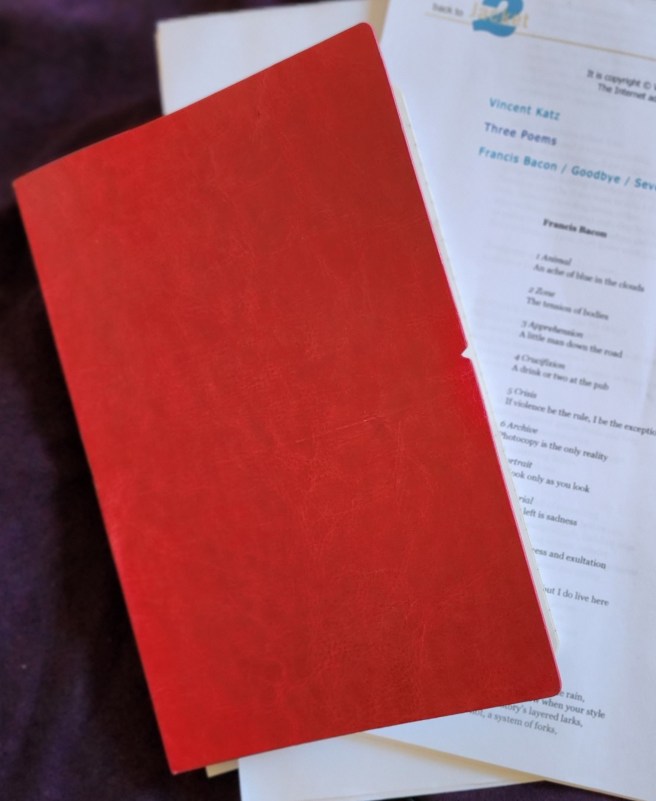
I did pack a Paris Review and a Harper’s magazine, should I feel like indulging in reading, but the heart of my “literary” life focused on a small red journal I had picked up a year or so earlier plus a few printouts of Vincent Katz poems that set a direction that has intrigued me.

Katz, like his father, the American painter Alex Katz, can look at mundane things in a seemingly flat tone that feels seminal.

Consider the line, “I wish I lived here but I do live here,” from “Francis Bacon.” It’s a feeling I know.

As he says in “Back on 8th Ave.”:

The job of the poet is not easy:
be utterly observant, tracking,
and to note down, in plain language,
with minimal emotional distortion,
what s/he sees.


For me, it had been ages since I’d sat down before a blank page and started off without any idea of where the words would be going. My usual journaling at least has a calendar full of events to catch up on, plus notes I’ve scribbled out, maybe even emails. And my more public writing has been things like this, with a purpose.

My goal was to fill the little notebook in a week. Quality or substance was not the measure. Just look and listen and try to be very much in the present moment.

It was a harder assignment than you might think. But it did provide much of the text for many of the posts you’ll be seeing this year.

Here are a few samples of what I entered:

looking for the obvious can be a challenge

 ~*~

Yellow house
behind a brown one
on a hill
flagpole and staircase
down to a wharf

the dreadful verses
you attempted
page after page
of aspiring youth
reached and fell

that stuff now is flatter
but more secure

likely no more profound
or less

don’t worry, Jnana, nothing’s happening
you’d think I could fill this small notebook with drivel in a week
but I’m halfway short

I did end the entries

[to be continued]

Hopefully, on an upcoming cruise in late summer.

A few thoughts spinning around Scripture

  1. Even if Biblical Scripture is essentially the “men’s minutes” of divine history, the women therein generally come off much better than the men – and whenever the women are named, there is growth in the church: Sarah, Rebecca, Rachel, Miriam, Deborah, Hannah, etc.
  2. Because the male gender language has been inclusive, representing the universal, there is no English way for men to refer to themselves in the particularity of being male – no way, in other words, that we can distinctly represent the specifics of being male only. So just who has been more impoverished by this defect?
  3. When I get away from my emotions, I’m also far from my God … (God is love).
  4. Argument: It’s possible to do religion without faith, but impossible to maintain a mutually loving connection without faith i.e. trust. Thus, positive relationship exists with the Divine.
  5. Hosanna and Alleluia as universal expressions of awe and ecstasy.
  6. Hashem = “the unnamable name” = neutral.
  7. Adoni = lord = male.
  8. Elohim = breast = female.
  9. The idea of “casting spells” is that you can order God/the gods/spirits to do your bidding rather than the other way around.
  10. Zionism originated to save a language. That is, a language needs a place where it lives.