Like an editor staring over a reporter’s shoulder as a news story comes together?
Just what are you doing, anyway?
Even with a saw and hammer?
You never know what we'll churn up in cleaning a stall
Like an editor staring over a reporter’s shoulder as a news story comes together?
Just what are you doing, anyway?
Even with a saw and hammer?
Week 7 brought the dramatic steps that would be seen from the street. This is a small town, after all, and people would talk. Fortunately, all we heard was approval and admiration.
As another plus, the weather turned in our favor, a week without rain.
As an added blessing, Adam, our exacting contractor, was joined by Keith, a simpatico master carpenter (even mediocre ones are hard to find around here). Fortuitously, they melded into a relentless team that raised the back wall, crafted new rafters, and encased the roof like clockwork.
Doing that precisely to an old freeform house like ours required many adjustments akin to sculpting, which these two performed with great understanding and patience.
The new wall would be sitting atop an old wall that was serpentine in length and height. It required a lot of precise correction.
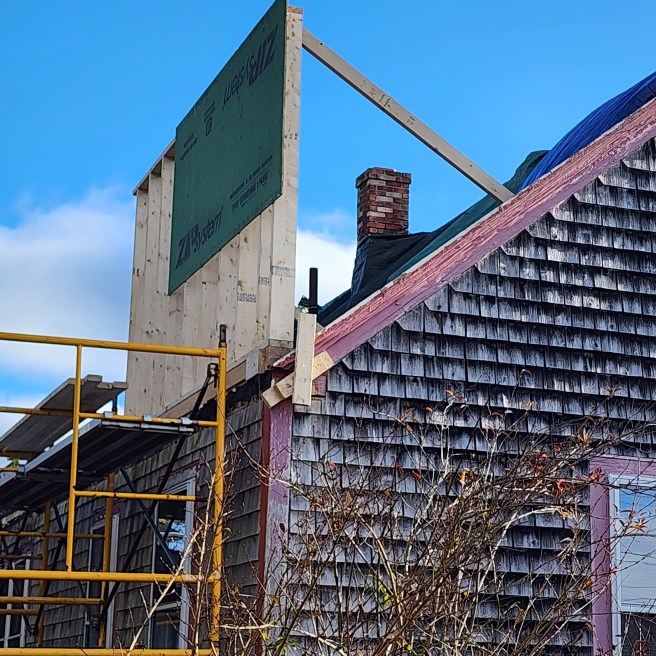
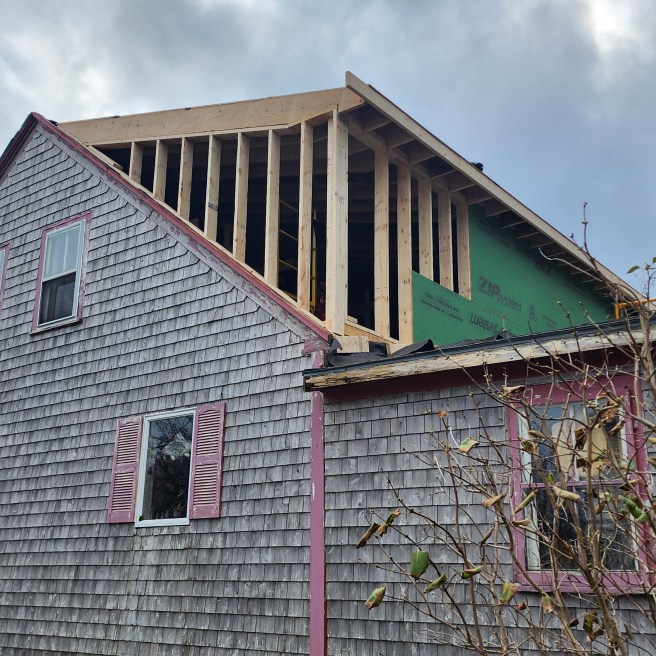
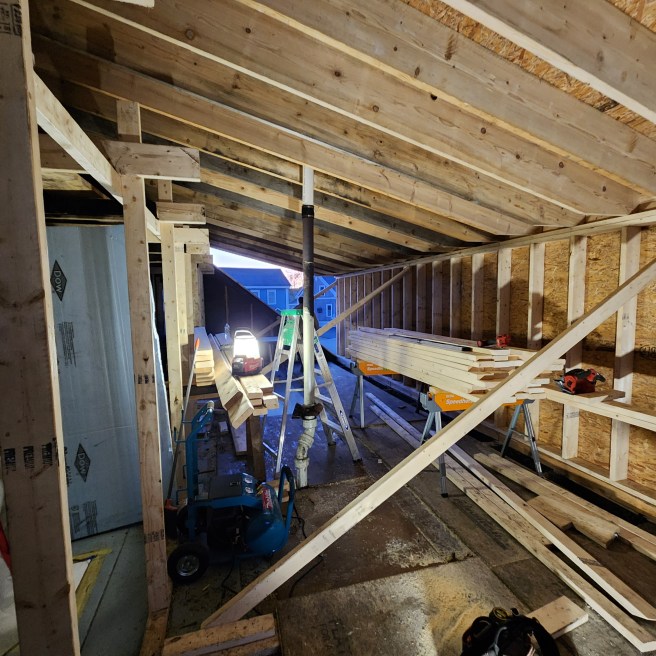

The week ended with the thrill of seeing back half of our greatly expanded upstairs actually buttoned up days before Thanksgiving and the wintry weather to follow.
The front half will have to wait till spring, but there’s plenty to do before then. Much more, actually, than I wanted to consider.
Shortly before finding myself officially unemployed, I engaged a typist to prepare a clean draft of Subway Hitchhikers for submission to literary agents or book editors. At least that would be moving forward.
And then, when the ax fell, I was surprised to find that after arriving in Baltimore, in debt from divorce and selling a house at a loss in a recession, I had saved up a bundle in just two years. Having a company car and an expense account covering my meals during the week added up. Rather than return immediately to the workforce, I decided to give myself some time off, a sabbatical, as it were, to concentrate on the writing I had always wanted to do. The kind that would put my name on the cover and the spine. Something more lasting than a byline on a daily paper or even, more prestigiously, a magazine.
Watching a colleague who was waiting till retirement before he could tackle the children’s book he always wanted to write nagged at me. I had heard a few similar dreams – wait for retirement. Except that a heart attack felled Russ shortly after he got that farewell cake.
In my job-free spree, I hunkered down to hard writing, up to 12 hours a day. By this point, I was pretty proficient with my personal computer and its dot-matrix printer. And so, while she was typing up Hitchhikers, I turned to keyboarding other material.
What I see as I look back on my sabbatical was that I entered the year more prepared than I’ve assumed. It wasn’t like I was sitting down and staring at a blank page and waiting for inspiration to strike. Besides, I had journal notes, correspondence, even maps and photos to draw on.
Every writer works differently, as interviews in the Paris Review demonstrated. The one with Jack Kerouac had inspired to use the end rolls of teletype paper for drafting, freeing me from having to keep inserting new sheets into the typewriter. Using a PC was like that, only instead of having to replace paper I had a 5¼-inch flopping disk that filled up. If only I had an editor waiting, like he had.
As I awaited word on my query letters to agents and publishers, I began examining my life from college to the present through the eyes of fiction. Keyboarding large sections from my journals gave me a foundation for following my moves from the East Coast back to Ohio, on to Indiana, again, and finally the Pacific Northwest, events that included my first marriage. Making it work as fiction, though, was the challenge.
My primitive PC was still a huge advance over typewriters, in my case, an Olivetti Editor 2. And here I had been seeing the ubiquitous IBM Selectric as an enviable sign of a successful writer? The thought is rather amusing today. Gee, and there was no Internet yet, hard as that is to believe now.
In my sabbatical I concentrated on a single manuscript and then put it aside as I awaited feedback from potential agents or publishers or maybe just for a space to season until I could come back to it afresh. That opened a window to start drafting another. I was a fiend, having waited years for this opportunity.
My hunkered down life? I got the deepest tan of my life by taking a midday break at the pool, at least through the summer. And did get out for hikes, especially in nearby pine barrens that had lead mine remains and a waterfall. Spiritually, I was connecting with Plain Quakers, liberal Mennonites, former Amish, and a small circle from the Church of the Brethren – all in the pacifist tradition. There was even a writers’ group that Tom Clancy addressed just as he was on the cusp of celebrity.
What I see now when I look at my earlier writing is that I could never have created those pages later in my life. Too many details would have vanished, along with the urgency and originality and even the voice.
The sabbatical was also a period of heavy reading for me, including the brat pack being edited by Gary Fisketjon at Vintage Contemporaries, Lawrence Durrell’s Alexandria Quartet, and George Eliot’s Middlemarch.
As my savings ran out, I still hadn’t found an agent or publisher. Realizing I’d need at least another year clear to achieve that, I reluctantly headed back to my career in newspaper journalism, this time in New Hampshire. There was a crucial shift, though. The archconservative Union Leader had a unionized newsroom where I could go back into the ranks as an editor and still earn more than most small paper managing editors across the country. I even had job security and a 35-hour workweek that allowed me time for a real life.
I packed up with the first rambling draft of what would become Promise, released via Smashwords in 2013, and two related novels, plus Hometown News and all of the outtakes from the subway project. I could continue to revise those drafts in my free time, but the book publishing world was changing in ways that baffled even the most celebrated literary agents.
Looking back, I must admit how much risk I took in my year off. I had no health insurance, for one thing, and no guarantee I could return to the shrinking ranks of journalism. I was also perceiving the pace I was working at could not be sustained.
I had been appalled in reading interviews with famed authors who boasted that they worked four hours a day – what slackers, I thought. Now I see that as a rather lavish amount of time, considering the additional hours of research, related correspondence, submissions, reading, and basic home-business demands (yes, writing is a business). Gee, how did I overlook all those hours of lunch conferences or cocktail hours in the lives of the literati, which were essentially business? Or even their hours in psychotherapy?
Or more properly, in the northern hemisphere, today is the vernal equinox, derived for the Latin vernal for “spring” and equinox for “equal night.” And that means it’s officially spring, even if there’s still snow on the ground or a blizzard in the forecast.
For folks south of the equator, today’s the beginning of autumn.
Either way, the date usually falls on March 20 or 21 – the 19th is more of a rarity, with the next one not until 2044. (Hmm, looking that far ahead, I’m not seeing any on the 21st. I’ll let the experts argue.) The problem arises in the fact the Earth doesn’t circle the sun in exactly 365 days – there’s that nagging quarter-day that gives us our Leap Year and its February 29, which we just passed.
That said, let’s allow ten other items spring up. Remember, in much of the world, we’re coming out of hibernation, of one sort or another.
After a week or more of finetuning the ridgepole and columns, Adam was ready for more drama. It was time for the old roof and rafters to go.
By now, much of the time the work was mostly loud reverberations punctuated by pounding and thuds within the top half of our house. Most of it mystified me. It often sounded like a war zone, especially when the air compressor kicked in. Not that I’m complaining.
Here we were, six weeks and thousands of dollars later and nothing we’d done was of the sort that would appear on a flip-this-house kind of a video streaming channel – the superficial changes that one local inspector we know dismisses as “lipstick.”
You do have to love an old house. Or, for perspective, an old lover.
Now we faced the decisive moment. Off with the back half of our upstairs!
A large, “rolling” dumpster was in place.
 That saw appeared like the fin on a shark.
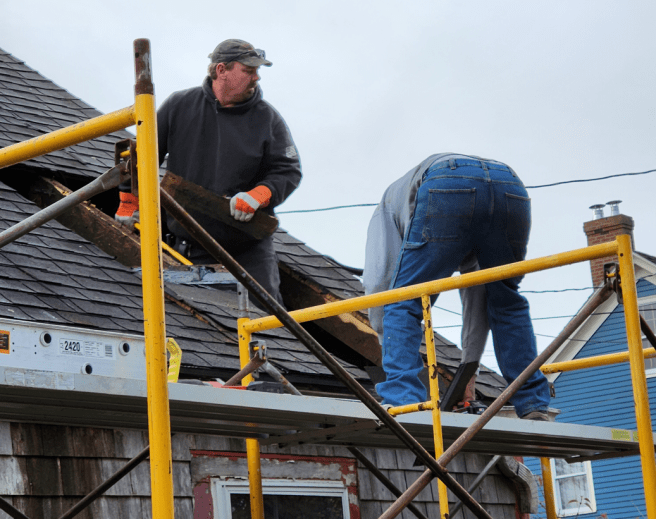
And then the roofing was removed in panels.

We got an idea of what a deck up there would be like.
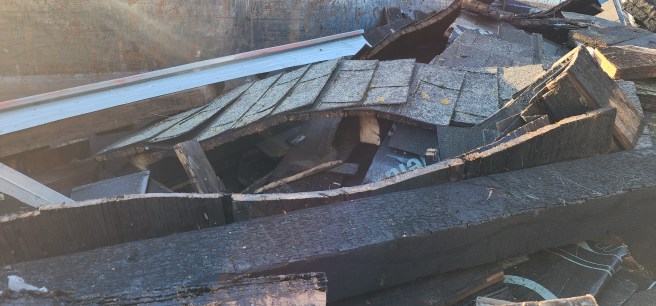
The dumpster quickly filled.

The last Saturday in October arrived clear and cool. We were now officially a month into the project, and Adam showed up with a crew of three for the dramatic operation of inserting a ridgepole. It was rather like laparoscopy, if you want to consider the small incision he made near the top of a street-facing gable.
Here’s how it went.
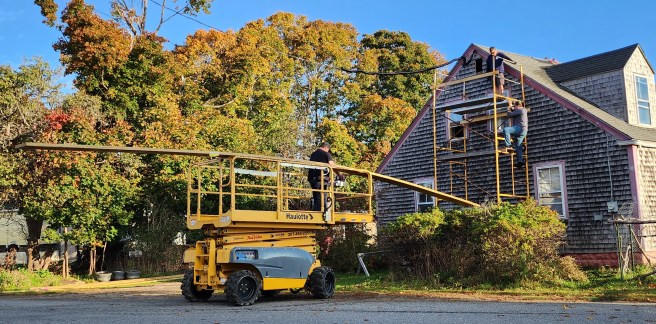
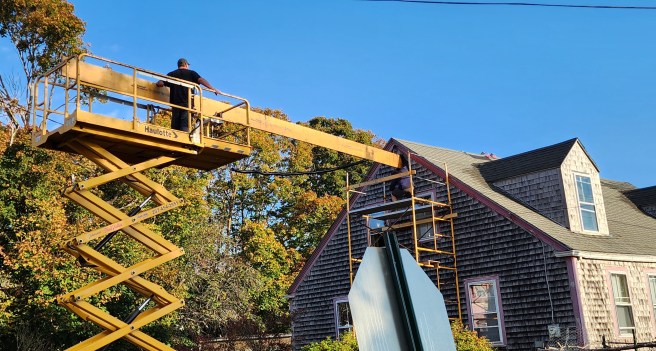

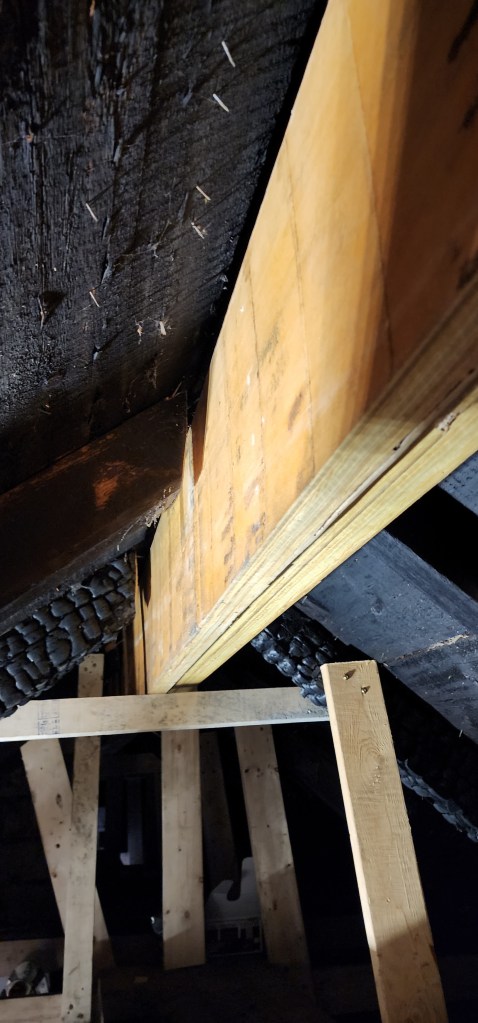
There was also the column to insert.
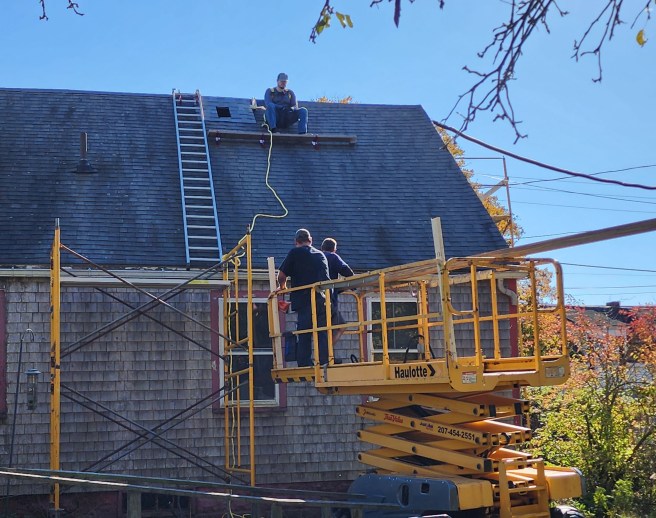


There was no anesthesia.
The ‘80s hit me with a couple of hard setbacks. First, Mount St. Helens blew up, as did my job in what I had seen as my Promised Land. I went bouncing back east, first to a stint along the upper Mississippi in Iowa and then three years in the Rust Belt of Ohio, where my shirt-sleeve management position ate up 60 hours or more of my life every week. Shortly after my first marriage fell apart there, my job was eliminated. At least I had a hot love going, with an engagement to be announced once I could relocate to Baltimore, where she had moved for her studies.
Somehow, I landed a field representative job with the Chicago Tribune’s newspaper features syndication service, one that allowed me to move anywhere I wanted within the 14 northeastern states I would be covering. Baltimore was perfect.
Except, once I ensconced in the top floor of an 1840s rowhouse in a gentile in-town neighborhood, my beloved wasn’t. If only I could get a straight answer from her.
Complicating matters was that I was out on the road three weeks out of four, home only to unpack and repack on the weekends. The job introduced me to a world many American men know: frequent flyer lounges, taxis and limos, hotels and motels, expense and mileage reports, quarterly sales meetings, three-piece suits custom made at Joseph Banks, a company car, bonuses. Newspaper management, especially on the smaller papers that I had known, were nothing like that. You might get a nice note from your boss or someone up the ladder thanking you for a particular job well done.
Getting from one sales call to the next gave me a lot of time for thinking as I drove or even reading, if I was flying. The time allowed me to decompress from a decade that had included 11 addresses in seven states. I could journey at ease or read or revise earlier manuscripts at night in my room, whatever its number.
My personal life included some of the loneliest nights ever but also led to my best friendship ever, a Plain Quaker who worked as a supermarket meatcutter when he wasn’t working as a nurse. I also had a circle of Mennonites who introduced me to four-part a cappella part-singing, a step that would lead me to the excellent choirs I would join in Boston and Eastport. I also visited among Friends, aka Quakers, and sometimes managed a few hours for genealogical libraries and archives or walking through cemeteries where my ancestors are buried. I even revisited the ashram and my old stomping grounds in upstate New York.
None of this apart from the newspaper world has entered my fiction directly. I thought she would be a fine character to build on, except in retrospect it turned out all too banal. What these experiences did feed was my poetry later.
Thanks to my best friend from my junior high and high school years, who was now living an hour south – unlike the previous decade, where we kept landing on opposite ends of the country – I obtained my first PC, something some of his buddies were building. It had 5¼-inch floppy disks, which would be ancient history to so many tech-savvy youths today.
In my travels, I saw much industrial wasteland. Not just Pittsburgh and western Pennsylvania or Sparrows Point outside Baltimore, but also around Philadelphia, across upstate New York, in Worcester and Buzzards Bay and the Merrimac/Merrimack River in Massachusetts and New Hampshire.
The newspaper industry was also taking hard hits. As manufacturing jobs disappeared, so did readership for afternoon papers, which were read by people taking the bus home or waiting for dinner. That greatly reduced the opportunity to place new features in their pages. As I was told, only a few years earlier, I would have had no difficulty selling to editors. Now, the challenge was keeping them happy with what they were already buying. I also saw great turnover at the helm of papers. I would curry an editor and have promises for a sale once the new annual budget was approved, only to find that he was no longer there in a year. The position I had aspired to and been groomed for was now revealed to be something less than desirable.
What became clear to the five of us out on the road was that the business was in trouble. One or more of us would be cut. I was the one. Besides, I really never was much of a salesman.
My observations of visiting other papers did augment my actual newsroom experiences that would emerge as the novel Hometown News.
One of the big themes running through my novel What’s Left was that “family” can mean so many different things to so many different people.
Maybe it’s all the renovations going on in our old house, but recently I’ve been pondering many varied understandings of the word “home,” too.
For starters, sampling of what others have said, a home is:
Is it even a place at all?
Cecilia Ahern insists it’s a feeling. Lemony Snicket pegs that as homesick, “even if you have a new home that has nicer wallpaper and a more efficient dishwasher than the home in which you grew up.” Maya Angelou relates it to an ache “in all of us, the safe place we can go as we are and not be questioned.” For John Ed Pearce, it’s a state of mind, somewhere “you grow up wanting to leave, and grow old wanting to get back to.” Edward Sharpe senses home as his beloved’s presence, “Wherever I’m with you.” Edie Falco connects it family when he returns to them from his paying job and realizes they make his labors “richer, easier and more fun.” For May Sarton, it must have “one warm, comfy chair” as the line between being “soulless.”
While waiting three years for our big renovations to transpire, I often joked that living here was like camping. I won’t go into the list now, but I did accept defects that could have greatly raised my blood pressure if they weren’t already on the to-be-addressed list.
I could even go into the pro-gentrification argument that if big repairs weren’t being undertaken, these dwellings were well on their way to collapse.
Our renovation, daunting as it is, remains a minor effort compared to a few others in town, including true mansions being brought back from the brink. One is a fussy restoration project to keep the place as close to historic accuracy as possible, apart from wiring and a kitchen upgrade. Another is to improve its Victorian social showcase qualities.
I’m also finally understanding why so many old houses out in the surrounding countryside have been left to fall in. They simply weren’t worth the cost of upgrading, not when you could build newer, better, even closer to the world for less.
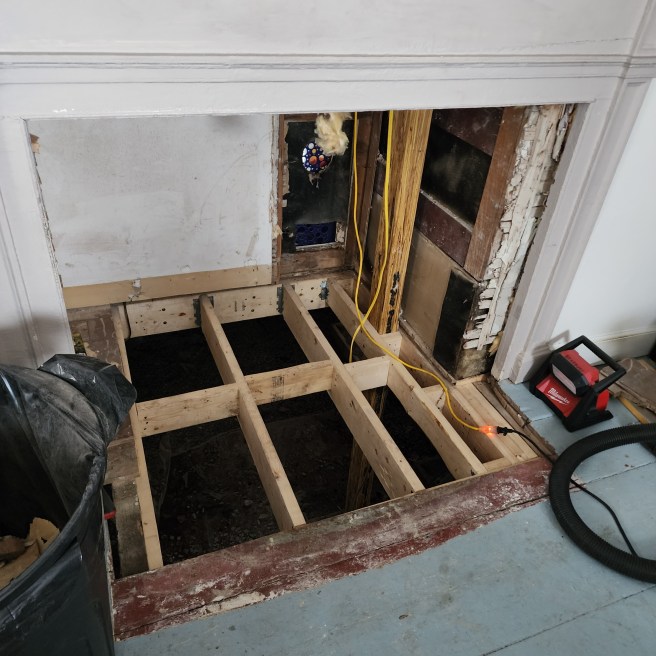

One of the annoyances we had tolerated was the big cavity where the second chimney had stood – the one that was about to collapse when we bid on the house.
We had passed on an offer to rebuild the brickwork, no matter how charming a working fireplace would have been. The chimney would have limited our remodeling options on the second floor, or so I argued, and without it, we do have a 2½-by-5-foot space to develop into a closet or something on the main floor. Patching the floor itself would be a huge improvement, as well, rather than having a light covering that couldn’t bear weight.
The cavity now provided a place where that 28-foot-long LVL column could run down through the house, as well as some new electrical wiring.
And, during a later break, Adam even fixed the holes.
Yes, step by step, it was all coming together.
 Jnana's Red Barn