Skillsets that became useful in my non-fiction book

Returning to that adage, “Write about what you know,” I realize how some work experience from my past gave me a unique edge in drafting Quaker Dover.

For instance:

  1. My journalism career included an early gig of pure research for a daily Action Line column. (We had an editor/writer, a secretary, and two researchers – big time!) Writing and editing, of course, were the staples of the rest of those years.
  2. From writing and then revising the novels, of course, I had explored the dynamics of building a large book and then the distinguishing qualities of fiction in contrast to journalism. I even learned to excise a hundred or more pages from a manuscript and not weep.
  3. My long service in Quaker meetings, as presiding clerk in addition to committee work and visitation, steeped me in the decision-making process and culture of the Society of Friends, past and present. Along the way, I gained familiarity with our peculiar customs and historic language, ranging from liberal “unprogrammed” worship at one end and old-order conservatives at another to pastor-led evangelical at the other extreme.
  4. Genealogy research accompanied much of those discoveries, especially as I gleaned the old minute books and journals. (Many of my findings appear on my blog, Orphan George.)
  5. Triangulation of three or more differing versions of an event, as I encountered especially in material and correspondence regarding my grandparents, became helpful in considering Colonial history in New England. I could live with the ambiguity while letting the conflicting accounts still add to the bigger picture.
  6. My long interest in geography – maps, especially – came to play in placing Dover in perspective with the rest of New England as well as Devonshire in England itself.
  7. My training as an artist in high school and my work with photojournalists in the years after came in handy in examining portraits of Quakers (once those were permitted) as well as related locations. Sometimes I could see where an individual was in regard to changes affecting Quaker practice and the world around them.
  8. Online sleuthing, rather than archives (which I had explored in the genealogy), came to the fore during the Covid-19 lockdowns. Somehow, I think my experience in formatting my novels as ebooks, fed into this, but I had already devoured many digital texts by the time I became amazed at the number of rare old, arcane books I could download for free.
  9. Despite the fact that Quaking Dover is a history involving political conflict, I was surprised to find that my political science degree didn’t add that much, though the way Vincent Ostrom had taught us to closely read an argument came in handy, especially in looking at a system from the ground up rather than top-down.
  10. Moving to Maine before the final revision and publication also added to my perspective as I settled in. Dover, like much of New Hampshire, gravitates toward Boston, as did much of the Dover Quaker history. Little did I suspect just how much Dover Friends and the broader community influenced the growth of Maine to the east and northeast once the territory reopened to English settlement once the conflicts with the French and their Native allies wound down – earlier than I had presumed, in fact.

As an added complication, we were getting a woodburning stove

Considering the frequency and length of electrical outages in Maine, having an emergency heat source in place was a high priority. I’ll explain later what derailed us from going directly from an emergency generator. Wood heat was the more obvious answer for us, but the big obstacle was that we didn’t have a usable chimney. We couldn’t just run up to Tractor Supply or Tru-Value, pick out a cast-iron stove, plug it in, and breathe a sigh of comforting relief.

Instead, we needed some professional advice, and that’s where we were stymied. Local inquiries led nowhere. The nearest wood stove and fireplace dealers were 2½-hour drives away.

Since Ellsworth has two, that’s where we headed. The smaller dealership was far more helpful than the other – and it referred us to a nearby chimneysweep who, after we approached him, did agree to install a stove for us as well as, more crucially, addressing the chimney situation.

While a previous woodburning cook stove in the kitchen had vented into the same flue that the furnace uses, that’s now contrary to building code.

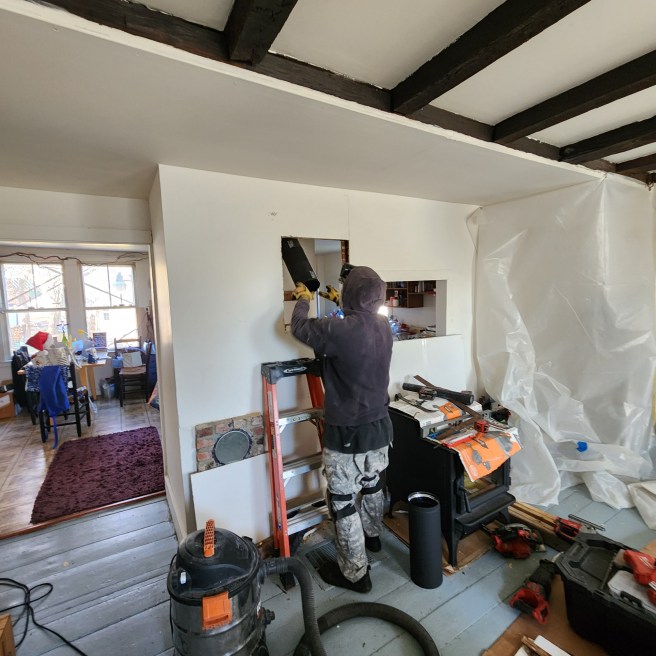
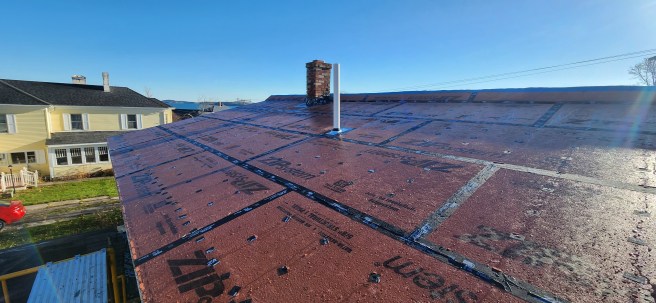
Tim confirmed that our best smoke-venting option was to run an insulated metal chimney pipe straight up next to the existing brick one. At this point, with our upstairs about to be torn apart and the rafters exposed, we wouldn’t be disrupting anything there. Our ultimate placement of the stove itself would require moving a water heater and a cold-air vent in the floor. Not that big of an issue, now that we had a contractor. Glory be!

As for the existing but inefficient hot water heater? That advanced our planned acquisition of a heat-exchange water heating unit, but just where?

That’s when Adam, our contractor, lined up a license plumber, Thomas. You’ll be meeting more of him later.

~*~

Back to the central decision, which stove?

From my days in the Pacific Northwest, I was impressed with the pioneering Norway’s Jotul brand, a view reenforced by our purchase and intensive use of a small model in New Hampshire two decades ago.

Still, looking for maximum efficiency of our new stove, I was pressed to research other available options. After all, a lot has happened in the interim. And how, as I discovered.

Since our stove was also for a power-outage alternative and not just supplemental heat, wood pellets were out of the question. Alas, perhaps. A pellet fire isn’t quite the same when it comes to simple repose.

Two new considerations for me were cast-iron versus straight metal. The former takes longer to warm up but holds longer. The latter, the opposite.

Since much of our usage Way Downeast involves offseason chilly mornings and evenings in spring and autumn, the metal models gained an advantage over cast iron. We’ll see how that holds.

A complicating factor was catalysts, which would require attention every few years – and, more critically, by whom? By this point, Jotul slipped from the picture.

From my book Quaking Dover, I knew that soapstone and other heat sustainers worked as efficiency boosters, but in this round, the added cost and weight didn’t fit our setting.

Vermont Castings, which had been our principal rival to Jotul, fell from consideration over quality control issues, as other, newer, brands came to the fore: Ambiance, Blaze King, and HearthStone, among them.

We did have to quibble about how our stove would look and function in our situation, but in the end, after a thorough review of the efficiency specs, sizes, and prices, we went with a Lopi model, one from an enterprising Pacific Northwest outfit.

Alleluia. We even got it installed before deep winter kicked in.

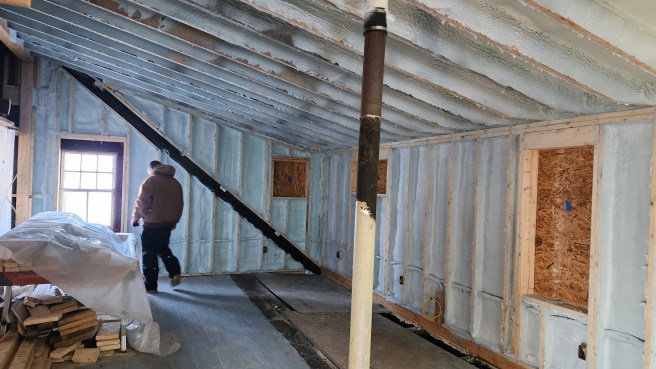
Second floor.

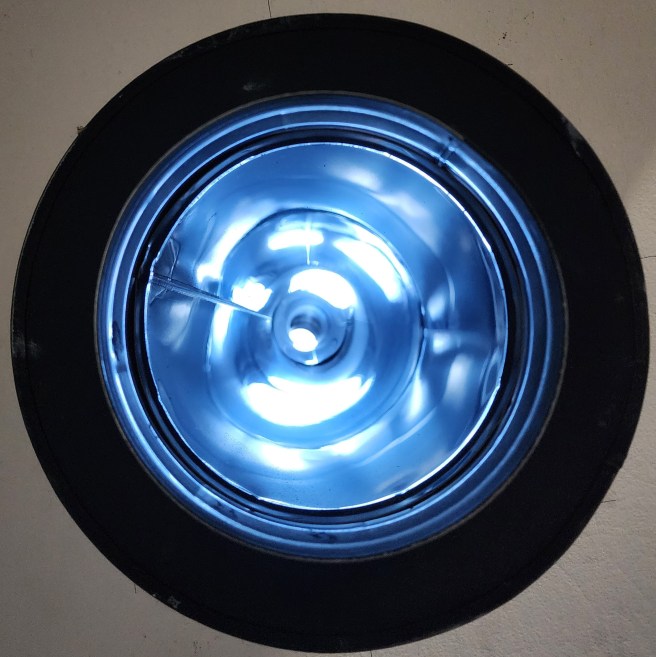
A view up the pipe before it was capped.

Meanwhile, on the ground floor.

And there it was, just in time for Christmas.

~*~

Let’s be honest. The new stove wasn’t entirely about emergency heating. It was mostly about having the utter pleasure of wood warmth. It was even about reducing our onerous fuel oil bills, even before we add heat-exchange units upstairs.

After waiting three years to get the renovations underway, the unfolding events sometimes felt chaotic. So much happened at once.

Still, looking at the glossy brochures, I’m left thinking there’s a much bigger picture left to be presented. Sitting back against the unrivaled comfort of a wood fire and reading in my favorite chair is an unsurpassed pleasure in my book. This was a definite improvement over our previous winters.

As a slide flash, as a writer I’m reminded about the adage, “Write only about what you know.” Is there anything like this in a novel? Or even a movie? Maybe the bearskin rug in front of a fire as a photo?

By the way, we never heard back from the other stove dealership. The bigger one. We do have an affinity for smaller is beautiful, especially when it’s family-centered.

Wandering through a personal wilderness without Moses or Miriam

Nothing was holding me Baltimore, as much as I loved it. And so, getting back into the American workforce in my mid-30s, I wound up in New Hampshire with the equivalent of a basket of wet literary laundry on those 5¼-inch floppy diskettes.

Although I had called on newspaper editors throughout the region, New England was largely unfamiliar to me. Apart from one couple in Boston, I knew no one. Beyond that, my love life was in ashes.

Thus, I unpacked in a new life along the Merrimack River in New Hampshire, the first of three addresses I would have in the state, fully intent on revising the lode I had mined and finding a literary agent or publisher once I got settled into my new job on the night shift.

What intrigues me looking back is that nothing in my life after my move to Baltimore prompted new fiction. Some details got woven into the revisions, but my literary output during the next three decades was mostly poetry, a more manageable format considering my hours of paid labor. Writing fiction demands the luxury of immersing yourself fully in the lives of your characters. It takes more than a full day once a week.

Besides, unlike my previous settings, New England has been thoroughly mined as far as fiction goes. What could I add to the picture? It had more layers and nuances than my previous locations, and many of them remained cryptic. Besides, I had enough to contend with in my existing manuscripts and the rapidly changing, increasingly confounding, commercial book world. Fewer publishers were accepting fiction, and those that did kept merging. More ominously, they weren’t nurturing promising authors with the hopes of getting a hit five books down the road but rather expected a blockbuster right out of the starting gate – if you could get in. It felt a lot like I had encountered as a newspaper syndicate field representative.

I was, however, appearing widely in the small-press literary scene, mostly with poetry but also chapter excerpts from the lingering novels. It kept me going.

~*~

My persistence finally paid off. After collecting the proverbial stack of rejections and a more widespread snubbing in which agents didn’t even bother to return the self-addressed-stamped-envelope, I finally got a nibble to co-publish with a Santa Barbara press of some distinction. Three years after my move to New England, Subway Hitchhikers appeared in print, right into what became the worst bookselling season in memory, thanks to the First Iraq War. Just my luck.

I did get one extended – and favorable – review, but that was it, no matter how much I pushed the self-promotion. My job schedule, which included a double-shift on Saturday, didn’t help. I couldn’t go to book fairs or author workshops.

My copies to sell appeared shortly after I had moved to a small townhouse atop the highest point in town. Moving them into the hands of readers and reviewers was the next challenge. As I said about the book market?

What did change was my self-image. Publication, for me, was the equivalent of a Master’s degree. I had something to show for my work. People respected that, even if they didn’t buy a copy. As for my personal life? There was a second Summer of Love! I was back in the euphoria of the early ‘70s, only better.

The swirl also had me thinking I could solve the tangle of my Pacific Northwest tale, so I kept revising, usually on a vacation week or holiday weekend.

And then, in 2005, Adventures on a Yoga Farm was published – as a pioneering ebook at PulpBits in Vermont. Again, it went nowhere as far as recognition, though several incarnations later, it’s Yoga Bootcamp and a much better book. As for timing? The yoga movement hadn’t yet rebounded and PDF books never really caught on. There I was ahead of the curve.

Somewhere in that stretch, my PC’s green screen went dead, already obsolete, meaning forget finding a replacement. Instead, the option was to upgrade to a new computer, one with a hard disk and telephone access to an online browser. Email was still somewhere off in the future. And I had to convert all of my keyboarded material from WordPerfect 4.1 to Microsoft’s Word. I wasn’t happy.

Are you one of the folks who recognizes these steps? Or are they all way before you came along?

And who sez the writing life is glamorous or that it runs along the lines of the movie plot were you’re suddenly rich and famous?

As I look back on this period, I see myself in a kind of wandering in the Sinai without a Moses or his sister Miriam to guide me. At least I developed an active social life, largely through contradancing and Quakers, and I was regularly riding Boston’s Green Line in underground tunnels.

Next up, a set of chain-reaction decisions

The roofing wasn’t the only thing taking place. We had to make some more key decisions regarding the next steps.

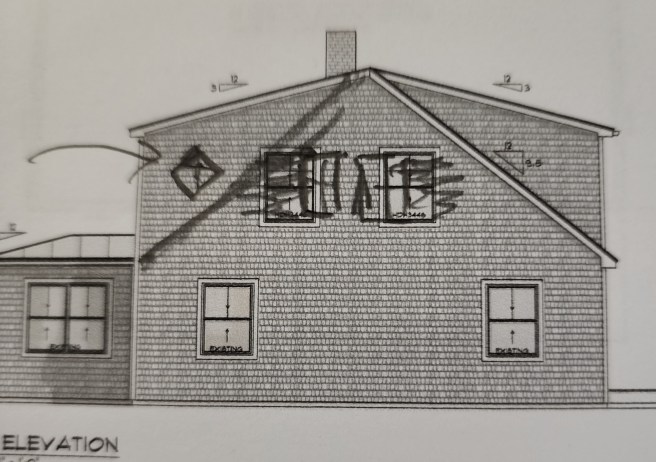
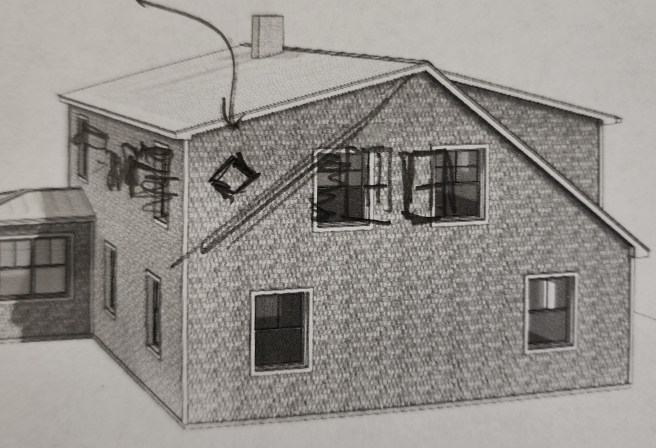
First was settling on the size and shapes and placement of windows in the back half of the house. We’ll examine those later. The glossy catalogues had a wide range of types and sizes, but no prices. For now, Adam needed to know where to frame them.

To do that much, we had to finalize our upstairs layout, at least roughly. A new bathroom and laundry room were part of that, details to come later.

Getting that far included electrical outlet placements along the exterior walls.

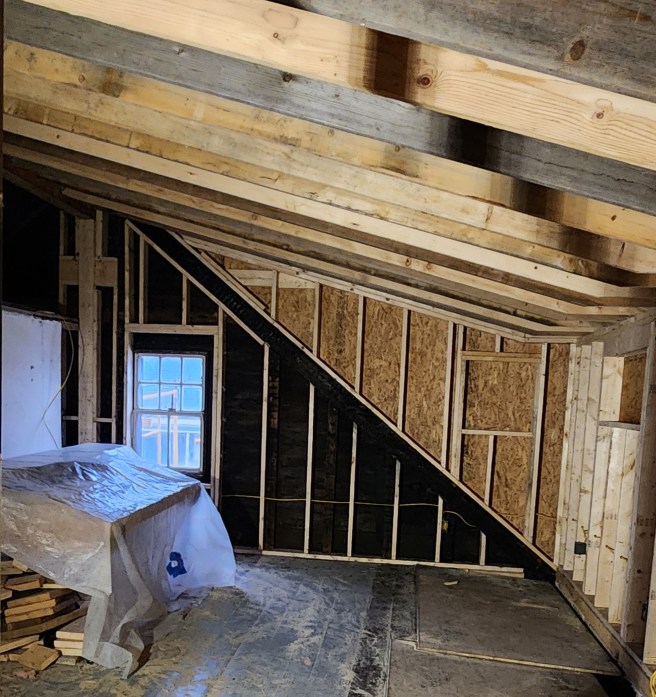
Those were steps that had to be taken before the spray-foam insulation crew showed up – which they did, two days after promised and leaving us with a nonrefundable Airbnb reservation. On top of that, we were required to be out of the house for 24 hours after they finished. Back to the Airbnb reservation. The crew’s deadline here was also contingent on a bigger job they were doing downtown – the two brothers live an hour-and-a-half from Eastport. We were second in line.

Before.

And after. Note that a diamond window in the corner is no longer in the plan.

Was avoiding a genre a mistake?

Introduced to contemporary Inuit art by professor who had been in Alaska as a consultant for the drafting of state constitution, I was told of one artist who never did a similar piece twice. If he carved an image of a standing bear, that was it – not even a painting or print would follow in that vein.

Apart from working in a series, which feels more like developing a single long piece, I’ve tried to avoid any sense of getting stuck in a vein of seeming repetition. I mean, if I do another bear, it’s going to be sitting or stretched out or even nursing cubs.

I have taken the thought to heart. I’ve wanted each of my books to be distinctly different.

Most readers, though, are different. Not just from me, but from art collectors, too. When these readers enter a bookstore, they want to know which way to head and then which shelves are most likely to produce pay dirt. In addition, publishers want to invest in sure-fire hits, even of a modest sort. Beyond that, librarians and literature teachers want to have labels to ease the handling of authors and new books.

And that’s why genres proliferate.

My, how naïve I was, setting out to write fiction. What’s the story? How well is it told? What’s it’s style?

First off, I don’t read in a genre. I’m not shopping for sci fi, per se, or romance or mystery or detective or fantasy or historical of any kind or young adult or even erotica aka pornography. And bestseller status means nothing for me, a veteran of the small-press scene. Nope, I’m fishing in what’s now called literary fiction, especially of the contemporary vein.

And, as I’ve learned, that label can be the kiss of death.

~*~

I object to genre mostly because it leads to stale, cliché ridden cookie-cutter commodities produced for mass consumption. I find them too predictable, formulaic, and jargon-filled. A genre comes with the requisite tropes, after all.

I write and read to discover, to make sense of life as I’ve known it, especially, no matter how far afield that goes. Haven’t I wandered across the Arctic or Sahara in some form, after all? I don’t need to go into interstellar space or an alternate reality to get away from everything. In fact, I doubt I can go anywhere without taking my personal baggage along. How about you?

 ~*~

As for conflict?

When Mrs. Hines, my senior-year high school English teacher, said that all fiction is based on conflict, I piped up, contrarian that I am, “Oh, no it’s not!” To some degree, I’ve been trying to prove my case.

Nor would anything I’ve done fit Kurt Vonnegut’s advice, “Be a sadist. No matter how sweet and innocent your leading characters, make awful things happen to them – in order that the reader may see what they are made of.”

There are no murders or bear attacks or invading armies in my stories. Well, maybe off somewhere in the distance. They never get personal. think most of my characters are nice folks.  Daffodil Uprising and Hometown News have the most outward conflict, I’d say, while Subway Visions has almost none. The most recent revisions have added some layers of darkness but not enough to alter the overall direction.

Stepping back, though, I see something that surprises me alone these lines. Almost all of my novels are countercultural, by definition in conflict with the surrounding society. In addition, the central conflicts are usually internal or small scale. In the Secret Side of Jaya, she sees and hears things others don’t. Tell me that’s not a conflict. Nearly Canaan examines the consequences of times and places a promise falls short, one after another, in the characters’ lives.

~*~

Still, I have to ask if my resistance against genre or commercial publishing has really been another fatal flaw in my ambitions. Would Subway Visions been more successful if I’d recast it as fantasy, for instance?

Was it foolish of me to avoid genre?

My genre, such as it is? Experimental fiction? It fits me but does little to attract a book buyer.

How about “contemporary history,” which is not an oxymoron. So much that’s happened in my lifetime is ancient history to the majority of the population. My daughters listen amazed at the era – did this or that really happen? Yes, I reply, and you take it all for granted. (Or granite, as I prefer.) So much of it runs counter to the mass-media stereotypes. Yes, my focus has been counterculture, as I’ve encountered it.

~*~

I do like the term genre-bending, which I’ve recently encountered. It’s something I was already exploring in the final round of revisions, especially once Cassia went goth.

A few things to do in Dayton

The Gem City of Ohio has taken some hard hits since I left for other points as an adult. Even then, many folks said there was nothing to do or see, but that’s not what I find in return visits. Here are some things I’ll recommend.

  1. Carillon Park: This charming 65-acre historical park, originating with support from the National Cash Register company and designed by the famed Olmstead brothers, is somewhat like Henry Ford’s Dearborn Village but much smaller and less crowded. Settled in the shadow of a limestone carillon tower donated by engineer and industrialist Edward Deeds and his wife, the campus of small, often historic buildings at the foot of a wooded hillside showcases the region’s industrial innovations and contributions to world progress. One pavilion displays an early Wright Brothers’ airplane, while other buildings feature the automotive self-starter (launching the Delco division of General Motors) and indoor refrigeration (leading to Frigidaire), among the many contributions inventor Charles F. Kettering that advanced the lives of Americans and the rest of the world. John Henry Patterson’s development of the cash register changed retailing from cigar-box accounting while pioneering modern marketing and creating demand where none had existed. The displays have grown and become more diverse, and there’s even brewpub and festivals now. Still, it used to be free admission.
  2. Air Force Museum: My, this trove at the edge of Wright-Patterson Air Force Base has come a long way from the old hangars it occupied inside the base when I was a teen. You can get lost in what’s billed as the world’s oldest and largest military aviation museum. Some of the Wright Brothers’ earliest work in human flight took place in this locale. Free admission.
  3. Cox Arboretum: New to me is this botanical delight on the former estate of newspaper publisher, governor, and U.S. Democratic presidential nominee James M. Cox. The floral displays and gardens at this 174-acre park can be stunning, the trails are gentle, and there’s even a butterfly house. Thank goodness it was spared from development.
  4. Dayton Art Institute: Some astute collecting over the years has resulted in a wide-ranging collection of masterpieces from both the Old World and the Americas. While others were bidding up prices on third-rate pieces by famed signatures, Dayton was acquiring first-rate works by lesser-known hands or rare pieces from Inca and Aztec traditions, among others. Now it even has extensive Asian galleries.    
  5. Paul Lawrence Dunbar home: The Black American poet is finally getting due attention. His neighborhood on the West Side, which he roamed with friends Orville and Wilbur Wright, is now restored and open to the public.
  6. America’s Packard Museum: New to me is the world’s largest public collection of Packard automobiles and memorabilia – more than 50 classic cars, thousands of parts, and a research library in a 60,000 square-foot facility that was built in 1917 as an art deco Packard dealership, the Citizens Motorcar Company.
  7. Miamisburg Mound and Fort Ancient: Many of my favorite memories involved hiking in the neighboring landscape. These two sites – one in neighboring Miamisburg, the other further south along the Little Miami River, give a clue to the wonders of the ancient peoples who constructed intricate earthworks we’re only beginning to comprehend – think Stonehenge, for an English parallel, only vaster. Miamisburg’s, for instance, rises 65 feet, has a circumference of 800 feet, and contains 54,000 cubic yards of earth, all built by hand.
  8. Clifton Gorge, John Bryan State Park, and Glen Helen: Upstream on the scenic Little Miami River, these three sites connect into one for the ambitious stroller. The gorge, or limestone canyon, was largely unknown when I explored it but is now more available to the public. The river then meanders through the state park and its trails. Glen Helen, in Yellow Springs, was part of Antioch College.
  9. Englewood dam: The largest of the five passive flood-control dams erected in the Great Miami River watershed after floodwaters in 1913 devasted the valley, Englewood’s is 4,716 feet long and 110.5 feet high, part of an innovative civic district and remarkable engineering feat that became a model for the federal Tennessee Valley Authority during the Great Depression. Here, as well as at the Taylorsville, Huffman, Germantown, and Lockington dams, the retarding basins on the upstream side and the wooded hillsides now form the Five Rivers Metroparks system. And downstream has never been inundated since.     
  10. Aullwood Audubon Center and Farm: Adjacent to Englewood dam is one more relief from the suburban sprawl that has overtaken much of Greater Dayton. This 200-acre sanctuary includes a nature center and educational farm, along with eight miles of walking trails.

Ten recent tools that greatly changed carpentry jobs

Remember, not everyone who carries a hammer is a carpenter.

Apart from the Amish, who often are master carpenters, today’s tradesmen are indebted to these advances:

  1. Rechargeable batteries for all those power tools.
  2. The Sawzall. Top of the list. Any project working on an older house requires getting through earlier construction. This chews right through the mess.
  3. Oscillating multitask tool. The Sawzall’s little sister. Chews through the finer details. It’s like the equivalent of laparoscopic surgery that doesn’t leave huge scars.
  4. Carbide blades. They go right through nails and screws and greatly outlive their earlier incarnations. Think time of constantly replacing the blades as well as the time and cost.
  5. Laser-light “stick.” (And before that, the retractable metal measuring tape.) Look, our contractor’s working with 1/16-inch tolerances. Accuracy counts, especially when dealing with hand-hewn beams and posts from nearly two centuries earlier. He’s trying to get a plumbline precision to preserve the earlier let’s-hope-it-works construction.
  6. Laser level indicator. This one really blows me away. Place the small device where you want and it shows an appropriate line all around. I have no idea how you’d accomplish the measurements otherwise, but they can be crucial. Especially when we’re dealing with everything that’s overhead.
  7. Structural fasteners. They’re engineered to be superior to earlier long screws or bolts. I guess it’s kind of like those zip-ties I’ve come to rely on in gardening, but I’m told this is huge.
  8. Cell phone, including Internet access. You know, YouTube advice, as well as ordering online or by phone, calling consultants, even checking on the status of other participants in the project. Not all of those calls are personal, not that I’d begrudge a hard-worker there.
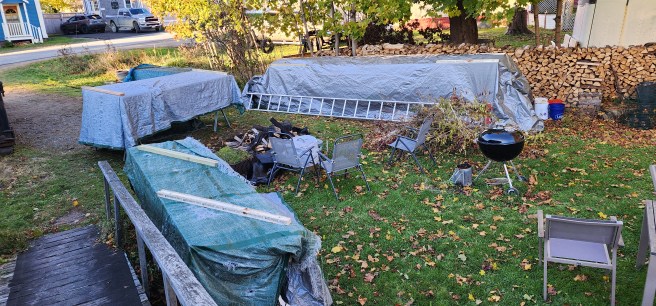
  9. Clear plastic sheets and zipper strips. A lot of dust and whatever goes flying around, after all. Keeping it rounded up is definitely appreciated, especially as we’re trying to live in the same house. Add to that the power vac. Maybe it’s a guy thing, but these are amazing. Even with water.
  10. Dumpster. I’m starting to see having one outside our house as a kind of status symbol.

Status symbols? We could do a whole other Tendril about those pickup trucks and trailers or the guys’ preferred brands.

Source: Mostly Adam Bradbury.

Weatherproofing the new exterior came next

We now faced some related decisions, beginning with the kind of roofing.

Our preference was for standing seam metal, but we were concerned about the price. It would, however, allow for a lesser roof pitch, and that would give us more headroom, and that was in addition to its added durability.

Asphalt shingles may be less expensive, but we live in a heavy winds-prone town. The forecast seems to have gale warnings every other day, at least for small craft out on the water. After a strong storm, the streets and yards are littered with blown-away shingles, even from new houses.

As I said, living beside the sea exposes us to a lot of wind.

~*~

The next decision involved the color. There were more standard color options than I’d thought from casual observation.

We liked bright red and the bold cobalt, at least for homes out in the country, but ours is tucked into a tight neighborhood and we wanted to continue to blend in. Our goal was something subtle but still classy. The color of the metal would also determine the shade of trim we would be applying later, maybe around the foundation, too.

We settled on a pale blue, which we find is common around the neighborhood.

There was far more to do up there than we could see from the street, and far more steps than simply putting the metal sheets down.

With condensation as a consideration, a vapor barrier went up. Strapping and rigid-foam insulation boards were fitted and secured. A weather-resistant fascia went around the trim. As did flashing.

And finally, we had the metal roofing itself.

After several setbacks from bad weather, Adam and Keith worked like maniacs over the weekend to have it securely in place before a hurricane-force storm – and then Christmas, a storm of a whole other nature.

~*~

As for the exterior walls, new cedar shake shingles were a given.

Haunted by a big bad Wolfe in a white suit

“You’ll be the next Tom Wolfe,” one creative writing prof promised me. I loved the guy’s flashy writing and, for the most part, his subject matter.

Where he eventually rubbed me wrong was his consternation that no big novel of the hippie era had appeared. There, he kept ringing as a prompt for me.

Part of his hook for me was the fact that my dream job in the newspaper world would have been as a columnist, especially one like Hub Meeker’s State of the Arts in the Dayton Journal Herald. Arts journalism was, alas, a shrinking field, along with the more general community columnist, like that paper’s Marj Heydock or Binghamton’s Tom Cawley.

Wolfe had briefly been one of those, at the New York Herald Tribune.

The bigger part, of course, was about that novel. He was dismissing Richard Brautigan’s unique voice altogether and others, like Gurney Norman, John Nichols, Tom Robbins, who rode the vibe.

Wolfe was also snidely suggesting that he had been the one exception, with his Electric Acid Kool-Aid Test, which really wasn’t a novel and predated the blossoming of the hippie movement.

His idea of the Big Hippie Novel reeked of the misguided quest for a Great American Novel.

Quite simply, there were too many strands of the movement to fit into a single book. Political or social action, anti-war witness, civil rights, gender equality, environmental awareness, organic and vegetarian foods, intentional community, group housing, alternative education were all part of it, even before the sex, drugs, rock’n’roll, hair, fashion, or slang.

These other factors would come more fully into play when I revised Daffodil Sunrise into Daffodil Uprising, and Hippie Drum and Hippie Love into Pit-a-Pat High Jinks.

I’d like to think of those books as nominees for the Big Hippie Novel distinction.

Wolfe’s charge also overlooks the outstanding nonfiction books that reflected the experience, such as Zen and the Art of Motorcycle Maintenance.

Moreover, I still feel that many of the difficulties in the current political scene arise from a failure to clearly understand the demons raging from the Vietnam conflict, both for those who fought in the army and those who fought the unjustified war itself.

So here we were, struggling through disco without having faced the lessons of either the hippie outbreak or the Vietnam disease. Hippie had become a dirty word, and many who had been happy to be one were no in psychological denial. It was something nobody wanted to relive either, apart from maybe Woodstock.

As others have observed, an ignorance of history carries a heavy price.