What a relief when spring arrives!

There was a seasonal correspondence with the renovation project and the winter season.

In a clime like ours, weeks pass when everything outdoors seems dead. Outside our vision, though, things are preparing for rebirth. Maple sap starts running, for instance, as the syrup makers know. And then the first flowers pop up.

Something similar was happening with the house work.

I mentioned the wiring. Here’s another look as it developed.

New wiring.

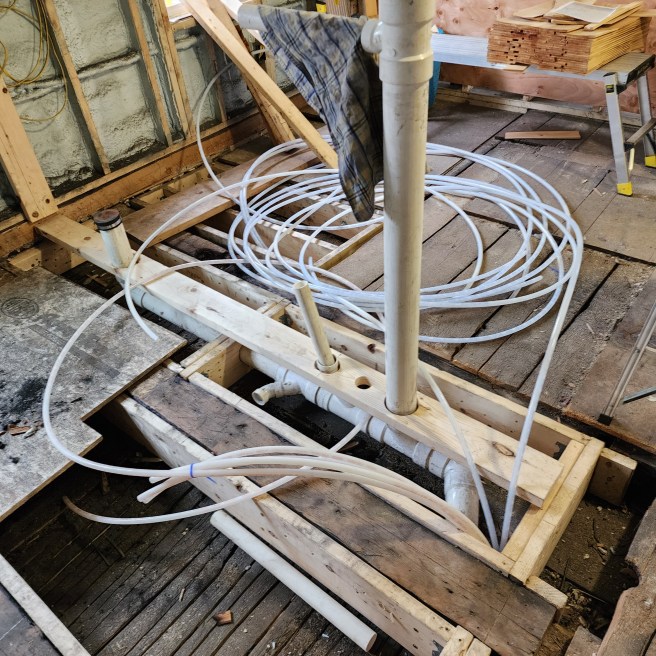
And then the plumbing.

And here I was expecting metal pipes rather than flexible tubing.

Selecting the toilet, tub, shower, and so on took more time than anticipated, especially when two separate trips to Bangor – a full day each – turned up nothing at Lowe’s, Home Depot, or Frank W. Webb.

You can’t always go by the description you find online or in a catalog.

I am looking forward to finally being able to take a bath without feeling like a pretzel. It’s been four years, in fact.

Visible progress was even appearing on the new exterior on the gable ends.

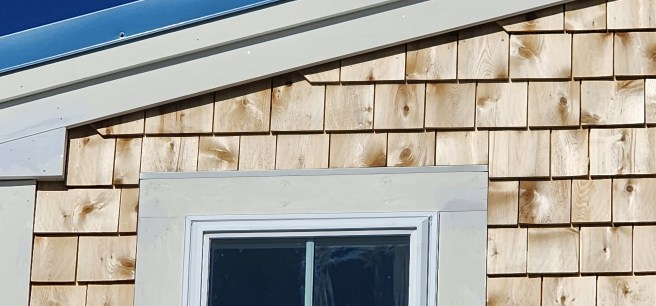
We love the little detail of the upturned notch on these cedar shake shingles. It matches the earlier ones that will remain on the other half of the exterior.

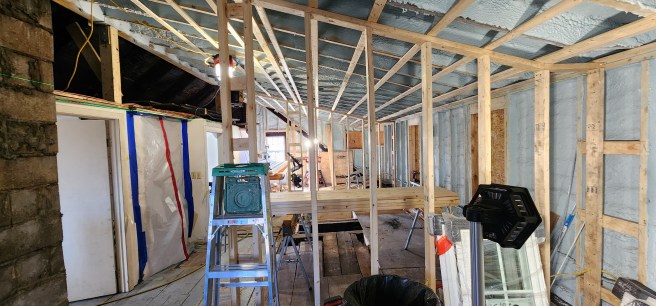
And the dividing walls along the center started coming down.

Do I sound impatient?

Is small really beautiful?

One place I was appearing as a writer was in the small-press realm. Largely unseen and at the fringe of the literary world, its prolific, low-circulation reviews, quarterlies, ‘zines, chapbooks, and even full-sized books reflected a passion for literature, an intense mission, or outright ambition rather than an accountant’s commercial motivation. Many were marginally funded, mimeographed or photocopied, while others had more traditional printers, perhaps even typesetters, and a few of the biggest even had paid staff. Most were edited by dedicated individuals or partnerships; others by an institution or circle; and still others by college English departments, with either students or faculty as the team.

It’s where the action was – and remains.

Among the book publishers, Black Sparrow and Copper Canyon stand out, along with Shambala for a Buddhist focus.

In general, university book presses garnered more respect and financial backing and weren’t open to those of us who weren’t in a professorial track.

In college, I had been told of a widely recognized poet who averaged 20 rejections for every poem he had accepted in one of these journals. That was meant as inspiration to keep us lesser voices from despair.

Well, a few years later, I was getting about 20 rejections for every batch of five poems I mailed out. Still, I got more than a thousand acceptances. They usually paid me with two contributor’s copies, or did before the action shifted online. There are some fine online sites, by the way, if you look.

The track was how you were supposed to build a reputation and even entice an agent or editor. I think they were all too busy to notice.

A newspaper career was usually supposed to grow the same way: start out on a small daily somewhere out in the sticks, one with next to nothing pay, and work your way up. Or as one critic warned publishers, this was a process of eating your young. Or your seed corn, in another version.

(The highest income I ever reached, by the way, was the national median. And that was thanks to our Newspaper Guild contract, unlike most of our rivals.)

~*~

Acceptances created another challenge, drafting a contributor’s note.

I noticed that many of the writers listed their most recent book or two, but I really didn’t have that much. Others went with where they were teaching or working on an advanced degree. With my name distancing myself from the more common tag I used in the newsroom, naming the newspaper wasn’t really an option – and not that wise, anyway, if the content was of a controversial nature, as many still saw the hippie movement.

The solution, then, was to look for some bit that would make me more human. Do try it, if you’re asked to come up with something similar. Even be flip, if you can.

~*~

The World Wide Web has taken all of this in a new dimension, of course.

We bloggers are essentially producing ‘zines or similar small journals. We even have photography as a regular option, not a given back in the day.

I’ve even gathered my published poems along with newer ones and published them as free PDF chapbooks at my own online imprint, Thistle Finch, a sister to this Red Barn. Do look it up.

More crucial has been the growth of ebooks and on-demand print publishing, which I’ll discuss in an upcoming post.

Like speaking to the ghost of my first lover

Let me explain. After showing my tech-savvy elder daughter a few things about Facebook during a visit, I had one of those “whatever happened to?” moments and chanced upon my first lover’s FB site. That led to what we call falling down the rabbit hole, in this instance this one where her photos and posts made me happy to see what appeared to be a good life … at least until getting to the point where she related that her husband had passed. Forty years together? Impressive. How was she holding up after the loss?

As I continued:

A lot has transpired since we last communicated, but I can say on my end much of it wouldn’t have happened had you not been so much a central part of my life way back when. You really did change my direction. Thank you for the positive things that followed because of that.

Should you want to know more or to just chat, fire back. Or peruse my profile or my blog for a sampling of what’s really been – and continues to be – a rich life, maybe more than ever. Yours, of course, is likely to be more fascinating. Best regards, all the same. Peace … 

Of course, I haven’t heard diddly.

A quick look at labor and income changes in America

Some realities and trends I find disturbing, as gleaned from Harper’s Index over the past few years:

  1. Hypothetical median income of full-time U.S. workers [2020] if income were distributed as evenly as it was in 1975: $92,000. Actual median income of full-time U.S. workers: $50,000. (Guess which direction the differential is skewered.)
  2. Percentage of U.S. manufacturing jobs that required a bachelor’s degree in 1983: 14. That required one in 2018: 31.
  3. Percentage of Americans who believe that a four-year college degree is not worth the cost: 56. (Are employers who expect a degree holder for a low-paying job getting a free ride?)
  4. Portion of all U.S. student-loan debt that is held by women: 2/3. (Does that reflect gender pay differences in similar jobs?)
  5. Percentage of unpaid taxes that are owed by the richest one percent of Americans: 70.
  6. Average percentage of their fortunes that the twenty richest Americans gave to charity in 2018: 0.8.
  7. Factor by which the average cost of a home in the United States is higher than the average salary: 8. (And the guidelines I grew up with said don’t go over 25 percent of your income. So now it’s twice that?)
  8. Percentage of Americans aged 18 to 29 who live with one or both of their parents: 52.
  9. Rank of workers 75 or older among the fastest growing demographics in the U.S. workforce: 1.
  10. Percentage increase since 2020 in the amount of work employees are doing outside of the nine-to-five workday: 28.

It wasn’t cabin fever, exactly, but somewhat close

The new year introduced what seemed like slow-motion forever, a superficially sluggish pace that lasted all winter.

The reality was that there were a lot more parts and details to attend to in a project like this than met the eye. As for patience? It’s a skill, as I’m observing.

Cutting the openings in the exterior for the new windows and then framing them inside and out was one example. One step required each window to be perfectly leveled and then sealed into place. It wasn’t nearly as smooth-going as you’d imagine. And that was even before Adam uncovered the rot under the north gable window. One more delay for repair.

I have to admit the varied sizes I’d chosen and their emerging views did give me a sense of confirmation and satisfaction, as did looking at the scope of the full back half of the upstairs.

Some of our new casement windows resemble what are called transom or awning windows.

Pulling up flooring to permit rough fitting for the piping in the bathroom and adjoining laundry room was another example, one we’ll cover in an upcoming post.

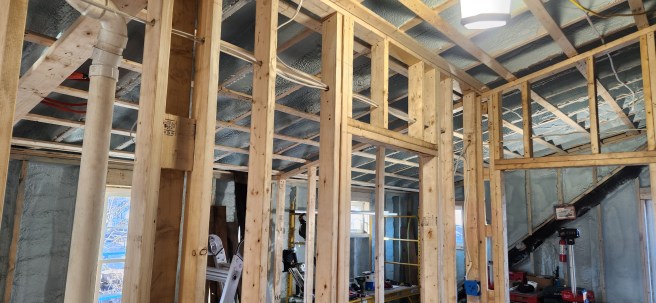
Framing for interior walls.

An unexpected discovery was a spider’s nest of tangled electrical wires, itself a violation of building code, but something that then led to the shock that none of our “modern” wiring on the first floor was grounded. Among other problems. Addressing that situation detoured Adam for more than a week, but it included a redesign of the wiring in the cellar, too.

That project was on our longer agenda, but it wasn’t something to ignore. I am delighted that we can now plug in three-prong wires without having to resort to those crazy converters for the two-prong sockets. As it turned out, none of our surge protectors would have worked when plugged into the old system.

It’s a huge relief knowing that’s all in our past now.

You’ve already seen photos of the knob-and-tube lines we found in the rafters. Some of those then led back to outlets on the first floor – connected by nothing more than stripping the main line and taping over the new wrapping. We already knew from experience that most of the first floor, plus the cellar lights, were on one circuit. Running the bread toaster and another energy hog could easily overload that, sending me flashlight in hand to reset the circuit-breaker in the cellar.

Our carpenter also found a junction box set in the upstairs floor – another violation of today’s building codes.

And here I’d been concerned about our lack of three-prong grounded outlets? Oy vey.

Of course, we’re looking to correct all that. My, are we.

In the end, the whole house was rewired.

Framing for the two bedrooms and the bathroom and laundry room also took time and care, as did the strapping for the drywall on the ceiling to come. For now, there were the electrical lines, outlets, and switches to install, once the holes were routed in the future walls.

The addition was really happening.

Outdoors, the back half of the house was surrounded by scaffolding. Although the first cedar shakes were applied to the new exterior early on, continuing was a random activity based on fair weather. The exterior work had to do more with flashing and the underside of the roof overhang. More details, as you’ll see in coming posts.

How much would have to be more or less finished before tackling the front half of the upstairs? Instead, we were trying to find crannies downstairs to move our possessions still parked overhead, but Adam also needed more workspace. It was amazing how many tools and related equipment he had there. Even his construction lighting was impressive, before we considered the permanent fixtures.

If I was looking for a halfway point, I was sensing the path ahead was more complicated. We still had plans for downstairs, too, if any of our nest egg remained.

Welcome to our learning curve and money jitters.

~*~

One thing we were discovering was that there are far more parts to house than you’d imagine.

All along, we kept hearing mysterious pounding and shaking overhead, the whine of power saws and the thumping of an air compressor, along with falling timber or worse. I learned not to anticipate taking a nap during what other’s consider normal working hours.

Aspiring to the big-time is natural

Let me confess to the allure of having an author’s photo and bio blip on the back dust jacket of a hardback volume. That’s always carried so much more gravitas than a mere newspaper byline – in my early days reserved only for major stories rather than distributed to just about every headlined item, in part to shift the blame for errors – or, one step up, the columnist’s thumbnail mug shots, for the truly honored writers. A magazine’s contributors page was a step up, especially when they included a full-color photo.

It’s not that being honored was essential – I was an anonymous, behind-the-scenes copy editor, after all – but more an acknowledgment of success, especially when it signified not being a hack. It’s just that everyone harbors a desire to be important, at least to someone, right?

~*~

For me, having the manuscripts but working on them part-time, I sensed myself racing a ticking clock. Would time run out on me?

The book publishing world was shrinking, as was daily newspaper journalism that provided my paychecks. Fewer houses were publishing fiction, and even those were in turmoil. They wanted blockbusters rather than the cottage-industry lines that previously prevailed.

Literary agents were struggling to support the writers they had and were less likely to take on new clients who would require more time and effort to promote. One, who had been considered hot just the previous year, replied to my query – a rarity, by the way – saying my proposal was an important book but not “commercially viable.” Another, equally acclaimed, vented her frustration with the changing publishing world and her struggles to cope within it.

Well, it did remind me of a letter I received from a newspaper editor I greatly admired during one of my job-hunting interludes. He was warm and welcoming, but confessed his career had turned into heading papers through their final days. From what I saw, he did manage some glorious sunsets.

My personal writing turned to several nonfiction projects that had commercial potential, but they, too, failed to break through the brick wall. One problem was that I was only a writer rather than an expert with academic or other highly placed credits.

It was a vicious circle. To get published, you had to have been published to some success.

~*~

It paralleled my earlier efforts to land a position on a major metropolitan newspaper. There had been some near misses, but the Union Leader proved to be a better fit for my remaining career. I even made it to the finishing line in a rapidly shrinking field.

In addition, “making it” as a poet was looking more and more like a dead end. Who can even name a living poet?

A few more things to put Maine in perspective for you

Geographically, Maine is the biggest state in New England – almost as large as the other five combined. That still ranks it 39th in size in the USA.

We’re also famed for some very dry humorists and fresh-from-the-sea lobsters the way Vermont’s stuck with maple syrup and a red leaves identity.

Beyond that, here are some other things that are unique to the place.

  1. It’s the only state that borders just one other state. But it’s also the only one that borders three Canadian provinces.
  2. Half of the state is essentially unpopulated – mostly forests, wetlands, black flies, and mosquitoes.
  3. Its craggy coastline is longer than California’s, but shorter than Florida’s and Louisiana’s and, of course, Alaska. While the state and its tidal waters are famed for lighthouses, Michigan – with four of the freshwater Great Lakes ringing its shores – has the most.
  4. The bulk of the population lives within twenty miles of the Atlantic and its tides. Less well known are the interior towns between the ocean and the mountains. Much of that belt’s suffering, economically.
  5. Some of the state’s biggest urban centers are divided into two cities by rivers: Portland/South Portland, Lewiston/Auburn, Bangor/Brewer, Biddeford/Saco, Brunswick/Topsham. Calias/Saint Stephen is complicated by the U.S.-Canada border. Augusta and Waterville are the prime exceptions.
  6. Demographically, Mainers are the oldest folks in the country. The median age is 45.1 years. About 21.2 percent of the residents are 65 and above while only 18.5 percent is under 18.
  7. Despite all the white steeples you see in the photos, Maine is among the four least churched states. Typically, it’s hovering at the bottom, with New Hampshire, Massachusetts, and Vermont as rivals. Some of the variation occurs when looking at religious affiliation versus measures of religiosity.
  8. Famed outdoor outfitter L.L. Bean in Freeport can be seen as the epitome of the Pine Tree State. But quirky discount chains Mardens and Remy have their own loyal following, as adventurous visitors discover.
  9. Maine is the leading lobster-producing state in the nation, employing more than 5,600 hundred lobstermen (male and female). The tightly regulated catch contributes more than a billion dollars to the state’s economy.
  10. The state is also famed for its wild, lowbush blueberries. More than 70 percent of them are harvested in Washington County, where I live. Ranked by dollar value in the state’s agricultural output, the berries traditionally come in second, a bit above $100 million a year, but way below the $247 billion potato crop, mostly in Aroostook County to our north or the $137 million milk output statewide. But medical cannabis sales, at $266 million in 2020, surpassed them, and that’s without recreational marijuana figures, $72 million in 2021. They’re expected to go even higher this year.

As if there would be a calm after the storm

The two weeks before Christmas got more than a little frantic around us, even without all of the holiday buildup. The renovation tradesmen were on a collision course. The spray foam crew gave us a date they would be in town for a bigger project down the street – they would dovetail us into the afternoon – but that meant the windows on the back half upstairs would have to be framed and the electrical outlets along the exterior wall would have to be in place before they arrived. We would also have to be out of the house for 24 hours afterward while the toxic vapors subsided.

Our contractor and his accomplished accomplice worked through the weekend to meet deadline.

We also had a plumber on-site – you don’t try to reschedule those guys, do you? It’s hard enough to get them at all. First, he was moving a cold-air duct for the new wood-burning stove and its metal chimney, accompanied by moving the water heater to make way for that metal chimney. As long as we were dealing with the water heater, we advanced our anticipated shift to a heat-exchange unit, which should drastically reduce our monthly electrical bill. While he was at it, he replaced the old sump pump and its precarious hoses. Some of those photos have already appeared in this series. We were delighted that the new stove and chimney were in place and working by Christmas Eve, when the rest of the family was visiting.

What I haven’t mentioned is the hurricane-force storm that hit a week before Christmas, pushing back the foam-installation crew by two days – along with our Airbnb reservation. (The tempest hit right after my choir’s two concerts, as if I needed any more activity.)

And then there we were, welcoming family and putting up the tree on Christmas Eve, this time in front of a warm fire.

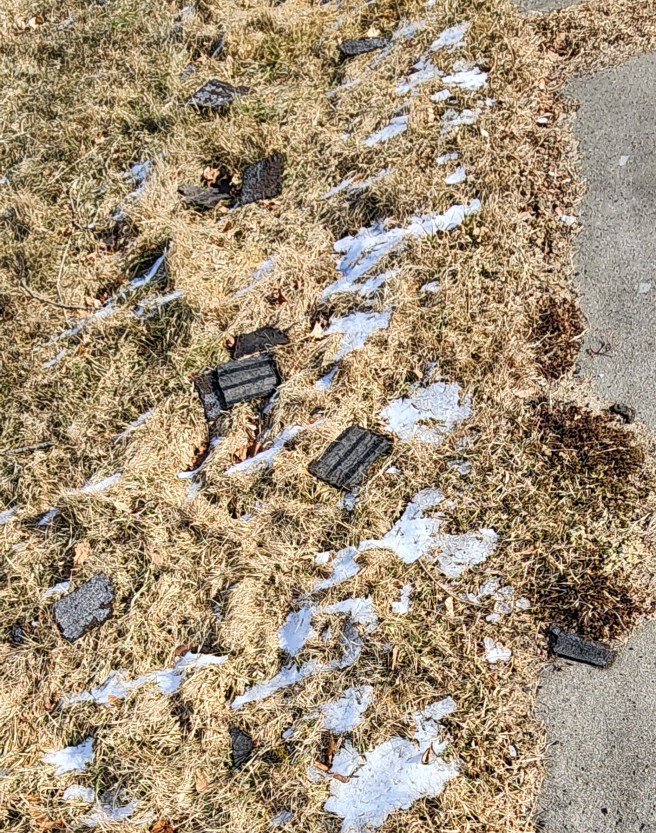
Our lawns, walkways, and streets are littered with asphalt roof shingles, thanks to some intense winter storms.

The region sustained two similarly intense storms, back-to-back on January 10 and 13, along with widespread power outages. Having a wood stove meant we wouldn’t be freezing.

Our roofing held, front and back, unlike many of the others around town. Asphalt shingles popped up in our yards and along the streets like dandelions in springtime, but few of them were ours. Even new buildings suffered. Not that we could sit back smugly. Our front roofing was still precarious, awaiting the next big step of transformation come springtime. And here the insurance company had insisted three years earlier we had to replace it pronto?

We were tempted to leave the space open.


With the windows framed and now outlined by the foam, we had a much clearer idea of how the upstairs was shaping up. In looking at the space, we found ourselves wondering if maybe we should just leave it as one big room. We let that dream give way to more practical thoughts, including gaining a second bathroom.

We did, though, decide to have the new ceiling rise with the roofline rather than be flat. It’s not quite as step as a cathedral, but who’s quibbling? It means the new bedrooms will be more like a tent or small pavilion rather than bland boxes.

Scratch that, add this

Back when I was a summer camp counselor, I had one of Phil Donahue’s kids among my assigned campers. On parents’ night, he advised me to revise, revise, revise, as he was doing as a newscaster. And then he turned into a hot syndicated talk-show host.

It took me a while to appreciate his counsel, along with the adage, “Talent goes into the first draft, genius goes into the revision.”

Originally, my feelings about revision were like those regarding playing musical scales, relegating the practice to a secondary status nay nuisance. It took me a long time to appreciate doing it as a practice in itself rather than as a prelude to the primary action.

Indeed, more than once I’ve discovered a better novel buried under the first draft. Or perhaps lurking in its bones, waiting for release, akin to Michaelangelo’s block of marble.

It’s never easy, though. Thorough revision takes longer than the draft did, and that’s for each sweep. The fact remains that multiple deep revisions will be required.

One of the places it engages me is the use of synonyms. I’ve come to rely on a thesaurus more than some other writers, and doing so comes with a caution. While it increases the vocabulary count and possibly adds words a reader doesn’t know, I feel it allows me to unpack dimensions of a central word or phrase that keeps repeating in a long work. In my case, there are usually 20 or so in each piece, and I find them cloying. Take the term “revision,” which turns out to include amendment, reconsideration, modification, adjustment, alteration, change, correction, improvement as its shadings. It’s much more thorough than typical editing.

In some of my manuscripts, the revisions demanded I change the tense throughout, as well as the point of view – third person to first to second, for example. The genders of key characters even flipped.

With ebooks, I’ve even replaced the titles and characters’ names.

~*~

While I had done major revisions on Subway Hitchhikers from its inception to the breakthrough publication, the manuscript had also grown blubbery with backstory and detail in the in-between stages. My revisions occurred in sweeps in my moves from Ohio to Indiana to Washington state back to Iowa and another corner of Ohio and finally Baltimore, adding backstory and explanation before landing on the butcher block that produced a lacy, playful ride through the imagination.

Still, that process was nothing like what happened after my move to New Hampshire and had a computer to work from. I can’t imagine trying to retype so many pages on paper, nor did I have the funds to hire a typist for the pile of drafts in front of me. Remember the poor starving artist image?

When Hitchhikers came out, I had been in New Hampshire three years.

I had all that excess from its intervening years and saw promise for several new books in those pages. I took them back to the drawing board.

Emotionally, I was going through a long recovery period, including therapy – self-induced depression, as I quipped. In the process, I was learning to take feelings more seriously, and that extended to my revisions. What was the underlying feeling in a particular line or scene, rather than simply the action or physical detail? That sort of thing.

At least I once again had mountains at hand, abetted this time by the Atlantic, and even a boss with a sailboat for some of my initial outings.

With a pile of drafts already keyboarded, I could pick up a section in any available time and work away to make it somehow better.

This was when I really began to appreciate the importance of deep revision. Not just the superficial polishing to make a story read more clearly, but transformations to probe into underlying events. I was examining much that I had experienced in my life without fully seeing what was happening at the time. Some of these were shared by many in my generation. Some by kindred spirits who were simply somewhere out of the spotlight. And some were essential unique and personal.

~*~

As I reflect on the revision process here, I ask about what was going on in the background. Remarrying grounded me, for certain, and gave me a sounding board for troubling passages. As I’ve joked, everything before that now became ancient history, including the substance of the lingering novels.

What, if anything, was playing in the background as I worked in the top-floor next, my not-quite Fortress of Solitude? Kronos Quartet, late Miles Davis, or the Shostakovich preludes and fugues might give me a different ambiance than Bach organ works or Beethoven – some inclination for edginess or gravity, depending. If someone was in the bedroom on the other half of the top floor could have an impact, too, if only by limiting by space to pace within.

The view outside, the weather, even the season of the year?

So far, I haven’t heard any discussions about the practice of revising, certainly not along the scale of drafting. I’m coming to think of it as living with a project, the way you would with a kid in the household, knowing vaguely that at some point they’re going to grow up and leave.
How I slowly became aware of Greek-Americans

Back in high school, my best friend’s mom was buddies with a Greek neighbor who used to proclaim, “Athens! She is beautiful! The rest of the country?” A spitting sound I could never ever spell out accompanied by the open palms of both hands coming down side by side from overhead.

His other best friend was Greek, too. A kind of philosopher, in fact.

My civics teacher was Greek, as was the drama and debate coach.

In college, a landmark restaurant just off campus passed into a new generation much the way the one in my fictional Daffodil did. Somehow, the details stayed vaguely with me.

Off in the Pacific Northwest, I became fond of souvlaki and spanakopita on our forays to the University District of Seattle.

On my return to Ohio, there was a delightful Greek bakery in a small storefront on a quiet residential street six or seven blocks east of our house.

In Baltimore, “All the pizza’s made by Greeks,” seemed wrong – where were the Italians? And out on the road, “All the diners are owned by Greeks.” Little did I know about flatbreads.

In New Hampshire, the Athens restaurant in downtown Manchester – popular but, to my senses, bland and tired – in contrast to one of my favorite takeout places where we ordered for the office – the menu that introduced me to gyros.

Add to that the cathedral’s big Glendi, which sent food to the newsroom in gratitude for our coverage, or the little frame St. Nicholas I’d pass on one route to and from the paper.

One of our older coworkers, a photo lab tech, was Greek – kind and smiling, though I got to know little else.

A sharp-tongued but very competent colleague in the composing room was also Greek. Named Pericles after his grandfather, though it was shortened for us.

All of this was fleeting and fragmentary but came together in Dover and its annual, free-admission Greek festival.

And then confirmed at Davos in Watertown Square, Massachusetts, a block down the street from our weekly choir practice. The food was great, though run by Hispanics.

Now I can tell you there are Greek-Americans almost everywhere. Opa!