Tag: Life
Reshuffling the deck
The unexpected complication of discovering that all of the dumpsters in town were tied up until after the big Fourth of July events forced our contractor to delay the demolition of the front half of our upstairs. Our attention turned instead to the back of the house, where a wheelchair-ramp and small deck were seriously deteriorating. Think of it as a safety issue.
The project would fit into the interim.
Unlike a previous owner, we didn’t need the ramp. Basic stairs would do in their place, and that would free up more of our small yard. The existing deck, meanwhile, was too small for our needs, and my coconspirators already had dreamed up designs that included a ground-level apron. For now, we would focus on the upper level just outside the mud room door.
The old deck top and ramp walkway were deposited at the far side of the backyard, where they will serve as a platform for stacking our next firewood delivery, keeping the split wood off the soil itself.
The deck structure itself became more involved than I had imagined. This house renovation is, after all, a vast education for me.
For starters, the new concrete footers were more deeper than the amateur ones and large rocks previously used. Three feet rather than a foot max. No wonder the deck was sagging. I wasn’t surprised there, but I was definitely impressed by seeing the new ones done right.
The underpinnings for the new top were another matter. No 2x4s or X-bracing this time. I wondered if Adam was overbuilding this, but he assured me this was according to code and would support a roof, if we decided at some point in the future to turn this into a screened-in porch. OK, I’m on board.
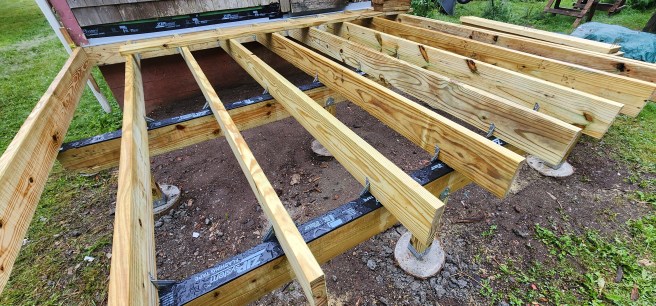
Carpentry really is about building boxes, as I once heard. The framing above became the rigid system below, awaiting the deck top and railing.
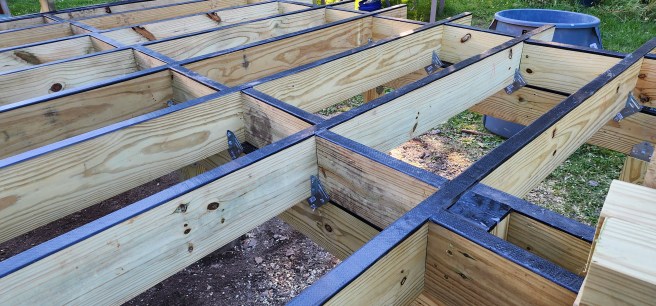
The results so far really are redefining our backyard and its uses. Dining out there without having to consider those nasty fire red ants under your chair is a definite step forward.
Poetry has been an influence, too
Through much of my adult life, I’ve spent more time writing and distilling poetry than I did with fiction.
Part of the reason was that poetry fit my once-a-week time for sustained “butt time” addressed to my literary efforts. A novel, in contrast, requires a bigger window, at least for me. I have to admire mothers who put something good together while toddlers and family meals gave little respite.
For me, the practice of poetry, both as a writer and reader, springs from the practice of meditation I took up as a yogi and continued as a Quaker, though now it’s once or twice a week rather than daily.
Prose simply feels more secular and aimed more at a general reader. And even there, I’ve come to see that writing hundreds of thousands of headlines for a living had a poetic component in its brevity. My personal writing was one way of staying sharp there. As for the hundreds of thousands of newspaper pages I designed? They did fall back on that intense visual art training in high school.
Like my fiction, my poetry originated in trying to remember and make sense of what was happening around and within me. Sometimes, when I got around to a manuscript of fiction, I would cannibalize a poem, especially if it hadn’t yet been published in a journal. That was especially true when it came to Nearly Canaan and the Secret Side of Jaya.
I wonder if any of this goes back to my childhood interest in chemistry and then being stymied when I wasn’t taught algebra when I needed it, back in fifth and sixth grades. Freshman year of high school was too late, my line of inquiry had shifted to classical music and visual art.
Poetry is a kind of equation, even geology, rather than the Friday night football game a novel can play.
~*~
My juggling act between the daily journalism that paid my bills and the literary aspirations that I hoped would finally free me did result in what I’ve come to see as literary graffiti – flashes written on the run, even when they then underwent much distillation and refining. I think that’s most obvious in Subway Visions, Nearly Canaan, and the Secret Side of Jaya but also befits everything except What’s Left, and even there may have crept in through the earlier outtakes I wove in.
~*~
Shortly after my books were up at Smashwords, a fine writer I know told me over coffee that I was more of a poet than a novelist. Ouch! He may have even said a better poet than novelist.
I hope I’ve improved since then and have arrived at a better balance in the revised books.
ATVs all around
My introduction came back in the late ‘70s when our landlord acquired a three-wheeler to get him easily from one end of his orchards to the other, and even up to the hill ranch and back. It was certainly easier to navigate through the trees than a tractor was.
These days, though, I see them everywhere.
Even though they’re not my cup of tea, here are some reasons.
- The machines themselves: More properly known as all-terrain vehicles, these small open motorized conveyances are either buggies (“quads” or “four-wheelers”) or tricycles (“three-wheelers” or “trikes”) with big, low-pressure tires and a seat that is straddled by a driver who steers with handlebars. So they’re not quite a motorcycle, OK? They are intended for off-road use, but commonly show up running on highway shoulders.
- Popularity: Honda introduced the three-wheeler in 1970, followed by the four-wheeler from Suzuki in 1982. They originally appealed to hunters and then sporting trail riders. Yamaha entered the market in 1987 with the Banshee, which added sand dune riders as fans. By the early 1990s, ATVs had also become a part of the American workplace.
- Pure fun: There’s a good reason for the big club down in Dennysville, as well as the recreational riders at the trailhead in Machias during their summer vacations. The activity is seen as a major tourism opportunity. You can zip along and bounce, feeling free. I think of them as a kind of three-season snowmobile.
- Ease of getting around: On the Passamaquoddy reservation just to our north, they’re a common way to get from one part of the village to another, no matter the rider’s age. Here in town, they’re still pretty much banned, with some folks complaining of the noise or potential trespassing. The controversy is a hot topic in many localities.
- Regulations: Few states require a license to operate an ATV. In Maine, where I live, there is an annual registration fee for an ATV. In addition, no one under age 10 is permitted to operate an ATM, and youths 10 to 16 are required to have completed a safety course and be accompanied by an adult. The rules don’t apply to land where the operator lives or on land owned by the operator’s parent or guardian.
- As for kids: Youths can drive them, although children under age 12 are advised not to ride machines having more than 90 cc engines or, under stricter guidelines, no one under 16 should be driving, period. In practice, though, parents do send the kids to the grocery and hear no complaints. In addition, smaller models designed for young riders are available. Engine limiters are among the safety features. Still, an estimated 22 percent of the deaths involved children under 16, as well 26 percent of the reported emergency room injuries.
- Safety: From the beginning, deaths and serious injuries occurred, most of them blamed on reckless operation and failure to wear safety gear such as helmets and goggles. Tipping and rollovers accounted for a majority of the accidents. In 1987 a moratorium on the production of three-wheelers went into effect, shifting the market entirely to four-wheelers. In 2021, there were 293 deaths on public roads – 59 of them riders age 29 or less. Texas, West Virginia, and Pennsylvania have the highest fatality rates, followed by Kentucky and California.
- Environmental impacts: They’re largely negative. Off-road use contributes to soil erosion, damages vegetation, and disturbs wildlife habitats. All uses increase noise pollution, greenhouse gas emissions, and air pollutants. On the other hand, they’re not as bad as a pickup.
- Cost: Roughly $4,000 to $12,000 for a new one, though customization can really up the total.
- Annual sales: North America recorded $2.2 billion in sales in 2022, nearly two-thirds of the global market, and it’s growing.
Now, for some ‘Bodoni-Bodoni’
Hometown News is the one novel Cassia from What’s Left didn’t press me to revise, but it got the treatment anyway. At least the title stayed the same, though the subtitle “Reports from Trump country” was added.
Political novels rarely work, so I’ve heard. And I didn’t pitch this was as dystopia, though casting the book more along those lines might have been more successful.
The book still stands apart from my others.
In the time since its first draft and my big round of deep revision, much that I had investigated only worsened. The once powerful newspaper industry was a ghost of itself, and many of the once legendary nameplates were owned by hedge funds whose owners or managers were among the world’s top billionaires. The Rust Belt communities like Rehoboth still hadn’t rebounded – their lucrative unionized manufacturing jobs were never coming back, either.
~*~
Unlike my previous newspapers, the final one I served had job security and decent wages, thanks to our Newspaper Guild representation. I finally made it to median income, even.
Socially, its newsroom broke down into three distinct circles with little overlap. There was the daytime staff, an echo from the days when we still had an afternoon edition; it was the crew that did the features and opinion pages. The nightside staff produced the next day’s daily editions right up to 1 a.m. And the Sunday News staff worked a four-day week culminating in a double shift on Saturday. We got to know each other the most through union meetings revolving around contract time.
At my first paper, where we worked into the night, the staff usually gathered at the bar next door after their shifts and stayed till closing time.
At another, where we were mostly young and without kids, it was on Friday afternoon – the POETS society, as our divorced city editor dubbed it: Piss On Everything, Tomorrow’s Saturday.
Usually, everybody lived at a distance from the newspaper plant. Few could afford the rents or mortgages in the city of publication.
I can’t speak for other office situations or professions, but I did find that close friendships were rare. You knew your coworkers more by a phrase or two they repeated or a favored style of clothing they wore or, as some of the guys seemed to do, by the kind of car they owned.
Still, things came up at parties. Consider the quip from one generally naïve woman regarding the allegator-skin cowboy boots one of the sportswriters once appeared in: “Hey, you look like a pimp. What’s up?” And then the shock we felt a month or two later when he was arrested, having procured women and motel rooms for men in the car racing circles he covered.
At these gatherings we usually huddled around the share our war stories and talk what one spouse dubbed “Bodoni-Bodoni,” after a widely used headline typeface.
Most of the papers I worked at were the smaller operation in a broader market. And I usually was part of a news team with a competitive, aggressive mindset. That part was exciting.
In the revisions, I did have a new paper to draw on, not that it was of the progressive mold I was pursing in the book. The daily interactions, though, could be just as rich.
~*~
From what I’ve seen, the situation of low-level, “shirt-sleeves” managers has only worsened across the board. Perhaps the Covid pandemic work-from-home option has eased the pressures on white-collar jobs, but that happened after my final revision.
There was little job security in working for mass-media companies. When I was with the features syndicate, I’d spend a year nurturing a relationship with the top editor, who promised to buy a certain comic strip or opinion-page columnist or weekly business report from me when the next annual budget was approved – only he was gone by then. Turnover was high, often blamed on “bad numbers” like shrinking circulation or advertising revenue. Or, in one case, because the company headquarters decided to buy a radio and TV broadcast chain.
I do wonder what happened to several of the family-owned papers I called on. They’re top editors didn’t feel a need to attend the usual annual conventions where networking occurred.
I should also mention that several of the papers I worked for did bring in management consultants, giving rise to the team in my novel. Give credit to the one that threw up its hands halfway into the projected year of monthly meetings, declaring that the news business just didn’t fit any of their models.
The Dilbert comic strip touched on many of the office realities, but at a superficial level.
Best-selling management books – Tom Peters’ In Search of Excellence, for example – were exciting but didn’t reflect the everyday realities we faced meeting hourly deadlines leading up to the big, final deadlines. The ones you didn’t dare miss by more than a few minutes.
~*~
So I made tweaks to strengthen the focus on central characters and acknowledge the big hit from the Internet.
~*~
I should say something about public misconceptions of journalists and their papers.
One colleague, who lived a block from me in the town I call Rehoboth, told of a neighbor who complained to him every time the met around the driveway. There was always something wrong with something we’d done. Finally, my buddy fired back. “What do you think the reporter of that story is paid?” The man, a steelworker, fired off a figure. “Less than half of that,” my buddy said, “and she has a Master’s degree.” The man was shocked. After that, he always had something good to say.
As for the right-wing perception of liberal bias, the reality was that many of the biggest papers were unabashedly conservative: Chicago Tribune, Los Angeles Times, Phoenix Republic, Boston Herald, Cincinnati Enquirer, Columbus Dispatch, Indianapolis Star, and probably the majority in the smaller markets. And that was before Fox.
If there’s a bias, it’s for facts rather than presumptions. The Louisville Courier Journal’s Pat Siddons, who covered Bloomington, once said. “I know I have a controversial issue right when I get complaints from both sides of a story I’m covering.”
The fact that journalists are largely low-paid, working nights, weekends, and holidays, did nothing to incline them toward big business, though. One thing we hated was injustice. Another was the lies that accompany it.
~*~
Trying to locate Rehoboth?
It was a composite, drawn mostly from the Rust Belt that extended from Philadelphia and Baltimore west to the Mississippi or so. While my book describes the steel mill that dominated the town, similar communities may have had auto assembly plants, appliance manufacturers, parts makers – the list would be long, like the empty factories they left behind. I observed large swaths of devastated industrial zones in Youngstown, around Pittsburgh and greater Philadelphia or upstate New York or Detroit – places that resembled arial bombing scenes from World War II Germany and Japan. Similar scenes existed along the Lake Michigan shoreline of Indiana, and across Wisconsin and Michigan.
I could now add to that the former papermill towns of Maine.
The fact that there’s personal breakdown as well, as I present in the story, is more than symbolic.
~*~
As for authors and books percolating through me during the final revision and later, the culture J.D. Vance describes in Hillbilly Elegy is one I knew well. Our high school basketball team played his, for one thing, and I had toured its steel mill twice as a Boy Scout. His Middletown could be one more nominee for my Rehoboth.
Add to that Ben Hamper’s Rivethead: Tales from the assembly line, David Foster Wallace’s The Broom of the System, Charles Bukowski’s fiction, a shelf of business case-studies, Kenneth Patchen’s poetry, E.F. Schumacher’s Small Is Beautiful. And Brian Alexander’s Glass House: the 1% economy and the shattering of the all-American town is high on my TBR pile.
~*~
Seeing the loss of status and influence of an independent press has been personally painful, as has the breakdown of communities despite the opportunities of small is beautiful, especially in the Midwest.
Since the final revision, one of the figures in my book, the major scumbag, really, died in a horrific late-night car crash. And pneumonia took out Major Bohroh a little over a year ago.
If I were to tweak Hometown News yet one more time, I’d intensify their evil nature.
A few more inches each way add up
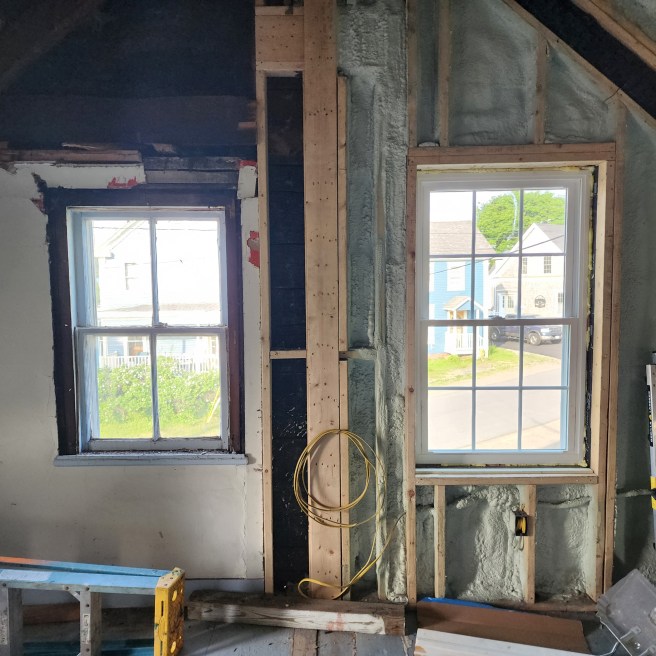
The new window, right, replaced a smaller one like the two-over-two at the left in the gable of our upstairs. The smaller one will soon be upgraded as well, and a closet will be inserted into the space between them to divide the bedrooms. The new double-hung sash windows match the ones downstairs in size. The amount of additional light and the enhanced views already amaze us.
Domestic pestilences
Let’s go alphabetically. Shudder or cringe as you will.
- Ants.
- Cockroaches.
- Deer, where I live. Doesn’t mean we don’t enjoy viewing them, but we know how much they devour. Even the flowers.
- Fruit flies.
- Houseflies. Even more than mosquitoes.
- Maggots.
- Mice.
- Rats.
- Spiders.
- Squirrels. And chipmunks. They may be cute, but when they get in the walls, watch out.
What are we overlooking?
It simply looks right
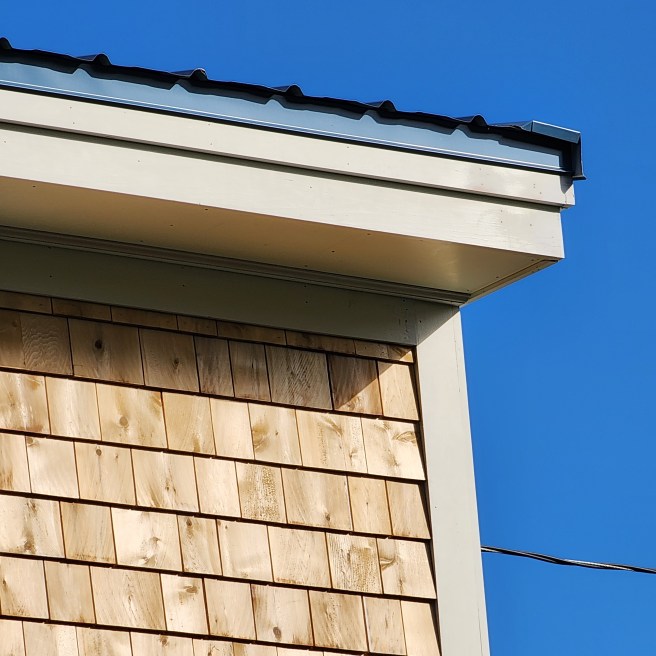
Looking up at the new roof’s overhang and fascia gives me a feeling of satisfaction. Far more labor, care, and skill went into these layers than I would have imagined. Our contractor is not one for shortcuts. He certainly intends for this dwelling to stand erect for another 200 years or more.
Consider that bold ‘John Hancock’ on paper
As a writer, I love what alphabet letters and words by themselves can do on paper, apart from any meaning. Just look at one man’s intrepid signature on the Declaration of Independence and try to imagine that document without it.
I used to love visiting a friend who was a professional calligrapher and type designer. This was her life’s work.
Are other writers also inspired by such visual artistry?
The Lilly rare book library at Indiana University puts on exhibits of historic volumes, not just their typography and inside pages but also their bindings, endpapers, and spines. This is part of a legacy every serious writer is indebted to.
In its reading room I delighted in periodicals from the 1700s as well as contemporary poetry broadsides, limited edition prints intended to be framed and displayed on walls or preserved in rich patrons’ collections. Who wouldn’t aspire to see their own work presented as such a creation?
And then there were the psychedelic rock concert posters for the Fillmore back in the 1960s. If words could dance, they certainly do so here.
~*~
Most people are baffled by the wealth that gets doled out to acquire a painting or even a bottle of very old wine. I’m not in their camp, either a collector or a scoffer.
I will, however, declare what some people spend for trendy items they assume will be valuable someday – baseball cards included – is utter folly.
What I will defend is those individuals who spend a fortune to preserve an exalted example of inspiration – and I worry about those who might use possession as an opportunity for ostentatious destruction. Consider the lost Buddhist statues in Afghanistan for the latter.
I raise this out of gratitude for those patrons who preserve examples of excellence.
~*~
While I lament the loss of the craftsmanship involved in the letterpress printing of my early days in journalism, I am recognizing that online design has come a long way in even the last decade. Much of it is truly striking. Still, even as an ebook author and a prolific blogger, I still hold a special place in my heart for fine paper that’s attuned to the words entrusted to it.
That said, what else do you know about Mr. Hancock other than his signature?
The Appalachian Trail is the grandaddy of a hiking marathon
Other parts of the world have long had their pilgrimages, but in the United States, when it comes to doing that on foot rather than by car, I’d say the Appalachian Trail tops the list.
The public pathway was conceived in 1921, built by private citizens, and competed in 1937. It officially became the Appalachian National Scenic Trail in 1968.
Here are some other perspectives.
- Length: Almost 2,200 miles involving 14 states from Georgia to Maine. Parts of the path get rerouted over time, a consequence of urban development pressures, loss of access across private lands, or other factors. It’s touted as the longest hiker-only trail in the world. Pack animals and wheeled things are shunted to other options.
- Heavenly heights: The trail ascends many of the tallest peaks in the Appalachian Mountain system, including the Great Smokeys of North Carolina and Tennessee, the Green Mountains of Vermont, the Presidentials of New Hampshire, and Maine’s Longfellows, many of them rising above the tree line. Most of the trail is forests or other wildlands, although some sections, especially in the valleys, pass farmlands, follow roadways, cross bridges, or run into small towns.
- Backpackers: Sections traversing roadways often have trailheads that give day hikers or overnighters access for short treks, the AT is celebrated for its backpackers, carrying all of their food, clothing, and gear and camping each night somewhere in the wilds. Some, like my Boy Scout troop when I was 12, venture out for a week or two, but the truly serious folks are the ones who trek from one end to the other in a single season. They’re known as thru-hikers, and those who return to hike the AT from the other direction the next year are considered a “yo-yo.” An estimated 3,000 people set out each year to hike the entire length, with a fourth of them actually succeeding. In 2017, 715 northbound and 133 southbound thru-hikers were recorded.
- Weather factors: Winter weather in effect shuts down many sections of the AT, at least for thru-hikers. Since the weather warms earlier in Georgia than in Maine is the reason most of the thru-hikers start at the south end and head north, hoping the snow and ice have melted from northern New England sections by the time they arrive that far. Some veterans argue that the trail is easier in that direction, too.
- Self-discovery: As one gets a distance away from a road or peopled location, the terrain becomes more pristine. There’s less litter and debris and less noise, too. The hiker encounters not only nature, on gorgeous days and raw ones, but also personal challenges and inner resources.
- Dedicated organization: The AT is maintained by 31 trail clubs of volunteers and other partnerships and managed jointly by the National Park Service, U.S. Forest Service, and nonprofit Appalachian Trail Conservancy.
- Angels along the way: Thru-hikers tell of remarkable locals who routinely come to the aid of the travelers. Need a bath or shower? A lift into town for groceries? A phone call, back in the day before cell phones? (Maybe today that’s a recharge?) They’re there.
- Memories: Many of the experiences are unforgettable. The scenery, especially. But there can also be downsides: Rattlesnakes, copperheads, bears, as well as ticks, mosquitoes, and black flies. Or some brutal weather, even in the height of summer.
- Mostly protected now: Passage of the National Trails System Act of 1968 allowed the Park System to purchase most of the lands still in private hands, assuring the AT of a permanent route.
- It’s not necessarily free: Portions of the trail require payment for backcountry permits or park entry as well as for shelters and campsites. Otherwise, access it free. Your gear, foodstuffs, and getting there are, of course, expenses to consider.
The AT is no longer the only long trail system in America, but it’s still the oldest. To achieve its length combined with Continental Divide Trail (2,700 to 3,150 miles, depending) and Pacific Crest Trail (2,653 miles) is considered the Triple Crown of Hiking in the United States.
 Jnana's Red Barn