Let’s not get too giddy yet

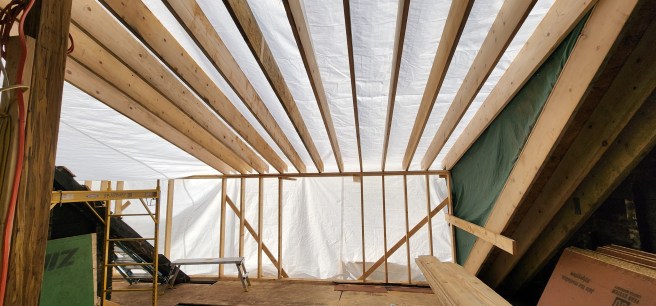
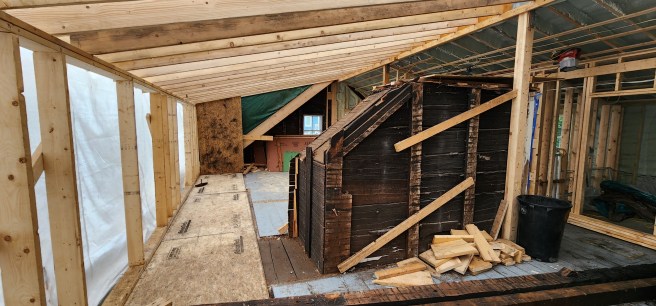
Having the upstairs buttoned up was our original goal.

People on the street can now see our intentions.

The roof is securely covered and we’ve gained more than 400 square feet of usable floor space. (Let’s see, with new home construction averaging $153 a square foot, according to a recent New York Times story, that would cost a bit over $40,000. Renovation, as we’re finding, can run well beyond that. I won’t say how much.)

We’re far from finished, I hate to confess. The front interior still needs to be framed, wired, and spray-foam insulated. Dry wall needs to go up and be painted, the new bathroom and laundry room plumbing fixtures installed, and something done with the flooring. We’re willing to keep the last item on the funky side as a historical touch. We’re still not sure about heating the space, either, though we’ve already found it has been comfortably warmed from downstairs, and perhaps we’ll hold off on a washer and dryer.

As for gutters? There’s more.

Downstairs, we’re looking at replacing the windows – 13 or 14, depending – and the front and back doors. Bigger is a kitchen redo, plus the tiny bathroom. And that leaves the back parlor to be tweaked into a combination dining and crafts room.

As for my remaining life’s savings? We have some difficult discussions ahead.

And then ‘What’s Left’ came into focus and changed everything before it

By the time the ebooks were published, I had remarried and settled into our little city farm on the New Hampshire seacoast, the one with the red barn that gives this blog its name. My life had stabilized and my job wasn’t devouring me alive, unlike my previous lower-level management positions.

But something kept nagging at me. I wanted to know just where the hippie movement had gone. Many of the insights have been posted here at the Red Barn, and I did draft a series of essays – Hippie Hopscotch – for a book competition that was cancelled after I sent my entry off. My conclusion is that the hippie impact is still around in many varied streams, much of the legacy taken for granted in contrast to the mass-media stereotypes or the current teens’ perception of hippie as being a girl thing. My wife and stepdaughters kept asking about the era and were astounded to hear just how much had changed for the better because of it. They were incredulous at the restrictions I had faced. Were things really as bad as Mad Men presented them? Yes, and the show had me retasting the first newspaper I worked for, the one that came closest to major metro. I mean, I could almost smell it.

Could any of this earlier work be salvaged? And what could I do with the searing childhood betrayal piece published online in Hobart?

My first published novel, Subway Hitchhikers, had ended with Kenzie’s return to Indiana. Intuitively, I had him, as a Tibetan Buddhist lama reincarnated into Iowa, marrying into a Greek-American family in Daffodil. I saw it as a way of blending two streams of ancient wisdom – one Asian, the other at the origins of Western culture. Something still felt incomplete in that ending.

Rather than trying to pick up the story with Kenzie himself two decades later, I decided to shift the focus to the next generation, which led me to create a daughter. This would be her story. As an added twist, I decided to have her lose him, not to divorce but an avalanche in the Himalayas, when she was just 11.

Unlike my earlier fiction, this one was undertaken totally in my retirement years. Yes, I had the ending of Hitchhikers as my prompt – and, based on that, some characters and a setting to work from – but this book would be done with fewer external demands than I’d faced in working on the others in my “spare” time.

Surprisingly, this became the hardest of all to bring to fruition, undergoing nine thorough revisions. In one version, there were no quotation marks. Another changed the tenses.

No quotation marks? Since she was relating the story anyway, including what other people had told her, who knows how accurately she repeated them. Blame Cormac McCarthy as a bad influence there. It was one flash of brilliant inspiration that ultimately proved confusing. Now, how many quotation marks did I eliminate in one sweep and how many did I have to insert as repairs? Both times, it involved a lot of keystrokes.

The focus shifted greatly, too.

At first, it was on what she uncovered about her father and his times. He was a hippie, after all, so we would see the hippie scene through her perceptions of his photographic record of people and events. In the next revision the focus turned to what had attracted him to join her extended family, one so different from his own roots. That led me to questions of just what a family is – a pretty slippery concept in today’s America – and then an examination of Greek-American culture in the Midwest itself. Finally, the focus was entirely on her, period, starting with her stages of adolescent grieving and emotional recovery.

I was a bit spooked when she began talking to me through my fingers as I was typing. She was snarky, too. Talking? She was dictating. Even scarier, she sounded a tad like my younger stepdaughter.

And it wasn’t just when I was up in my third-floor lair. Sometimes she talked to me while I was swimming laps or weeding the garden.

At some point this was no longer about a distant past, in her eyes at least, even when those roots impacted the present and its conflicts. By now, I was watching her grow up with each revision as she gained a snide, seemingly cynical tone and a goth appearance. I wish I had answers or at least advice for where she and her generation of the family wind up at the end of the book, but we do know what their options are.

The book also evolved into a multigenerational affair, reaching back to her great-grandparents and later jumping ahead to her nieces and nephews within a large, tightly knit extended family.

How to structure this baffled me until I came upon the way Jonathan Lethem handled a multigenerational novel that built on four sections of four chapters each, like a mosaic. Mine has five generations at play, once you include Cassia’s nieces and nephews, but the structure holds. Somehow it works differently than the traditional chronology of twenty-some chapters.

One of the 16 chapters, the subway ride to the Brooklyn art museum and its Tibetan galleries, comes from a lengthy outtake from a Hitchhikers draft, this time two or three decades later with Cassia, the daughter, rather than her father.

I should also admit that the title remained elusive. One I liked, Cassia’s Quest, got shot down for sounding more like a space journey. Another, in desperation, Diana’s Daughter pushed Kenzie out of range. What’s Left results as a double entendre, addressing both her situation and the manuscript itself.

Finding a suitable cover image was equally challenging. I liked a failing egg yoke as a reference to her being broken open and to her family’s restaurant. Photos of a grieving child or young woman never quite fit the physical description in the text itself and also failed to reflect the span from early adolescence into her 30s.

~*~

The project also had me reconsidering my own experiences.

Was I really ever a hippie? In my promotions for the novels, I contended that we came in all varieties and nobody fully fit the stereotype. That was, in fact, a central thrust of my novels, even when hippies are nowhere to be found, as was the case in Hometown News.

In the background, the local Greek Orthodox church opened the faith and culture to my curiosity. As I’ve discussed in posts here at the Red Barn, what I encountered was quite different from my Quaker simplicity but definitely enriched it, not just theologically but as in the traditional dancing, music, and food.

It was a good thing that I didn’t encounter the novels of the masterful Jeffrey Eugenides until after What’s Left had been published. I would have been too intimidated otherwise.

In addition to Jonathan Lethem, writers of inspiration during this project included Poppie Z. Bright, Anne Rice, and John Irving.

~*~

Not only was this the most difficult of my novels to writer, with deep revisions, but the central character, the snarcastic Cassia, had me rethinking everything that had gone before. She ordered me to revise the earlier books. Or else?

One of the advantages of ebooks is that new versions can be published rather easily. In this case, as you’ll see, she had my hippie books getting new titles, many characters getting new names, and many of the stories themselves being vastly enhanced.

All from what I jokingly called my culminating novel.

And that was before I returned to the others.

Here I had finally found myself in my goal of being free from the newsroom and having time to focus more fully on my “serious” writing. I just didn’t imagine it like this.

I still held a fondness for the hippie movement and its hopes but could clearly admit I had moved on. That part was liberating.

I’m still looking for that better world, though, as you know.

So here I was, back to the drawing board.

Finally, I turned the camera on the newsroom

My novel about small-market journalism originated as an experiment on my first PC, an off-brand back in the days before hard drives or the Internet. In this case, I decided to build a book as a series of variations on a theme relying on a template chapter that I then copied and pasted for development. Set in a newsroom, each day was the next day’s edition but sampled months down the road. Some of you may think of the movie Groundhog Day, but that was still seven years in the future. The key to the book’s development was a set of seemingly random search-and-replace possibilities I then ran through the manuscript – on both of the 5.25-inch floppy disks that were required for the full book. Other variations required physical input, one by one. Either way, think of Mad Libs with seemingly random repetitions popping up like loose threads through the entire tale.

The basis, of course, was a composite of several of the newspapers where I had worked. By extension, it could also represent offices anywhere, but I found myself thinking about how little we usually know about our coworkers. Often, it doesn’t go much deeper than a phrase they repeat all the time or a piece of their favorite clothing or some annoying habit they have. It was enough to sketch each of them through the rounds of the book.

And then I put it aside to season before tackling it again.

When I returned afresh, I had to admit that the variations were insufficient. The loops were, uh, loopy. By then, the revision was turning into a kind of paint-by-numbers to flesh out the bones.

The tale still needed more work. So much for my pioneering experiment with A.I.

~*~

Hometown News did take my fiction in a fresh direction. It wasn’t exactly countercultural, for one thing. And it took place largely within a workplace, with day-to-day drudgery many people might identify with or at least recognize.

While Kenzie in my hippie novels labored as a photographer on his campus newspaper and then on a small-town daily chronicle, he did move on to higher pursuits once he married. In contrast, when my savings ran out, I was back in the newsroom.

Another surprise as I look back. This manuscript was also in the works before my Baltimore sabbatical big writing spree opened.

I have memories of jotting down notes while driving Interstate 95 between sales calls in Connecticut. My time on the road and in motels left me plenty of opportunity for uninterrupted thinking.

Even with TV shows like Lou Grant and Mary Tyler Moore, the public had little idea of what really happens in a newsroom. At the time, the job carried some prestige, if not outright fear.

There was an adage that every newsman had a novel waiting to be born, and there was the cliché of the crusading reporter battling corruption and crime. Even Clark Kent and Lois Lane of Daily Planet renown. Mine wouldn’t be anything like those. The villains weren’t politicians or mobsters but, in the ultimate view, capitalism itself. And here I was, cheering for small, local enterprise.

For me, what emerged is the most problematic of my published novels, yet one of the most fertile. It certainly has the darkest humor and a large dose of dystopia.

I do recall one newspaper editor who candidly admitted to having taken a popular genre novel and essentially written over it to launch his own successful line of commercially published successes. Should I note that the owners of his newspaper also had one of the top book publishing houses in the world? Connections? Don’t discount them. Just don’t think of them as literary success, which I was aspiring to.

Rather than having the high drama of big bad guys somewhere outside of the newspaper company, mine were more insidious. In my experience, though, a more pervasive conflict smoldered behind the scenes within the business itself between the journalists, on one side, and the bean counters and their bottom line of obscenely rich profits, on the other. As the saying went at the time, many newspapers were a means of printing money for their owners. Not that much of it ever got down to the workers.

Let’s just say, too, that some papers were more competitive and innovative than others.

In my job of calling on editors across the Northeast, I heard personal stories that added to my own insights from working within two dailies that had undergone major transformations under inspired leadership, as well as lessons from leading a small paper in the town I call Prairie Depot and some stints elsewhere. Let’s skip the rest of the resume and get on with the book.

It was a world all its own. Or so I thought. And yes, it was set vaguely somewhere in the American Midwest.

Check it out at my Jnana Hodson author page at Smashwords.com.

Memories of Cincinnati

As I mentioned in a previous Tendrils (June 10), Cincy was the “big city” of my youth, an hour drive to the south once Interstate 75 opened.

Here are some memories.

  1. Music Hall:  Completed in 1878 and newly renovated, including a meticulous shrinking of the breathtakingly gorgeous main auditorium, this Venetian Gothic classic is the home of the Cincinnati Symphony and Pops orchestras, May Festival Chorus, and opera and ballet companies. I treasure the concerts I’ve heard there, often from the second balcony. It’s certainly among the oldest concert halls in America, with the Central City Opera House in Colorado being the closest rival for the title I’ve found so far.
  2. Carew Tower and Fountain Square: The observation tower 49 stories above the downtown, accessed by a “rocket speed” elevator, was my introduction to skyscrapers. It’s architect, William Lamb, went on to be one of the chief designers of New York’s Empire State Building, completed the following year. Fountain Square, in a dark canyon when I knew it, has since been given an airy plaza and become even more of a gathering place.
  3. Taft Museum: This small art collection celebrates one of the residents of the historic 1820 home at the edge of downtown, Charles Phelps Taft, half-brother of President and Supreme Court Justice William Howard Taft, who had accepted his nomination to the candidacy from its portico. The house fronts Lytle Park.
  4. Mount Adams: With the major art museum, repertory theater, Mahoghany Hall bookstore and jazz bar, a family-run Italian sub shop, and a once-famous Rookwood pottery operation at its edge, this was a bohemian center when I knew it.  
  5. Izzy Kadetz: Legendary Jewish delicatessen downtown where customers obeyed the owner’s orders, including, “Eat and get out!” He also charged customers based on their ability to pay.
  6. Zoo: I mentioned the opera in a previous post, and it’s no joke, but there’s more to the zoological and botanical garden. Home of the last known passenger pigeon, the institution has since pioneered species preservation and been a leader in creating habitats shared by various species.  
  7. Union Station: I vaguely remember a childhood train ride from Dayton and our late-night return. The grand 1933 train terminal was considered a masterpiece, one of the last, and today stands as the Cincinnati Museum Center, including the historical, children’s, and natural history and science museums. I think we went to the zoo during the day.  
  8. Riverboats: Several times during my youth, I found myself part of a group taken out on the Ohio River for a paddleboat trip. I heard a real calliope in the process.  
  9. Shillito’s: Cincy’s oldest department store was boldly art deco when my paintings and designs were included in the annual Scholastic Art competition displays on one of the upper floors. It was quite an honor and thrilling. Pogue’s, a somewhat more old-fashioned department store, was also fun to pass through. Shillito’s, Rikes of Dayton, and Lazarus of Columbus eventually became Federated Department stores, which ultimately took over Macy’s, including its name. Got that? Macy’s headquarters wound up in Cincinnati, returning to Herald Square in Manhattan only in 2020.
  10. King’s Island: The amusement park famed for its huge wooden roller coasters is my most recent encounter with the Queen City of the West, as Cincy had become known by 1820.  I remember the park’s earlier incarnation as Coney Island – or Coney Island of the West, to distinguish it from the tip of Brooklyn – where it was prone to flooding from the Ohio River. I did, in fact, visit once on a riverboat outing that originated and ended downtown. I’m surprised to see the first site survives as a water park. The visit to the current operation came while visiting my hometown. Accompanied by my two daughters, we ventured forth to the outskirts of Cincy facing Dayton and had a most memorable day.

Touching up the chimney and foundation

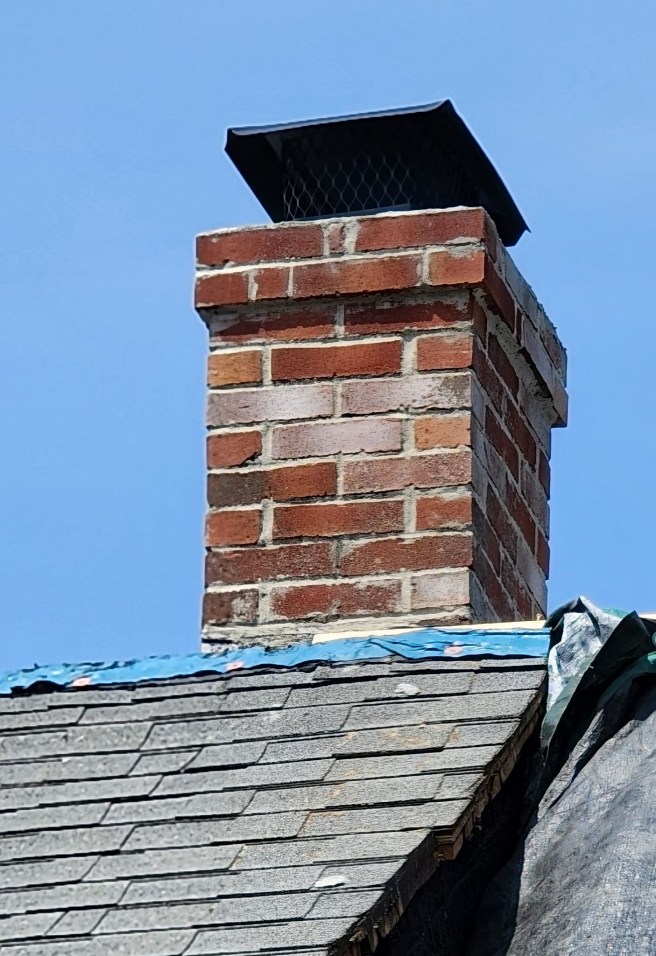
As all of the activity was picking up overhead, a mason our contractor had contacted earlier in the season showed up to touch up the top of our chimney and add a protective cap.

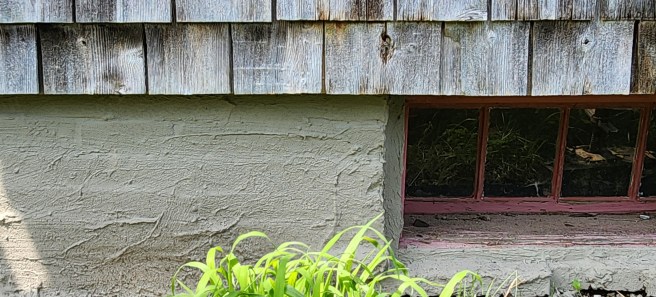
While Jason was at it, the exterior of the foundation could finally get some attention – the foundation itself was in good shape, thank you, despite the appearance from the sidewalk, but the housing inspector we had when bidding on the property suggested this as “something to do down the road.”

And it turned out, Jason the mason and his sidekick, Roger, could also relocate our new wood stove and its metal chimney to the corner of the front parlor. I was outvoted on that one (I hate taking steps backward) but will concede that the position will be safer and the flue will have a straighter shot to the sky, meaning less creosote buildup.

The chimney wound up needing a rebuild from the roofline up, but the results look great.

The foundation, meanwhile, got more than new mortar and concrete – it got a coating of Flex-Coat, too, which covered up the pink paint we had planned to replace anyway.

We had considered blue or perhaps gray as the new color, but seeing the gray in place sealed our decision. Somehow, it makes the place look more solid.

We do feel reassured seeing craftsmen who take pride in doing good work, and that includes taking extra steps on details joyfully.

More than volcanic ash spewed out from my days in the Pacific Northwest

Stephen King has advised novelists to have only one Big Idea in a book, but I came across that way too late to put it into practice. (Maybe if I ever tackle another novel?)

As I hunkered down in my self-imposed sabbatical in Baltimore – or was it self-incarceration or even cloistered? I did little else – my attention eventually turned to a more recent span of my life than the Kenzie novels covered. It was time to consider my nearly ten years of marriage and its breakup. If only I really knew how to star in it.

I thought that this next book would be about the most heavenly time and place imaginable, but as I typed and would eventually see, the real story was about a deeply troubled marriage, with me holding the debris after it blew up and a whirlwind romance afterward left me in a fog where I was.

So courtship, marriage, and relationship per se were one big subject. (Idea, in King’s expression, feels too refined.)

The other was the Pacific Northwest as seen from the other side of the Cascade mountains in Washington state, a land that is essentially desert rather than rainy gray Seattle.

One was something many people had some familiarity with, but the other was what I found more enticing as a writer. Besides, I had written many landscape poems I could draw from. Swami’s insight from her first visit to India, that the reason Hinduism had so many gods was a reflection of the ways each locale had a distinct vibe. The Yakima Valley and the Cascades were unlike anything I had experienced in the eastern half of the U.S. Especially the vast spaces you never see in a movie or read about in a book. And there I was with my new bride.

My inner drive was to better understand – and remember – the events leading up to what I thought was near perfection, my Promised Land. Except that it all blew up after four heady years, and we retreated eastward in haste. Now, six years later, I was trying to make sense of everything, and writing is my primary tool of thought.

One big hurdle was that I still had too many unresolved issues to provide clarity on the relationship struggles. I couldn’t see that the darling I thought every reader would find fascinating was, in a wider view, dislikable.

The plot – and the manuscript – kept growing by the proverbial pound.

Baltimore for me was so many lonely nights broken periodically by sex that wasn’t with my beloved. The whirlwind who came after the marriage. The one others have called my one true love. If only she had been true.

~*~

I really should go back to my journals to get a clearer sense of what I was going through both as I drafted it and also during its revisions. I suspect the reality would be painful, even embarrassing, and as I write this, those volumes are wrapped in plastic under the house renovation. Maybe that’s for the better.

What was I even originally calling the manuscript?

What coalesced for me was the many dimensions of the word “promise,” including the wedding vow, potential, and what I saw as our Promised Land. And then I had the flash of ending the book on a shocking note.

Well, so had much of my life.

I suspect that I spent far more effort than I’ve thought on the novel that now stands as Nearly Canaan.

Somehow, I even had a round with a real literary agent, who ultimately passed on the project.

During later revisions in New Hampshire, the big blob of material I had in hand turned into three parallel volumes – Promise, Peel (as in apple), and St. Helens in the Mix. And I was wondering about my subsequent engagement and the young woman I thought was a perfect subject for later. (I now see how banal that would have been.)

Would the project have been any easier if I had all the facts rather than empty denials and evasions? What if I had steered this more into the fantasy realm, perhaps having the earth magically speak directly to Jaya? Or broken it into a sequence of short books, each with a sharper focus?

A very bruised journalist, alas, was still at the helm, one still engaged in a difficult, painful exile and trying to report on the facts before me.

~*~

I’m trying to recall books and authors I was reading at the time, especially ones that might have nurtured this project. What comes to mind are Ann Tyler (I can smell the back entry of some homes in her Roland Park section of Baltimore); the Random House Vintage Contemporaries series edited by Gary Fisketjon and writers like Jay McInerney (Ransom more than Bright Lights, Big City) and Tama Janowitz; beyond that, Larry McMurtry, Tom Robbins, and Joan Didion; as well as Calvin Trillin’s U.S. Journal letters from here or there in the New Yorker. I also had John Nichols (Milagro Beanfield Wars), Ken Kesey (Sometimes a Great Notion), Edward Abbey, and Ecotopia.

~*~

Promise came out as an ebook at Smashwords but went nowhere. Rather than pay for covers for two companion volumes, I released them as PDF freebies at my Thistle Finch imprint, only to find nobody was downloading anything that big. Ditto for the full-length poetry collections. There would be a major refocusing of the offerings.

My outdated travel wishes

A season in Kyoto, Barcelona, or back in the Pacific Northwest.

Extended genealogical research in England, Ireland, and Alsace.

The Peruvian Andes.

Alaska or Iceland.

Ascending Mount Rainier or Adams.

Weekends of concerts, museums, and theater in Boston.

A week at the Metropolitan Opera.

Visiting friends in Baltimore, New York, and the Pacific Northwest.

Canoeing or kayaking in northern Maine.

On the other hand, I’d still love to experience the Orthodox icons in the churches of Macedonia.

And even some time on Grand Manan Island, New Brunswick,

Recalling some favorite magazines

As an editor and a writer, I’ve long been inspired by a stream of classy, glossy magazines with outstanding illustrations and design supporting sharply edited, masterful writing.

In this category, I’m skipping over purely literary periodicals, even the ones with deep pockets, as well as newsweeklies and many other kinds of magazines.

The ones I’ve admired, as I’m seeing now, all reflected a single editor’s voice and vision, not that I remember all of their names now. Maybe that’s for another Tendril.

For now, here’s what I mean.

  1. The New Yorker. The writing and editing, of course. I was captivated way back in high school – the staff of the Hilltopper even gave me a year’s subscription when we graduated – and still a delight in my retirement, maybe even more, in its current direction. Still, there’s no way to keep up. I should mention, in passing, its assiduous fact checkers, a vexation for many famed writers.
  2. Fortune, back when it was big and classy. Big? The pages were large, like 10 or 11 inches by 12 or 13 inches deep — often on high quality paper, and each issue was fat and thoughtful. Artists were commissioned to create portfolios, with authors to match. It definitely reflected wealth and luxury, unlike other business publications, which often felt pinched. And then the U.S. Postal Service began charging extra for oversize mailings, leading many magazines to shrink their formats. Titles like Life, Look, and Vogue lost their impact, and photographers, especially, took a hit.
  3. New York. Originating as the Sunday magazine of the New York Herald Tribune, this one took off on its own in 1968 after the newspaper’s demise. Brash and definitely connected to everyday life on Manhattan streets, it was an avatar of New Journalism and Push Pin graphics. Still has that cutting edge.
  4. Esquire. By the late ‘60s this former cheesecake vehicle had evolved into a champion of New Journalism and high-impact graphics. Some of the covers remain classic. More recently, Vanity Fair continued in that vein until its solid content evaporated in a demographic desert.
  5. Evergreen Review. Another of the late ‘60s blossoms, this one had a West Coast perspective, openly leftist leanings, and literary ambitions, including Beat poets. Its cartoon serial “Phoebe Zeitgeist” became an underground cult item of a scandalous sort.
  6. Playboy. As a matter of candor, consider its now-classic interviews, plus the fiction, and, yes, the cartoons, a nearly extinct venue these days. The photography was often masterful, no matter the content. The editor in this case did go on to become a pathetic caricature of himself, reflecting the vapid “philosophy” he was espousing.
  7. GEO. This hip German-based alternative to the National Geographic debuted in 1976, distinctive for its green-bordered covers, trend-catching photography, and progressive topics and awareness. The English editions blossomed and then trickled from sight. Much of it, like the international hippie roots it reflected, looks dated today.
  8. New England Monthly. Published from 1984 to 1990, it was an epitome of ambitious, sophisticated, city- and region-based magazines that flourished during the decade. It ran into an identity problem when big advertisers wanted a Greater Boston focus, while important regional issues spilled over into western Massachusetts and Cape Cod as well as Connecticut, Rhode Island, Vermont, New Hampshire, and Maine, where subscribers existed. The final edition featured a devasting account of the high-level executive arrogance regarding the Seabrook nuclear power plant in New Hampshire led to its corporate bankruptcy, rather than the commonly blamed regulations and enraged environmental protests. After revenue shortfalls shuttered the magazine, some of its writers went on to stardom.
  9. Elle. This upstart to established fashion bastions Vogue and Harper’s Bazaar was actually founded in 1945 in Paris as a newspaper supplement but came to prominence with a monthly American edition in 1969. Propelled by Gilles Bensimon’s inspired, fresh, even exciting photography and sharp page layouts that delivered in tight spaces, there was no mistaking this entry from its rivals. Another upstart, Sassy, a feminist teen platform aimed at well-healed Seventeen, lacked gloss and polish but sizzled on editor Jane Pratt’s brilliant assignments from 1988 to 1996, when it finally succumbed to a longstanding boycott by an evangelical women’s organization. As a former lifestyles editor, I found Pratt to be most refreshing.
  10. Harper’s. These days, it rules the roost for me. Its monthly index of seeming random statistics and trends, toward the beginning of each issue, even provided inspiration for these weekly Tendrils.

Our new upstairs front half takes shape

Do we need say how excited we’re feeling?

Let’s look at the continuing progress from the inside.

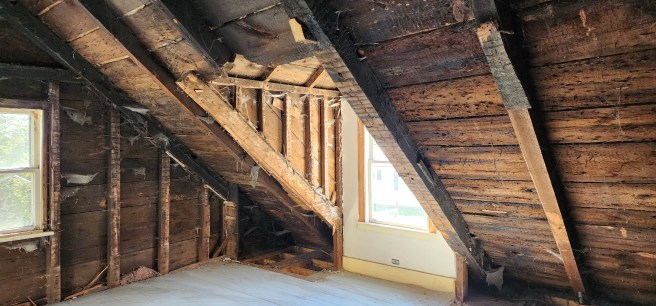
The northern half of our front upstairs with the small dormer still in place but the ceiling already gone.
And then with the plaster, lathing, and drywall gone.
We finally got to see what was between the stairwell and front. No hidden treasures or bodies, as it turned out. But we could finally see from one of the front bedrooms to the other.
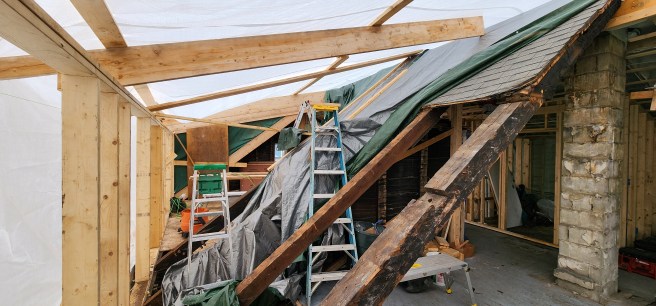
A spate of wet weather presented a challenge on how to proceed with the “dustpan” dormer that was replacing the old roof line. The answer was by working under a large white tarp. Here you can see a new rafter going into place atop the new front exterior wall. The final old rafters and last bit of asphalt roofing are about to removed.
Here the new rafters are in place under the white tarp. Compare this in the south front bedroom to the first photo in this series.
The front upstairs interior stands free of obstruction apart from the old shell around the stairwell.

Next steps will be the roofing, foam insulation, windows, siding, trim, and flooring.

Can this really be happening?