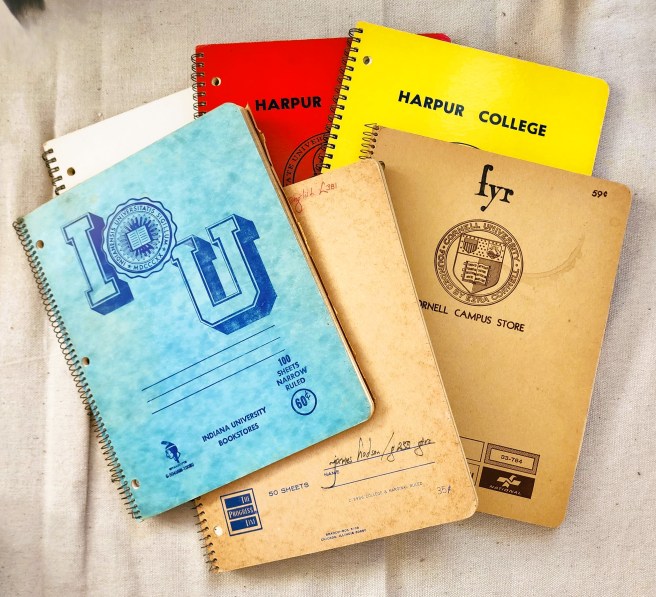
Starting a new spiralbound volume on a Saturday.
Molly’s sister was up: a Taurus, complete play: soft, active kisser – reminded me somehow of Tyner, way back in Ohio … just got back from a month in England, Shakespeare research at Oxford, very funny, a real up, drinking from a beer bottle in a shoe.
[Don’t think I ever kissed Tyner, alas.]
Molly, to me: “Sometimes I think you’ve changed, but sometimes I don’t.”
Both she and Lola 5’3.”
Gwen, repeatedly: “You know what?”
Copy courier Maddy to me: “How old are you? Not how old you act, but chronologically.”
Slip from teletype paper: what is is because it is and must be that way.
Helene: When I first met you, you were giving off funky vibrations like every hair was at a 90-degree angle, all nervous energy.”
The Bible does not have to be logical. If each recorded experience was authentic and full, words are irrelevant. The experience was right, regardless of how it connects. Both sides make the whole.
Monday, presumably after trip to ashram, apparently with Helene.
Levi, a fine class. Twice this week he has gone into trance. Swami Lakshmy took him out for drinks to pull him down. Swanandashram wanted to know it he had seen the Himalayas. He brought Levi out: “Levi, time to come back, Levi!”
Swanandashram down on both Helene and me: too skinny.
He’s 51 and sexless, sez she.
Letter from Shayna: “I’m a strange girl.” And that’s why I like her. She would have called if we had a phone. When I drove in, the phone company truck was in our drive. Party line, 669-4117.
A brunette here since Sunday, a Cuban friend of Rainbow [I erroneously record Luna]. Lola, from Maria Delores.
Some gray hair, from Vitamin B deficiency. Thick and curly, fine feel. Tomorrow we’ll swim across lake and back. Such clear brown eyes.
She had been up in March. Was just got back from Florida with mother.
Last night was the first time she had seen the Milky Way.
Next afternoon, she didn’t know the expression, “Mind your Ps and Qs.” Explained the type drawers. A mere 17. Hasn’t seen Cornell or Upstate: tomorrow, the gorges.
Rainbow (paranoid?) sez Gwen’s upset with her for the way she walks and Gwen gets turned on by Playboy centerfolds. Gwen this morning sez Rainbow’s paranoid of her.
Car turned 100,000 miles with Lollypop in it. She hasn’t yet seen the well, either.
[So much of her shows up in Pit-a-Pat High Jinks.]
When she said “no sex” and I replied OK, she was so happy and relieved, was afraid I’d be hurt or angry, “Many guys are.” When I told her how sexual she was, she answered, “I know.”
Swimming, we surfaced within the rim of an inner tube: no sight of others, only sky and treetops: kissed in our own sphere, so free … her kisses are so long, heavy, deep breathing yet breathless: wide and teeth bared, digging my lips: zowie! And back for more.
She prefers black and white to color: more discipline.
Said something to her in Espanol, she corrected me to use the personal tu.
Que piensa? I asked. Que piensas, she corrected me, smiling. And I loved her.
As a sorpriso, got her a can of apricots and some limonada … but she wasn’t back yet.
But then, she’s a Leo,. Seven hours of making out, she attacks so hard, I love her style. Sucking her breasts into my mouth, she even likes teeth: I broke some blood vessels in her areola.
But later, talking to her parents in Spanish, must go home tomorrow: no Buttermilk Falls or Cornell.
She insisted we sleep apart, and had a firm hand deflecting my prying fingers but so turned on anyway, viz the chest heaving and heavy breathing.
Her birthday was Aug. 5; Rainbow’s, Aug. 19, meaning our resident nudist had been 16 and not 15 as earlier recorded. Still! Her brother, 21, was attending Columbia, but her Columbia College T-shirt was a present from an uncle in Minnesota.
She lives in Elmhurst and wants me to visit.
~*~
~*~
Len, playing around with the idea of “making it legal,” sez “Have you heard the news?” Somehow I just can’t picture him married.
D-Man: “I used to think you were a narc. I’ll never forget the first time in the bank [when I saw their roommate wanted card] but then I decided we were just little fish, you’d be going after the big ones, you were just uncool.”
“Yeah, D-Man, I owe it all to you. I’m just so cool now!”
Lola doesn’t like most juices, except grapefruit, sometimes – and pancakes. Doesn’t eat a big breakfast, gets airsick. I gave her some Dramamine for her upcoming flight [why on earth did I have that?]: she loves the Metropolitan museum when it isn’t crowded.
When she speaks, it’s often abruptly and businesslike.
The Wrong Box was on the TV downstairs. So strange to hear the dialogue and soundtrack. As I described some of the scenes, she replied, “I thought it was the Firesign Theater.”
Nearsighted, she should have worn glasses while driving, to see signs. Giving her a driving lesson, I thought of Fay and Lonnie in Ohio.
Her father was a lawyer in Cuba, but a social worker in New York City. Still, he seemed to have money.
BECOME A SMILE!
I left a huge passion mark on her neck: big, purple, full, just in time for tomorrow.
She chews her nails.
Whenever anyone came up the steps, she pulled me closer.
~*~
The Marine Midland Bank building a plethora of scaffolding more interesting than the building itself
Look for Choconut NY or PA, as a driving destination …
Todd’s cosmic corn [not Rusty’s!] … the crowd, at least one event via teletype paper sliver: Moose, Luna, and later, Rainbow, Speedo, Skye, Linda, Duck, Donnie, Margie, Mountain Girl, Jack, Gwen, Moe, and Bill …
Also, cooking farina … cheap and hearty …
Taking a walk, I threw stones at the dogs … sat in a field, meditated: Q floated up, who are you? And in reply, I am happy! And then I laughed, grinned, felt good.
Big mossy rocks like Glen Helen (in Ohio)
Rusty’s red truck, Uncle Uh-Uh.
When you’re tired, it’s harder to FOCUS.
Hyperactive as I am, learn to SIMMER rather than FULL BOIL.
Get more out of life at roughly the same temperature.
Rainbow got fired, first day on the job, not fast enough.
Donald adds a fine guitar to our homey good times in the afternoon out back …
Lola smokes, but not much. (Game of the rolling machine.) And dope together. She doesn’t like the taste of yoghurt in my mouth and was glad when it was gone.
old roads disappear
a Saturday, another journal ends
[Incinerated]
~*~
From Spiralbound Hippies, with commentary from now.


 Jnana's Red Barn