Yes, I loved her
imperfectly
the night, then, unclouded
from above or below
You never know what we'll churn up in cleaning a stall
Yes, I loved her
imperfectly
the night, then, unclouded
from above or below
While awaiting the delivery of the windows for the front upstairs – once we had definitely decided on their size and placement – Adam turned to one of our optional side projects, redoing the back deck.
The ramp leading to it was becoming a safety hazard, and the existing deck was tiny and sinking.
The replacement and steps are a huge advance.
The windows arrived, and that put a hold on the bigger plan, for a lower deck on two sides below. It would be one way to keep Eastport’s red ants at bay when we’re dining outdoors, as well as less lawn to mow. Pluses on both counts, right?
Would Adam get back to it before the ground froze? We were facing a time crunch, and the interior was the priority, followed by the cedar shake siding.
~*~
Coincidentally, we found a mason who was able to get to repairing the top of our chimney – it really was in precarious shape – and touching up the exterior of our foundation. We wound up with a layer of supporting cover compound, too.
Our plumber had also installed three outdoor spigots and removed the one we previously had. It was leaking badly anyway and was on the side of the house where it was least useful.
Progress was taking place, just not always of the most noticeable sort.
I’m not sure when the practice started in my own life, but somewhere it did.
Typically, in a first visit to an art museum, I’ll move along quickly to get a sense of the fuller collection. In the returns, however, I’ve become more inclined to sit down in front of a particular piece or even a full wall or room and then more fully immerse myself in particular pieces, usually while the rest of our party roves on. Yes, I’m with notebook in hand.
Those scribblings have led to poems, especially those in which Norman Rockwell and Gertrude Stein appear commenting, somewhat like poet Lew Welch’s Buddhist Red Monk who kept popping up at the bottom of the page. I’m not quite sure how they showed up, either, but there they are, as you’ll find in recent entries at my Thistle Finch editions blog.
Let me repeat that I’m generally averse to poems about poetry or celebrating poets or that somehow place artists of any stripe above the rest of humanity, ditto that for movie stars or professional athletes or billionaires or politicians. We do need our heroes, but I’m convinced that it’s healthy to keep their human frailties and shortcomings in perspective.
In that regard, I do believe we artists need to keep our vision beyond our studio door. Anything less strikes me as incest, even for an interdisciplinary addict like me. It’s why I refuse to respond to political pollsters. Go ask somebody on the street, OK?
Still, I made the central character in my Freakin’ Free Spirits novels a photographer. Even having him make a living by working at a newspaper was skirting my taboos.
~*~
The term “ekphrasis” defines poems that describe visual artworks though it can be applied more broadly. Sometimes the results are admirable, as exemplified in music by Gunther Schuller’s “Seven Studies on Themes of Paul Klee” or Modest Mussorgsky’s “Pictures at an Exhibition.”
~*~
Lately, I’ve become quite fond of the Alex Katz galleries at Colby College, not just because he almost collected a painting by my first wife. Rather, I sense something in the plainness of his depicted figures and where I’d like my own work to head. It’s stripping something down to essentials.
We’ll see.
~*~
For Rockwell and Stein, take a look at at Thistle Finch editions. For Freakin’ Free Spirits, look for the four novels in the digital platform of your choice at Smashwords, the Apple Store, Barnes & Noble’s Nook, Scribd, Sony’s Kobo, and other fine ebook retailers. They novels are also available in paper and Kindle at Amazon, or you can ask your local library to obtain them.
Allow me to restate my argument that religion is important, along with a confession that in too many ways, at too many times, its proponents have betrayed its radical promise and its progressive direction, whatever their professed faith.
At its best, religion gives us individually and collectively a place to examine our hopes, dreams, and possibilities of a healthier, more justful, and more harmonious world. In short, moral and ethical guidelines. It can also provide the necessary foundation of community for pursuing and nurturing that goal.
Some of the sharpest critics of its practice at worst are prophets found in the Bible.
To see some examples of how that worked within the Quaker movement, visit my blog, As Light Is Sown.
Yes, I’ve long known the explicative, “Holy mackerel!” but have never gone beyond that until moving to Eastport, where it’s commonly fished from the Breakwater pier. Previous postings here at the Barn reflect that.
That said.
When I first began reading contemporary poetry (for pleasure, independent of classroom assignment), I often sensed the poem existed as a single line or two, with the rest of the work as window dressing.
Now I read the Psalms much the same way, for the poem within the poem, or at least the nugget I’m to wrestle with on this occasion. Psalm 81, for instance, has both the “voice in thunder” and “honey from rock.” What exactly are those in my own experience?
Maybe it was a good thing that we didn’t have too much detail in the CAD design we ordered from a local lumberyard. Initially, that was a miscommunication between our contractor and us, plus a looming deadline for a building permit.
The upshot was that as we watched the space open, our vision transformed. We saw new possibilities.
The first big one opted for cathedral ceilings in the four bedrooms. No big problem, said Adam.
Also, we wanted to leave the charred exterior rafters visible in the two back bedrooms. They were evidence of the 1886 downtown fire that started on the waterfront just below our house. They also reflect the original roofline, which we had now raised. And they were dramatic.

Alas, once we realized how labor-intensive (i.e., costly) keeping that touch visible would be, we opted to forgo it.
In another change, the windows in the bathroom and laundry room went from transom-style to narrow vertical.
The ceiling in the upstairs hallway was originally going to be flat, but we liked the feel of having it follow the roofline. Classy.
In the two front bedrooms, the width of the two side roofline panels was halved when we saw how much the original, aligned to the old dormers, really confined the rooms. The purpose of the panels was to keep a sense of the original profile of the house as seen from the street. What we wound up with does the job.
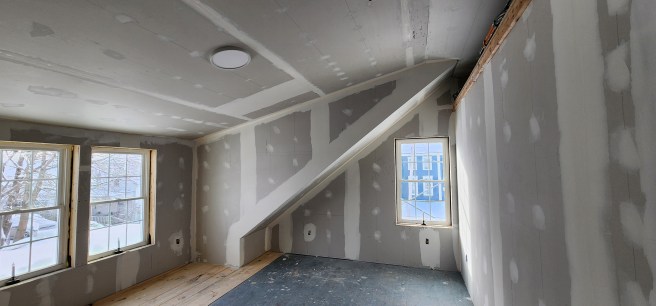
After that, the windows in the front two bedrooms went from spaced apart to being placed together, centered between the two pairs of windows below.
And there were some big tweaks in closet arrangements between bedrooms. The two smaller bedrooms got larger closets while the two bigger bedrooms got open loft above those.
As I’ve said, none of the bedrooms wound up looking like rectangular boxes with holes for windows punched in.
We did encounter so many unanticipated details. Things like molding, the placement of light switches, even the door latches – you usually open them with your right hand, it turns out. I’d never thought about it. How about you?
~*~
Did we see things an architect wouldn’t? I like to think so.
One of the artistic ideals in my life originated in the fantastic illustrations by Inuit craftsmen as they expressed the world they inhabit. Perhaps you’ve seen some of their calendars exhibiting owls, seals, the sun itself, and the like.
As I was told by the couple who introduced me to the Inuit works, an artist in the tradition does a subject just once, at least in the position or perspective that results. A bear, for instance, might be shown standing, but only once. If a bruin shows up again, it would be fishing or lumbering along or maybe paired. Each appearance, though, must be unique. There were still plenty of ducks, geese, walruses, whales, and other Inuit – hunters, mothers, and children – remaining for close examination, even in their Arctic environment.
The husband who told me this, let me add, was a coauthor of the Alaska constitution who had some acquaintance with the ecosystem. He had grown up at its southern edge, northern Washington state.
After more than two decades with that as a guideline, I faced a conundrum as I tried to assemble my own poems for submission as a competition for a chapbook – a booklet, essentially. A book needs to flow from start and middle to an end with some sense of continuity. My one offering that had that, American Olympus, had a received a provisional acceptance from a prominent press that later rescinded, claiming a cut in their grant funding. And my other pieces hopped, skipped, and jumped from one setting to another – if only I had been able to remain in one setting long enough for continuity in their completion.
Beyond that, my own life had moved on, providing me a lode of new material to draw upon. That’s when I turned to the idea of theme and variations, a major element of the classical music I so love and also big in jazz as improvisation. What hit me, especially, was Ted Brautigan’s sonnets from the ‘60s. They were essentially three poems, reworked over and over, into a full and very stunning collection.
I took that as my springboard into two intense weeks – while working fulltime as a newspaper editor – of reworking raw notes of loved desire that had incinerated into what you can read as Braided Double-Cross – a set that was rejected by the jurors in a competition based in its principal subject’s hometown. Maybe it was too intense. The poems are searing.
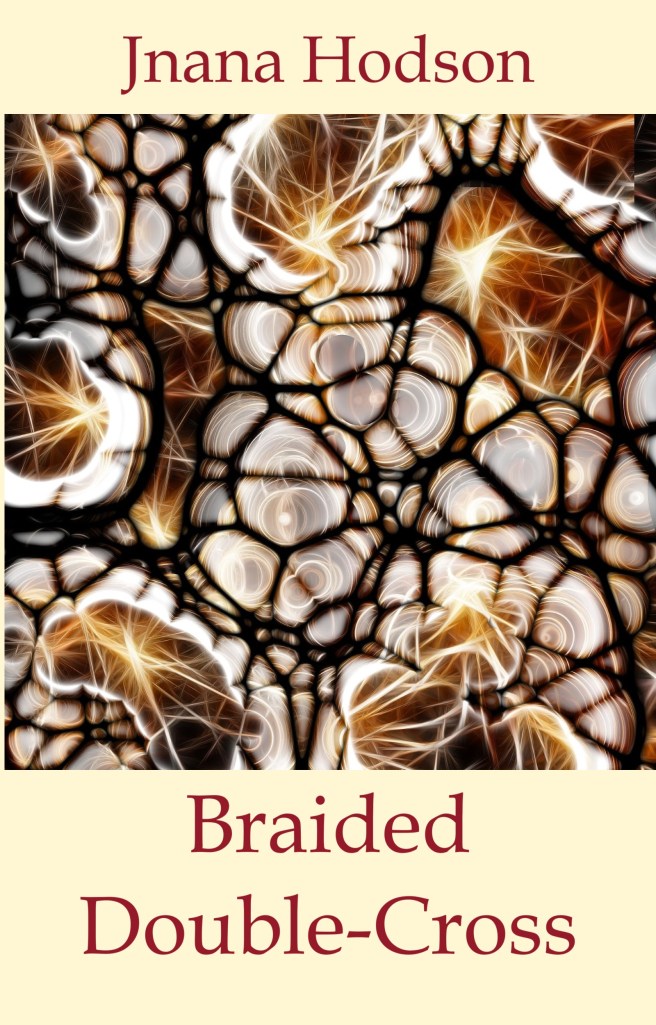
The night I finished drafting the 60 poems, I should note, I went out to dinner and have no idea how much I tipped the server. I was thoroughly exhausted, not just emotionally. Not that I remember of the meal I devoured.
Love really can be such a bitch. At least it still is with me, no matter how much she wonders why I still worship the one who continues in my life.
~*~
For now, let’s turn to the question of what makes a poetry collection “hang together”? In contrast to an assembly from my “best work,” however sporadic.
For perspective, also consider my aversion to series in fiction, where I’ve seen too many series as the same book done over and over with a few tweaks, even if that has led to way too many bestsellers. Yet I’ve gone back to my novels and reworked them to create linkage from one to the next, at least in two separate series. What I think now separates mine from most series is that none of my novels is a carbon copy of any of the others. Mine do, in contrast, represent a sequencing of growth from one to the other. In that way, they create one longer epic rather than imitative episodes like a TV sitcom.
Still, what is it that draws you back to a particular author, book after book?
~*~
I think now of the observation that an author’s next book springs from what was left unsaid in the volume published just before it. That point resonates and returns us to the question of how does an author know when a work’s finished.
Regardless, I’ve definitely done much more in the vein of “series” since completing the first.
~*~
You can find Braided Double-Cross and more in the digital platform of your choice at Smashwords, the Apple Store, Barnes & Noble’s Nook, Scribd, Sony’s Kobo, and other fine ebook retailers. You can also ask your public library to obtain it.
What was the best year of your life and how did it look?
Pondering the possibilities for my most perfect year, I see how much even the best was tainted.
’72, I had the high of the ashram but it involved going through a lot of psychological muck and growth to get there. See Yoga Bootcamp for the parallels.
’73 was the whirlwind with my future wife, but I was laboring at subsistence pay, at best. See Nearly Canaan for the parallels.
’83 encompassed both my divorce and an exhilarating engagement with the young cellist who promised to be The One. It was also crushed in long workdays as a shirtsleeves manager in a newsroom, no matter how engaging I found the challenge professionally.
’86, I was deeply ensconced in a self-awarded sabbatical, but generally loveless. The core of my fiction was drafted in this period, and my circle of friends included Mennonites and my introduction to part-singing.
’99, the excitement of the ultimate woman in my life, as well as our frustrations in trying to find a home we could afford along with some emotional upheavals at the office.
2021, my exile to Eastport in what became a heavenly writer’s retreat, resulting in the publication of Quaking Dover the next year. It did mean being apart from my family and friends back in Dover for much of the time, but included exploring the fantastic outdoors of the waters and woodlands around me as well as the artistic stimulation of my new community.
So here I am now, with what’s turning into the home of my dreams in the sunset of this life.
 Jnana's Red Barn