MULTIPLE MAPPING

Knowing how far to go — and when to turn back, to the best effect — are difficult matters. The wise traveler relies on those who have gone there already and returned. You hope they speak truthfully. Often your life will depend on their directions. Even knowing what to pack and what to omit may be based on their counsel. Mountains and rivers are only the beginning.

When there’s too much to remember, a map begins forming. That or a guidebook. But the map presents more possibilities than the book, with its linear narrative confined to one route at a time — even maps with vast portions blank or missing. Take two points on a map and connect them, this way or that. Add a third. And then a fourth.

I never would have arrived in this desert without maps. The airliner’s navigation charts, of course. And then the highway atlas. Many others, as well, become useful. Those that show back roads. Others, topography. Still others, property divisions — including the Indian reservation and Army artillery range, both declared off-limits. Maps of emotions, economies, explorations. Maps of oceans, weather, the heavens.

Disembark and you go to work filling in details and then connecting points like a spider. What’s around that corner? What’s over that ridge? Where will we stay, and what’s the best way to get there? A single map is only an blueprint. The particulars never quite fit. Especially in two dimensions. A breeze lifts the web. Coyote walks through it.

Each one distorts — some far more than others, and rarely by intention. Who made the map in your hands? And to what purpose? Some were mathematicians of few words. Others were empire builders or real estate developers. Some weave the directions into the stories they tell beside the campfire. Some ignore shadows. Fail to repent, ask forgiveness, extend blessing. Others know survival, as well as play, requires definition and decision. Obligates searching within, as well as around, in fullest candor. Some even deceptively point you away from your destination (why should they reveal their secrets?).

Those who were born and raised here know it in a different way from those who have migrated. Magpie will tell you one thing; a Canada goose, another. Same goes for where they’re positioned. Jackrabbit and dragonfly take separate pathways, as does beaver. You simply log where they cross and hope to find meaning.

I had thought maps were the essence of geography. Now the definitions spill over into history, geology, meteorology, political science, psychology, and much more. Because many misunderstandings afflict each life, there are bound to be collisions. Sometimes you move into a thorn that pierces consciousness, but even that rarely brings clarity. You see there’s endless discord among individuals, clans, tribes, nations, denominations — all to be traversed and mapped in the search for ways out and back safely. In this knowledge, jobs, aspirations, faiths, possessions, social standing are merely reflections of fundamental conflicts between human consumption and the good earth itself. No one can dwell anywhere without disturbing the whole; individuals and collectivities distort and contort to their own ends, some more benignly than others. The lines on the page do not hold their place. Without a divinity as a guide knowing these connecting pathways, then, there’s no return to full measure and health. The breath people exhale, fires they build, grains and flesh they devour are diverted to their chosen applications. “Tell us something better,” I implore. “Teach us the highest way.” Where anyone takes it from here is another matter.

Sadly, whether this transformation’s harmonious and renewing, guiding individuals as merciful stewards and co-creators with the divine, or self-centered and destructive as thieves, is rarely considered. Just observe how communities rationalize, arguing that the welfare of their women and children comes first, even as they bankrupt the farm to support worldwide armies or strip timberlands in a rutting for coal and iron.

You could perceive many aspects of this in these orchards within desert. While the choice of irrigating and producing fruit sustains many more humans than the arid range would, also ponder the long-term impact of the poisons applied through each season. Kill harmful insects and molds, but what else? And how soon before it seeps into the groundwater and household wells? It’s all an interplay of good and evil, which I observed through a giant spider web. As a practice within my spiritual discipline, the Dedicated Laborious Quest, I place maps atop other maps and find they are drawn to different scales. Many of the words require translation, which introduces its own misunderstandings. Some of the maps are even of places far from here, landscapes in memory.

Too many details and the sheet becomes a scribble. Maybe that’s why here, at an extremity of the continental United States, I now comprehend the American Midwest of my childhood and early adult years as something other than a uniformly Protestant corn belt. Even overlooking ecological differences between woodlands and prairies, or between the Great Lakes and the Missouri or Ohio river valleys, I reconsider its varied ethnic traditions and the hidden cost of the melting-pot focus. Speaking with other exiles like myself, I become aware of unique distinctions some of our ancestors resolutely upheld, at the cost of their own lives, if necessary. There were strains of Scandinavian Lutherans in the Dakotas, Russian Mennonites in Kansas, and Scottish Presbyterians in Iowa, whose distinct cultures were eroding like the topsoil itself. You would hear, too, why so many had fled. Some, desperately hoping to forget forever their terrors or shame, buried the evidence as best they could. Others, however, defiantly kept it aloft as a reminder of their liberation and a warning.

For more insights from the American Far West and Kokopelli, click here.

LET’S CAST THE SPOTLIGHT AWAY FROM POOR JOB

Could it be that the Book of Job isn’t so much about the suffering of Job, a man of faith, as it is a critique of conventional religion and religiosity itself?

In my volume Eden Embraced, I approach Job’s plight as if the text were a Hebrew Upanishad, one paralleling a type of classic Hindu writings. Yes, the thread holding the plot together follows one innocent man’s spiritual journey through unspeakable suffering. Blameless as he is – and uncomforting as God’s role is here – Job would have every right to turn in other directions, though he chooses to remain faithful.

The story is endlessly troubling, especially for those who read it from a legalistic perspective. From the outset, God is arrogant, even vain and cruel, rather than compassionate or even all-knowing. And Satan, a member of the sacred council, could be a favored golfing buddy arranging another wager.

The setup can easily lead to contortions as a believer attempts to reconcile other, more conventional, definitions of the Holy One with the action at hand, especially when Job’s buddies begin to weigh in with their platitudes. In many interpretations, Job’s faithfulness is held up as an example to emulate, no matter what. Fat lot of encouragement, right?

As a writer, though, I can see the axiom of trying to address a situation by taking an opposing, uncommon position, which is where I see the story of Job originating. After all, we are faced with the question of just where does evil originate, along with human suffering. Why not blame the Creator?

Is there even a large measure of humor in this? Take the events over the top, asking just what more can happen to poor Job? And that’s where his so-called friends step in, adding misery to his plight and their condemnation rather than comfort.

Would it be nearly as compelling if they did the right thing? If Mother Teresa had showed up instead?

By the way, I delight in the happy ending, which many purists object to as a later revision that doesn’t fit with the general thrust of the plot. Feel free to weigh in as you will.

AIR, AND THEREFORE

imagine
some flying heaven

with sparks
and the fantasized constellations

wind . inspiration . beclouds and clears

memory . learning
philosophy. theology. mathematics
within logic a song or cunning ethics

the conception . over land, over waters
even fire

all the legged and winged creatures
the very words God said

goodness as well as
food for the mind

dreams
wishes
visions

nothingness
and everything that moves in some fashion

positioning sun, moon, stars
the multitudes of birds
yes, singing

the WAY

I breathe, therefore, and am

ANY

light entering a shadow

light chasing a shadow

headlight of a passing car
swirling around the room

*   *   *

come to me anyway

come to me any way

Poem copyright 2016 by Jnana Hodson
To see the full set, click here.

ROOTS THROUGH THE SKY

Ours was not the journey of Ulysses. There had been no dramatic battle. No obvious defeat or shipwreck, either. We weren’t accompanied by our own troops. I intended to make my home here, at the edge of wilderness, and venture into its realms, rather than circle back toward some faraway but faithful woman or goddess.

With the exception of my spouse, who also traveled with me, I was fleeing my own people and hoping that strangers would be better, or at least different. Crucially, I would continue to enter the back country to be reminded of some mystery, as if on this edge of the continent some faithful remnant was making a final stand in defense of Old Ways handed down through practice from antiquity. Still, you could look at the ground and be disgusted here, too, to find white fibrous butts, the thimbles of broken cylinders left behind wherever man goes, along with the larger, inescapable debris. Look up and see contrails of airliners and military aircraft. You could scoff that in vapor-lighted cities, where cancer is the predominate cause of dying, few inhabitants are aware of the flickering stars or the planets in their orbits; the populace is ignorant of the very lunar phases you will so closely follow here. Taunt them, arguing that Jesus is the only bum welcome on their streets and parking lots, and accepted in their midst only because he’s conveniently dead. Maybe he’s not all that welcome, either, if you look closer. Meanwhile, vandals spray-paint his name on forest boulders alongside highways, as though a word alone can distribute clear-cut salvation. Ponder the contempt for both creation and creator. The Old Orders dismiss superficial religion. There’s fasting, and then there’s starvation. The soul knows a hunger, one that comes at the beginning of prayer. Some practitioners know this opens a furrow their horses help plow. For now, I would venture into high places to be reminded of the ancient interplay of dualities. Not just good and bad, but the overlapping harmonies as well. Make my rounds, however quickly at first, acknowledging the slower nomadic practice.

When I packed for this move, I preferred boxes over baskets. Something squared, for paper and recordings, especially. Typewriter. Electronics. We weren’t transporting dried berries or salmon. Blankets cushioned furniture and china. The cardboard presented fewer overlapping harmonies. Learn to weave baskets and I might learn something of the Cross. Especially in its curving.

Handle with care, all the same. Let go of one, something shatters. Or the other, something bounces. Baskets stack differently than boxes. See which one fits a squared room better. Which one, a hogan, wickiup, tipi, or kiva.

Step outside. Turn to the four directions. Then name them.

MALE / SUN
FEMALE / MOON.

Turn again.

AIR / FIRE
EARTH / WATER.

Once more.

SPIRIT / LIGHT
FLESH / SHADOW.

Draw out their colors according to tradition or your own intuition.

Soon the divisions break down, into Yin/Yang swirling.

This is where prayer begins its dancing, even without Kokopelli’s piping.

In such turning I was brought to the edge of my intellect. Facing the expanse toward the horizon, my knowledge of geography, geology, botany, zoology, astronomy, and survival itself proved defective. The edge and depth of my emotions, too. Return to my religious texts and I’d find a different story. Not the one taught to children, but more sinister dimensions. Walk far enough away from the village or highway into open fear, admitting this experience might break me. This Dedicated Laborious Quest draws on all my ability — mental, physical, and psychic — until I’m forced to pull strength from some kernel of infinity within myself. As you pull, roots come forth. Draw them from the emptiness within the basket. The emptiness waiting on the horizon’s circle, as well. More roots, reaching out like cosmic rays through the sky, are visible only to the spider — these beads on a rickety filament.

For more insights from the American Far West and Kokopelli, click here.
TURNING NORTHEAST

two blocks from my apartment, on the way
toward downtown
the Amoskeag Dam impeded the Merrimack
with a broad placidity I associated
with the upper Susquehanna
below it the roaring wildness of hydroelectric generation
or the snow-melt Yakima and its tributaries
why I didn’t just dump half my stuff way back
and start over before trekking through the marketplace
to rediscover how outrageously expensive all these goods
I need at hand can be? at last, though, my belongings
began falling into place where old mills extended
an eerie sense all too similar
to what I had created in one novel
to say nothing of the French-Canadian hilltop
on the west side of the river, neatly occupied
by descendants of Kee-beck, and an air of Kerouac
oh, how I’ve come through calculator-town
foundry-town, shoemaking-town, college-town
fruit-packing-town, sawmill-town, meatpacking-town
car-assembly-line-town, blast-furnace-town
summer-resort-town, and spice-grinding-town
on the harbor
to this ghost of a textile-town on the river where
the warehouses of my broken ambition overflow
once more, I arrived without a lover or children
for now, though
this life in a sleeping bag and cardboard boxes
fatigues and I long to get back to Owings Mills to pick up
the rest of my furniture and files so I can really move in
with essentials that include a toaster-oven and
the little red light on my answering machine,
items I’ve come to miss
but having a little cash in my pocket once more
feels wonderfully strange
and having seven book-length works
drafted and revised allows me to show something
more than a concept in my head or scattered notes
the arduous, tricky road to publication can take ages
usually eighteen months once a house accepts a work
and the contract’s signed, according
to the New York Times Book Review a few months back
In the meantime, my savings have gone
(the miracle is that they lasted as long as they did)
and it’s time to get back on my feet, financially

To continue, click here.
Copyright 2015

STILLING THE SEASONS, IF FOR A MOMENT

For all of their range across time, seasons of the Spirit, as well as seasons of the flesh, are grounded in the here and now. It’s the paradox that unites the two, and intensifies their wisdom. Eternity, in effect, as found in a flash.

Keep racing, and you’ll see nothing but a blur en route to some goal. You can be fully alive in the rush of adrenaline, your attention concentrated on what is essential in split-second increments. The pace is unsustainable for long, naturally, and an emotional crash will follow. The alternative is to stop yourself, to achieve calm before the storm or calm within the storm, before continuing. Stopping, to regain strength as well as collect scattered thoughts and actions. To restore focus and wholeness.

When I think of these seasons, I don’t know whether the yin-yang emblem of Buddhism, with its “S” rippling through a circle, and light on one side and darkness on the other (alternating day and night or sun and moon), or the Christian cross is more appropriate. The cross, after all, leaves us with four quadrants, like the seasons themselves, while the yin-yang expresses alternating rhythms encountered daily.

The daily rhythms converge on sunrise and sunset – in many traditions, times of meditation, prayer, or chanting. Moments to acknowledge the presence of Spirit with us, in our flesh.

Walt Whitman, describing his first Quaker meeting, tells of entering a room where people were “sitting still as death.” The phrase initially appears morbid and troubling. Even so, it reflects an early Quaker understanding of a necessity of “dying to the world” and its desires and distractions in order to become open to the Spirit. Deep silent meditation becomes a kind of winter, to be followed by spring. The flesh, too, is given symbolic rest and freed from unessential movement. The moment becomes timeless. The stream clears. Fears and worries fall away.

This, too, is a season I invite you to discover.

The hour will end, and we’ll return to our usual labors, before drawing back together in stillness.

~*~

For more Seasons of the Spirit, click here.

YES, AQUARIUS

Why wait for the dust to settle? Here are 10 bullets from my end.

~*~

  1. Since we don’t put up a Yule tree and decorate it until Christmas Eve, ours stays on display longer than any of our neighbors’. The lights make January a less forbidding stretch. Make it more festive and relaxing. So what do you do special this otherwise cold, dark month?
  2. She’s really at home in a grocery store. Knows all the comparative prices, what’s a bargain, what’s special. Not so in other retail settings. Still, you should see our pantry. Or the two big freezers in the barn.
  3. Swami had long ago said I didn’t need a job (I’m an old soul) because that’s not the work I should be offering. That was long, long ago.
  4. How often does it seem: Fashion = Money … along with the race for something better?
  5. Would I be satisfied with a single-line poem that said everything? Stake my reputation on it?
  6. Considering all the hours I put in on my “personal writing” over the years – the poetry and fiction, especially, or genealogy and Quaker fare – it would have added up to a lot of overtime pay. Even at 10 hours a week, though I suspect with vacations and holidays thrown in, the average would have been closer to 20. I’d really have to land a bestseller to come anywhere close to recouping that investment.
  7. The frustration of my twilight years in journalism, seeing us increasingly pander to stupidity, ignorance, and hatred rather than trying to lead and enlighten.
  8. As the funeral director told me, “We hate holidays. Holidays suck.”
  9. Fortune cookie: You will make many changes before settling satisfactorily.
  10. Can this really be happening to America? Or the world?

~*~


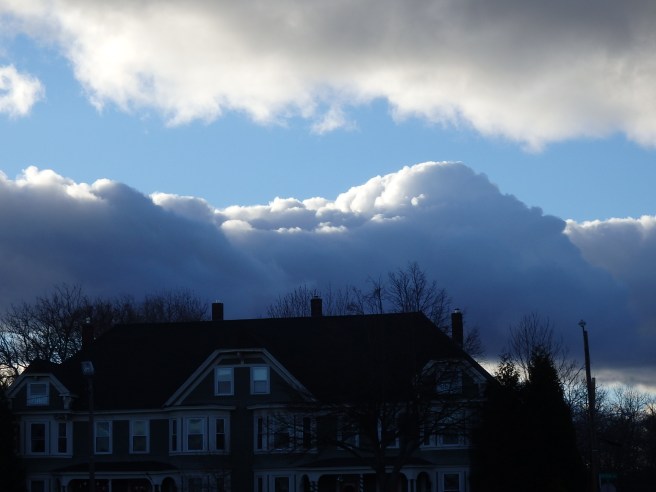
Looks like white-painted architectural touches to me.
Still looks like white-painted architectural touches to me.


WITH PRAYERS TO OUR LADY OF THE ASPHALT

In the congregation of pleasure:

Some are fat; some, skinny.
Some cute; a few, beautiful.
They smile, frown, dimple, blink.
Hair short, curled, long and free.
They come from anywhere.

~*~

“Roger was in my room again till five
telling me he didn’t want to sleep alone again,”
she said, glancing at her lover

while he simply smiled, facing away.

~*~

One votive burns
twice as fast
as the other.

Both, invoking
departed honeybees.

To continue, click here.
Copyright 2015

HOPING FOR ANOTHER ACCOUNTING

She liked to bite fingers.
She braided my beard.
Her nose and big toe were square.
Her tresses were thirteen years long.

~*~

She devoured the translation like a cheeseburger
and refused to understand me.

She spent her paycheck
on clothes she bought on layaway
while she was one unemployed
good dresser who had to do something.

She said Kayak poetry review
looked like a Sunday school booklet
with a cannon on the cover.

~*~

She didn’t like the antique silver fork
with the engraved W
I’d bought for a dime

– the yellowed marriage
whose bride was no doubt long dead
held no treasure in her eyes.

Why else would we have it?

To continue, click here.
Copyright 2015