Plenty of space for hanging clothes, by New England standards

A traditional New England home comes without closets, or perhaps has some quirky ones that were added later but inefficiently. It’s an unanticipated jolt for those of us who grew up elsewhere.

That tradition was something our renovation sought to rectify. Indeed, maximizing storage space was a pivotal consideration in our planning. As I’ve noted, our present home is smaller than the previous one, not that its closets were notable, even before considering all the storage capacity we had in the red barn. Yes, the barn that inspired this blog. The garden shed we added here is much, much smaller.

A few locals have been surprised by the results – what they see as closets everywhere in the newly redesigned upstairs. Each bedroom has one. Although these are shallower than a full-sized walk-in closet, they are deep enough for hanging clothes, which is our primary need.

The key in adding these came in realizing that the distance between the gable windows was two feet, enough to run narrow closets along the dividing line between the front and back bedrooms. Our original plan had those closets alternating, half for one bedroom and the other half for its neighbor. But that changed when we decided to give all of that opening to the back bedrooms, which were also smaller.

In compensation, the two front bedrooms got a shallow loft running atop those closets, as well as their own closets elsewhere in the reconfigured rooms.

Quite simply, the closet in each bedroom is unique.

Guest room closet will have three doors.

Additional storage space appears in the laundry room as well as a small hallway broom closet. Yes, even a place to stash the vacuum cleaner.

Not every lover finds roses comforting

In support of that statement, let me offer Long-Stem Roses in a Shattered Mirror, my collection of poems released to the public today.

Think what happens when a hot relationship goes belly up and everything you trusted turns painful.

These poems arise in a brutally honest reevaluation of those interactions, as one of the lovers insisted on at the time, as well as the larger hopes and desires.

Many of the poems appeared in small-press literary magazines around the globe, but this is their first outing complete.

I have come a long, long way since, perhaps because of lessons I learned in these earlier relationships.  The poems remain intense, vivid, and powerfully moving, even at my age.

For my series of passionate roses, check out my collection in the digital platform of your choice at Smashwords.com and its affiliated online retailers. Or ask your public library to obtain it.


How many types of boats under sail do you recognize?

Living around big waters, as I do now, means hearing a number of new terms to identify boats big and small. When you merely read about them, say in a history book, you can usually skim over the word and move on.

Not so when you’re trying to describe what you just saw.

Today we won’t attempt to get into the array of mostly motorized vessels. Not even a Bayliner versus a Boston Whaler. Naval ships alone would require a long list.

Instead, let’s look at a general overview of boats originally powered by the wind. (Admittedly, today many of them will have an internal engine for additional power.) These can range from small sailboats to majestic tall ships.

  1. Sloop. The most common type of sailing vessel, it has a single mast, usually with one triangular mainsail (in what’s called Bermuda rigging) and, in the front, a triangular headsail, usually a jib. These can range from small, single-person fun boats to larger racing boats manned by trained crews.
  2. Cat. Or catboat. Has a single mast rising from the front of the boat and a large, single sail on a long boom. A second beam of wood, called a gaff, runs along the top of the sail, turning it into a four-sided sheet of hexagonal shape rather than the triangle. They were popular New England workboats around the early 1900s, short (typically ) 20 to 30 feet long and wide, highly stable, and have made a comeback today.
  3. Cutter. A single-masted vessel resembling a sloop, but often having a gaff-rigged mainsail and an extended spar called a long bowsprit extending from the bow, which allows a second headsail (a staysail, or “staysul.”)
  4. Schooner. Two or more masts, with the largest sail (the mainsail) at the aft, plus a foresail (resembling the mainsail) on the mast ahead of it as well as a jib and staysail at the bowsprit. They may also have one or more topsails and a small sail called a mizzen aft of the mainsail. With their complex rigging, they can be fast and undeniably majestic. And, yes, my favorite.
  5. Ketch. Resembles a schooner but has an extra mast behind the mainsail.
  6. Yawl. This term has several different meanings, the first regarding rigs with one or two fully equipped masts plus a mizzen mast aft. It can also refer to a double-ended hull boat that could be worked from the beaches, not that I’m finding any reference to sailing in what would be the equivalent of reverse gear. Some of them, if you’re a bettor, may have been the fastest-sailing open boats ever built. And it even seems to be a kind of dinghy. Just so you get an idea of how loose some of these terms can be.
  7. Brig. This two-masted ship introduces us to square-rigging with sails arrayed on horizontal spars perpendicular to the keel and masts – that is, “squared.” The spars, called yards, present the sails to face the wind from behind. The foremast of a brig is always square-rigged, but some varieties may have a gaff or lateen sail on the mainmast. (Lateen is an ancient arrangement I won’t get into unless you’re going to Egypt.) “Square,” as far as masts go, means more or less perpendicular to the hull, unlike the ones more or less parallel to the hull. Trust me on this.
  8. Barquentine. Its foremast was square-rigged, with gaff-rigged masts behind. But let’s skip ahead.
  9. Barque (or bark). A three- to five-masted square-rigged ship consisting of a foremast, mainmast, and a smaller, often gaff-rigged mizzen mast at the aft for steering stability. Far and away the most numerous of the square-rigged vessels. Enough of the finer points. Let’s turn to the most glorious.
  10. Tall (or full-rigged) ship. Three or more masts, all fully square-rigged, one sail above another, often five or six on a mast, with a hull often much longer than a schooner. The individual sails were smaller than a schooner’s and less likely to rip out in a storm, but the number of them provided more overall sail surface, allowing for maximum speed. The downside was that crews of 30 or more sailors were required for handling those sheets. Still, seeing one of them is exciting. It’s what you really picture first, after all. Now, for all of the subcategories, such as a frigate.

Underfoot counts, too

Another consideration I haven’t mentioned was the upstairs flooring.

As much as we would have liked polished hardwood, our budget called for something more affordable.

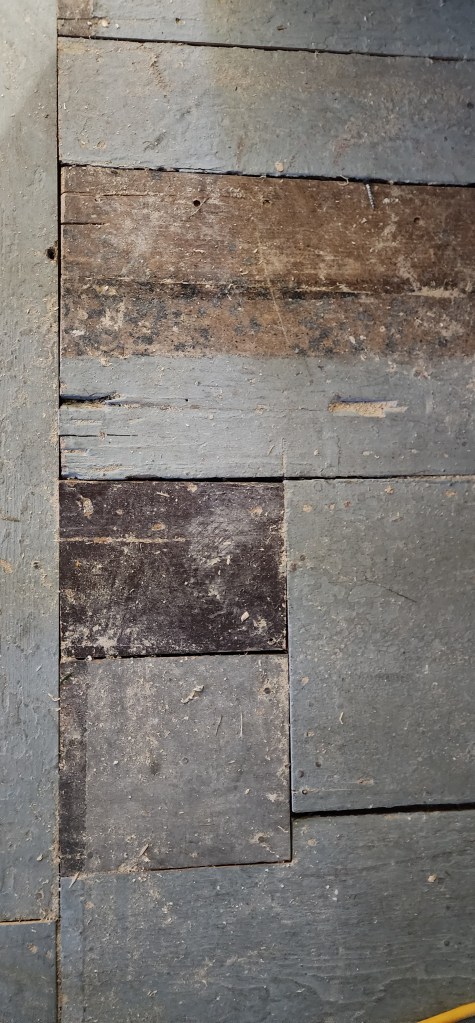
The existing flooring was more piecemeal, with unevenness and knots. It did speak of the rustic origins of the house and its historic character. Our contractor mentioned some flooring that would match it, and we were onboard. (Sorry for the pun.)

Refinishing those planks might have looked historically charming, though they were never great to begin with. Instead, we salvaged what we could and added fresh to continue.

The next question was how to treat it. Apart from two rooms and a hallway of vinyl flooring downstairs, the existing flooring, upstairs and down, had been painted a light blue that easily flaked. Could it be sanded and refinished in a natural finish? Did we have time to undertake that? Otherwise, what color of paint could we agree on, at least for the bedrooms? The bathroom and laundry room might be a different matter requiring something more waterproof.

I had hoped to decide on a paint color extending across all of the upstairs. Mine was the minority vote.

That left me facing a decision for my room. Please stay tuned.

How would I have envisioned literary success?

Let’s start with the prompt: Imagine yourself in the position you desire.

For much of my life, that had two conflicting scenes, the newspaper editor in his community in contrast to the successful novelist in a tweed jacket in a New York study or a poet in something more funky.

Much less for the supporting people my life, starting with wife and children?

When I last looked at the question, it essentially asked me to consider my early retirement years. How curious! The newspaper editor, at least, was out of the picture.

At its core, I craved recognition (affirmation!) – after years of largely reclusive labor. But which circle did I most want to recognize me – hip, alternative culture? Quaker, international literary, Seacoast New Hampshire? At some level, perhaps, it was also wanting to visit Dayton and be known even there – or to hear again from many people I’d known and lost contact with in my relocations. The Quaker world is awfully small and restrained, especially with its three sharp divisions. The literary world, meanwhile, has so many high priests and exclusive emphases – could I move among them? Yet, if the Society of Friends is to survive and grow, I needed to move beyond its confines and reach out to a wider audience. In a larger sense, then, my recognition would be as one who brilliantly bridges these disparate worlds. If only.

I did imagine a significant amount of time would be engaged in travel – public readings, workshops, conferences. Eight weeks a year, split between Quaker and literary? Perhaps an additional retreat or camping trip? The travel could also include three-day weekends for symphony, opera, and galleries.

I also imagined having three books published on paper each year – one of poetry, one of Quaker practice, and one of fiction or memoir/genealogy. (They were already written.)

The rest of the time would be correspondence and basic living, including a social life, concerts/plays/etc.

I do believe such reflections are important in channeling what might otherwise be simply drifting through life.

So back to the questions.

Define what you are trying to accomplish. Be clear about what you’re setting out to do. What problem are you trying to solve? What new ground are you trying to break? What will happen if you manage this well? What will happen if it isn’t managed well?

I would have said, Brand myself as the leading new Quaker voice – or at least an original Thinker. (Think of Bill Stafford in the Church of the Brethren, Wendell Berry, even Mary Oliver the Unitarian – who has emerged since?) What I want to do is bring Quaker theology into the center of contemporary thought and discourse, and then to renew the life of the Society itself. The poetry and fiction add to my credibility as a writer.

Well, that has slipped past me.

Now for another hard question.

Who do you think would play me in the movie version?

~*~

You can find my surviving novels in the digital platform of your choice at Smashwords, the Apple Store, Barnes & Noble’s Nook, Scribd, Sony’s Kobo, and other fine ebook retailers. They’re also available in paper and Kindle at Amazon, or you can ask your local library to obtain them.

Inside Charles F. Kettering’s mind

The prolific inventor, entrepreneur, and civic influence Charles F. Kettering was still alive in the Dayton community when I was an aspiring chemist in my youth.

My career in science never materialized, but his influence as an inspired ideal of leadership remains.

You may recognize the name from the famed Sloan-Kettering cancer research hospital in Manhattan or from the city in southwest Ohio named in his honor. He also led the research teams that invented the electric cash register, the automobile electrical self-starter, and no-knock gasoline. Other work made the diesel engine practicable as well as the refrigerator and, in time, air conditioning. In all, he had 186 patents, second to fellow Ohioan Thomas Edison. He was a founder of Delco (Dayton Electrical Laboratory Company) and from 1920 to 1947 was head of research for General Motors.

As a power in the new General Motors corporation, he aligned with management pioneer Alfred Sloan – as in that Sloan-Kettering Hospital in Manhattan,.

Let me repeat, there’s even a city named in his honor.

Today we have another Double Tendrils.

Get ready to know him better. Let’s start with his perspectives on the creative process and problem-solving, especially as they apply to engineering and invention.  Here’s what he said:

  1. If you want to kill any idea in the world, get a committee working on it.
  2. I don’t want men of experience working for me. The experienced man is always telling me why something can’t be done. The fellow who has not had any experience is so dumb he doesn’t know a thing can’t be done – and he goes ahead and does it. … The person who doesn’t know something can’t be done will often find a way to go ahead and do it.
  3. Every great improvement has come after repeated failures. Virtually nothing comes out right the first time. Failures, repeated failures, are finger posts on the road to achievement. One fails forward toward success. … 99 percent of success is built on failure.
  4. An inventor fails 999 times, and if he succeeds once, he’s in. He treats his failures simply as practice shots.
  5. Inventing is a combination of brains and materials. The more brains you use, the less material you need. … A problem well stated is a problem half-solved.
  6. All human development, no matter what form it takes, must be outside the rules; otherwise, we would never have anything new.
  7. A problem thoroughly understood is always fairly simple. Found your opinions on facts, not prejudices. We know too many things that are not true.
  8. Research means that you don’t know, but are willing to find out.
  9. We work day after day, not to finish things; but to make the future better … because we will spend the rest of our lives there.
  10. If I want to stop a research program, I can always do it by getting a few experts to sit in on the subject, because they know right away that it was a fool thing to try in the first place.
  11. When I was research head of General Motors and wanted a problem solved, I’d place a table outside the meeting room with a sign: “Leave slide rules here.” If I didn’t do that, I’d find someone reaching for his slide rule. Then he’d be on his feet saying, “Boss, you can’t do it.”

And now for his perspective on life itself.

  1. There is a great difference between knowing a thing and understanding it. You can know a lot and not really understand anything.
  2. The world hates change, yet it is the only thing that has brought progress.
  3. If you’re doing something the same way you have been doing it for ten years, the chances are you are doing it wrong.
  4. Where there is an open mind, there will always be a frontier.
  5. My definition of an educated man is the fellow who knows the right thing to do at the time it has to be done. You can be sincere and still be stupid.
  6. If I have had any success, it’s due to luck, but I notice the harder I work, the luckier I get.
  7. The whole fun of living is trying to make something better.
  8. No one would have crossed the ocean if he could have gotten off the ship in the storm.
  9. You can’t have a better tomorrow if you are thinking about yesterday all the time.
  10. Every father should remember one day his son will follow his example, not his advice.

He really was one who made America great.

Surprise at the top of the stairs

People looked skeptical when they heard that we were living in the house during all of the renovation.

It’s not like our budget had enough of an edge for us to lease quarters elsewhere. Were we just more daring or more tolerant than others?

A key to the project turned out to be the translucent plastic “door” created at the top of the stairwell at the beginning of the work, the one with the zipper. It reduced the amount of dust that escaped from the construction and also kept much of our heat down on the first floor.

The sound of that zipper became a fact of life for us. All three zippers we had over the course of the project.

~*~

What awaited us on the other side of that veil went through a progression.

At first it faced a crowded set of shelves set in under the sloping roof, along with sliding doors to two makeshift closets and a narrow hallway running to each side.

After that came the demolition that revealed charred rafters and sheathing.

We briefly had a stretch of open sky followed by the raised roof and then the framing for the bathroom and laundry room.

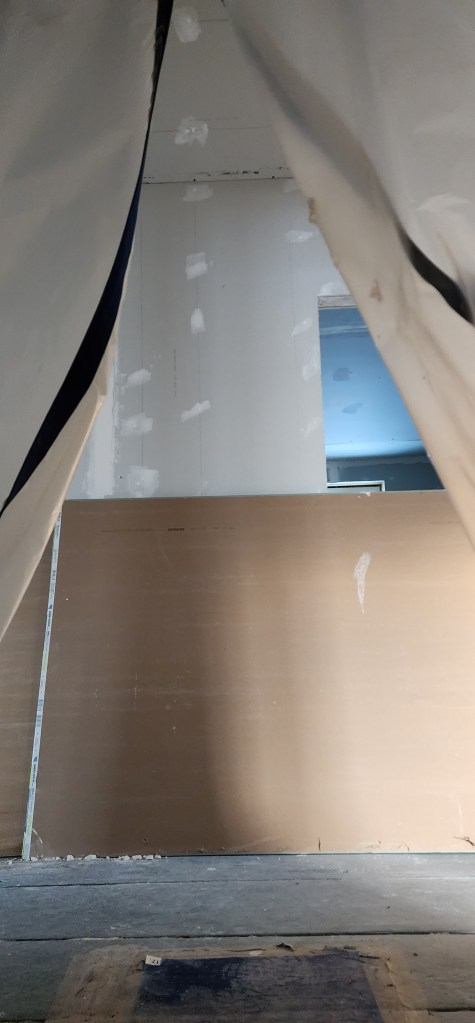
What caught us by surprise, though, was the blank wall when the sheetrock went up. The stairs didn’t lead straight to another door. What would we put there? A large painting? A bookcase? A settee?

With the zippered curtain pulled back, you can see the wall and a corner of the laundry room door. Drywall panels are stacked upright against them.

One of the coconspirators in our planning insisted on having a wide hallway, or perhaps more accurately, a landing – 6-by-16 feet, it turns out – conjoining the doors for the four bedrooms, the bathroom, and the laundry room. As a practical matter, this would make moving large items much easier, but aesthetically, the space feels wonderful, especially when we decided to keep the ceiling there running all the way to the crown of the house rather than having a low flat one.

No photo would get you a sense of that.

~*~

Somehow, Adam managed to keep the stairwell in place through all of the demolition and rebuilding. It did have that hand-cut oak lathing that predated 1830, for one thing, and the period molding.

For months, it stood like a dark ark at the center of all the action.

Once the new upstairs walls and details were in place, he turned to repairing the stressed stairwell walls and ceiling. One alteration we had envisioned was an interior window for natural light from the bedroom nook. Minor touch, but satisfying. Alas, one that was cut, in part for budget considerations.

We also gained storage space above in a kind of mini-attic accessed from a bedroom. It’s perfect for seasonal decorations that are needed just once a year. Easter, Halloween, Christmas, mostly.

~*~

As I had to confess by this point, the project was much more complicated than I had expected. I could now see why one contractor had just wanted to gut everything from the get-go, while another wanted to rip the top off and replace it with a gambrel roof. But I’m confident neither of those routes would have led to what’s emerged.

How do you come upon the writing that excites you?

Assuming that you’re an active reader, let me ask where you’re obtaining your books of interest. With a thousand or more new novels every week, you can’t possibly keep up there. As for bookstores, there are only so many shelves. Ditto, public libraries.

Some of those stores and libraries do have sections where their employees recommend new volumes, and I applaud that, even while physical bookstores fight for survival.

Goodreads is another option, though also quite crowded.

For commercially released works, the New York Times reviews and a few other sites are key to the latest.

But my interest – and work – falls outside of that realm, and I do believe the real action takes place at the fringe.

Quite simply, I see opportunity for a dedicated reader – especially a recent graduate in literature – to set up shop online as an informed critic in a specific vein. What I’ve seen too often among the bloggers who review is gushing froth about stuff they like, akin to movie fanzines, rather than any critical detailing of why something soars above the pack or even why others fail. They don’t say what makes the piece they’re praising truly stand out.

The ideal I’ll acknowledge is the French film magazine Cahiers du Cinema, founded in 1951, which ran only pieces extolling new work of merit, rather than all new movies. It gave rise to a new wave of cinema, one based on daring directors rather than the film actors aka “stars.”

~*~

Real change originates at the fringe of society, not at the center. It typically develops in obscurity, sometimes flashing into widespread recognition and acceptance, and that’s been true in literature over the years.

Rarely will truly adventurous pages be found through the bestseller lists, but when one does break through, then everyone – writers, readers, publishers, and booksellers – will be in pursuit. Imitations will abound, as well as new labels and genres for marketing.

So how do you find fresh books and their writers, the kind who turn you on, fill you with a sense of discovery and make you want to tell everybody you know what they’re missing?

The history of novels is filled with instances of canon masterpieces that were rescued from oblivion by a single critic, either in a pivotal review or by sustained championship. And nothing beats word-of-mouth by a few fans.

So here we are, in a remarkable period of access for both readers and writers, thanks to digital advances. The problem is that there’s so much, there’s no way to keep up.

That’s where a few celebrity critics could step in.

~*~

Sometimes I regret writing novels that are “out there.”

It could be fun writing sharp reviews of many lousy books if I weren’t facing retaliation. (By idiots.)

Still, I feel it’s an opportunity well worth examining for an enterprising young English major graduate: sorting through the eruption of new writing and signaling what might be worthy of further examination.

By the way, online I usually don’t click the button on “pages” or “posts” that have more than 20 “likes.”

Like what is this, a popularity contest?

Still, on the receiving end, it is nice knowing that some folks are at least seeing this. Better yet is when you know that someone else “gets it.” Or, as I originally wrote, “Digs it.”

~*~

So back to the opening question, How are you finding the writing that excites you?

Are there any websites you would especially recommend?

Here’s your chance to give a shoutout.