Gleanings from the pressroom

After four decades as a daily newspaper editor, I was recognizing I was among the last in a long tradition. I do worry about the future of community and democracy in the aftermath.

As I pitched my novel at the time, “Hi, my name is Jnana Hodson and I’m not surprised American newspapers are in crisis. In my four decades as a professional journalist, I’ve seen news coverage under attack – not just from the outside, but more crucially from owners who first bled billions from its renewed growth and vitality and now give the product away without a viable business model in sight. My novel, Hometown News, pays homage to the battle and what could have been, along with journalists’ role in the survival of communities across the continent and democracy itself. Along the way, Brautigan and Molly Ivins meet Dilbert and Kafka on the prairie, even when their names, sex, and races are changed. May I introduce you to the full story?”

An alternative version went, “Hi, my name is Jnana Hodson and my career as a journalist has placed me in enough decaying industrial cities to shape my novel of high-level global investor intrigue. If you think Dilbert tells of modern business operations, think again. May I show you my take?”

A bigger question was why anyone would be interested in this or see themselves impacted by these corporate machinations.
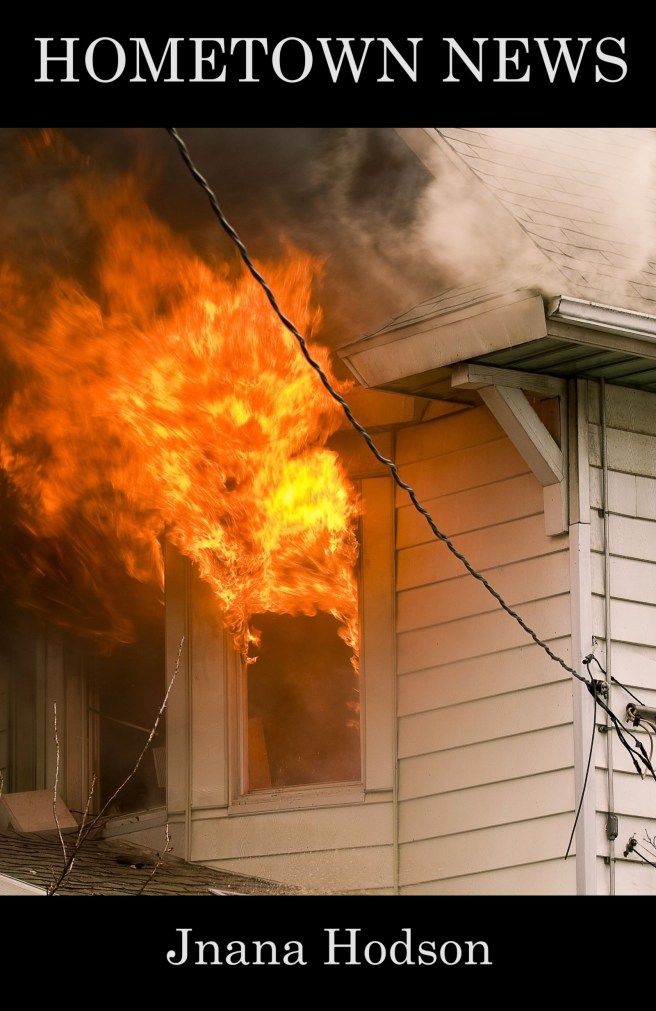
At their best, daily newspapers have shaped both a central identity for localities across America, and their conscience.

For many years, despite the arcane business structure in which advertising rather than sales of copies provided the bulk of the income, hometown newspapers were cash cows for their owners – who, in turn, paid their reporters and editors minimal wages.

The resulting management practices – reflecting those of surrounding corporate retailers and manufacturers – have put news coverage at risk, endangering both the communities and democracy itself. How will they, like the reporters and editors, survive?

As a journalist, my touchstones have been Accurate, Informative, Useful, and Entertaining. I wonder how those apply to poetry, as well.

The novel is cast on an experimental frame, one that anticipated AI and then backed away from it. The daily events, however, get weirder and weirder as the demands and tensions ratch up. You might even think of it a dystopian.

That said, you can find Hometown News in the digital platform of your choice at Smashwords, the Apple Store, Barnes & Noble’s Nook, Scribd, Sony’s Kobo, and other fine ebook retailers. It’s also available in paper and Kindle at Amazon, or you can ask your local library to obtain it.

So how are you, really?

If AGE was a sign of WISDOM, a vast age might have been a sign of great wisdom, so that Biblical ages stand not as a measure of time but as a scaling of experience or insight.

Methuselah, 969 years; Noah, 950.

Also, the the closer to historic times, the more normal – i.e., smaller the number, though still bigger than today’s.

Good thing negative numbers don’t apply here.

Some Maine towns were named after Sacred Harp tunes

New Englanders sometimes joke that a town name will be found repeated in five of the six states of the region. It can be confusing. You know, people moving from one place to a new one but keeping the town name.

Maine, however, has its own twist, since much of the settlement occurred after the American Revolution, especially in the early 1800s, when “singing schools” became a popular community activity. Many of these were related to church life and the spread of four-part harmony hymn singing. So what if someone else had claimed the town name you had hoped to repeat, here was a fresh source.

Today many songs in a hymnal carry a title reflecting the words, but in earlier times the name identified the music itself – many of their lyrics can be transported from one composition to other scores within a given syllable-count system anyway.

That older tradition is continued today in a style of a four-part cappella singing called Sacred Harp, reflecting the title of the hymnal of shape notes that it used. Shape notes, should you ask, are not all of the round kind you see in most musical scores. Instead, some are little flags called fa; others are little boxes called la; or diamonds called me but spelled mi; and the round notes are called so. And there are no instruments, not even harps, much less pianos or organs, in this often rowdy tradition.

So much for that arcane sidetrack. Back to the song names.

I had assumed that the composers applied them to honor where they were written or some such. “Detroit” is one that always makes me smile.

At any rate, during a sacred-harp singing session a while back, it was mentioned that some Maine towns were actually named for the tunes, rather than the other way around.

Bangor was one. Though not in the Sacred Harp collection, the tune was written in 1734, “Oh very God of very God,” and influential. The Maine city was incorporated in 1834 from what had been known as Sunbury or Kenduskeag Plantation. The name “Bangor” is said to have been taken from a Welsh tune. Voila!

Now, for ten examples drawn from the shape-note collection. The name of each tune and town is followed by its date of composition and then the first line of the text it accompanies in the Sacred Harp collection, the date of the founding of the town, and then by something about the Maine community.

  1. Chester: 1770, “Let the high heav’ns your song invite”; settled in 1823, the town north of Bangor had 201 households in the most recent tally. The name, however, came from an arrival from Chester, New Hampshire. No dice for the hymn, then.
  2. China: 1801, “Why do we mourn departing friends”; 1774, with the name being chosen by Japheth Washburn. He wanted to call the town Bloomville, but people from a town of that name objected, saying that the similarity could cause confusion. Washburn then settled on the “China” because it was the name of one of his favorite hymns. Today, the summer youth camp of New England Yearly Meeting of Friends (Quaker) is on the town’s China Lake.
  3. Enfield: 1785, “Before the rosy dawn of day”; about 1820, originally called Cold Stream. A third of the town is occupied by Cold Stream Lake. A possibility.
  4. Liberty: 1800, “No more beneath th’ oppressive hand”; incorporated in 1827. Another possibility.
  5. Milford: 1760, “If angels sung as Savior’s rest”; incorporated in 1833 from what had been known as the Sunkhaze plantation. Milford is a town name found across New England.
  6. Newburgh: 1798, “Let ev’ry creature join to praise”; settled about 1794 and incorporated in 1819, it is spelled like the town along the Hudson River in New York, which probably influenced the naming of both the hymn and the Maine town.
  7. Northfield: 1800, “How long, dear Savior, o how long”; the town was settled about 1825 and incorporated in 1838. Thus, a possibility.
  8. Oxford: I’m not sure about the hymn’s date, “Shepherds rejoice, lift up your eyes,” though when the town incorporated in 1829, the honor went to the university town in England. Well, that left the other famed university town, which also has a hymn title in the Sacred Harp collection, “The Lord will happiness divine.” In the second case, the name came up at a town meeting when the community was preparing to be set off from Ripley. The 11-year-old daughter of the household where the discussion took place was asked to suggest a name for the new town. She proposed the name Cambridge, from the English town of the same name about which she had just been reading. It was applied in 1834.
  9. Poland: 1785, “God of my life, look gently down”; when the town was incorporated in 1795 from Bakerstown Plantation, early resident Moses Emery was given the privilege of naming the town. He had always been fond of an old melody called “Poland,” found in most of the collections of ancient psalmody, as the history goes. Today the place is best known for the Poland Springs bottled water brand.
  10. Portland: 1802, “Sweet is the day of sacred rest”; the Maine city was set off as a town in 1786, named after an isle off the coast of Dorset, England. Alas for the influence of the hymn, though it may have been the other way around. The city in Oregon, should you wonder, was named in honor of the one in Maine in an 1844 toss of a coin. Otherwise, the Pacific Northwest city would have been Boston, which somehow doesn’t seem to be a tune name.

There are arguments that some of the hymns were named after Maine towns. Just consider Mars Hill, 1959, or Mount Desert, 1985.

Finally, something the public could see

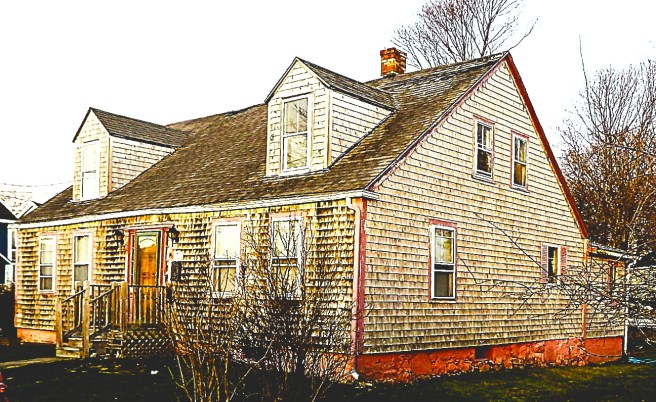
When the scaffolding around the front and side of the house came down after more than a year, the public could finally see what we had intended.

The result actually took off in some tweaks that left it looking, well, we hope for the better – things like the double windows upstairs, which I’ve discussed in previous posts.

In a small community like ours, people were bound to gawk and talk, and so far all we’ve heard has been admiration.

As it now stands.
Starting from this.

When we embarked on this project, I quipped that old-house fixes took three times the estimated time and budget, and ours (alas) has been no exception on both fronts.

Actually, more, or maybe less, if you consider the Covid whammy and inflation. Besides, we got into a great deal more than adding space overhead: many of the extra costs addressed items in our home inspection report, things like rot, wiring issues, plumbing, masonry. Oh my, it was a long list in addition to the more pressing roofing situation that concerned our insurance policy.

So much of what we paid for would be unseen: the aforesaid rewiring (throughout the house, cellar to roof), sculptural work to allow the new farming to sit atop the old (how this structure ever survived before this is a miracle), spray-foam insulation, caulking. The interior storage lofts weren’t as simple as promised but they add for architectural drama (and the name of our architect, mainly us and Adam), nor were some of the exterior efforts to preserve the Cape image as seen from the street while drastically altering the reality.

But then, when our new cedar shingling was finally finished and the construction scaffolds were removed after more than a year, how handsome, as one of the coconspirators put it. Or, from my perspective, dramatic.

I’m hoping both Anna Baskerville and Captain John Shackford, as previous residents, would approve. As well as the list of others who have left their imprint here.

Frankly, we treasure all of it.

With an eye and ear of personal detachment

One of the luxuries of not writing under deadline is that you can put a work aside for a while to let it season. Pick it up again a few months or even years later, and you may see so much that needs reworking or the trash can, but at other times the page can astonish you.

I’ve had that experience lately at the monthly open mic nights at the arts center, where I’ve been reading snippets from my published The Secret Side of Jaya as well as selected poems. As I was halfway through my time on the stage one night, I was struck by the thought, “Who wrote that!” It was a daring approach to fiction, completely contrary to what would emerge from the Iowa Writers Workshop, but it was mesmerizing my audience. I certainly wouldn’t write that way again, either. Still, I feel pride.

Sometimes, of course, that sense of “Who wrote that, it is so incredibly fine,” is countered by “Who wrote that piece of tripe? I’m glad it never saw publication.” Sometimes only pages apart.

Reading at an open mic or as a featured reader is a valuable test for how a page works, as you can feel from the energy in the room. Lately, I’ve been taking pages from the middle of a novel and reading them without an explanation of the previous action. Think of them as a trailer for a movie.

~*~

Well, mine is a contrast to the kids who get up on the stage and apologize for reading an old work, meaning something they wrote three weeks ago or even three months. Little do they know!

Parts of The Secret Side of Jaya go back 50 years.

~*~

At the moment, that has me wondering how non-writers revisit earlier times in their lives. Photos, old letters, trophies, musical albums?

The Argentine writer Borges took the concept so far as to ask himself about Borges and the other Borges – the one on paper and the other in the flesh – which one was which, at any given time? He no longer knew.

Or the Japanese composer who insisted he wasn’t the same person today he was yesterday, much less 30 years earlier.

Another consideration in revisiting earlier writing, especially as drafts, is that what we’re most fond of is likely to be what bothers others the most; what we’re about to toss out in the next revision may be what is most effective with our readers. The point was raised, I believe, by Joyce Carol Oates, but it’s true to my experience.

As critics of others’ work, by the way, we’re likely to be harshest on those whose work is most like our own! Too much mirror?

~*~

You can find my novels in the digital platform of your choice at Smashwords, the Apple Store, Barnes & Noble’s Nook, Scribd, Sony’s Kobo, and other fine ebook retailers. They’re also available in paper and Kindle at Amazon, or you can ask your local library to obtain them.

Oh, for the tart wit of the Algonquin Round Table   

Whatever happened to the art of witty retorts? For that matter, the cozy gathering places of sophisticated regulars in urban centers, where at least one of the participants slyly made note of the ongoings?

Does this have anyone else evoking a picture of the New Yorker crowd at their daily luncheons at Manhattan’s Algonquin Hotel, where Noel Coward, Harpo Marx, and Dorothy Parker, among others, held forth. I’m surprised to see that cartoonist James Thurber wasn’t among them, especially since he resided in the hotel, nor was Cole Porter diddling away at a piano. Well, Thurber didn’t enjoy their penchant for practical jokes.

Still, on other occasions, the Algonks delighted in charades and the “I can give you a sentence” game, which spawned Parker’s memorable sentence using the word horticulture: “You can lead a horticulture but you can’t make her think.”

I’m assuming you groaned there.

Now, let’s consider ten more caustic wisecracks from Dorothy herself:

  1. “Beauty is only skin deep, but ugly goes clean to the bone.”
  2. “If you want to know what God thinks of money, just look at the people he gave it to.”
  3. “The first thing I do in the morning is brush my teeth and sharpen my tongue.”
  4. “Don’t look at me in that tone of voice.”
  5. “I don’t know much about being a millionaire, but I’ll bet I’d be darling at it.”
  6. “Tell him I was too fucking busy – or vice versa.”
  7. “Heterosexuality is not normal, it’s just common.”
  8. “Brevity is the soul of lingerie,” along with, “I require three things in a man: he must be handsome, ruthless, and stupid.”
  9. “I hate writing, I love having written.”
  10. “That would be a good thing for them to cut on my tombstone: Wherever she went, including here, it was against her better judgment.”

Let’s not overlook her classic verse:

I like to have a martini,
Two at the very most.
After three I’m under the table,
after four I’m under my host.

What do you think about doors?

Most of us, I suspect, seldom think about them at all – they’re just there, open-or-shut as we move on to something else or perhaps seek some privacy. Oh, sometimes they stick or squeak or the knob needs tightening, but for the most part we rarely even see them. As for simply walking into one, BLAM! Sometimes it’s not a joke or only a black eye.

As perspective, when our renovation project began, I was occupying a bedroom that had no door. Ours is an old house, after all, and the back parlor, as we also call the room, sat off the kitchen and our tiny bathroom. At least the bathroom had a door, though it didn’t close fully. As a matter of fact, few of the indoor doors in our house closed fully and the exterior ones were equally suspect.

Adam, our amazing contractor, raised another question about which way each of our upcoming doors would open. I assumed, erroneously, that they would be situated to minimize obstruction of open space. Instead, it seems that doors conventionally open with the right hand. Not the left. From either side, at that. Try it and let me know if I’m wrong.

The discussion thickened, no pun intended, when one of the coconspirators in this renovation declared she wouldn’t have hollow-core doors in the house, not even the bedrooms. My leaning for two of the upstairs bedrooms had been for Japanese-style curtains and for leaving the laundry room open. But then considerations of noise, privacy, and smoke-and-fire emergencies overruled me. A bathroom, of course, needs a solid closure, period. Would ours upstairs have a frosted window, like the one downstairs? As you see, this can get complicated. Those popular flip-this house cable TV programs are so lacking.

But back to topic.

The other coconspirator proposed picking up antique doors salvaged from other renovation projects, and we decided to go that route. They didn’t even have to match, did they?

~*~

Still ahead was what to do with the two exterior doors downstairs.

They were leaky, as far as bad weather went, warped, and rotting. The front door presents a neighborhood impression as well as the challenge of upholding the town’s historical character. Its storm door had already fallen away, due to frame warping.

To see some examples of exterior doors of Eastport homes, take a look at the Doors Fit for a Cape photo album at Thistle Finch editions.

A baroque twist runs through my distilled expression

Samuel Johnson and his baroque literary constructions gave a big push to my writing ambitions after high school. Let me just say I’ve loved the clarity of Mozart from my adolescence on, and Bach and Handel have risen in my estimation in the years since. The brash English master fell right into that, though I now see again just how irreverent he was, despite all of his professed orthodoxy.

What it means it that I’m comfortable reading and writing certain kinds of complex sentences that are foreign to modern readers. Perhaps I should apologize? At least it’s not the only way I put sentences in line. Still, there’s a richness that’s missing in Hemingway and his progeny.

And here I am, drilled in the newspaper journalism Papa Ernie claimed was his inspiration. Think again. (Ernie? Makes me think of Pyle, and his big desk at the Indiana Daily Student, where I once collaborated.)

But then there’s Nicholson Baker’s effortless spinning of sentences of 250 to 300 words spanning a full book page. What wonder!

My wife has noted the dichotomy between my fondness for many Old Ways and the rule-breaking, experimental edge of so much of my writing and thinking. She can point, for instance, to my fascination with the fiery writings of early Quakers in the mid-1660s placed in contrast to wild hippie extremes.

Are they really that different, though? I feel they enrich and deepen each other.

Well, to go back to the late ‘60s, let me share a personals ad I placed in the Purdue Exponent, which charged by the word.

~*~

ANNOUNCING

Dr. Samuel Johnson’s first eventful super cosmic transcendental celestial love in, incorporating the essence of mystical human enigmatic & existential psychic understanding & zodialogical causes of karmic experiences in the metaphysical process.

Syllogistic examination of cerebral chemo electrical phenomena are hitherto banished to the outermost polarities of unconscious stimulation for the duration of the aforesaid soiree.

All persons, souls, and spirits seeking admittance to the heurese beuverie must present evidence of psychological and physical preparedness & predispositions for the event. Mind blowing, seclusivenessly introverted behavior, and abstinence from mind-liberating drugs, drink, or sex, will be considered detrimental to the well-being of the sociological matrix selected for hedonistic propensities &, to avoid contamination & empoisonment of the purity of the greater society therein gathered, will be cause for expulsion.

Adoption & encasement in persona & masquerade are desired for the happening; the playwright hereby assumes no further responsibility for the roles assumed by the characters. Coming soon at your local neighborhood hanging, where all else be suspended for the duration.

RSVP

~*~

In case you’re wondering, she wasn’t impressed.

I have come a long way since then, in more ways than one.

My, that is embarrassing.

That said, you can find my novels in the digital platform of your choice at Smashwords, the Apple Store, Barnes & Noble’s Nook, Scribd, Sony’s Kobo, and other fine ebook retailers. They’re also available in paper and Kindle at Amazon, or you can ask your local library to obtain them.