A major influence on my work has been an awareness of the variables of place. When I lived in the ashram, my yoga teacher returned from her first trip to India and described with wonder her sensation that each locale there felt different – to the extent that each village or region had its own god or gods to embody its distinct character or, as she put it, vibration.
Fifty years later, having lived and worked in eight states, I can say that’s true in America, too, even though we’ve muddied much of the indigenous awareness. I’m especially convinced that people in deeply prayerful states do somehow leave an imprint on a place.
That sensation has unexpectedly led me to Quaker meetinghouses and burial grounds or arisen in the midst of conversation in old houses of worship.
behind plaster we rip from the kitchen crumbling accounts of protracted death Floyd Collins 15 days 1925 age 36 Sand Cave Crystal Cave Kentucky as published in Boston, accounting inescapably cold mud and implacable rock when my own parents were first walking, yet this story my mother related as if she were on the carnival rides of its macabre vigil but now we find nothing holding this roof to the walls so much callous indifference riding on the blind arrogance a foolish turn, perchance, or just dumb luck when it comes to catastrophe of course, I remember living on the roof of a cavern down in muddy Indiana
In my novel Nearly Canaan, Joshua and Jaya settle into a place unlike anything they would have imagined. It’s desert, for one thing, where nearly everything has to be irrigated, for another. Quite simply, it’s a lot like Yakima, in the middle of Washington state. The closest big city was Seattle, three or four hours away. And that, too, was far from much else.
Just consider these in miles, apart from flying time, even when you could fly direct.
Anchorage: 1,448 miles. Alaska has a spiritual affinity in the Pacific Northwest, like it’s just up the road, more or less. Plus, it had good summer jobs on the crab boats, forget the riskiness.
Honolulu: 2,680. Naturally, driving isn’t an option. As a vacation destination, though, this was a highly popular option, especially considering the sunshine.
San Francisco: 679. Like this was the next town south, and like a grown-up version of Seattle, a few decades back. It’s still a long way to drive.
Las Vegas: 871. Seemed close, especially in winter. Say a weekend getaway. Again, factor in the sunshine, if you ever left your hotel/casino.
Denver: 1,024. While many think of the Mile High City as Western, we thought of it as Out East. Our awareness largely skipped right over it. See next item.
Chicago: 1,737. Alaska was closer, and more of a kindred nature.
New York: 2,408. Largely didn’t matter in our eyes.
Washington: 2,306. Ditto.
Tokyo: 4,792. Psychologically, it felt as close as the East Coast of the U.S. and about as influential. We shared an ocean, after all.
Atlanta: 2,182. And you still had to get to Florida, which didn’t matter since we had Hawaii when you added it all up. Blah!
I had already made this point elsewhere in my novel What’s Left, so this sentence was trimmed out of the final version:
Theos Graham joins Theos Barney and Thea Pia in feeding the homeless at Carmichael’s back door or the soup kitchen at the Lutheran church or even letting them sleep in our bus, once we have one.
I do miss the mention of the Lutheran church or the bus, by the way, but they just didn’t fit what was left.
~*~
Yes, we all have found ourselves proclaiming, “I’m starving!” Not that many of us have suffered so much as starvation itself.
Have you ever gone truly hungry? Have you ever wound up accepting handouts from strangers? Have you ever fasted? What’s the longest you’ve gone without food?
~*~
In the family, Cassia would have had food like this.
In the Society of Friends, or Quakers, testimony and witness are synonyms. It’s what one does in one’s life, not what one says about the nature of faith or social stances. Here are some ways we practice this:
Open, Spirit-led worship. Traditionally, sitting together in silence, but many Friends today do have pastors and hymns within a loosely structured worship program.
Peace. It includes pacifism and non-violence, extending to speech.
Honesty. No oaths, which can lead to a double-standard of truthfulness.
Integrity. This means doing what we say.
No creeds or dogma. We speak from our own hearts and experience. We do, however, recognize doctrine (meaning sound teaching) as useful.
Queries. Use of questions and deep listening to guide actions and faith, rather than barking orders.
Equality and social justice. (You don’t have to be a protester, though, to be a member.)
No gambling. And no getting something for nothing, especially at another’s expense.
No voting to arrive at decisions. (Voting in public elections, however, is strongly encouraged.)
Simplicity. It’s more complicated than you’d think.
One test of a poem (for me, at least) is based on the qualities of good vocal ministry arising in the traditional quiet worship of Quakers: incantatory language and prophetic whirlwind. Unlike “slow prose” as a kind of sermon.
In vocal ministry, how often the message comes from within our current conflict or personal struggle!
Yes, we wrestle with God.
Poems and prayers you feel in your hands more than bounce around ‘tween your ears.
what’s happened I no longer want to travel or climb the high mountains or is it just all the moves across the continent and back, my years on the road, my commute daily so stretched I’d contract into my nest and grounds for reading or revision, the places I’ve been and people I’ve known so many I want to know my own better . people come from all over the globe to see the landscape I call home
In early drafts of my novel What’s Left, I considered going into detail on her uncle Dimitri’s practice of micro-lending and startup investing. Here at home we discussed including a whole list of failures and successes — or reasons applications were approved or rejected. Just think of all the once bright options that soon failed, as well as the ones that have since gone mainstream.
One proposal that didn’t survive my second-thoughts was this:
Thus, when friends decide to launch a local winery, we support them.
At the time I first noted this, 45 or so years ago, a local winery would have been cutting edge. Now there seem to be wineries everywhere, and their output can be widely uneven and often overpriced.
~*~
My experience as a home brewer, making more than 2,500 bottles of beer, was fascinating. We relied on kits from a local aficionado and never had a bum batch. But we still haven’t tried making our own wine.
Gardening, of course, is another matter. As is composting.
Do you raise any of your own food? Make your own bread or yogurt? How about jams or jellies or artisanal vinegars? Any other hands-on touches?
~*~
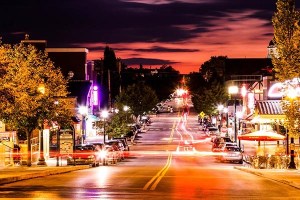
Cassia’s family transforms an off-campus neighborhood into something like this, one they call Mount Olympus.
Let me express my own everlasting gratitude for Glenn Thompson and his eye for talent, in my case after my letter to the editor and then his offer of an internship, later followed by a full summer. In a seemingly casual interview, he urged me to keep a personal journal, which I actually have. And then came the job offer. Without him (and so many others), my life would have taken a different direction. Gee, indirectly he even led to my first lover. (Look for Mitch in Daffodil Uprising, who’d been a copy boy I met thanks to Glenn’s support. Mitch was the catalyst to the crucial introduction. That dimension, in itself, could be a novel.)
Glenn was the editor-in-chief of the morning newspaper in Dayton, Ohio, and in his own way, a visionary. Behind the scenes, he even brought together the first university I attended, Wright State. And also, through him, I became a professional journalist, even while still in college. Another long story.
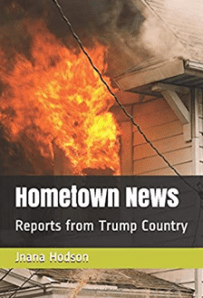
The paperback cover …
And he asked questions no one had prodded me with before. How would I change the world? What issues could I raise and address? At first, I was speechless. We were so green, and within a year, everything would look different. The biggest item on the agenda was the Establishment, not even its war in ‘Nam. Civil rights issues were a distant second.
The next summer I was a hundred miles up the road from Woodstock, working for a publisher who totally ignored me and editors who kept their heads down. But a new direction was taking shape for me.
Alas, as I’m also seeing, mine are steps youth today cannot follow. The pathways simply no longer exist, to the larger society’s impoverishment.
As I describe in my novel Hometown News, American journalism has long been based on a precarious business model. News itself is a byproduct of trying to attract customers for advertisers, and many publishers considered news gathering mostly as a costly nuisance. Successful newspapers were defined mostly by their obscene profits, and the pay levels for reporters and editors were often at the bottom of pay scales for professionals. As a priest reminded me before my first marriage, we might as well have been bound by vows of poverty. Oh, yes, and some of the highest quality papers – the kind I aspired to – were fighting for their very survival. We can now add to the toll of the role of the Internet.
So it’s all in flux now.
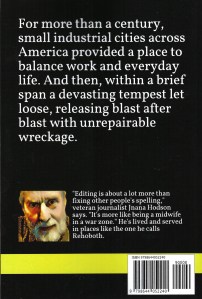
… and the back cover.
Still, newspapers show up in the majority of my novels, though in Nearly Canaan the field turned from journalism into non-profit organizations where the long, odd hours, public service, and stress nevertheless remained.
As I look back on my own years of being on the management track in a shrinking business, I see how I started out a hot-shot who thought the New York Herald Tribune in its last years was the best newspaper ever – led by an editor who later admitted in a letter to me he seemed to have become a specialist in trying to recover dying papers. Even then, I would have loved to have worked for him.
Despite my own honors, I had some crucial near misses. For one, I wound up in the final 24 for a dozen summer internships at the Washington Post but failed to make the final cut. The next summer, the Wall Street Journal was laying off staff rather than hiring, so their interest evaporated. Ten years later, something similar happened with timing for a high-level spot at the Detroit Free Press. And so my career veered away from the big cities where I had dreamed of living and from the big time, maybe for the best for me personally and ultimately professionally.
Somehow, this also has me thinking back to the lost hippie wannabes at the corner of Third and Main in Dayton during the summer of ’68. Theirs was a story I had hoped to write, but I couldn’t ask the right questions, I was too green myself. But, more honestly, maybe I just wasn’t cold-hearted enough to cut through to the real hurt and relate it without concern for the consequences.

 Jnana's Red Barn