QUEEN SLIPPER CITY

The train station, perched at the side of downtown, includes Amtrak's Downeaster service to North Station in Boston, in one direction, and Maine in the other. (That run stops in Dover, New Hampshire.) There's also MBTA's Purple Line into Boston.
The train station, perched at the side of downtown Haverhill, Massachusetts, includes Amtrak’s Downeaster service to North Station in Boston, in one direction, and Maine in the other. (That run stops in Dover, New Hampshire.) There’s also MBTA’s Purple Line into Boston.

New England’s waterways are dotted with historic mill towns. The Merrimack River alone could boast of the water-powered industrial centers of Manchester and Nashua in New Hampshire as well as Lowell, Lawrence, Haverhill, and Amesbury downstream in Massachusetts, along with Newburyport and its harbor.

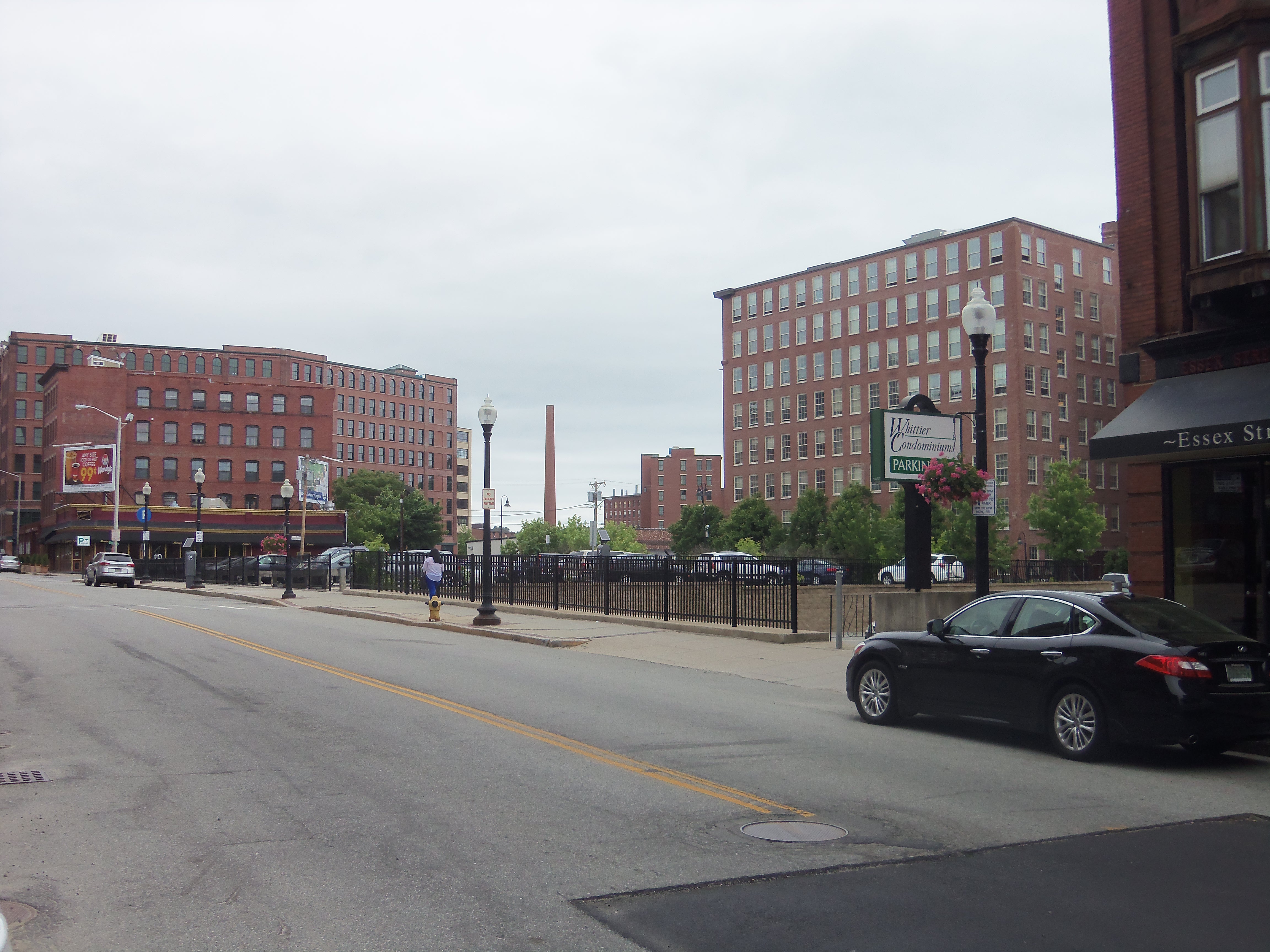
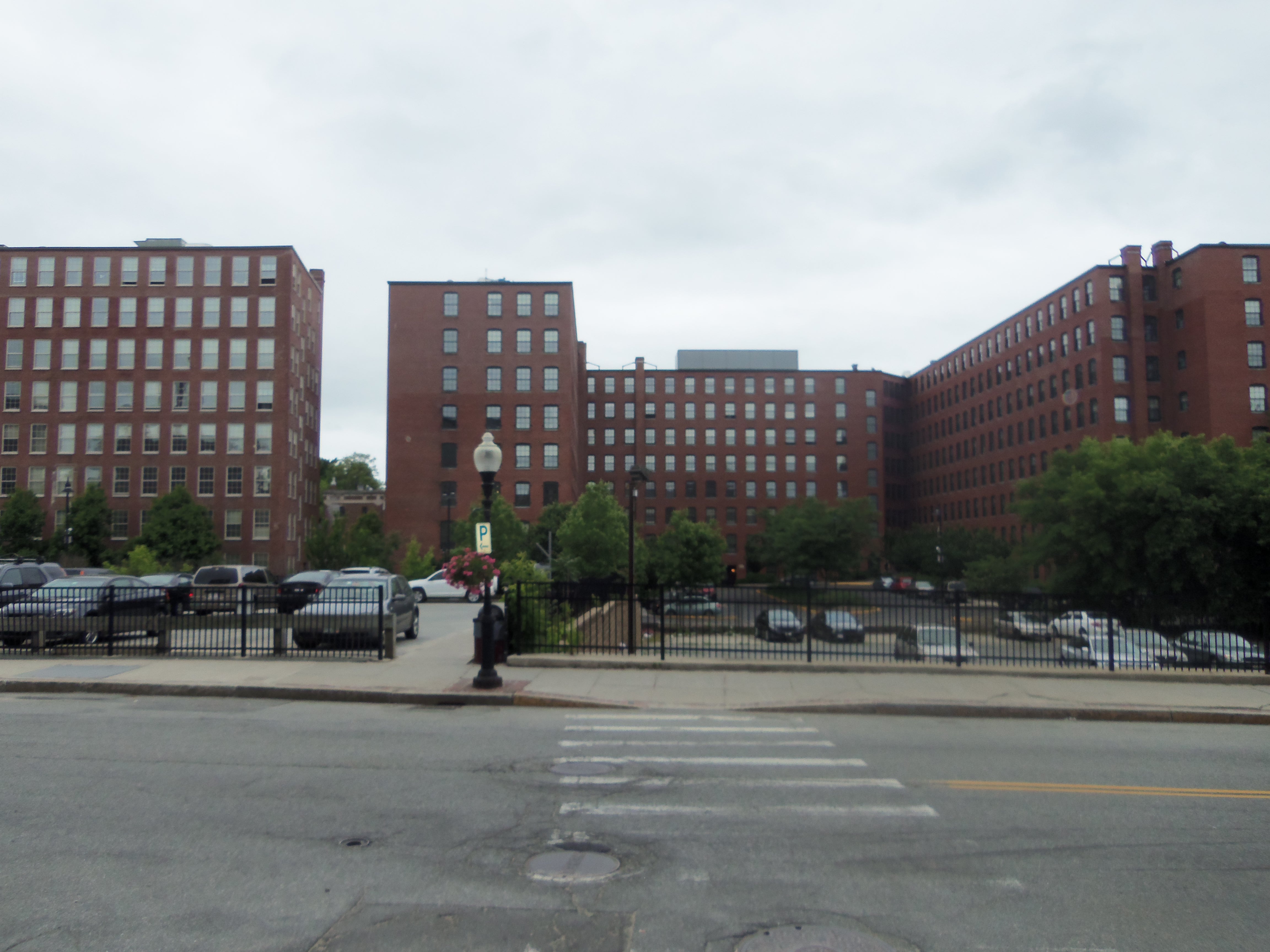
Some of the warren of old mills remains, including buildings converted to offices and housing.
Some of Haverhill’s warren of old mills remains, including buildings converted to offices and housing.
Catch the view of the distant church in the gap.
Much has also been razed, often for parking lots.
Here's a bit of scale.
Here’s a bit of scale.

While textiles were the focus of much of New England’s mill output, the power was applied to other products as well. Haverhill, for instance, emerged as a center of shoemaking, by 1913 producing one of every 10 pairs in America and earning it a whimsical nickname of Queen Slipper City. Its earlier commerce rested on woolen mills, tanneries, shipping, and shipbuilding.

Downtown details.
Downtown details.
Still impressive.
Still impressive.
In those days, every building could be a "block."
In those days, every building could be a “block.”
Facing the train station, a reflection of earlier prosperity.
Down the street, around the corner.
Not everything was brick.

Like many of these once industrial centers, the city has been struggling to adapt to new directions and refit its legacy of old structures.

By the way, in Yankee style, it’s pronounced HAY-vril and is today a city of 60,000. But the river still runs through it.

The river flows toward the Atlantic.
The river flows toward the Atlantic. The tides fluctuate widely here twice a day.
The railroad crosses from downtown and then follows the river upstream to Lawrence. It's a lovely ride.
The railroad crosses from downtown and then follows the river upstream to Lawrence. It’s a lovely ride.


READERS, READERS, WHEREVER YOU ARE

Are there many readers outside New York City? When it comes to literary fiction, at least, the majority of the work often seems to be set in the City, and maybe that becomes a self-fulfilling prophecy.

I do love the fact that so many subway riders are also transit readers, though, and maybe that plays a big influence in the book reading populace. Ditto for taking the bus.

But I’m always baffled by the question, “Who are your readers?” I like to think they come from everywhere, and from all walks of life.

And just who are you?

The marketing crowd, of course, likes to peg a genre to a demographic. Chick Lit is a prime example, which in turn created Hen Lit for an over-29 female readership. Romances we can guess. Maybe even the many strands of Sci Fi.

But I still like to hold out hope for a more diverse core of readers for my own work, including the new books appearing at Smashwords. Am I just being naive?

Heavens, is it really Boomer Lit? I’d hope not to be so limited.

FINANCIALLY SECURE?

This was one of the big items that used to appear in the personals ads. The lady wanted a gentleman who was “financially secure.” But what did that mean in practice?

For some, I suppose, it was a seven-figure portfolio … or better.

For others, maybe someone who held a steady job or was supporting himself? Or maybe could simply pay his half of the rent?

Of course, it was ultimately a personal perspective.

So how would you have defined it?

REVISITING THE PERSONALS

Finding yourself single after the dissolution of a marriage or the death of a spouse is bewildering, at best.

The loneliness and grieving can be nearly unbearable, and emerging from that into some kind of social scene is, well, a lot worse than high school ever was.

Trying to find the right place to meet appropriate potential partners is no less challenging. You hear all kinds of suggestions, from health club to Laundromat, and all of that’s problematic. These days, as a male, I’d look at a yoga studio, just saying …

Another of the complications is the fact – well, it was a quarter-century ago – that the available women were concentrated within the bigger cities, while the corresponding men were an hour or more away, beyond the suburbs.

In the time since then, a number of online dating sites have appeared, and I’ll let others relate their adventures and successes or failures.

But when I was available, the personals ads began to flourish. Out of necessity, I suppose. They even had their own free booklets, like TV listings.

Coincidentally, around the time I remarried, there was a blowup at my newspaper when the publisher went livid over a personals ad where one hopeful had described himself in opposite terms to the usual cliches. (He touted himself as fat, lazy, unemployed, and the like, as I recall.) It was enough to get me and now-elder stepdaughter (and fellow writer) to start reading the Boston Sunday Globe’s more varied ads for insights in the ways people perceived themselves or tried to portray their desires. Usually, they churned out short resumes full of contradictions or things only others could adjudge. “Beautiful” or “handsome” was common, usually preceded by “very,” but that’s something purely for the viewer to decide, thank you.

At any rate, a few entries would stand above the crowd.

One, for instance, described herself as a “Land’s-End kind of gal,” and you really do get a good sense of her in those five words. (We gave her ad a B+ or A-.)

The all-time winner, though, was along these lines: “Happy blue-eyed plumber in search of articulate, well-poised woman to bring (something) into my life. Children a plus.”

He alone could say if he was happy, and “blue-eyed” certainly told the reader about looks. “Plumber,” meanwhile, indicated responsibility and economic status. As for children? Few novelists deliver as much with such economy.

The ad, we noticed, ran just once.


THE SHORT VERSION

Asked for a short theology, I’m likely to reply I’ve come to the conclusion God has a different way for us, individually and as a society, to be living.

It’s the story I see evolving in the Bible, for one thing. And in much of the history since.

It’s not hierarchy-based, for starters, and something quite different from nations, with their armies, as we know them.

We get a hint of it in the suggestion of the Jubilee, the redistribution of wealth every 50 years for the entire populace.

Maybe you’re already sensing I don’t draw a distinction between here and eternity, not the way Augustine did. It’s the “Kingdom Come, on Earth as it is in Heaven,” as Christians pray.

The long version, of course, is where all the details come into play.

WHEN LEADERSHIP GOES WRONG

Leadership is a fascinating subject, not just the source of many intriguing biographies but also corporate case studies and political histories and military campaigns and religious movements and … well, feel free to add to the list. We’ve all been in places where we’ve worked with admirable leaders, as well as places where we’ve suffered – perhaps even leaving in despair.

Outstanding leadership is, of course, a rare and wonderful occurrence. Mediocre is, by definition, the norm. And then there’s the kind that worms itself into position and sets about doing destruction.

Lately, I’ve been reflecting (again) on the last one. Not just inept, but destructive. I can work around one, but the other one makes for an impossible situation. Think Moby Dick.

It doesn’t always start off as badly as I’ve portrayed. Sometimes the individual begins gangbusters, doing everything right, before something goes seriously wrong. The person may simply burn out or lose interest. Conditions may change, so that the fit no longer works to the organization’s advantage. (Corporate organizational consultants have elaborate charts of the qualities needed for a startup versus a maturing company, or one shifting from private ownership to a public stock offering or the reverse.) Sometimes the person is fine for when everything’s going smoothly but has no ability to adjust for necessary – and often painful – restructuring, especially when layoffs and shutdowns are involved. Or there may be a buried demon that is let loose somewhere along the way, perhaps triggered by a divorce or death or temptations such as greed or power-hunger or sheer arrogance or flawed leadership techniques such as bullying and abuse or deep-seated insecurity or an untamed ego or, well, again the list goes on. Feel free to add or amplify. This, too, is a source for many great works of literature, operas, plays, and movies. The dark side comes forth.

My big question is whether an organization reacts in time to save itself, and what steps can be taken before it’s too late.

One of the first signs of trouble is the departure of key personnel, often lower-level individuals on the front line – or at least a failure to hear their complaints without retaliation. Sometimes it’s flight at some of the highest levels. After all, their jobs are at stake.

Usually, however, the awareness comes later.

The New York City Opera, for instance, appointed a new CEO whose brief tenure was disastrous. His flamboyant, extravagant vision for the company sent it straight for the cliffs, and the trustees’ decision to terminate his reign ultimately came too late to prevent the train wreck. This was a company, we should note, founded by visionary leadership that continued through several administrations. RIP.

I’m thinking, too, of situations where one of the top leaders engages in clandestine conflict – often backstage, one-on-one building alliances – that’s ego-based to the detriment of the organization. Commonly, the player lacks an appreciation for the culture and values of the organization and seek to turn it toward his or her own goals, including self-power enhancement, regardless of the trustees’ projections. Removing such a toxic manager, however necessary, produces ill feelings and misunderstanding all around, especially when the others are prevented by legal constraints from speaking openly of their underlying reasons.

Sometimes I think it’s a miracle organizations get anything done, top to bottom or, more accurately, bottom to top. There’s far more to leadership than barking orders, for sure, or undue frugality. I’d put mutual understanding high on my list of leadership qualities.

How about others?

~*~

I looked at something similar – good bosses and bad – back on June 28, 2013. To take a look, just click here.

MOVING TOWARD A NEW PERIOD

This miracle of being allowed to release so much pent-up work is impossible to describe, but it is fostering an incredible change within me. The publication of my novels as ebooks through Smashwords.com and the postings on this blog of so many bits from my archives are allowing me to enter a period of reduction – something I’m calling “decollecting,” when it comes to my books, recordings, manuscripts, extra clothing, and other assemblies. What I’m also finding is an opening to rethink almost everything and, like the layers of an onion being stripped away, of finding myself willing to rely on fewer and fewer answers … and more and more questions. Add to that a growing sense of wonder, in many cases, or of futility and cynicism, when looking at so many of the political and economic policies being followed blindly.

What I am accepting is that I require less and less material support. Maybe it’s the renunciation in my yogic past finally kicking in, or maybe it’s the tightened focus on what remains before me.

One thing I know as I view the trail markers before me: I’m not ready to kick back, for certain. Let’s see where this goes.

HOW DID THEY AFFORD IT?

Viewing several documentaries on the writing life in Manhattan in the 1950s leaves me wondering just how anyone could afford it. Yes, the world was quite different then and, if we can believe their arguments, the written word was king the way it would no longer be by the late ’60s.

Still, it’s hard for me to believe that writing would have paid that much more in the era than it did when I entered the profession. How many plum magazine assignments were there, anyway? Or how many lucrative book advances?

The argument that rents were low, especially in Greenwich Village, is hard to believe for anyone who tried to find a decent place upstate in the early ’70s, as I did. Even for a full-time journalist working for Gannett, the best the pay would cover was a slum where a heavy rain would leak on my typewriter.

And that was without the heavy drinking that we’re told was required of the New York literary set, as well as the psychotherapy, sometimes daily. Plus the heavy smoking. Did I add, all the men wore suits and ties. (And all of the writers and editors, it was emphasized, were males. Women were employed as “fact checkers.”)

Still, when I run the numbers, they don’t add up. Can anyone tell me what I’m missing?


SLEEPING LATE

Back in my college years, I was definitely a night owl. Did much of my best work after midnight, in fact.

But my first job after graduation required me to be at the office no later than 6:30 in the morning most days – sometimes at 5 or 5:15. It was never easy, although I did find that a nap when I got home allowed me to socialize in the evenings.

Moving to the ashram, with its daily predawn meditation sessions, was no less grueling.

In the years after, though, there were many days when I could “sleep late” or “sleep in,” often till noon or so on a day off or when I didn’t have to be in the office till much later. Those were glorious.

When I remarried, however, a new tension arose: my wife is an early riser. No matter how late she turns in, she’s usually awake by 4. On top of it, I wound up going back to the second shift, which meant I’d make a serious effort to be in bed and asleep by 2 a.m. We could have been playing team-tag.

Now that I’m in what’s considered retirement, I’m pretty free to let my natural rhythm settle where it may, apart from mornings or nights when something’s scheduled. What’s surprising is how much I’m turning into an early bird rather than a night owl. I find the early hours conducive to clear thinking and writing – maybe I’ll even get back to meditating and exercising first thing in the morning.

It’s staying up late – even on choir rehearsal nights, with the long commute home afterward – that’s become the challenge.

Never would have expected this, believe me.

Now, if I can only get the power nap going in the early afternoon.


WEATHER REPORT UPDATE

Noticed a few months ago I wasn’t checking the weather forecast as much as I did when gainfully employed.

Back then, I faced an hour-long commute each way and knowing the outlook might prompt me to leave earlier or take a less vulnerable route. Trying to navigate a downhill curve in a freezing rain was one experience I never wish to repeat, and I’ve seen enough vehicles slide off the road while trying to go faster than the nasty conditions allowed, well, to keep me from trying to press my luck. Arriving early might also help, since we’d often be handed an early lockup on the first edition of the newspaper to give the delivery crew an extra edge, and anything to lessen the deadline pressure on all of us would be a blessing. A storm might even mean packing for an overnight at the office, as some of my colleagues did during one really big blizzard. The forecast could even prepare me for changing my plans at home beforehand when shoveling out the driveway would take priority.

This time of year, flash flooding, sleet, fallen limbs, or power outages can also be a problem.

This is northern New England, after all.

Now that I’m retired, the commute’s no longer an issue, except for my weekly trip to choir practice in Boston – and if the weather’s treacherous, I have the option of staying home, which was never the case with my job. Since we rarely need both cars on conflicting schedules, it’s much easier to leave them at the end of the driveway to cut down on the snow shoveling. Our biggest weather concern is frost at crucial times in the garden. Or, during the summer, the Atlantic water temperatures when I’m considering a swim at the beach.

This winter, though, has rekindled some of the obsession. We’ve had far more single-digit and zero-degree nights than usual, plus a constant snow covering with more than six feet total by the beginning of March, even as most of the storms have veered south of us. My fascination has come in tracking four different online forecasts and seeing how far off target they’ve been. As for agreement, forget it. You could just as easily toss a coin. (And that percentage thing they throw at us? A 60 percent chance of snow in practical terms means nothing: either it snows or it doesn’t. In other words, it’s all or nothing.)

Considering everything, though, it’s rather nice to not be complaining about the weather itself. I can more or less take it as it comes, thank you, with all of my sympathy to those who must venture forth, regardless. At the moment, I think I’ll put another log on the fire.