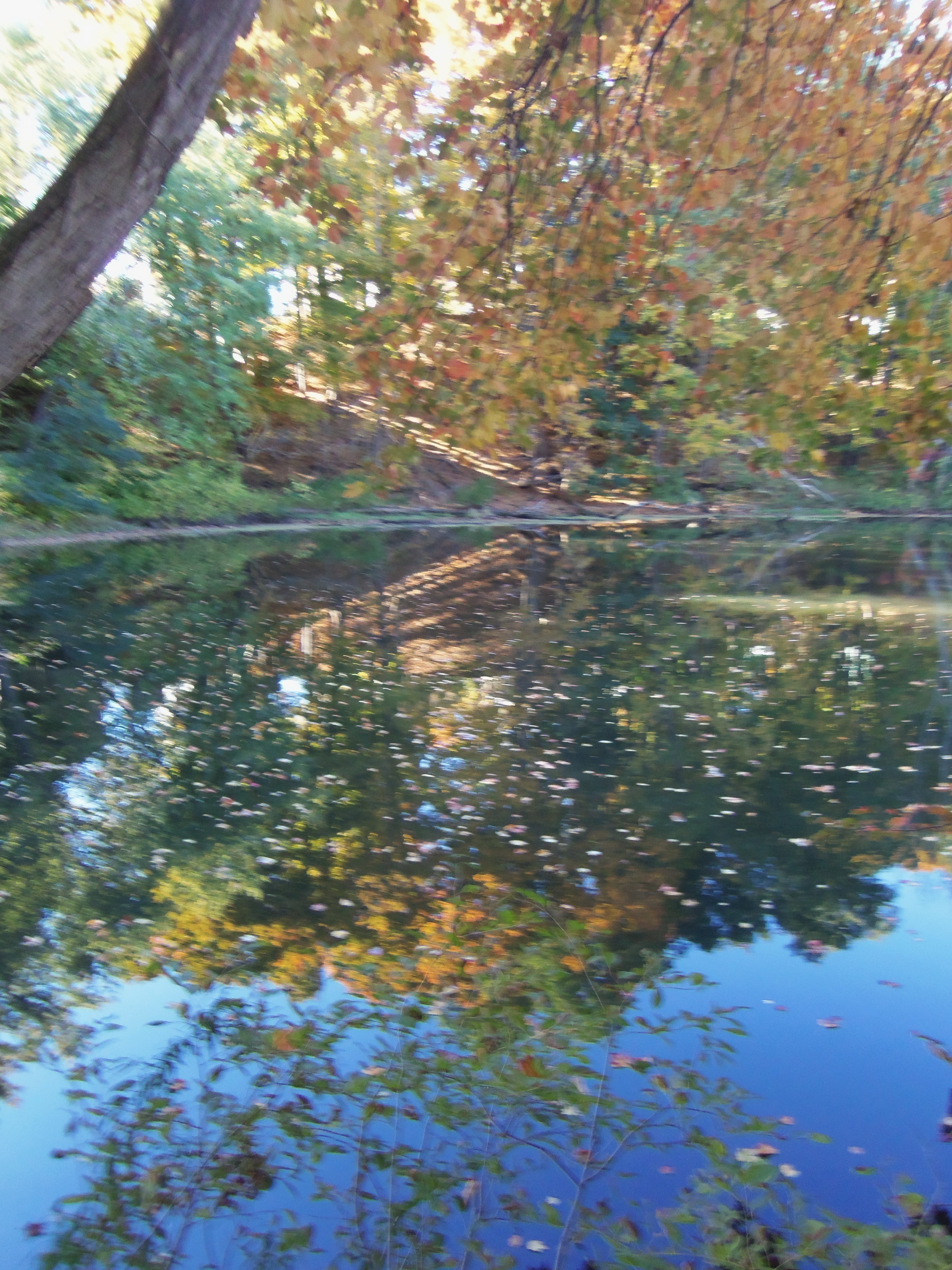
AUTUMN IN THE WATER
You never know what we'll churn up in cleaning a stall
Through much of the summer, the sun on the barn roof makes it difficult for anyone to spend much time in the loft, and later, the depths of winter add their own limitations. But there are stretches of spring and autumn that can be heavenly when it comes to a time and place to retreat.
Yes, we’ve discussed remodeling the loft to make the space usable year-round, but frankly I rather like it as is, with all of its rustic charm.
My favorite moments often come in the afternoon as I call an early happy hour, pour myself a martini, and nestle into the papasan in front of the open hay door. The view over the garden or out either window at the ends of the barn can be delightful, and in many ways I feel I’m in a tree house. This fall I’ve been catching up on issues of The Paris Review and a host of symphonic tapes, so it can even feel uplifting.
As we slip into the second half of autumn, though, I’m all too aware this pleasure’s about to come to a close again. Already we’ve had a few evenings of sitting in front of a wood fire and watching the flames dance.
Long ago I discovered how essential such seemingly short breaks are to my sanity. And then it’s full-bore back into the vortex.
The cult of celebrity continues to baffle me. The mass-media fascination with people who are famous for being famous draws none of my interest except, maybe, for a few who are simply breathtakingly gorgeous – the ones, I should add, whose words and actions aren’t completely repugnant. As you might guess, the photos are worth far more than any accompanying text.
OK, I’ll push the blame away from mass media and on to the audience that prefers celebrities to real reality. (Not to be confused with “reality television.”)
To see this outlook at work, we can extend the People magazine and supermarket tabloid spotlight beyond the realms of Hollywood and Nashville, high-level fashion models and designers, professional athletes, monarchy, and rock stars.
In the publishing industry, for instance, we have “bestselling author.” At least there’s an accomplishment to back up the fame, regardless of quality. The recognition level, let’s be honest, will be lower than in the aforesaid big-money glamor fields. But my guess is that these aren’t the writers who are high up on your own list of favorites, either. For that matter, few who make it to the bestseller list ever gain that widespread recognition. No, we are far from the days of Hemingway, Faulkner, Steinbeck, Thomas Wolfe, Mitchner, Sandberg, or Frost in the eyes of the general public.
Likewise, in classical music or opera, where fame is a crucial component of box-office appeal, we’re far from the era when having “Sol Hurok presents” as part of an artist’s credentials spelled a degree of celebrity. Hurok was an artist manager who handled all of the big names, or so he made the world believe. But the cult of celebrity still plays a role, as Yo-Yo Ma, Renee Fleming, and Lang Lang demonstrate. (Note, though, that by now we need both first and last names.) And, we should acknowledge, you don’t get there without talent.
All of this, though, is by way of introducing my favorite conductor ever: Max Rudolf (1902-1995).
As another former Metropolitan Opera conductor once told me, “Rudolf could have been as famous as Leonard Bernstein, if he had wanted it.” Obviously, he didn’t.
What impressed me – and continues to impress – is that what he really wanted was to make music of the very highest level and to nurture that tradition. This could follow a much different route than mere celebrity, even in the arts.
At the time, Rudolf was music director of the Cincinnati Symphony, which he headed for 13 years.
To be honest, the first time I heard the ensemble, I was not impressed. It was on a road trip to Dayton, and Rudolf was pushing for rhythmic precision at a time when I wanted plush sonic, well, uprisings of bombast. Only later did I comprehend what he was instilling – a unity of perfection of structure and meaning.
He offered his players precise, expressive, often restrained gestures and obtained “maximum results with minimal effort,” as I think one critic observed. Unlike the over-the-top dramatic Bernstein, I should add. What I now see is that the gravity of playing was somewhere back in the orchestra, rather than focused on the podium. In other words, despite all of his Germanic authoritarian roots, something organic was happening. And, as I would see, they played as one – more than some of the famed soloists I’ve heard.
His lineage runs back to the opera at Prague, where he worked under George Szell, and ran to the Metropolitan Opera, where he wound up as administrative assistant to Rudolf Bing. (Two abrasive personalities, from all we’ve heard.)
When he accepted the Cincinnati post, others had cautioned him not to go. “You’re making a name for yourself here in New York. You’ll give that up if you leave.”
Thankfully, he followed his heart, and classical music has been all the richer.
One of the things I remember is the amber sound he developed, not just in Cincinnati but in some of his other recordings as well – the Metropolitan Opera and even Italy.
As one of this first-chair players once told me, his mantra was, “First it must be in time.” And then the rest could follow. The trills, for example, as miniature roller coasters rather than flutters.
The former first cellist told me he received eight coaching sessions a week as a young player. How remarkable!
Even in the recordings, I still marvel at the entire ensemble playing with more unity than some soloists I’ve heard. If the Cleveland Orchestra was the Rolls-Royce, then Cincinnati was a Ferrari … fast, tight cornering.
He once lamented to a reporter that, at the time, the Cincinnati audience did not appreciate Mozart. He was one of the greatest Mozart conductors, ever.
And then there were his discoveries, beginning with Erich Kunzel and James Levine, who achieves some of the sound I associate with Rudolf.
There is, after all, a theory that your ideal orchestral sound is the one of the first great orchestra you heard. For me – and I believe, Levine – that’s Cincinnati.
Unfortunately, Rudolf came down with hepatitis, blamed on seafood during his summer in Maine, and that cut short one season and more. In his place came the Michigan native Thomas Schippers, assuming his first and, lamentably, only orchestral leadership post. As Time magazine lamented, the operatic master Schippers could not take over the Metropolitan Opera when the opening occurred because he was tied down in Cincinnati. And then, all too early, both Schippers (an addicted smoker) and his wife died of cancer. He was 47.
I can only assume Rudolf had been somewhere in the background pushing for Schippers’ appointment, and no doubt did the same in getting the young James Levine a position in Cleveland under Szell.
Rudolf went on, in part at his friend Rudolf Serkin’s urging, to create an opera program at the Curtis Institute in Philadelphia, and then a conductor’s program there. Among his prodigies on the podium are Robert Spano, Michael Stern, and Paavo Jarvi, who later spent a decade at the helm in Cincinnati.
~*~
Back now to James Levine, who went on to the top of the conducting world. The story I want to hear is what role Rudolf had behind the scenes. In Levine’s music-making, I hear Rudolf as well – the sound of the musicians making music together (a center of gravity back in the band, not simply at the podium). And the warmth, that amber sound in the strings I so admire.
Levine more or less moved into Rudolf’s earlier role at the Met, but then he expanded it all into his own. Aficionados can argue all they want, but both Rudolf and Levine will probably wind up in the top two dozen opera conductors ever.
Just as Rudolf did in Cincinnati, Levine later restored the Boston Symphony to its glory. Its sister band, the Boston Pops, had its own Rudolf legacy – Keith Lockhart, who came by way of Kunzel, that former Rudolf assistant.
I hate to think what might have been lost if Rudolf had followed the advice not to go to Ohio. Could he have exerted the same influence in Manhattan? I doubt anyone could.
While symphony orchestras continue their tradition of playing symphonies, concertos, and overtures, American ensembles have their own unique tradition of the pops repertoire.
It can be traced to what Arthur Fiedler did in Boston as he pushed the light classics repertoire into a blend all his own. Or it can be traced to John Philip Sousa’s work a generation earlier with the concert band.
Either way, something remarkable happened in the aftermath.
First, while Fiedler was still busy in Boston, Max Rudolf asked his young associate conductor Erich Kunzel to take over the Eight O’Clock series in Cincinnati. He told Kunzel there were a thousand young conductors who aspired to Mahler, but here was a repertoire begging for leadership – and Rudolf was overwhelmed as it was.
The rest is musical history.
Just look at the recordings – and that’s just the tip of an iceberg that includes performances with Tina Turner (when she could really use them) and local bluegrass bands and, well, anything that was music. Kunzel was also big on extending local connections.
Somebody could probably do a doctoral dissertation on the way Kunzel built a spider web of concert themes. You can look to his fabulous Telarc recordings to build the connections. The Hollywood albums, of course. Plus Mancini. There were all the Star Wars/Star Trek albums, each leading to the next. The Roundup album led to Happy Trails and Down on the Farm. The light classics discs soon focus on American orchestral selections leading to the piano and orchestra masterpieces as well as the Gershwin series. Well, they radiate outward, each one rising on something earlier.
The Cincinnati trustees quickly established Kunzel’s Pops ensemble as a separate brand, one that played throughout the year, unlike Boston, where the pops band is a late spring/early summer staple.
Each to his own.
So second, I should point out that when the flamboyant Kunzel was passed over in Boston after Fiedler’s demise, the film composer John Williams instilled another repertoire, giving film music an esteemed place.
I should add that the two become big fans of each other, rather than seeing themselves as rivals.
Now that’s music-making!
There’s much more, I sense, in that range between popular (commercial) music and traditional orchestral fare that could be explored – a third stream, more adventurous than most pops programming and, dare I say, than most classical scheduling these days.
As I hope will yet happen.
As for a connection between these two cities? Kunzel’s assistant, Keith Lockhart, took Williams’ place on the podium in Boston. Seems like just yesterday, though it’s been … I don’t want to count!
It’s tune in, turn on, and take action in this tale of campus intrigue. Little does a small band in a remote college town realize its opposition to small-ante bureaucracy goes straight to the state capital. And then Washington and the Mekong Delta are another matter as the hippie movement hits tranquil Daffodil. Nothing will remain quite the same.
As the headline said:
BOTCHED DRUG BUST BACKFIRES.
When narcotics agents made an early morning knock-down-the-doors raid on the twelfth-floor of one of the high-rise dormitory towers, they turned up nothing – and were surrounded by irate residents before they could frame anyone, either.
“If you think the slaying of innocent students at Jackson State University was merely a racial atrocity,” Lakasha proclaimed, “you’re not seeing the big picture. It’s about an attack on civil rights – freedoms that belong to all of us. You don’t have to live in a big city to live in ghetto housing. Every student in Daffodil lives in a ghetto. Where I come from, we have a word for high-rise housing like these big dorms – the Projects. And the pigs who come charging into the Projects act just like those who busted in on the twelfth floor the other night. Never mind whether they find anything or not. Look, the university’s demanding that the students pay for the busted doors and busted furniture and busted walls. That’s why they call it a bust in the first place. Wake up, America! Demand the names of the ‘unnamed informants,’ the ones who were so wrong about the presence of illicit substances in those rooms. Wake up, I say! Mississippi’s closer to Daffodil than you think!”
~*~
To learn more about my novel, go to my page at Smashwords.com.

I read – and write – not to escape the world but rather to more fully engage it. So literature for me hardly falls into the Entertainment category, even when it’s entertaining.
Likewise, my goal in the written word is to perceive some basic or essential connection with new clarity, understanding, and compassion.
This makes a world of difference, page by page. Maybe I’m just looking for holy scripture, even of a secular sort. Or at least the Holy One along with the mundane.
Often, my approach to writing and other fine arts resembles the essence of a dream – one foot in the present, the other in the past. Or, in another way, one foot in concrete reality, the other in fantasy of some sort, such as surrealism, as a way to engage more than I’d otherwise apprehend.
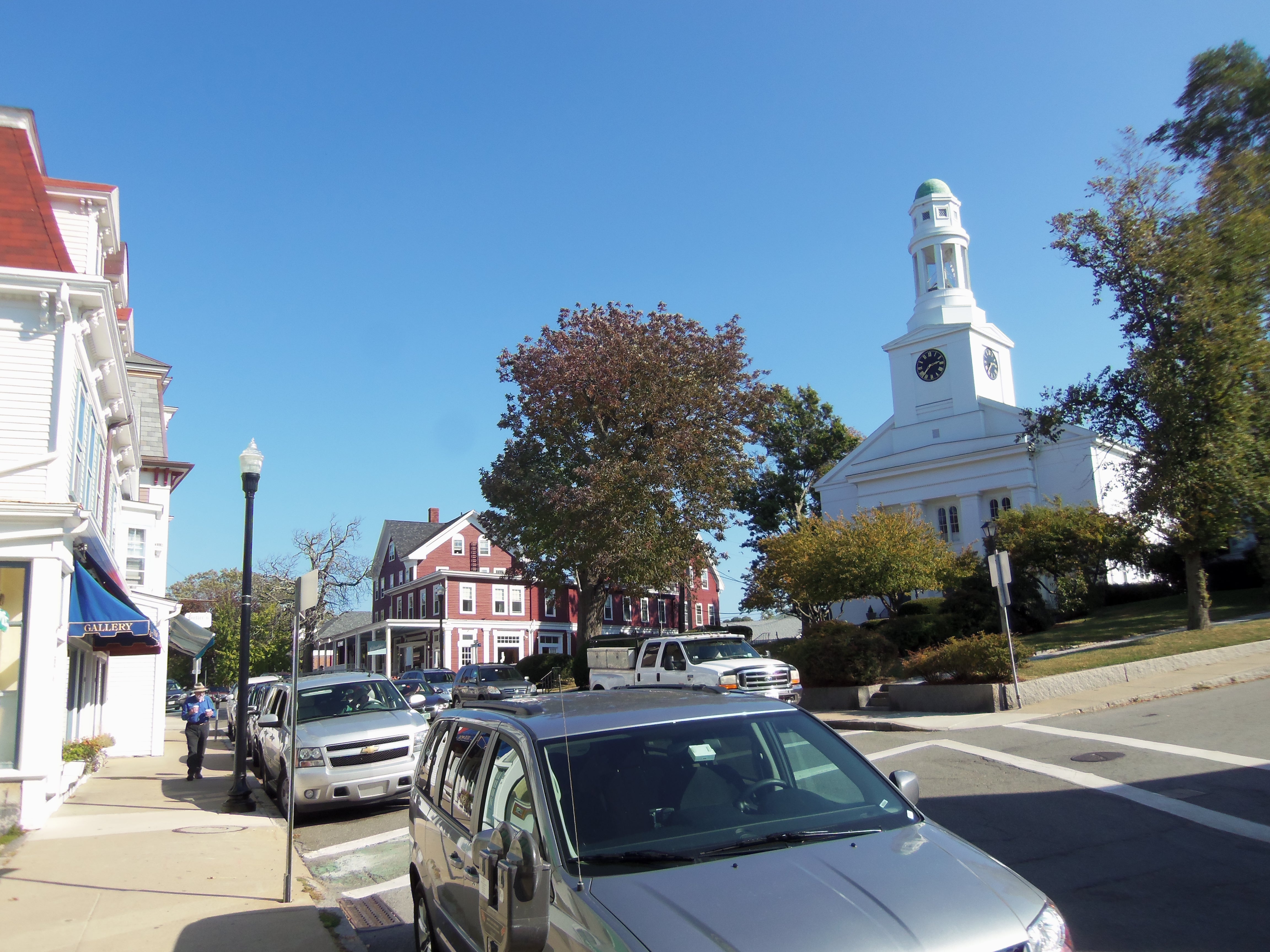
Mention “the Cape” anywhere in New England and people assume you’re talking about Cape Cod, that marvelous arm extending from southeastern Massachusetts. (Well, it does have its own dictionary entry.)
Mention “the Other Cape,” and a few knowing heads will nod or smile in recognition of Cape Ann, jutting from Boston’s North Shore.
It’s not that those are New England’s only two points of land extending into the ocean – the definition of a cape. For perspective, two of Maine’s most photographed lighthouses are on Cape Elizabeth and, close to us, Cape Neddick.
What Cape Ann and Cape Cod share is a certain ambience, a feeling that – well, you’re in a unique place and not just anywhere in New England.
If you’re not familiar with Cape Cod, let me say there are many fine guidebooks that describe the experience. Today’s gallivant, though, takes us ever so briefly to Cape Ann, which by its most generous definitions (probably mine) can be no more than a third the length of its famed rival. While Cape Cod is neatly demarked by the Bourne and Sagamore bridges, Cape Ann is a bit more diffusive. Since we come down from the north, we find that “Cape” familiarity in the air as we come into Ipswich, which claims more “first period houses” (1625 to 1725) than anywhere else in America – 58 in all. It’s a charming community and, like most of Cape Ann itself, has a more varied mix of social classes than you typically find on the bigger peninsula.
My introduction to the town came last fall when K. Peddlar Bridges invited me down to do a poetry reading on his Roadpoet cable-access television show – and we had a blast. Before the taping, I went for a walk through some lovely year-round neighborhoods that could stand as textbook tours of American architectural styles. I crossed a stone arched bridge as geese took V-formation and honked low above me. Turns out the 1764 Choate Bridge is the oldest double stone arch bridge in continuous use in the country. (I don’t make this up, nor do I challenge the accuracy of the claims.) Leading to an impressive Colonial-era garrison house, the span connects to Turkey Shore and Labor in Vain roads. You get the picture. And, yes, you don’t get a better sense of that Puritan outlook than “Labor in Vain,” do you?

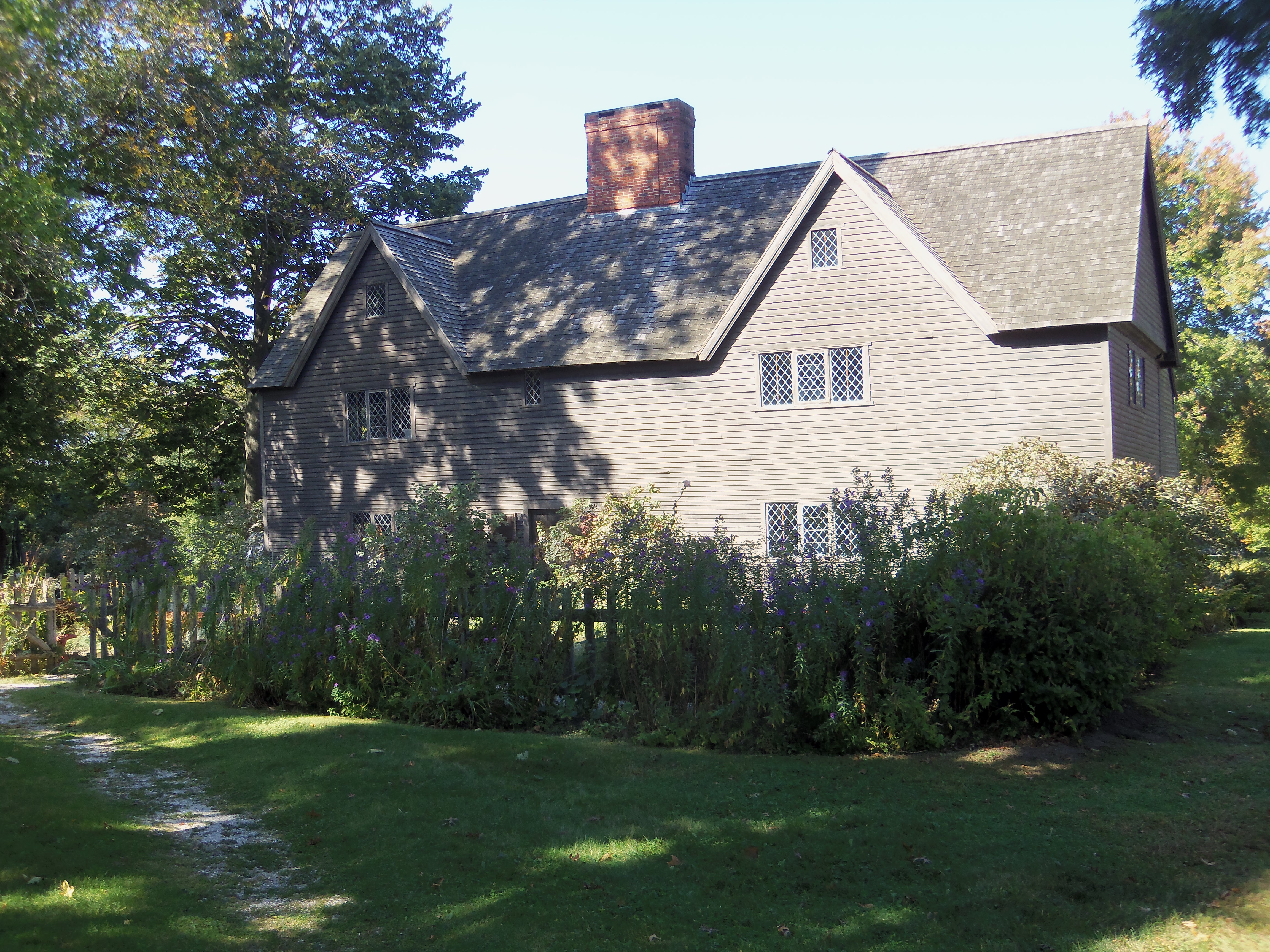
So the next week, my wife and I took off for a fuller exploration. We headed on down the road through gentleman farms and veered off for Crane Beach, passing long vistas of salt marshes where prized hay was once harvested. (It was high in mineral nutrition but gave the milk a salty taste, according to the tales.)
The beach itself was once part of the Crane family’s Castle Hill summer estate, which is another destination. The estate, the 1,234-acre Castle Neck dunes and beach, and adjacent 700-acre wildlife preserve are part of the Trustees of Reservations holdings. (Be advised, there’s an admission fee to the park – $8 a car when we went; up to $25 a car on summer weekends.)
But what a beach! My wife was overjoyed to see white sand, like those of her native North Carolina, rather than the usual gray or brown of New England. And that sand seems to run on forever, with fascinating patches of rippled washboard, tufts of sea oats, and an array of shells we don’t find in our usual rounds of the coast. It may have been October, but our nostrils were greeted with that distinctive Coppertone aroma, and our eyes viewed an array of sun worshippers extending their tans as well as a few daring souls in the water. We walked and walked and, well, might still be walking if we hadn’t felt hunger kick in.
We’ll be back.
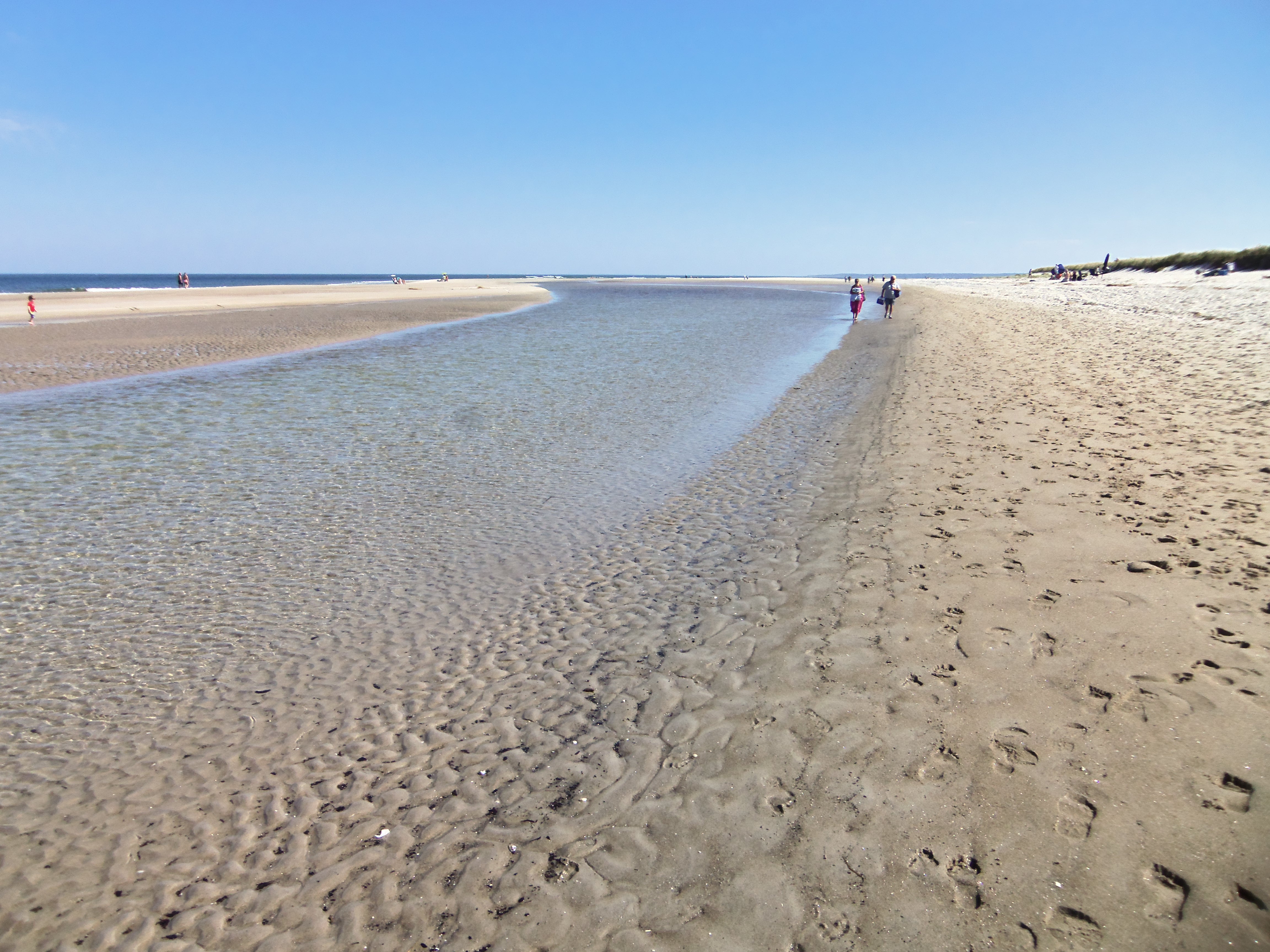

Venturing on, we came into the small waterside village of Essex, where we poked into Woodman’s “in the rough” for a seafood lunch. “Rough,” which is also in the name of an outdoor haunt we love in York, Maine, seems to indicate ordering and picking up from a counter rather than wait staff service, as well as a picnic-flavor rustic decor. As we looked at the blackboard and its prices, we nearly left for cheaper fare, but Rachel caught a posted review by food gurus Michael and Jane Stern – and I knew we weren’t leaving. I’m glad we stayed.
It was fun and filling – they don’t skimp on their portions. We can see why it’s a classic destination for the traditional regional seafood, especially of the “messy” sort. And, as she said, they “know how to do batter.” That’s a high compliment on her part. (Onion rings, anyone?)
The heart of Cape Ann is the city of Gloucester and its varied neighborhoods around the waters. It claims to be from the same year as Dover, although unlike my city, it was abandoned for a period, and is about the same size, roughly 29,000 residents. It lays claim to being America’s oldest seaport and has always been a busy, often brutish, fishing harbor. Gorton’s Seafood uses the city’s sea captain sculpture as its emblem. The Perfect Storm movie captures some of this legacy. These days it’s also the home to a number of whale-watch operations, due to its proximity to the famed Stellwagen Bank fishing grounds. In the 1950s and ’60s poet Charles Olson sought to capture the local spirit in his Maximus series, drawing on Ezra Pound’s literary foundation.
For us, though, the glory of the place is its three large wind-generator turbines rotating gracefully from the highest points along Route 128. They are immense works of art, comforting, landmarks. How anyone can oppose their construction baffles us. And, yes, they do sing … softly.

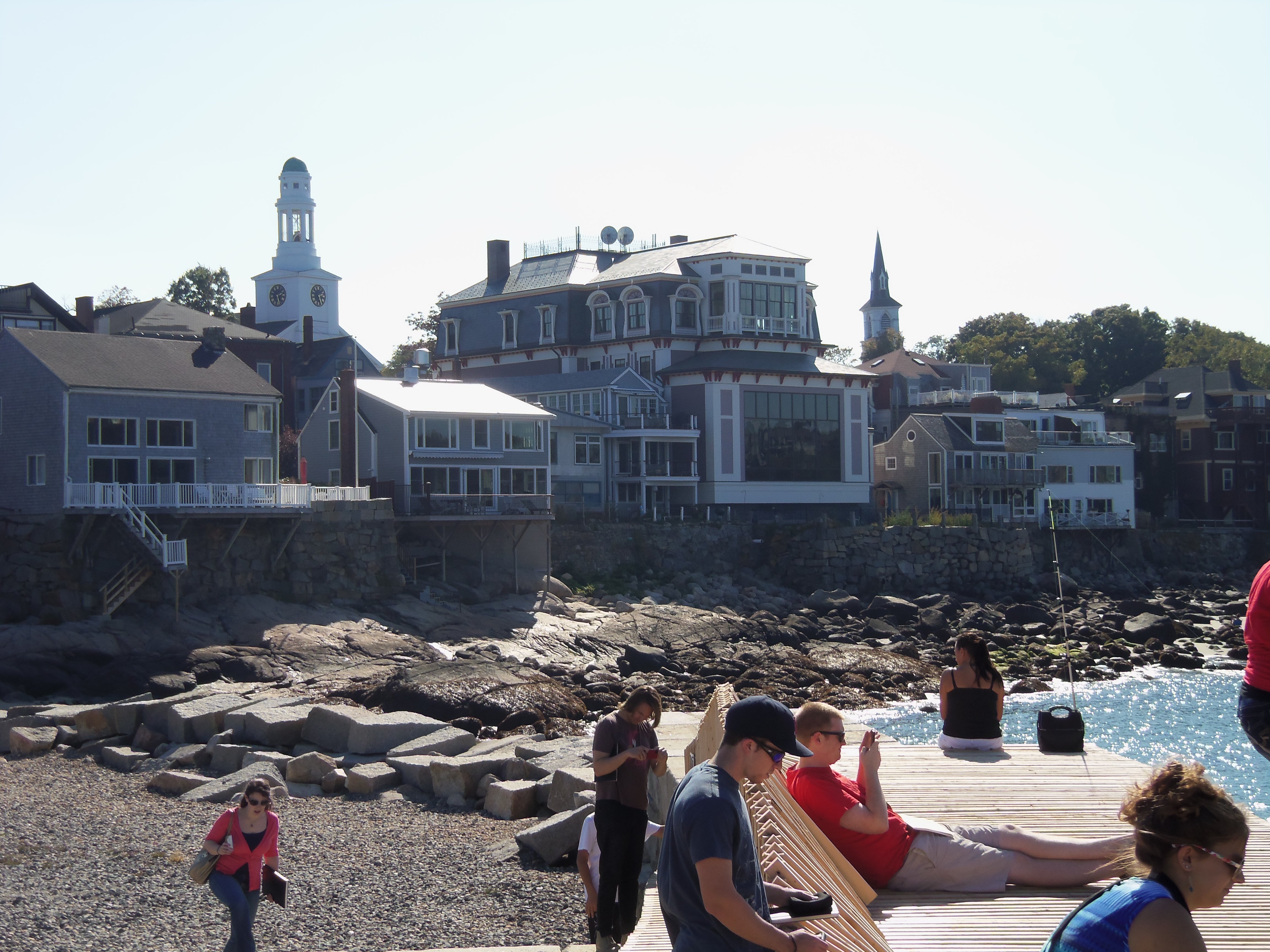
Cape Ann culminates in the town of Rockport, which has long attracted summer artists to its shores. More recently, the three-decade old Rockport chamber music summer festival has developed a loyal following, which led to the 2010 opening of the 330-seat Shalin Liu Performance Center and its year-round offerings that include classical, folk, blues, and jazz. When they say “intimate,” it’s true. What makes this hall truly amazing is that the back of the stage has wooden panels, for acoustical purposes, that roll away to reveal a panorama of the harbor. Maybe the Santa Fe Opera surpasses the view, but I bet you can find folks who can quibble.
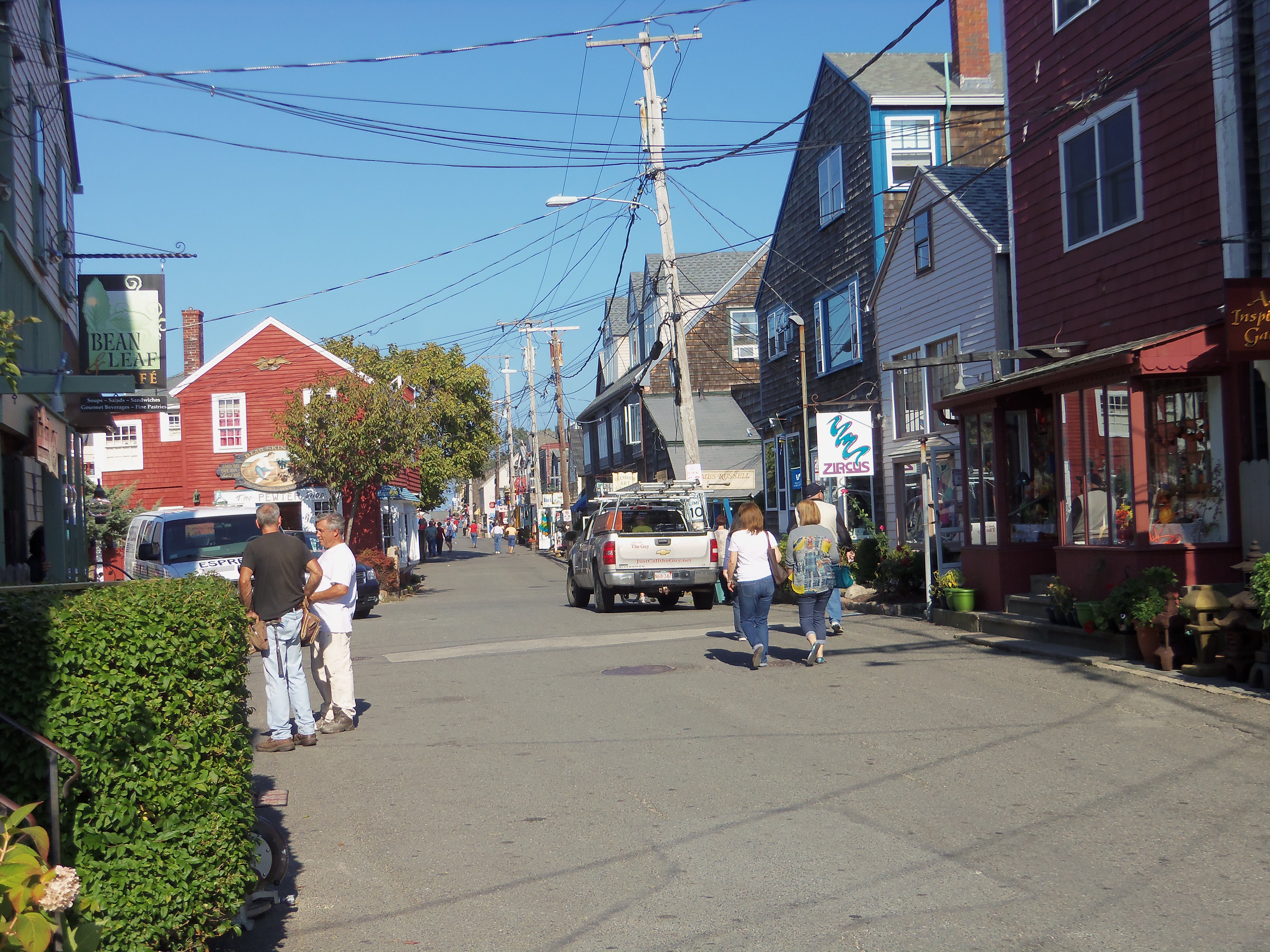
The village itself has much of the Cape Cod shopping flavor of boutiques, restaurants, artist galleries, jewelers, and so on – especially in its Bearskin Neck district.
By the way, Massachusetts Bay Transit trains run from Boston’s North Station to Rockport, with Cape Ann stops along the way.
While I mentioned whale watches, I should note we prefer to venture out from Newburyport to the north, in part because the vessel there has the option of heading to either Stellwagen Bank in Massachusetts Bay or Jeffrey’s Ledge in the Gulf of Maine. When it goes to Stellwagen, though, it cruises around Cape Ann and offers fine views of the Straightsmouth Island and Thacher Island twin lighthouses – the 1861 replacements for the 1771 originals – closer to Gloucester Harbor.
Not bad for one day, eh?
We could be considering writing or painting and drawing as much as the photography that prompts today’s line of thinking. Specifically, I’m reflecting on the tension between trying to capture everything I see everywhere versus the reality that one needs limits.
For starters, I reach a point in shooting where I begin to weary. Push hard enough and everyone hits a wall. When it comes to photography, I just stop seeing images of interest. When I’m writing, my words go flat. Folks in other endeavors can relate their own versions.
A second fact of life comes in trying to arrange and manage what I already have. Accumulate too much and I’ll never find anything when I want or need it.
I find a similar tension in a writing project, where I can hope for a tightly focused, crystalline work even as it begins to expand into a complex baroque construction. Or the other way around.
As I’ve been shooting over the course of the Red Barn, I’ve found myself increasingly resisting an urge to range more widely from my base in Dover. I’m sticking more and more to what’s at hand here and in a few other familiar places like Sandwich, to the north, and Fort Foster in Kittery Point, Maine. We’ll see how that evolves in the future.
For now, what fascinates is seeing how much new keeps appearing to me in our yard or while I’m walking to meeting for worship on Sunday. Perhaps that’s why working on pieces in a series hold so much appeal as more and more keeps surfacing from the depths.
The other aspect of the series is the desire that somewhere in there is the one iconic piece that rises above the rest, can stand on its own, deserves its own place.
Oh, what would Monet say to all this? Or Matisse? Or any of a host of others!

Not long ago, I came across this note to myself:
“Story idea: paragraph or two, repeated … one or two words changed each time, till the end provides an entirely new view.”
It’s old, probably from the mid-’70s, and yet has become the basis of several series of my poems from the last decade.
In a way, it’s also the basis of my novel Hometown News, although the repeated sections and their variations are much longer than single paragraphs.
Works for me. Wonder what else I’ll turn up.
~*~
To learn more about my novels and poems, go to my page at Smashwords.com.
 Jnana's Red Barn