to have the sense
to do things that make no sense
but to do them anyway
You never know what we'll churn up in cleaning a stall
to have the sense
to do things that make no sense
but to do them anyway
For whatever impulsive reason, I ended my first published novel, Subway Hitchhikers (now revised into Subway Visions) in a Greek family’s restaurant in Indiana. In a town I I’ve dubbed Daffodil, which shows up in the title of the next book in the series., in fact
At the time, I saw it as emblematic of East Meets West, especially apt considering its Tibetan Buddhist twist.
Little did I know, once I picked up the trail again not quite two decades after that publication, of the ways Greek-Americans interacted with my life, even in the Midwest.
Consider these tidbits:
My best friend’s mother was delighted by her neighbor’s repeated explanation, “Athens! She is beautiful. The rest of the country?” A spitting sound I could never ever spell out was accompanied by the open palms of both hands coming down side by side from overhead.
His other best friend was Greek-American, someone of a philosophic outlook who wound up living in my circle in Upstate New York after getting out of the Army. Yeah, some hippies were veterans.
Later faint details of a landmark restaurant passing into a new generation much like the one in the novel, still in Daffodil.
In the Pacific Northwest, discovering souvlaki on our forays to the University District of Seattle.
Back in Northeast Ohio, the Greek bakery in a small storefront surrounded by houses on a quiet street six or seven blocks east of our home.
In Baltimore, “All the pizza’s made by Greeks,” which seemed wrong – where were the Italians? And, in my salesman role on the road, “All the diners are owned by Greeks.”
In New Hampshire, the Athens restaurant downtown – popular but, to my senses, bland and tired – in contrast to one of my favorite takeout places where we ordered for the office – the menu that introduced me to gyros.
Add to that the cathedral’s big Glendi, which sent food to the newsroom in gratitude for our coverage, or the little frame St. Nicholas church I’d pass on one route to and from the paper.
One of our older coworkers, a photo lab tech, was Greek – kind, smiling, though I got to know little else. Later, one of the men I worked more closely with in the composing room was half Greek. His name, Perry, was after his grandfather, Pericles.
All of this fleeting, fragmentary, but coming together in once I moved to Dover and its annual, free-admission Greek Festival. From there, I picked up Greek dancing and the liturgy of the Orthodox faith, not that I converted. It still enriched my Quaker Christian strand.
And then there was Davos, in Watertown Square, a block down the street from my weekly choir practice. The restaurant was expertly run by Hispanics after its founders moved on.
It’s an element I miss living on this end of Maine. The closest Greek restaurants are in Brewer and Waterville, both blissfully satisfying.

For more of what they present, look to the Cassia’s World category here at the Red Barn or to the novel, What’s Left, which is available in the digital platform of your choice at Smashwords, the Apple Store, Barnes & Noble’s Nook, Scribd, Sony’s Kobo, and other fine ebook retailers. It’s also available in paper and Kindle at Amazon, or you can ask your local library to obtain it.
Why be abnormal?
Turn it around.
Accept authority.
Step up or down.
Turn it aground.
Preparing my collections of poetry for release, as well as the shorter chapbooks appearing at my Thistle Finch editions blog, has been eye-opening, especially after spending so much time concentrating on the novels.
A lot has changed in my half-century at this. At first glance, my work has seemed to shoot off in every direction. But then, in spite of that, commonalities appear. Some of them, to some extent, apply to both the prose and poetry.
Despite all of the changes in my life and the differing approaches of my writing that accompanied that, I believe some underlying qualities run through my output.
Here goes, mostly from notes to self from way back and up:
And the fiction? You can add:
Well, that’s how I’ve defined my efforts over time. Sometimes the results do startle me, all these years later. And some of my results come closer to my ideals than others, not that I’ll fault those, either.
~*~
You can my works in the digital platform of your choice at Smashwords, the Apple Store, Barnes & Noble’s Nook, Scribd, Sony’s Kobo, and other fine ebook retailers. Or you can ask your local library to obtain them.
Sex or food?
Is that what desires ultimately come down to?
In support of that statement, let me offer Long-Stem Roses in a Shattered Mirror, my collection of poems released to the public today.
Think what happens when a hot relationship goes belly up and everything you trusted turns painful.
These poems arise in a brutally honest reevaluation of those interactions, as one of the lovers insisted on at the time, as well as the larger hopes and desires.
Many of the poems appeared in small-press literary magazines around the globe, but this is their first outing complete.
I have come a long, long way since, perhaps because of lessons I learned in these earlier relationships. The poems remain intense, vivid, and powerfully moving, even at my age.
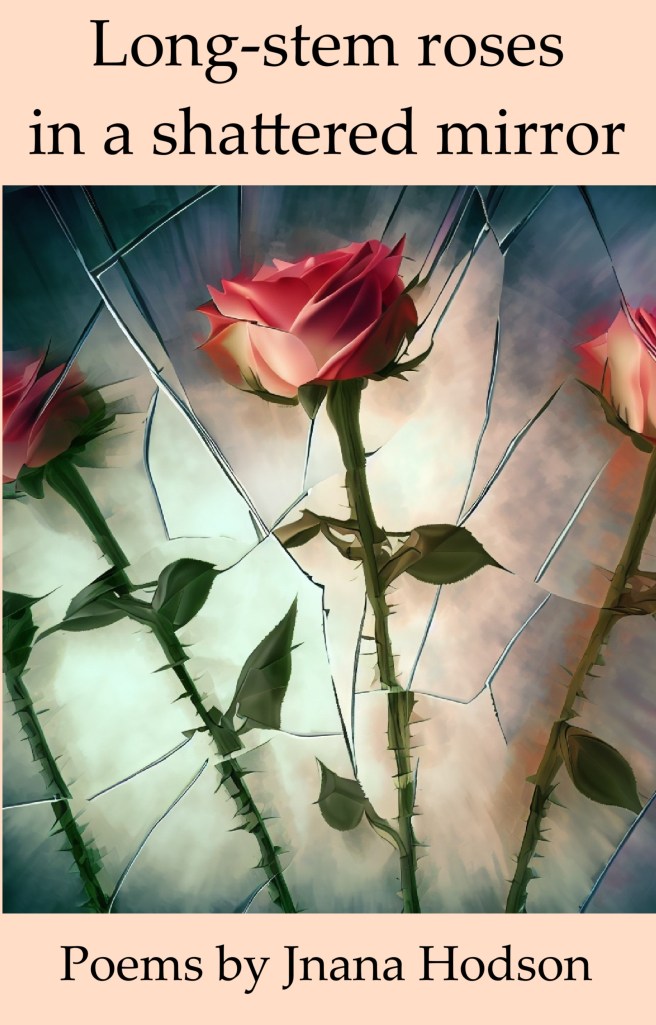
For my series of passionate roses, check out my collection in the digital platform of your choice at Smashwords.com and its affiliated online retailers. Or ask your public library to obtain it.
Meaning?
Just what is?
Let’s start with the prompt: Imagine yourself in the position you desire.
For much of my life, that had two conflicting scenes, the newspaper editor in his community in contrast to the successful novelist in a tweed jacket in a New York study or a poet in something more funky.
Much less for the supporting people my life, starting with wife and children?
When I last looked at the question, it essentially asked me to consider my early retirement years. How curious! The newspaper editor, at least, was out of the picture.
At its core, I craved recognition (affirmation!) – after years of largely reclusive labor. But which circle did I most want to recognize me – hip, alternative culture? Quaker, international literary, Seacoast New Hampshire? At some level, perhaps, it was also wanting to visit Dayton and be known even there – or to hear again from many people I’d known and lost contact with in my relocations. The Quaker world is awfully small and restrained, especially with its three sharp divisions. The literary world, meanwhile, has so many high priests and exclusive emphases – could I move among them? Yet, if the Society of Friends is to survive and grow, I needed to move beyond its confines and reach out to a wider audience. In a larger sense, then, my recognition would be as one who brilliantly bridges these disparate worlds. If only.
I did imagine a significant amount of time would be engaged in travel – public readings, workshops, conferences. Eight weeks a year, split between Quaker and literary? Perhaps an additional retreat or camping trip? The travel could also include three-day weekends for symphony, opera, and galleries.
I also imagined having three books published on paper each year – one of poetry, one of Quaker practice, and one of fiction or memoir/genealogy. (They were already written.)
The rest of the time would be correspondence and basic living, including a social life, concerts/plays/etc.
I do believe such reflections are important in channeling what might otherwise be simply drifting through life.
So back to the questions.
Define what you are trying to accomplish. Be clear about what you’re setting out to do. What problem are you trying to solve? What new ground are you trying to break? What will happen if you manage this well? What will happen if it isn’t managed well?
I would have said, Brand myself as the leading new Quaker voice – or at least an original Thinker. (Think of Bill Stafford in the Church of the Brethren, Wendell Berry, even Mary Oliver the Unitarian – who has emerged since?) What I want to do is bring Quaker theology into the center of contemporary thought and discourse, and then to renew the life of the Society itself. The poetry and fiction add to my credibility as a writer.
Well, that has slipped past me.
Now for another hard question.
Who do you think would play me in the movie version?
~*~
You can find my surviving novels in the digital platform of your choice at Smashwords, the Apple Store, Barnes & Noble’s Nook, Scribd, Sony’s Kobo, and other fine ebook retailers. They’re also available in paper and Kindle at Amazon, or you can ask your local library to obtain them.
Assuming that you’re an active reader, let me ask where you’re obtaining your books of interest. With a thousand or more new novels every week, you can’t possibly keep up there. As for bookstores, there are only so many shelves. Ditto, public libraries.
Some of those stores and libraries do have sections where their employees recommend new volumes, and I applaud that, even while physical bookstores fight for survival.
Goodreads is another option, though also quite crowded.
For commercially released works, the New York Times reviews and a few other sites are key to the latest.
But my interest – and work – falls outside of that realm, and I do believe the real action takes place at the fringe.
Quite simply, I see opportunity for a dedicated reader – especially a recent graduate in literature – to set up shop online as an informed critic in a specific vein. What I’ve seen too often among the bloggers who review is gushing froth about stuff they like, akin to movie fanzines, rather than any critical detailing of why something soars above the pack or even why others fail. They don’t say what makes the piece they’re praising truly stand out.
The ideal I’ll acknowledge is the French film magazine Cahiers du Cinema, founded in 1951, which ran only pieces extolling new work of merit, rather than all new movies. It gave rise to a new wave of cinema, one based on daring directors rather than the film actors aka “stars.”
~*~
Real change originates at the fringe of society, not at the center. It typically develops in obscurity, sometimes flashing into widespread recognition and acceptance, and that’s been true in literature over the years.
Rarely will truly adventurous pages be found through the bestseller lists, but when one does break through, then everyone – writers, readers, publishers, and booksellers – will be in pursuit. Imitations will abound, as well as new labels and genres for marketing.
So how do you find fresh books and their writers, the kind who turn you on, fill you with a sense of discovery and make you want to tell everybody you know what they’re missing?
The history of novels is filled with instances of canon masterpieces that were rescued from oblivion by a single critic, either in a pivotal review or by sustained championship. And nothing beats word-of-mouth by a few fans.
So here we are, in a remarkable period of access for both readers and writers, thanks to digital advances. The problem is that there’s so much, there’s no way to keep up.
That’s where a few celebrity critics could step in.
~*~
Sometimes I regret writing novels that are “out there.”
It could be fun writing sharp reviews of many lousy books if I weren’t facing retaliation. (By idiots.)
Still, I feel it’s an opportunity well worth examining for an enterprising young English major graduate: sorting through the eruption of new writing and signaling what might be worthy of further examination.
By the way, online I usually don’t click the button on “pages” or “posts” that have more than 20 “likes.”
Like what is this, a popularity contest?
Still, on the receiving end, it is nice knowing that some folks are at least seeing this. Better yet is when you know that someone else “gets it.” Or, as I originally wrote, “Digs it.”
~*~
So back to the opening question, How are you finding the writing that excites you?
Are there any websites you would especially recommend?
Here’s your chance to give a shoutout.
BEAN
HOLE
HELL
. . .
BEAN
HILL
SWELL
 Jnana's Red Barn