
Tag: Inspiration
Know the feelin’

Takin’ the ferry in New England
Washington state isn’t the only part of the country where ferry service is important. The Staten Island ferry makes appearances in my Subway Visions novel, strange as that sounds. Check it out.
A bit further to the northeast, here in New England the boat service can also be impressive. Most of my trips here, I should add, have been as a walk-on passenger.
Now for a look.
~*~
- Casco Bay. Portland (as in Maine, not Ory-gone) overlooks Casco Bay and some of its neighborhoods are on islands. A state-created ferry service makes daily stops on four islands within the city limits plus two in towns beyond. The little yellow-and-white boats are rather picturesque, truth be told, and the fares are quite reasonable. We’ve become quite fond of the mail run, which has six stops on five islands out and then back.
- Portland to Nova Scotia: Also out of Casco Bay is a catamaran ferry that zips to Nova Scotia in half the driving time. (Looks like there’s one stop en route, at Bar Harbor.) Back when it was a conventional boat, much of the appeal was in overnight gambling, once you were out in international waters.
- Nantucket. There are several routes, mostly from Cape Cod. The island likes to think of itself as a world all its own.
- Martha’s Vineyard. Like Nantucket, but maybe more exclusive.
- Boston to Provincetown. The catamaran zips from downtown Boston to the Cape in just 90 minutes, half of the time of driving in good conditions. I might mention some Boston Harbor commutes for shorter ventures.
- Block Island. Out from commercial fishing Port Judith in Rhode Island, it’s a fine daytrip. Rent a motor scooter when you land for a quick tour.
- Isles of Shoals. Just downstream from us, there are several services linking Portsmouth and the Isles of Shoals. The small islands split by the New Hampshire-Maine boundary include the Star Island summer retreat run by a Unitarian-Congregational church arrangement.
- Mohegan Island. Penobscot Bay in Maine has several ferry trip choices available. Mohegan Island is a prime destination served from several points onshore.
- Lake Champlain. Several crossings connect Vermont to New York State. Of the ferry trips on this list, these are the only ones on freshwater, not saline. One even follows a cable from one shore to the other.
- Campobello Island. OK, that’s in New Brunswick, Canada, but it’s once again served by a small ferry from Eastport, Maine. Sometimes the boat goes further, too, out on the world’s biggest tides.
~*~
Ever been on a ferry or whale watch? What’s your experience?

Out 2 please

Ever take a ferry for fun?
When I lived in the desert in Washington state, we used to joke about the “rainy side” of the Cascade mountains, the strip where most of the people resided and worked.
When we visited that side, though, we often found ourselves driving the car onto a ferry and venturing onward. The state government manages an impressive fleet, some of them small and others, well, more substantial. It’s the largest ferry service in the country and fourth largest in the world. Its boats even show up in my novel Nearly Canaan.
Here are its nine routes plus one, all on Puget Sound but the last, which is a private operation.
~*~
- Seattle-Bainbridge Island: 6,429,853 riders a year. Big-time commuter run from downtown. (That’s still only a fourth of the volume on the Staten Island ferry, and there’s no Statue of Liberty along the way. But the New York line has eight boats compared to this route’s two.)
- Edmonds-Kingston: 4,114,181. With a terminal just north of Seattle, this route offers a quick hop across Puget Sound. Obviously, popular with commuters.
- Mukilteo-Clinton on Whidbey Island: 4,073,761. It’s the first leg to Port Townsend from Seattle. Most of the riders are commuters who live on Whidbey Island.
- Fauntleroy-Vashon-Southworth: 3,059,587. Operates as a “triangular” route from West Seattle.
- Seattle-Bremerton: 2,739,926. Includes some hairpin turns getting into Bremmerton while passing a U.S. Navy shipyard.
- Anacortes-San Juan Islands: 2,009,438. The San Juans are four gemlike isles north of Seattle. Popular with sailboat owners.
- Port Townsend-Coupeville on Whidbey Island: 819,285. Port Townsend, at the “anvil” on the Olympic Peninsula, has become a trendy, artsy waterfront town.
- Point Defiance-Tahlequah: 812,786. Links Tacoma and Vashon Island.
- Anacortes-Sidney, British Columbia: 123,001. Also stops at Friday Harbor in the San Juans. Landing is a 30-minute drive from Victoria.
- Port Angeles-Victoria, British Columbia. Its 90-minute voyage across the Strait of Juan de Fuca links the Olympic Peninsula to downtown Victoria. The vessel carries up to 110 vehicles and a thousand passengers. The Black Ball Ferry is not a state-run route, but it is truly a “poor man’s cruise.” I remember eating well and being agog at our landing in the heart of the classy Canadian city. (A foot-passenger-only rival sails from downtown Seattle.)
~*~
How about your experiences riding ferries?

Of course, on a hippy machine

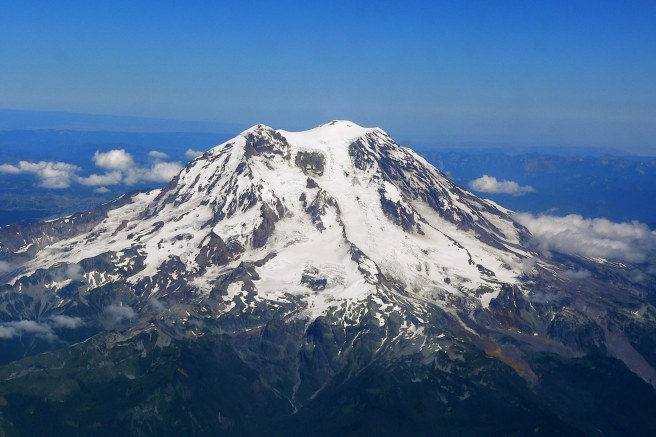
How could you not be impressed by Rainier?
I’ve never seen a photograph that captures the breathtaking majesty of Mount Rainier. Even from miles away, it can seem to hover over your head, perhaps even reaching on around for the back of your neck.
Like Joshua and Jaya in my novel Nearly Canaan, I lived in the desert to the east. That meant we usually frequented parts of the national park that the folks from nearby Seattle were least likely to visit.
It’s been 40 years since I was forced to move elsewhere. Here are ten things that still impress me.
~*~
- The park: Established March 2, 1899, Rainier is America’s fifth oldest national park. It covers 369 square miles, making it the 21st largest in the continental U.S. and the third largest in Washington state.
- The central mountain: Also known as Tahoma, Rainier rises to 14,411 feet above sea level, making it the second tallest peak in the continental U.S. Unlike its rivals, its base is only miles inland from sea level. Measured from base to summit, or by its topographic prominence, that’s 13,210 feet – more than K2 in the Himalayas. It’s the most heavily glaciated mountain in the continental U.S.
- It’s a stratovolcano: Rainier is an active volcano, with sulfur-fuming pits in the ice at its summit. Considered one of the most dangerous volcanoes in the world, it leaves about 80,000 people and their homes at risk of an eruption.
- Distance from the summit to downtown Seattle: 59 miles, if you’re a crow.
- Diversity of ecosystems: About 58 percent of the park is forested, ranging from dense evergreen forest to open ponderosa. The tall Douglas firs and western red cedars are nearly as impressive as the sequoias further to the south. Another 23 percent of the park is subalpine, above the forests but having evergreens at distances. In season, this is wildflower heaven, with orange paintbrushes, lupines, and white-starred avalanche lilies in profusion. Above that, half of the remainder is alpine, having unique vegetation, while the other half is permanent snow and ice.
- Year-round ice and snow: Depending on your source, 26 or 27 major glaciers cling to the mountain. They release thunderous booms of breaking ice during the summer. Combined with permanent snow patches, they cover about 35 square miles.
- Ice caves: By late summer, the mouths of some of the glaciers melt away to form mystical blue caverns. They’re dangerous to enter but unforgettable if you’ve ever been in one.
- Reaching the summit: Climbers are required to register for permits before setting out. They must possess technical skills regarding ice axes, harnesses, and ropes and be in good physical condition. They face a 9,000-foot elevation gain over eight or more rugged miles. And then they repeat it in reverse. For most, it’s a two-day trek. About 10,000 people set out for the summit each year, with half of them succeeding. The mountain claims an average of two lives a year.
- Thermal hot springs: Furthest away from Seattle is the Ohanapecosh Hot Springs. Once a resort, it now features trails that are delightful to hike in winter.
- Two lodges: Situated at 5,100 feet elevation in the subalpine terrain, Paradise receives an average of 53 feet of snow a year. Sunrise, at 6,400 feet elevation, is the highest point the roads reach. The lodges are often snowed in till the Fourth of July.
~*~
If you’ve ever been there, what would you add?
Just a local thing, I assume

You don’t always have to eat those apples
In my novel Nearly Canaan, Joshua and Jaya find themselves surrounded by orchards. They quickly appreciate apples as much more than an orb to eat daily.
Here are ten unexpected uses.
~*~
- Headache relief. Cut a green apple open and start sniffing. It’s supposed to work faster than some pain pills.
- Christmas decorations. Slice an apple, then carve out the core. The rounds can be hung individually or as a garland on the tree or window. They’re fragrant, too, as they dry.
- Shrucken heads for Halloween. Bake them on low for three hours or so, then carve out a mouth and nose, maybe the eyes too. Add buttons or other small objects for the eyeballs. Quite spooky and yet funny.
- Kiddie craft stamper. Cut one open, then carve out a design for imprinting with ink on paper or fabric.
- Candleholder. Carve the core from an apple, then insert a votive or tea candle. It makes for a romantic glow.
- Hair rinse. Dilute cider in water, then rinse after shampoo and conditioner rounds. Removes excess oil.
- Salt reduction. Ever put too much salt in something you’re cooking? A few wedges of apple or potato added to the pot can turn the trick. Remove them after ten minutes. Don’t see this helping on the table, though. Any suggestions there?
- Green tomato ripener. Place an already ripe apple in a paper bag for a couple of days. We’ll have to remember this in the fall, when we harvest everything we can before the first big frost.
- Potpourri. Stud an apple with cloves stems and let it dry in a clothes drawer. I remember that from childhood.
- As a bow-and-arrow target. Especially if you’re William Tell.
~*~
Gee, aren’t we feeling like Martha Do-it!
What else do you suggest?
Anytime you’d like

 Jnana's Red Barn