Ding, dong, ding!
You could hear the apple bell chime.
You never know what we'll churn up in cleaning a stall
Ding, dong, ding!
You could hear the apple bell chime.
Let’s start with a pitch I once considered using.
“Hi, my name is Jnana Hodson and I’m a retired hippie. One of millions and, unlike many, I’m not embarrassed to admit it was a time to remember, no matter how short we’ve fallen from its potential. What is often overlooked is that the central element was the hippie chick. My novel, Hippie Farm, celebrates her in her many guises, even if you can’t even use the term “chick” anymore without being corrected. At the time, though, it was a badge of honor and invitation – one leading, in this case, to a rundown farmhouse in the mountains outside a college town. May I introduce you to the full story?”
Well, that attempt has now been woven into what stands as Pit-a-Pat High Jinks. Still, as I also proclaimed:
“In many of my novels, the hippie movement opened their minds. Or at least their horizons. Or even a few hearts. What’s most opened yours?”
That led to these points:
Now, back to those contributor’s notes possibilities:
Or, to reconnect with Ezra Pound, literature is slow news, something allowing some breathing space and reflection, rather than the minute-by-minute confusion before us.
Which takes me back to Scripture, diving into antiquity for parallels to today.
Now, let’s sit back tonight for some gloriously fleeting pyrotechnics. Something that might inspire and awe almost everyone.
LOON
MOON
TUNE
I’m not sure when the practice started in my own life, but somewhere it did.
Typically, in a first visit to an art museum, I’ll move along quickly to get a sense of the fuller collection. In the returns, however, I’ve become more inclined to sit down in front of a particular piece or even a full wall or room and then more fully immerse myself in particular pieces, usually while the rest of our party roves on. Yes, I’m with notebook in hand.
Those scribblings have led to poems, especially those in which Norman Rockwell and Gertrude Stein appear commenting, somewhat like poet Lew Welch’s Buddhist Red Monk who kept popping up at the bottom of the page. I’m not quite sure how they showed up, either, but there they are, as you’ll find in recent entries at my Thistle Finch editions blog.
Let me repeat that I’m generally averse to poems about poetry or celebrating poets or that somehow place artists of any stripe above the rest of humanity, ditto that for movie stars or professional athletes or billionaires or politicians. We do need our heroes, but I’m convinced that it’s healthy to keep their human frailties and shortcomings in perspective.
In that regard, I do believe we artists need to keep our vision beyond our studio door. Anything less strikes me as incest, even for an interdisciplinary addict like me. It’s why I refuse to respond to political pollsters. Go ask somebody on the street, OK?
Still, I made the central character in my Freakin’ Free Spirits novels a photographer. Even having him make a living by working at a newspaper was skirting my taboos.
~*~
The term “ekphrasis” defines poems that describe visual artworks though it can be applied more broadly. Sometimes the results are admirable, as exemplified in music by Gunther Schuller’s “Seven Studies on Themes of Paul Klee” or Modest Mussorgsky’s “Pictures at an Exhibition.”
~*~
Lately, I’ve become quite fond of the Alex Katz galleries at Colby College, not just because he almost collected a painting by my first wife. Rather, I sense something in the plainness of his depicted figures and where I’d like my own work to head. It’s stripping something down to essentials.
We’ll see.
~*~
For Rockwell and Stein, take a look at at Thistle Finch editions. For Freakin’ Free Spirits, look for the four novels in the digital platform of your choice at Smashwords, the Apple Store, Barnes & Noble’s Nook, Scribd, Sony’s Kobo, and other fine ebook retailers. They novels are also available in paper and Kindle at Amazon, or you can ask your local library to obtain them.
SCARE
SNORE
SCORE
One of the artistic ideals in my life originated in the fantastic illustrations by Inuit craftsmen as they expressed the world they inhabit. Perhaps you’ve seen some of their calendars exhibiting owls, seals, the sun itself, and the like.
As I was told by the couple who introduced me to the Inuit works, an artist in the tradition does a subject just once, at least in the position or perspective that results. A bear, for instance, might be shown standing, but only once. If a bruin shows up again, it would be fishing or lumbering along or maybe paired. Each appearance, though, must be unique. There were still plenty of ducks, geese, walruses, whales, and other Inuit – hunters, mothers, and children – remaining for close examination, even in their Arctic environment.
The husband who told me this, let me add, was a coauthor of the Alaska constitution who had some acquaintance with the ecosystem. He had grown up at its southern edge, northern Washington state.
After more than two decades with that as a guideline, I faced a conundrum as I tried to assemble my own poems for submission as a competition for a chapbook – a booklet, essentially. A book needs to flow from start and middle to an end with some sense of continuity. My one offering that had that, American Olympus, had a received a provisional acceptance from a prominent press that later rescinded, claiming a cut in their grant funding. And my other pieces hopped, skipped, and jumped from one setting to another – if only I had been able to remain in one setting long enough for continuity in their completion.
Beyond that, my own life had moved on, providing me a lode of new material to draw upon. That’s when I turned to the idea of theme and variations, a major element of the classical music I so love and also big in jazz as improvisation. What hit me, especially, was Ted Brautigan’s sonnets from the ‘60s. They were essentially three poems, reworked over and over, into a full and very stunning collection.
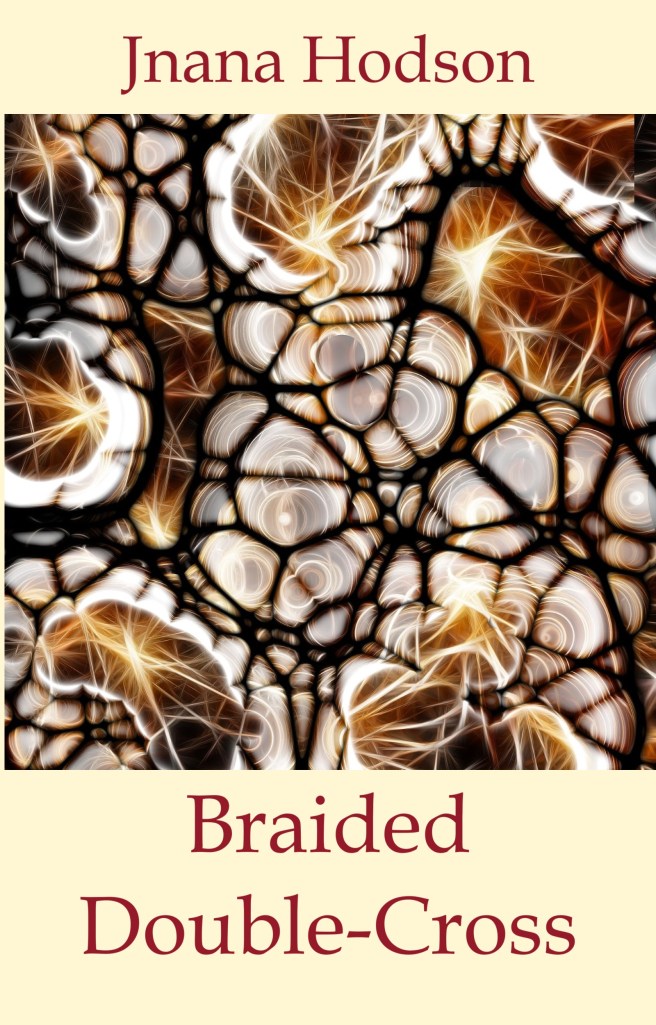
I took that as my springboard into two intense weeks – while working fulltime as a newspaper editor – of reworking raw notes of loved desire that had incinerated into what you can read as Braided Double-Cross – a set that was rejected by the jurors in a competition based in its principal subject’s hometown. Maybe it was too intense. The poems are searing.
The night I finished drafting the 60 poems, I should note, I went out to dinner and have no idea how much I tipped the server. I was thoroughly exhausted, not just emotionally. Not that I remember of the meal I devoured.
Love really can be such a bitch. At least it still is with me, no matter how much she wonders why I still worship the one who continues in my life.
~*~
For now, let’s turn to the question of what makes a poetry collection “hang together”? In contrast to an assembly from my “best work,” however sporadic.
For perspective, also consider my aversion to series in fiction, where I’ve seen too many series as the same book done over and over with a few tweaks, even if that has led to way too many bestsellers. Yet I’ve gone back to my novels and reworked them to create linkage from one to the next, at least in two separate series. What I think now separates mine from most series is that none of my novels is a carbon copy of any of the others. Mine do, in contrast, represent a sequencing of growth from one to the other. In that way, they create one longer epic rather than imitative episodes like a TV sitcom.
Still, what is it that draws you back to a particular author, book after book?
~*~
I think now of the observation that an author’s next book springs from what was left unsaid in the volume published just before it. That point resonates and returns us to the question of how does an author know when a work’s finished.
Regardless, I’ve definitely done much more in the vein of “series” since completing the first.
~*~
You can find Braided Double-Cross and more in the digital platform of your choice at Smashwords, the Apple Store, Barnes & Noble’s Nook, Scribd, Sony’s Kobo, and other fine ebook retailers. You can also ask your public library to obtain it.
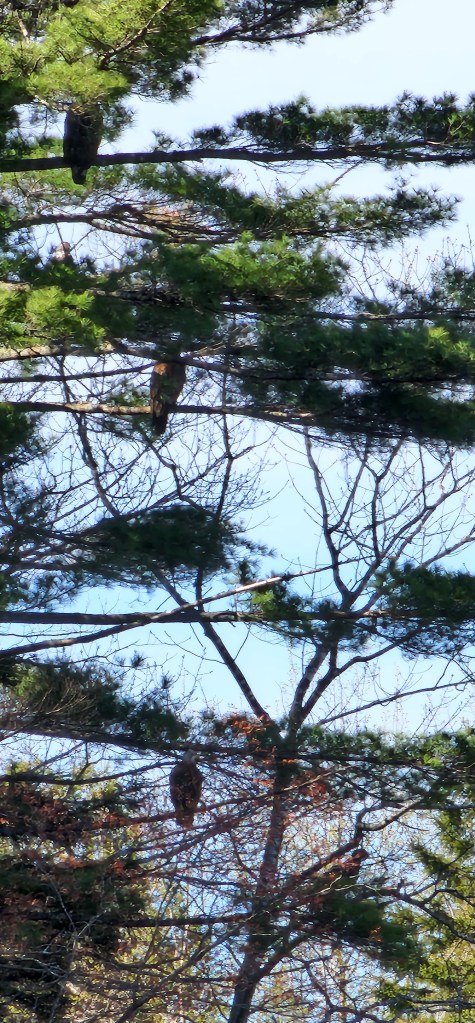
There had been five when I reached for my camera.
To explore related free photo albums, visit my Thistle Finch blog.
think of these as dream fragments
not always bad
In being held aloft as the epitome of English language and arguably world theater, too, the Bard of Stratford on Avon stands as an overbearing, even oppressive, figure.
Any writer since has faced the reality that by definition no one else can measure up, period. The fact that others have managed to carve out niches in the field in the centuries since is remarkable, considering.
Still, William’s presence was the reason I didn’t major in English when I transferred to Indiana University in mid-sophomore year. The department required a Shakespeare course predicated on memorization, something that’s not high in my skillset.
Beyond that, my focus has been on contemporary literature, at the time fiction and non-fiction but soon turning to poetry as well.
As a contrarian, I see no value in iambic pentameter, which we don’t speak, OK, and when I wrote in the form, the lines were always needlessly wordy. I like tight, direct, distilled, edgy. Later, the more flexible lines on Japanese poetry fit my ear as more reflective of American speech, at least as it was being applied by some West Coast poets. Count me in.
Not to deflate the Great Bard myth, but long ago I came independently to debunk William Shakespeare’s authorship of the plays. Nobody could have such an acclaimed vocabulary, for one thing, especially in the days before a thesaurus or dictionary. As for such a wide panorama of human values and foibles? Maybe it was a committee or at least a collaboration of greats – you know, a circle of improvisers whose takes were dutifully taken down as dictation – I was willing to accept that much. Sir Walter Raleigh has his backers as the likely author, and his poetry is more vernacular than his contemporaries, more akin to what we were doing in America in the 20th century.

Remember, though, having to memorize his plays, or at least the great moments, was the swing factor in why I majored in political science instead. Otherwise, I would have continually been trying to rewrite it. Instead, avoiding the Bard, I was still able to minor in English abetted by the Comparative Literature department.
More recently I’ve embraced the argument that Emelia Bassano Lanier was the actual playwright. From the existing evidence, she was better read and had a wider command of foreign languages. She likely had more time for composition, considering all the time Billy Boy would have been tied up as a theater manager, director, and actor. To pursue the fuller case, you can start by looking her up online.
~*~
For my own quirky entry here, I’ll remind you of my own Hamlet, a collection of poems spread over five two-scene acts with intermissions and intermezzos.
You might say it has more in common with Chaucer, though, with a rock ‘em, shock ‘em beat.

You can find it and more in the digital platform of your choice at Smashwords, the Apple Store, Barnes & Noble’s Nook, Scribd, Sony’s Kobo, and other fine ebook retailers. You can also ask your public library to obtain it.
As I reflect on the many facets of my life to this point – including the zig-zag route that has led me to here – I realize what draws them together is the two central metaphors I’ve found in the early Quaker movement: divine Light and the corresponding Seed. One, as spirit, draws forth; the other, as physical matter, responds. These two, however abstractly, are embodied in both my writing and spiritual practice.
Not that anything’s been quite that easy or direct, even before our current dark times.
At least I haven’t been alone.
~*~
In my fiction, they’re most prominent in Kenzie’s Tibetan Buddhist discoveries in the novels Pit-a-Pat High Jacks and Subway Visions and in Jaya’s practices in Yoga Bootcamp, Nearly Canaan, and the Secret Side of Jaya.
Not to be dogmatic in any of this. What I have now is what I found missing in both the Protestant circles where I grew up and the Eastern practices later. The second, as the ashram, was a step that taught me to sit in silent meditation as well as to live in community, lessons that flowered in relation to my Quaker, Mennonite, and Brethren circles that followed.
Trying to live in the “real world” of employment and a partner and family definitely thickened the plot as these have unfolded. As I’ll concede, a spiritual life needs to be grounded. That is, the gritty realities.
~*~
Trying to be faithful to the Way as it has opened before me was hardly the path I would have expected. It has, though, been blessed with mutual irradiation, in Douglas Steere’s brilliant term, including a Greek Orthodox infusion.
More recently, attempting to get back to some of the basic hatha yoga exercises, has inflicted the humbling blunt recognition of what 50 years of neglect can do to the physical body.
And cutting through the platitudes and BS of the literature remains a challenge.
~*~
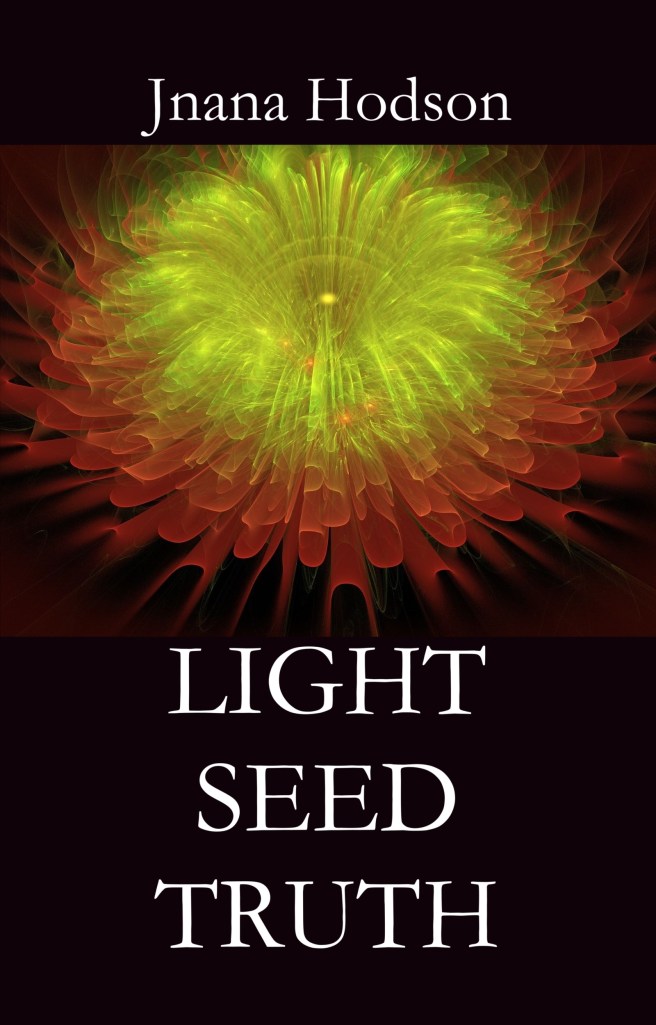
These elements drive the essays of my book Light Seed Truth, examining the three central metaphors of Quaker Christianity. It really becomes a different way of thinking.
Here are some of the things I’ve noted along the way.
I’ve been a Quaker for nearly four decades now, coming to the faith of my ancestors by chance after living and working on a yoga farm in Pennsylvania. Lately, I’ve been uncovering a revolutionary understanding of Christ and Christianity – one the early Quakers could not fully proclaim in face of the existing blasphemy laws but experiences they couched in metaphors of the Light, Seed, and Truth. As I systematically connect the dots 3½ centuries later, I’m finding a vibrant alternative to conventional religion, one full of opportunities to engage contemporary intellectual frontiers, individual spiritual practice, and societal crises. As an established writer – a professional journalist, poet, and novelist – I’ve organized these insights into a book-length manuscript. Would you like you to see it?
What I’ve found is an astonishing course of religious thought no one else has previously presented systematically. Reconstructed, their interwoven metaphors of the Light, the Seed, and the Truth provide a challenging alternative to conventional Christianity, one full of opportunities to engage current intellectual frontiers ranging from quantum physics and Asian spiritual teachings to psychology and contemporary poetry.
Embedded under the conventional interpretation of the scriptures and teachings about Jesus is an alternative definition of Christ and Christianity.
When early Quakers in mid-1600s Britain experienced this as their “primitive Christianity revived,” they were forbidden by the blasphemy laws from proclaiming their understanding openly. Instead, they couched it in overlapping metaphors of the Light, the Seed, and the Truth.
Embracing holy mystery, I’ve found the Hidden Path emerges.
Forget everything you’ve heard about Christianity. Let me show you an alternative portrait of Christ, and a much different practice that results. It can change your life. For starters, you need to realize that Christ is bigger than Jesus.
I can introduce you to the Universal Christ, which is quite distinct from Jesus. It can transform your spiritual understanding and make your life deeper and richer.
This can revolutionize your experience of Christ and what it means to be Christian.
This is not simply an intellectual exercise, but a visceral awareness
The results will startle and provoke, not just across the spectrum of today’s Society of Friends, but among Christians everywhere.
Sometimes I experience the act of writing as prayer. Neither is done for outward compensation, much less any guarantee of results, but rather to open one’s heart and mind to what is eternal and true – and attune oneself to that, regardless.
Culling my collection of photography and tearsheets, I’ve recognized I no longer desire to travel many places I haven’t been, but would rather revisit places I have. Either in person or, in the case of Tibet or Japanese temples, in my thinking and study. I also recognize that could change, given different economic circumstances and an influx of free time.
I now seethe early Quaker vagabonds were Dharma bums, too. The itinerant ministry proffers its own humor.
Quakers are still around, all right. And more relevant than ever. Just listen.
You can find it in the digital platform of your choice at Smashwords, the Apple Store, Barnes & Noble’s Nook, Scribd, Sony’s Kobo, and other fine ebook retailers. You can also ask your public library to obtain it.

