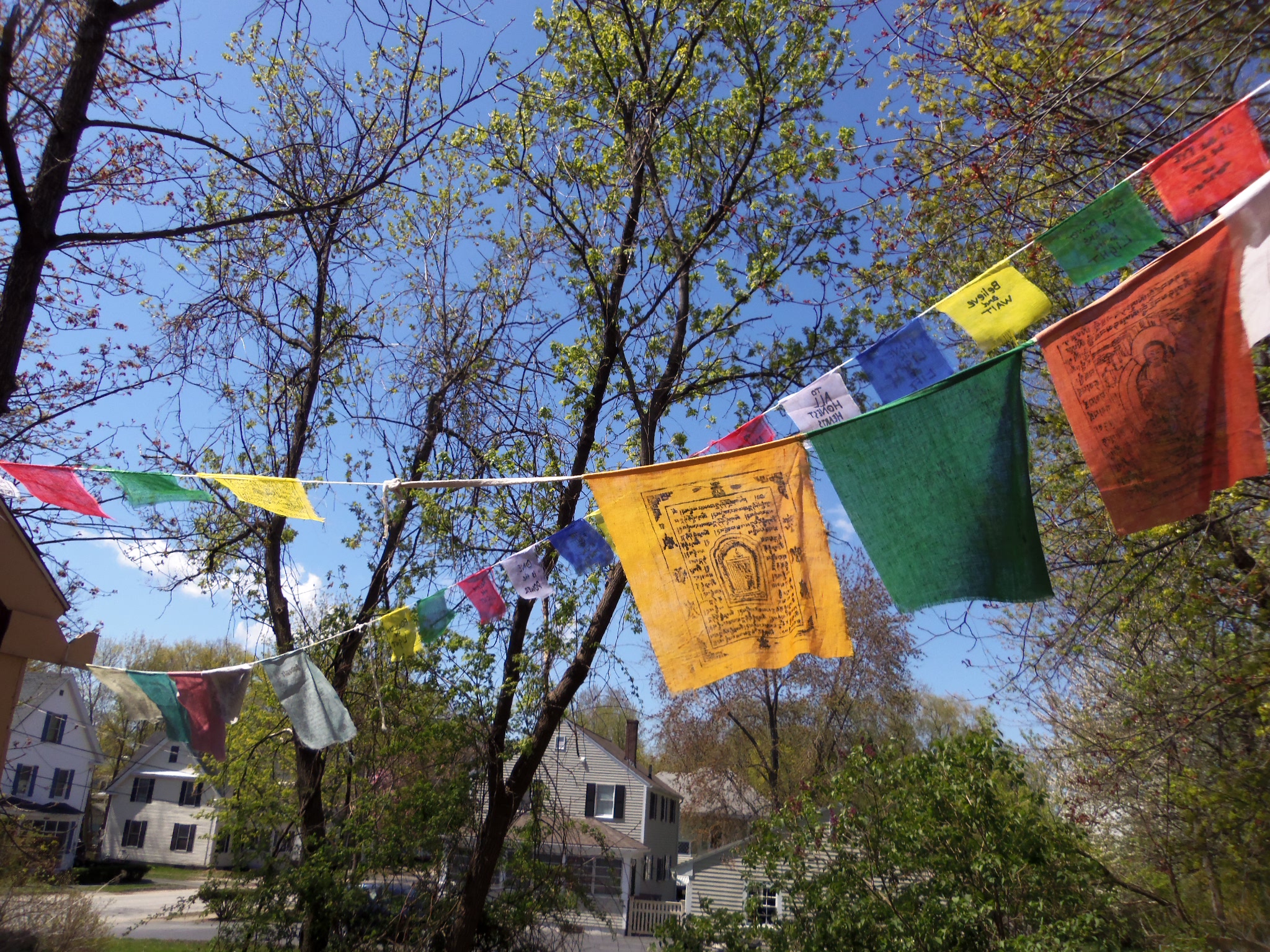
The Apostle Paul has urged Christians to pray without ceasing.
I view Tibetan prayer flags rising in the breeze as joyous reminders my heart can do likewise.
You never know what we'll churn up in cleaning a stall
The Apostle Paul has urged Christians to pray without ceasing.
I view Tibetan prayer flags rising in the breeze as joyous reminders my heart can do likewise.
Asked for a short theology, I’m likely to reply I’ve come to the conclusion God has a different way for us, individually and as a society, to be living.
It’s the story I see evolving in the Bible, for one thing. And in much of the history since.
It’s not hierarchy-based, for starters, and something quite different from nations, with their armies, as we know them.
We get a hint of it in the suggestion of the Jubilee, the redistribution of wealth every 50 years for the entire populace.
Maybe you’re already sensing I don’t draw a distinction between here and eternity, not the way Augustine did. It’s the “Kingdom Come, on Earth as it is in Heaven,” as Christians pray.
The long version, of course, is where all the details come into play.
The window I long viewed from my seat on the facing bench in the meetinghouse may also be regarded as an icon or mandala – a piece of art to facilitate the practice of spiritual focus and release. As an image used to settle a person into meditation, the window is hardly static. I’d settle in and close my eyes, as usual. At some point, though, I’d open them, softly, gaze around the room and then the window. Where is my heart today, truly? Where are my emotions? Let my thoughts still, for now. One looks out, to look within.
I recall another Friend, Randy Kezar, who once proposed photographing the view from another window in the room. His concept was to shoot the same scene from the same spot, at the same hour every Sunday for a full year. The record would show the small wooded slope blooming and in fullness, autumn color, snowfall and melting. Sunny days and rain. Glimpses of the city cemetery beyond.
On most Sundays after that, I would ask myself which artist best related to the scene framed before me. It turned out to be quite a collection.
And then there was that one April morning when I realized the visual quality of the air itself had changed. We’d crossed out of winter and into the light that accompanies summer. In the coffee hour afterward, a former TV producer told me of the ways his cameraman had to have the film adjusted to accommodate for this change every spring and again every autumn.
Just as telling was that one morning in May when I was struck by the hues of green and blue in the window and saw what resembled a Monet painting. While this was not a reference many of the earlier Friends in the room would have acknowledged or accepted, it definitely was one I could … along with most of the others present that day. The view in that color continued for three weeks but has never returned quite the same.
If I watch my own window hoping for a return of the Monet experience, I can too easily miss what’s present.
Come springtime every year, there’d be a predicable domestic spat. I’d say the compost was ready. She’d look at it and retort, “No, it’s not: you can still see bits and tell what it’s made of.” (Actually, two shes – mother and daughter.) “Then you’ll have to wait another year for it to finish to your specifications,” I’d shoot back, only to be told we couldn’t wait that long. And so on.
Part of this seemed to question my very manhood. I was, after all, the one doing all the work, from collecting the bags of leaves around the neighborhood and dumping the kitchen garbage in the covered bins to changing the rabbit cages, in large part for their precious, nitrogen-intense pellets.
Well, most of the work. The red wigglers would also do a large share.
Still, I suspected that if we waited as long as they wanted, all of our organic matter would evaporate.
At last, I had a flash of genius. I’d slowly sift the pile, trowel by trowel, and whatever came through the screen turned out beautiful. They approved and used buckets of it on the square-foot garden beds as fast as I could provide them. The part that didn’t fit through the screen was also beautiful, along the lines of woodland detritus with flecks of brown eggs. I put that aside to decay further, perhaps to be spread as mulch in July or August.

The motion of sifting itself can become a kind of Zen practice as you admire the material before you and the thoughts flitting through your awareness.
This movement’s like panning for gold, as I found washing my dishes in the glacier-fed river below Mount Shuksan. Back and forth, back and forth, with all that matter getting smaller and sparkling more in each round of swirling.
All the peach stones are tokens from our cheap peach bonanza after Hurricane Irene ruffled nearby orchards.
The squirrels plant a lot of our wild black walnuts.
Listen to all the cardinals and mourning doves.
Plastic, in flecks, is inescapable.
How loud, those geese overhead! Me, I’d be more stealthy.
We eat a lot of eggs.
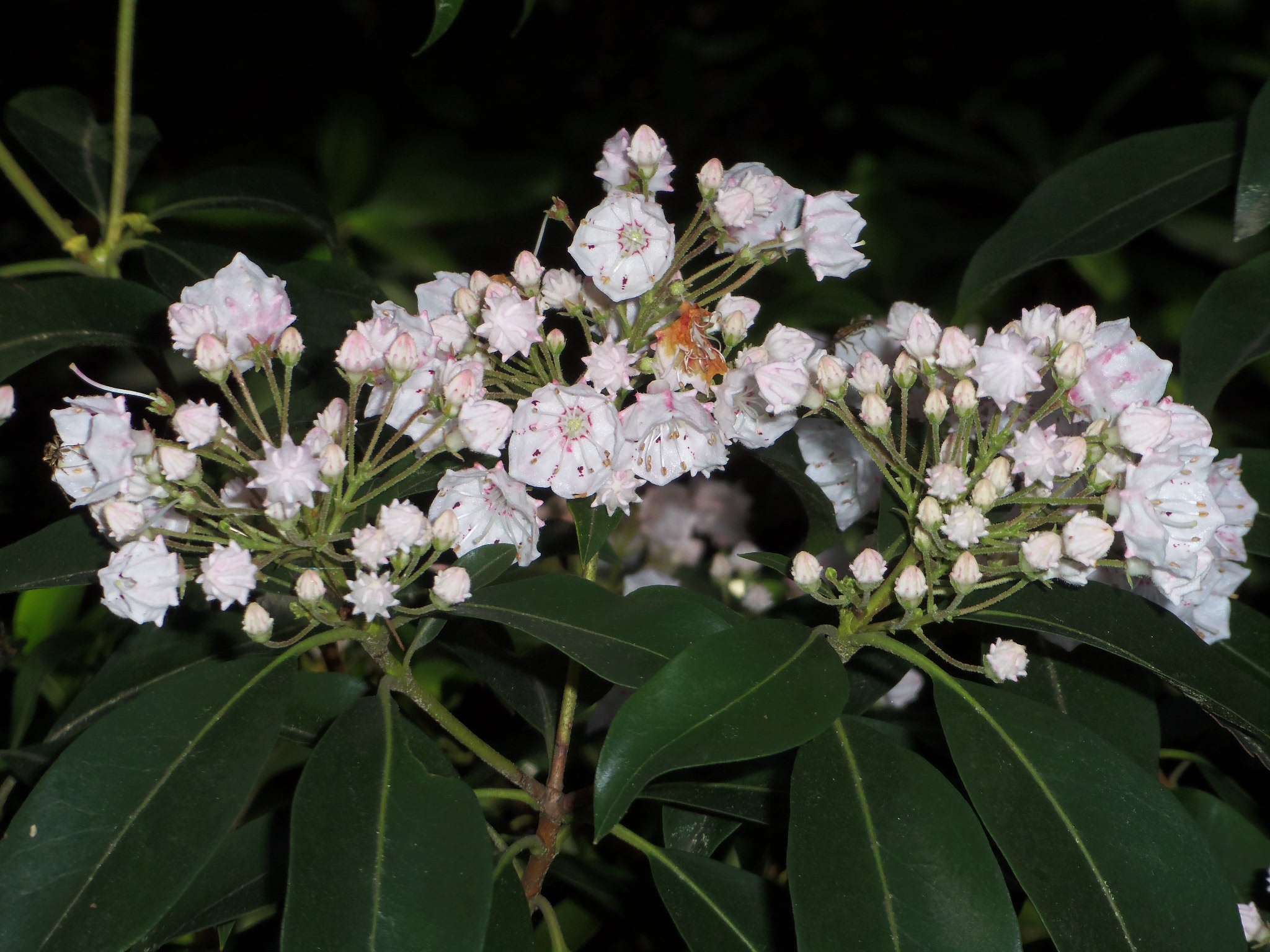
My fondness for mountain laurel springs from my days in the ashram in the Poconos. Those tiny white clusters like origami that open into tiny teacups are, I was told, the state flower of Pennsylvania, and protected by state law.
My fondness for rhododendron goes back even further, to backpacking a section of the Appalachian Trail as an 11-year-old Boy Scout and coming upon Roan High Knob in full bloom in North Carolina.
Joe Pye weed is something I’ve learned to appreciate here, after we bought our annuals at the Conservation District sale.
Add that, as it thrives, to our azaleas.

One of my annual rituals involves emptying the large compost bin as we prepare to enrich the garden for our new plantings, and then refilling it with layers of collected leaves (bagged by our neighbors, especially, each October), a winter’s worth of kitchen garbage, and bunny-cage hay and its prized pellet-manure. The production of “organic matter” to counter our clay soil is also part of our battle against what my wife calls Dead Dirt Syndrome, and it’s been a wonder to observe progress over the years we’ve been at it.
The Apostle Paul has exhorted Christians to pray without ceasing – an impossibility, as we know – yet as I lift forkfuls from the big bin, reline its sides, load and unload the wheelbarrow, I often find myself entering a prayerful zone of reflection. First, there’s the reminder that humus – the stuff of compost – and humility are words sharing a common root, and that both are nurturing elements for life. Then there’s an awareness of our essential abundance – all the meals we’ve enjoyed; the reality that children in America are familiar with tastes that kings in earlier times would have never imagined. We haven’t gone hungry. In fact, there’s so much waste to lament, a resolution to be more frugal or attentive, and then a sense of contrition knowing that we’re still putting this to work rather than tossing it out to the local landfill. Soon I’m appreciating the stages of transformation as I observe how matter breaks down into something resembling potting soil – rich, dark, soft. But I also know this always requires patience and will go at its own pace, no matter how I might try to rush it.
I’ve learned to watch the stages of change, too. That period when the pile begins steaming and its interior reaches 140 degrees or so. Followed by that period when the red wigglers (or is it wrigglers?) appear and proliferate. My buddies, reducing the leaves and hay and newspaper and cardboard and garbage into finished compost. You could view them as angels, arriving from wherever to bless the home and garden. At least I do. Yes, gratefully.

This miracle of being allowed to release so much pent-up work is impossible to describe, but it is fostering an incredible change within me. The publication of my novels as ebooks through Smashwords.com and the postings on this blog of so many bits from my archives are allowing me to enter a period of reduction – something I’m calling “decollecting,” when it comes to my books, recordings, manuscripts, extra clothing, and other assemblies. What I’m also finding is an opening to rethink almost everything and, like the layers of an onion being stripped away, of finding myself willing to rely on fewer and fewer answers … and more and more questions. Add to that a growing sense of wonder, in many cases, or of futility and cynicism, when looking at so many of the political and economic policies being followed blindly.
What I am accepting is that I require less and less material support. Maybe it’s the renunciation in my yogic past finally kicking in, or maybe it’s the tightened focus on what remains before me.
One thing I know as I view the trail markers before me: I’m not ready to kick back, for certain. Let’s see where this goes.
Monday morning, as I noted at the time:
I’d thrown the kids off the PC, where they were watching an episode of The Simpsons, only to find out it was actually an assignment for the older one’s upper-level college course, the Sociology of Humor. [No joking.] And then I got around to some poetry submissions, including an acceptance or two.
Glad you like the work I sent. The elk poems arise out of the four years I spent in the desert of Washington state, bordering the “dry side” of the Cascade Range. They’re part of a series, most of which has already appeared in journals. I’m not a hunter, but living as I have most of my adult life in places near forest (even my time in Indiana and Iowa), I’ve had to acknowledge the existence of hunting as a fact of life – and the ways ancient hunting, with its religious/spiritual dimensions (the discipline of meditation, for instance, arises from waiting for the game), contrasts with modern “harvesting.” Even so, some editors have rejected the work out of hand – maybe they thought I’m a NRA member (quite the opposite, in reality – no guns for me).
Among the poems I’ve written are “After the Fact,” which comes out of Native American lore. It turns out that Gary Snyder also has a piece drawing on the same myth – “This Poem Is for Bear” – which acknowledges the aspect of the girl’s disrespecting the bruin before the abduction. I found another piece along this line of my work, “If a Man Goes Mad,” which works along a similar grain.
Finally, as I look back on the period, I reopen a longpoem, my American Olympus, based on a one-week camping trip with a now ex-wife and a former girlfriend who was visiting (who would have guessed they’d actually enjoy each other’s company). As it turns out, I still hear from the ex-girlfriend.
We sometimes express a yearning for the return of the Renaissance Man – the individual who could be conversant on all fronts of intellectual inquiry – but the reality today is that it’s impossible even to stay abreast of the developments in one’s own field, much less other more widely shared interests.
Just ask folks who read if they’ve read your latest hot discovery, and you’ll likely get blank looks. It’s just a fact of life, even for works that are in the basic canon.
It extends to the other arts, too, and we won’t even raise the frontiers of science.
That reality hit home the other night when we sat down (finally!) to view Citizen Kane. I knew from my cinema studies (uh, 44 years ago) that the work was then considered one of the four greatest movies ever made, but somehow it had slipped through my viewing. Yes, I’d seen Birth of a Nation and the Battleship Potemkin and likely the fourth work on that tally, though I can’t remember what it was.
And now? I’m in the camp that considers Kane the most important movie ever made. Period. And, as my viewing companion said afterward, “I was ready to respect the movie, but I didn’t expect that I’d enjoy it as much as I did.” Which was immensely.
If you want to know how Orson Welles and his team changed the face of movie-making so utterly profoundly, go to the Wikipedia entry for the movie and then watch Peter Bogdanovich and Roger Ebert’s running commentaries, which are included on the Netflix DVD. Apart from the advent of color, there’s really nothing they didn’t revolutionize. (If you see something they missed, speak up.)
I’m glad we saw Kane after we’d watched The Grand Budapest Hotel. For all of Wes Anderson ‘s wonderful quirkiness, we could now appreciate the ways he and his team paid homage to Welles and the incredible cinematographer Gregg Toland at the head of that list.
We’re now going to have to watch both movies again.
Spring yellow, for Easter. I cut branches of forsythia, bring them indoors, find an appropriate vase with water, if Easter’s falling early. And then they open, with a profusion of yellow. Sunshine.
Some, soon adorned with suspended eggs.


