Returning to my native corner of Ohio, I’m astonished by its flatness; what had seemed to be large hills or significant valleys now appear embarrassingly horizontal.
On the other hand, as I’ve uncovered my ancestral roots in that land, I’m finding a lost and untold richness in what was essentially a Pennsylvania Dutch heritage continuing in western Ohio. Feel free to take a look at my findings at the Orphan George Chronicles.
We’re well into the back-to-school swirl. Considering how many Friends teach for a living, it’s a wonder we don’t talk more about what Quakers used to call Sound Doctrine.
Not dogma, creed, doctrinaire, or even indoctrination, mind you. Doctrine, meaning teaching. The essentials for practicing our faith, just as certain skills are needed in mathematics or foreign language. Or, for that matter, for good cooking or carpentry or sewing.
It’s not just the children, either. Some messages arising in worship are basically teaching, and some are admittedly sounder than others, the latter including those that George Fox derided as mere “notions.” (Consider the Quaker who preached that Friends should not disturb the ground to obtain well water, until another spoke out during worship, “And Abraham digged a well,” citing Genesis 21:30 and apparently settling the matter.) Our own reading and inquiry, meanwhile, can be pretty much hit or miss. Who knows about other sources? Film, television, radio? And, as with all teaching, how strict should one be – and how flexible?
If we were passing a hat to collect slips of paper suggesting what should be included in our own “sound doctrine,” what would you write on yours? For that matter, how much would be a matter of content – and how much, process?
Sometime, perhaps, we’ll even have a session to hear our teachers talk a bit about their teaching – both content and method – and a continuing awareness of learning. Or maybe another, to consider all the ways we have learned from each other – and not just matters of faith, either. The progress of my compost bins, after all, is guided in part by eavesdropping on a few after-meeting conversations and their lessons of patience, humility, and renewal.
~*~
This has me wondering, as well, how we might extend a pursuit of “sound doctrine” into our secular circles. Economics, politics, education, even entertainment could all use a dose of what Friends used to call “close labor” – the effort of living with ever greater integrity. Any ideas?
For much of its history, the Society of Friends forbid the use of engraved gravestones, deeming them vain and superfluous. Even so, another custom emerged, the drafting of memorial minutes for Quakers whose lives might serve as an inspiration for others.
The result was quite different from either the typical obituary or eulogy, and many of them prove surprisingly candid, as genealogists discover. If a eulogy celebrates the person, the memorial minute focuses on the individual’s spiritual life and service, especially in the ways these play out in the world.
Often, the minute would be approved by the local Quaker Meeting and entered into its records. If the individual had been active at a wider level, the minute would also be forwarded to the Quarterly Meeting (a gathering of local meetings that comes together four times a year), where it would be shared and, in due practice, approved. If appropriate, this would be repeated at the larger Yearly Meeting level.
As an example of the practice, here is the nearly finished draft of the minute for one Friend. As a member of the committee that prepared this, I’d like to show the “long” version that includes more of her remarkable career, in contrast to the shortened versions that were approved by the circles of Quaker meetings.
Alanna’s minute was approved by Fresh Pond Monthly Meeting and endorsed by Dover Monthly Meeting, and then accepted by Salem Quarterly Meeting, before being included in the minutes of New England Yearly Meeting’s sessions last month.
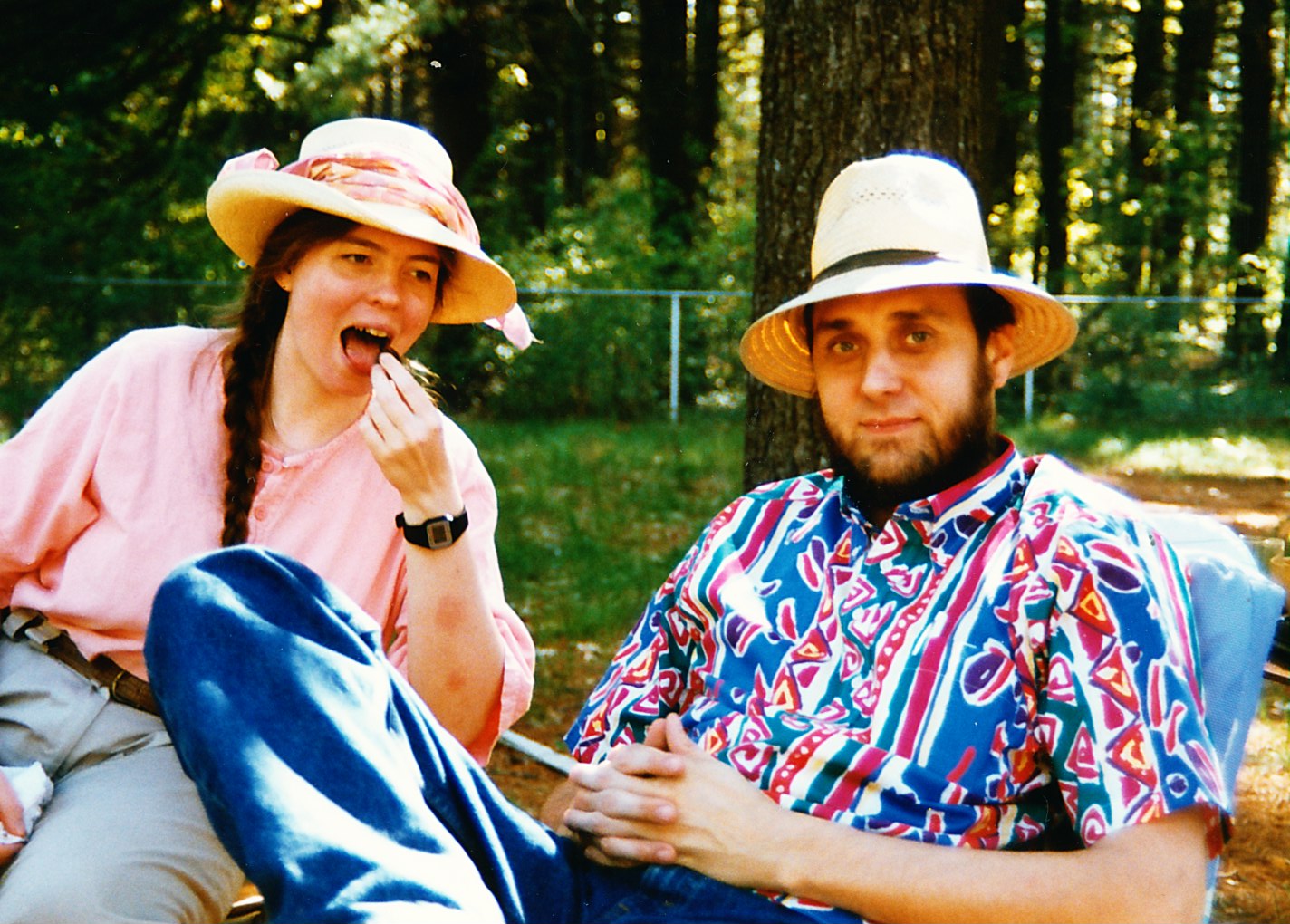
Alanna and me early in our friendship.
ALANNA CONNORS
September 25, 1956 – February 2, 2013
From an early age, Alanna Connors discovered a need and a capacity to trust her own compass. She was a mathematician at a place in time where women were seldom found. When her high school math teacher flunked her for excellent work, another teacher told her: “You know he’s giving good grades to boys and not to you, because you’re a girl.” Recounting the story in later years, Alanna said, “I didn’t need that; I knew I could do the math.” She held true to her course.
Long before finding Quakers, Alanna lived the testimony of experiencing God in everyone. While most of us have tight circles of caring – our family, friends, coworkers – Alanna’s circles were as unbounded as a wave expanding to all of space. It seems no accident her profession became looking at objects distant in the universe: across the many communities of her life’s paths, she welcomed all beings. Living with her was a joy; her love for others was never abstract but a centered flame close to her and everyone she touched.
Alanna was born September 25, 1956, in Hong Kong to Richard and Sonia Mitchell Connors. Her mother, who herself had a degree in mathematics and studied with Jean Piaget at the Sorbonne in Paris, ultimately worked as a font designer. Richard learned to fly in his youth and became a pilot with Pan American Airways, stationed in Hong Kong. Through his delight in sailing, his five children all learned to sail. Alanna took the lead, becoming a competitive sailor in her time at the Massachusetts Institute of Technology.
Returning to the United States in 1963, Alanna’s family settled in Greenwich, Connecticut. Living with four siblings – one older, Cynthia, and three younger, Kathleen, Noirin, and Patrick – in environments not always centered on these children’s welfare, Alanna developed an immense capacity to listen and extend empathy. Imagination shone through her grade school writings; her elaborate, award-winning gingerbread houses; and family-staged dramas.
Alanna was irrepressibly fascinated by math and science. She thrilled to the elegance of mathematics in expressing, revealing, and predicting physical behaviors. For her, mathematical physics was inseparable from the playfulness, color, artistry, and imagination by which she produced it. Whether it was classroom notes, derivations on scratch paper or napkins, or formal solutions, her handwritten analyses were crafted in flourishing script, vivid with colored pencil illuminations, and playfully annotated with such characteristically inventive words as “whatsit.”
Alanna’s dorm room hosted a wide array of human spirits. Her hotplate, washstand, handmade teapot, and mismatched cups provided hearth and an excuse for tea and convivial warmth at all hours of the night.
She met fellow student Phillip A. Veatch while they were both organizing MIT’s first on-campus food cooperative. After a year of courtship, they exchanged private vows of marriage in 1978, on a basketball court in East Cambridge. Alanna was opposed to the state-sanctioned institution of marriage because of its historical role in the oppression of women.
Communal living, conceived around Alanna’s dorm room, continued into her committed life with Phil through group houses with shared vegetarian cooking. While in Maryland during her doctoral years, they asked all prospective housemates: “Can you have: 1) too much garlic; 2) too much chocolate?” A no answer on both questions was mandatory for joining the group house.
With one housemate, Alanna went “church shopping.” While appreciating the wide span of worship experiences, Alanna gravitated to the Religious Society of Friends in 1982 in Adelphi, Maryland, dragging along her then-reluctant partner. A deep commitment to the Quaker principles of simplicity, peace, integrity, and justice soon enriched both of their lives. They continued at Dover Monthly Meeting in New Hampshire and finally settled at Fresh Pond Monthly Meeting in Cambridge, Massachusetts, in 1998.
Wanting to understand stars, she became a groundbreaker in charting the sky of X-ray sources. Being of a mind to “like thinking we are all professional visionaries,” Alanna’s deep searches into the distant sky uncovered new observations and questions. After earning her doctorate at the University of Maryland, Alanna made significant contributions to the Compton Gamma Ray Observatory as a research scientist at the Space Science Center at the University of New Hampshire. She introduced astrophysics to Bayesian methods of statistics, which start from an assumption that knowledge about a problem is always incomplete. Applying this rigorous data analysis to X-ray and gamma-ray astrophysics, she provided a foundation for statistical methods generally unknown to astronomers in the early 1990s.
As a banjo player, she encouraged use of the Rise Up Singing songbook, learning by heart its song “Julian of Norwich.” Original lyrics and tunes came to her, either fully formed or developing through writing. Alanna’s spirit still comes to us through the texts and music of the dozen songs she set down in composition.
Despite being an intense introvert, she harbored a lifelong belief in the importance of community-building. She cofounded an astrophysics statistical working group at the Harvard Smithsonian Center for Astrophysics. As a senior scientist, she was known for her support of young graduate students. She founded a singing group at Dover Meeting, and while living in Arlington, Massachusetts, enjoyed singing with Nick Page’s Mystic Chorale Singers. After the birth of her son, Roy, in 1999, she worked with other parents to reform special education in the Arlington public schools. She volunteered regularly at New England Yearly Meeting annual sessions working both in child care and the bookstore. She regularly attended the Women’s Group at Fresh Pond Meeting, where she spoke regularly about her concerns in raising her gifted son.
Alanna envisioned and encouraged public science education. She taught astrophysics at Wellesley College as a visiting professor, participated in university physics instruction at UNH and UMD, contributed to public education in science through projects at the Christa McAuliffe Planetarium in Concord New Hampshire, c0-organized family science days at her son’s elementary school, and encouraged exploratory science learning and teaching through many other avenues. She had an abiding interest in the history of physics and astronomy from its ancient origins, in welcoming women’s participation in physics, and in celebrating stories of diverse contributors to science.
Alanna was first diagnosed with breast cancer in 1995. She lived with the disease for 18 years. Characteristically, through its recurrences and treatment, she refused to be defined by the disease and conceived her son, Roy, born in March 1999. To her, the illness was but a single strand of her life. When Roy was 4, her disease recurred, and she took him with her to treatments, where he found the hospital’s high-energy accelerator intensely interesting. Whatever life brought her, she lived with it; she saw illness as no excuse to build walls. When her disease recurred for the last time, in an advanced form, Phil asked if she wanted to go on a special vacation. She did not, preferring to live in her callings.
At Dover Meeting, 1988-1998, she rotated through nearly every committee but also stayed long on Buildings and Grounds. During the first Persian Gulf War, Dover Friends called on her to write a compelling minute explaining the Meeting’s opposition to the invasion of Iraq and Kuwait. Phil and Alanna were lifelong advocates of same-sex marriage. When they decided for Roy’s sake to get legally married, they would not seek marriage under the care of Dover, as that meeting had not yet completed its process of hosting marriages for same gender (it has since done so).
During her time at Fresh Pond, her participation in committee work was limited by parenting and the recurrences and treatments of breast cancer. She was, however, a quiet and regular presence at Meeting for Business and an infrequent but powerful minister during Meeting for Worship, where her ministry was often structured around song.
Just as she knew not to take to heart a teacher’s censure that could have devastated a young mathematician, Alanna maintained integrity without ceding herself, her work, or others to be diminished. Mathematics was one route by which she independently investigated, questioned, and confirmed the truth for herself without relying on the claims of teachers and other external authorities. She stood up for discovering and expressing the full potential of one’s mind and heart, inspiring those around her to undertake aspirations and risks of which they did not suppose themselves to be capable. She knew greater being lies imminent within us all. Whether it was the rights of any couple to publicly live their committed love or a child’s mind emerging along ways and curiosities differing from the school norm, Alanna honored and worked for the fuller life she knew to be there.
Alanna’s spirit lives with us and continues to teach us. We remember her implacable but gentle striving to see the truth and to tell it. The women of Fresh Pond recall Alanna’s intense, powerful mothering, against all odds. Throughout her life she resisted the limits and distortions that social norms can impose on our vision of others. Knowing that a prism takes a beam of light and separates it into many separate parts, Alanna lived her life striving to bring the many separate parts of our world together into one shining beam.
Her memorial service was March 2, 2013, in the Wellesley Friends meetinghouse under the care of Fresh Pond Meeting. She was 56.
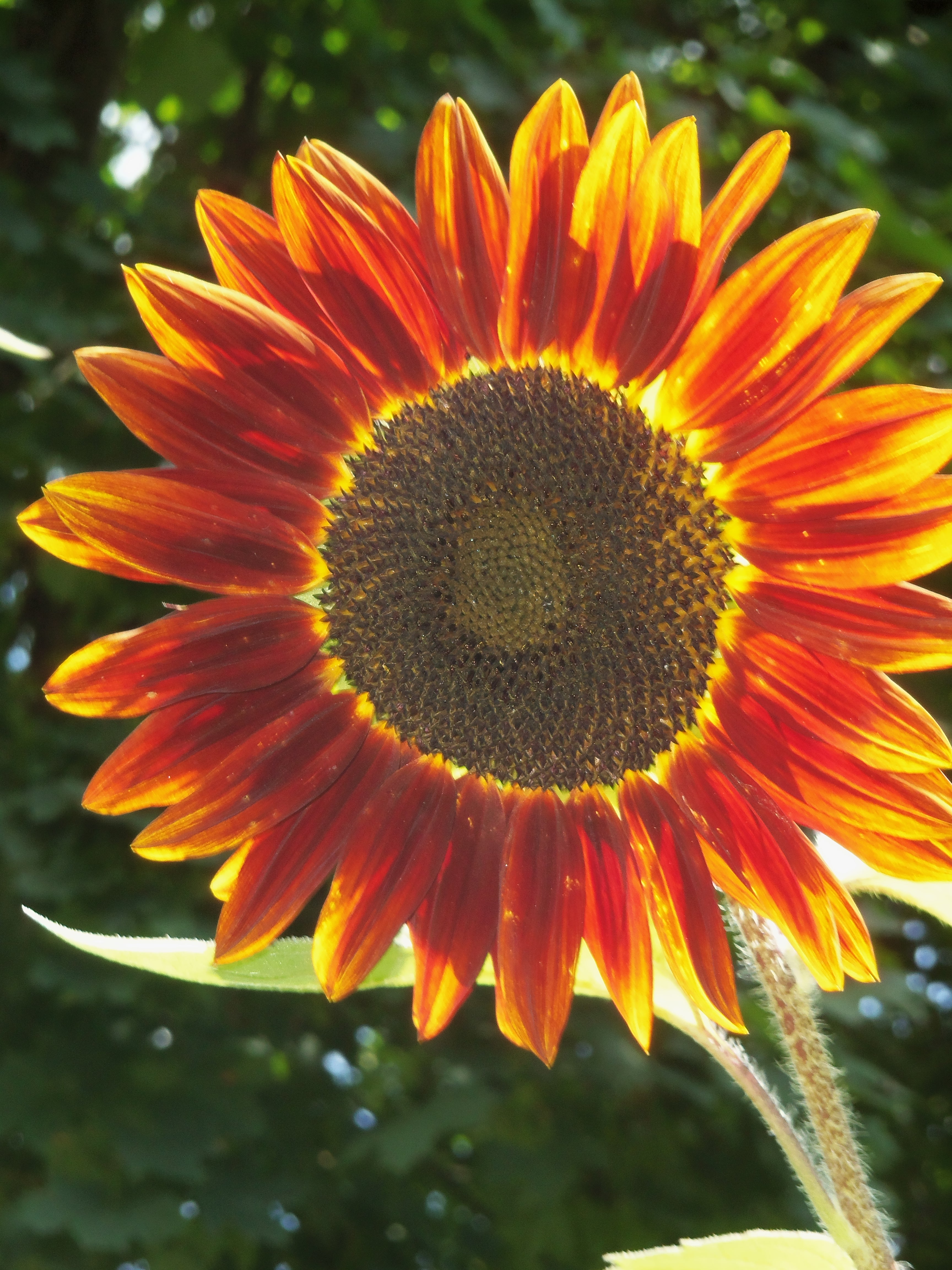
Some varieties of sunflowers have dramatic dark reddish petals instead of the usual yellow. This one is all the more stunning with the sunlight illuminating it from the back.
So we’re having coffee once again, one of my favorite authors and I, and while he’s a decade younger than me, I still marvel at his relentless output.
Why do you pace yourself that way, I ask.
Because time’s running short, he answers.
As I said, he’s a decade younger.
Maybe we should talk to an older painter we know, a good decade-and-a-half ahead of me. The one who’s still painting furiously. Quite possibly better than ever.
You have to wonder what makes some voices so distinctive. Maybe it’s what makes a master. They way a few notes instantly separate Mozart from Haydn or announce Beethoven. A few strokes, a Rembrandt from Vermeer. Any number of writings.
I think of particular musicians, too. The conducting of Max Rudolf, for certain.
The way God claims to know each of us by our voice.
It’s been a long time since we planted morning glories, but they just keep coming back. Here’s one vine that just decided to follow an old telephone line up the side of the barn.
It’s hard to believe five years have passed since we made the loft of the barn much more usable.
When we moved here, the loft was accessible only via a second-floor catwalk from the master bedroom, and getting there and back could be tricky, especially when snow was piled on the deck.
I’ll save the home renovation project description and photos for another time, and just mention that it involved removing the catwalk, deck, bedroom doorway, and barn loft doorway, installing stairs inside the barn and lighting in the loft.
What it essentially did was give us another 450 square feet of usable work and storage space – especially once we replaced the leaky roof two years ago. (Gee, I think that’s the size of some of those Ikea model apartments.)
Admittedly, it’s not someplace you linger for much of the year. It’s not insulated and there’s no heat, so you do little more than dash in and out in January-February or July-August, but for me it’s been a huge blessing.
As I wrote in August 2009, an “especially humid Tuesday: No Rick yesterday or today.” Our carpenter/master electrician was “off on another project.” We were in no rush, anyway. Still, enough of the project had progressed for me to note, “Having the top of the barn – the Squirrel Piss Studio or Jnana’s Red Barn or the Summer House – finally available as usable space is mind-boggling. At last! Ten years. A time for decompression, unpacking. The difference in scale as a result of the larger space (framed posters, for instance, now appear so much smaller).” I detailed more effusively in my journal. What I noted was “t
he array of items: places I’ve gone off to, to live. Sometimes unwillingly. The skulls – steer, horse, dog. Elk bones. Shells.
“So much to discard, too. My burgundy valet bag, an artifact of the past (after 9/11, nobody travels with one). Burgundy, LAL’s color. Same as the Chevy. The specially designed coat hangers, with their folding hooks – open for the hotel, closed to slide into the bag. Those two years, a ‘backpack for business travelers.’
“A Quaker altar: a candle on a piece of squared birch firewood, the side with bark facing the sitter; incense; in time, flowers or dried arrangement; Bible, Gita, notebook?
“I sit in the space and recall how Roger Pfingston could sit for hours in front of a blank piece of paper without writing a word. Maybe smoke a cigar. Now see it as his way of meditation and self-collection.”
The space also gave me a place to resume hatha yoga exercises after way too long a hiatus.
I love having large surfaces where I can spread out the pages for a poetry collection and rearrange the sequence. I’m not one who works easily with a crowded desk, unlike many of my colleagues. No, it’s Zen order or Quaker/Shaker simplicity I desire.
The loft is far from the year-round office studio I’d envisioned when we moved here. To get there, though, apart from the money, we’d have to cover the wooden underside of the roof I’ve come to enjoy viewing. The feel would become much different than the funky, well, summer cottage I so much enjoy now – even when it’s fall and spring rather than summer when I most use it.
Besides, to be candid, as I’m able to clean out and dispose of more and more, and as I move increasingly to online, paperless writing and submissions, I don’t really need the big office of those earlier dreams. At least that’s what I’m thinking now.
When I was 38, several developments occurred in a way that allowed me to give myself a year of unemployment, drawing largely on savings. Rather than travel the world or undertake some related activity, I hunkered down in a writing spree [that resulted in the novels now (finally) being published]. The sabbatical meant that for the first time in my life, I had a period of uninterrupted concentration on this work. The writing itself. Three fast novels, now to be revised, and thud! skidding to a crash or whatever. Enough to expand to a dozen, in the hours of revision after I went back to the paying work. Looking back, I know it had to be done. And done then.
Nevertheless, in my struggle between practicality and art, there’s been a longstanding sense of guilt in spending time on myself. To my surprise, a resolution came through a workshop on prayer, when we were divided into smaller groups and then asked to write out a prayer request. Not for what others might need or a social issue, but for something we needed individually. “Ask for something for yourself,” which the others would then pray for.
Of course, each of us works differently. I’m not one for the blank sheet writer’s block syndrome: I’m usually springing from notes jotted down earlier. (Pacing is another matter: just where is this going? And why?)
In contrast, I recall a poet friend who was also a public school teacher; he was quite prolific during the busy school year, yet during the summer, could produce little, though he could never quite figure out why. (He could also stare at a piece of paper for five hours and then turn out a sharply focused gem.) The other friend, having all the leisure in the world, could produce only disconnected flashes. Could it be some juggling or resistance is also essential to the practice?
So here we are. Who would have thought we’d be attending kids’ soccer and rugby matches? Not us!
Or dealing with declining parents. Your mother’s dementia must be difficult. You mention that she still remembers people and is in a wheelchair, which makes me wonder if she’s afflicted with Alzheimer’s or something different. My wife and the girls talk fondly of Grandpa Marion and how his Alzheimer’s brought out a sweetness in him, while another, with episodes in the past years, turns mean and paranoid. Parkinson’s is rough, too, with its long decline; I lost a dear Mennonite mentor last January, in Virginia, and one of my best friends here is in the early stages – so far, controlled by medication, when they get it right.
Galapagos? My elder girl will be very envious. At age 11, she went on a big Darwin kick, a passion that has never abated. A few years ago, we went down to the Boston Museum of Science for a special exhibit they had, and it was quite impressive. In all of the historical debate over his insights, I’m surprised we don’t hear more about the religious roots of his work – most of his encouragement and support seemed to come from clergymen. Me, I’m quite fond of his later affection with earthworms. Maybe it has to do with my monster composting.
Now I still want to hear how you distinguish between mystery and magic. I have a few ideas, but I doubt they’re as expansive or insightful as yours.
In the meantime, I’m hoping to get back to poetry by early fall. Why can’t I stick to just one kind of writing? Or be somehow easily identifiable? A good friend’s son, who is a successful serious novelist, seems to have the same problem. He, too, wants every book to be unique, rather than a continuation of or variation on his others.
Gotta run … time to commute, again. And tomorrow, another birthday. How can that be?

 Jnana's Red Barn