Tag: Humor
Kinisi 94
the wet horizon pours out
draped in fish
down to the seed
rather than transcendence
As for my emotional home, I’m lost
without geohistory and mythopoetics
where I wanted to collapse into your dreams
once you came
Kinisi 92
barking crows
whims of courtly love
course you hate being ordered about
marble, limestone, granite, ice
soapstone as a handyman’s tool
sweating came much later
to this cold-blooded frame
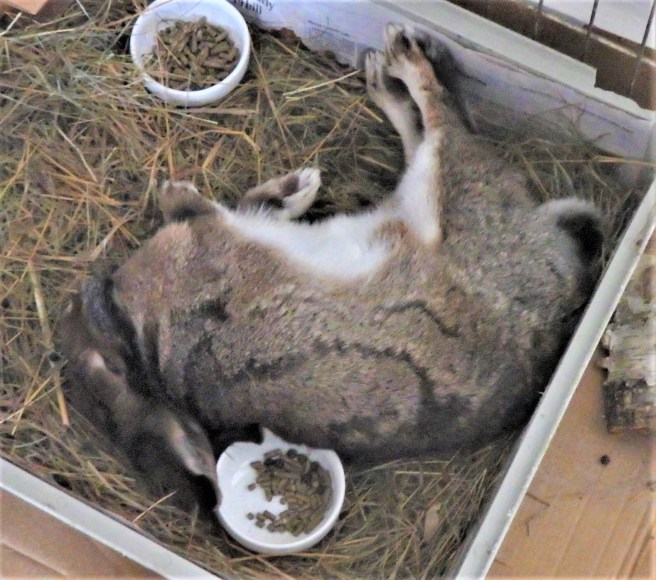
Just a bunny … or bfunny?
In a really big snow, you might not see the stop sign at all
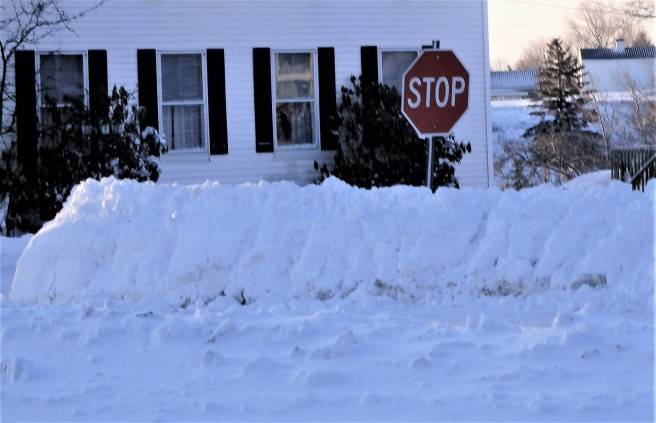
Snow comment needed.
Kinisi 93
natchurrally, I’d drive the tractor, back up skillfully, too
as I’m still flat, flattened, corn, soy, wheat to the core
plus hogs and cattle. As for chickens, you need
justly one rooster
let me cackle, however faintingly
An orange is an orange is an orange orange
The mystics and traditions I’ve encountered are anything but airy-fairy. In fact, they can be pretty down-to-earth and practical, based on personal experience and testing rather than empty speculation or dogma.
As George Fox said at the beginning of the Quaker movement, “This I knew experimentally.” That is, by first-hand experience including trial and error. Or as was said a few years later, “Some of the best barns in Rhode Island were designed during Quaker Meeting,” during quiet meditation.
Never underestimate the importance of the disciplined circle of fellow practitioners, either. Anyone who says “I’m spiritual, not religious,” but lacks that communal base is headed for trouble.
I learned that 50 years ago in a yoga ashram – see my novel Yoga Bootcamp for unorthodox examples of how it works – and have seen it in other traditions since, especially my Quaker circles.
One of my favorite stories comes via fellow blogger Tru-Queer, who relayed the incident this way:
A Tibetan lama and a famous Korean Zen master in the Rinzai school were to have a debate.
The Tibetan lama sat meditating, counting his mala. The Zen master produced an orange from his robes and asked the lama, “What is this?” It was a famous koan. Waiting for a response, the lama continued meditating. The Zen master asked again, “What is this?”
The Tibetan lama spoke with his translator for a moment, who said, “Do they not have oranges where he is from?”
~*~
I suppose I should explain that a koan is a kind of mental puzzle intended to push a student beyond rational thought. Zen is essentially black-and-white ascetic, while Tibetan Buddhism is full of colorful esoteric teaching and drama. Yet here the roles are reversed, in a great joke.
But it doesn’t end there. When’s the last time you really looked at an orange? How many varieties can you identify, much less their differences in uses or subtle flavors? Does your recognition that it’s “an orange” put a stop to regarding it fully? That is, when’s the last time you had an “OH WOW!” moment with something so seemingly commonplace.
Gertrude Stein was aiming at something similar with her “A rose is a rose is a rose,” which blows open when you learn she was also speaking of a friend named Rose and not just the metaphors associated with a specific flower that somehow too often gets lost in the entire equation.
So just how do we live full of wonder – a state a Friend hailed as the Holy Now?
I’d say having dear ones who share it with you does help. Even if they’re Zen Buddhists.
Kinisi 91 as a shadow box
never intended to become this monkish
or wrote on the wall
now
regarding my social or love life
or worldly rage
Wall crab or what?
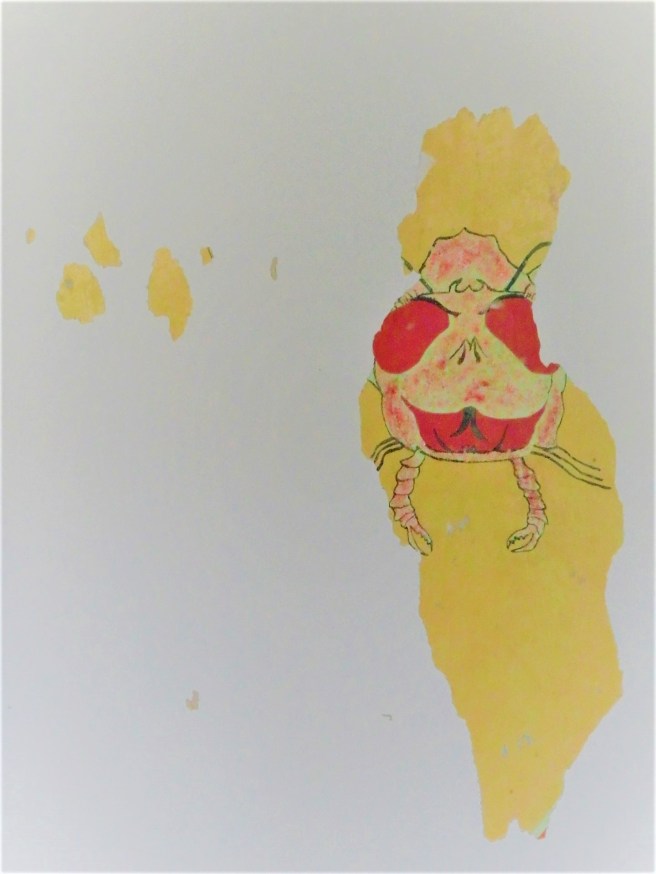
I don’t think so


 Jnana's Red Barn