Settling on Moose Island 

John Shackford senior definitely explored what would become Eastport in 1782, and, as one account expressed the encounter, “determined to remain and make provisions for the safety and comfort of his wife and children preparatory to permanent settlement.”

The early years of Eastport and its Moose Island are generally fuzzy. Legally, the pioneer white inhabitants were squatters. Captain John initially settled at Broad Cove at the neck of what became known as Shackford’s Head, and soon afterward built a mile-and-a-half away, at the edge of today’s downtown and what was soon known as Shackford’s Cove.

In one version,

“The Shackford family originally settled on Shackford Head, where Revolutionary War veteran Captain John Shackford began a homestead in 1783. … He built accommodations for curing the fish he hired caught by the Indians and some white fishermen … He also erected a strong storehouse of logs, where he kept and sold such merchandise as met the requirements of the fishermen and Indians; the fishery and storehouse were in full operation, and he set about building a dwelling house and planting part of his farming lands. Everything being ready in 1784, he set out in his small sailing vessel, the Industry, for Newbury, and brought to their new home his wife and two children, John and William Shackford.”

The Indians, mind you, were Passamaquoddy, who are still vital component of the community.

In the other version, “In 1787, having built a dwelling-house near the shore, at the foot of Shackford Street, he brought his family, consisting of wife, sons John and William, to their new home in the wilderness …” Not only is the date different, but also their address or its equivalent.

As I said about fuzzy? The consensus for the Shackfords’ arrival seems to be 1783/1784, the end of the Revolutionary War.

Jonathan D. Weston’s recollections had the Shackfords as one of the first six white families in town, arriving in the spring of 1784. Five years later, Weston calculates, the number of households had increased to 22 or 24, “the heads of one-half of these families were either men of English birth or those who had adhered to the royal cause of the war.” Either way,

“John’s little craft was the first vessel owned in the place, as the fishing business up to that time had been done in open boats. Among the vessels subsequently owned by him were Delight, Hannah, Sally, and Patty,” two of them apparently named for his daughters. Patty, meanwhile, “plied between Eastport, Portland and Boston, and was the first freight and passenger boat employed on this route. She was commanded by his son, John.”

While that jumps ahead in our chronology, it does reflect the family’s identity as shipmasters and perhaps also shipbuilders. Shackford Cove wound up with four shipyards along its short shore.

From the start, even before being named Eastport, the small frontier community on Moose Island comprised of a handful of families gained a reputation for “sheltering and sharing the gains of adventurers, smugglers, and gamblers.” Not to cast a shadow over the Shackford family integrity, right? Or making a nice profit?

Welcome to America’s Wild East.

Revolutionary War veteran John Shackford senior

John Shackford was a Revolutionary War veteran who brought his young family to Eastport at the end of the war, making them one of just six households on Moose Island. For the next half century and a bit more, they were influential figures and then faded entirely from the scene by the turn of the 20th century. It was a pattern I’m seeing in seafaring families in coastal communities in American genealogy.

His ancestry in America goes back to Dover, New Hampshire, where I lived for 21 years before moving on to Eastport. His father, Samuel, was a mariner who resettled at the mouth of the Merrimack River in Massachusetts, where John was born in 1753 in Newbury, a decade before the port was set off as a separate town, Newburyport.

Among the other children of Samuel and his wife, Mary Coombs, were Mary, who married Caleb Boynton, for whom Boynton Street and Boynton School in Eastport were named; Captain Samuel Shackford, who died in Newburyport; Levi; and William.

As a sailor, John may have visited Eastport as early as 1763, age 10 or so. (As one version goes, “He was brought up a sailor and while so employed his ship visited Eastport, Maine, as early as 1763.”)

Around here, “captain,” as you may be noting, more often referred to a shipmaster than an army rank.

As a soldier in the newly formed Continental Army in its second major military operation, John enlisted in the strenuous march in September and October 1775 through the wilderness of Maine under the command of General Benedict Arnold. Serving in a Captain Ward’s company, Shackford was one of 1,100 men in the arduous trek that saw 300 soldiers turn back and another 200 die en route The surviving troops were left starving and lacking in many supplies and equipment assigned to attack Quebec City.

Joined by General Richard Montgomery’s forces after their capture of Montreal, the Americans attacked Quebec City in a snowstorm on the last day of the year. They were roundly defeated.  Montgomery was killed and Arnold’s leg was shattered.

Shackford was taken prisoner and confined for nine months, six weeks of the time in irons — that is, chained.

After his release, he broke his promise to his captors not to engage in battle. In early 1780 he and instead served under George Washington at Kingsbridge, in Westchester County, New York.

During the Revolution, John’s brother Levi was wounded at the battle of Bunker Hill. More extensive was the service of brother William. First, he was captured on the privateer “Dalton” and confined in the Old Mill Prison in Plymouth, Devonshire, England, for three years; and then, on being released, he served under John Paul Jones and was either killed in action or died from hardships endured in the war — he never returned.

On the other hand, as a veteran, Private John Shackford returned to Massachusetts and married, on November 26, 1780, Esther, daughter of Captain Gideon and Hannah Woodwell. Her father was an extensive shipbuilder at Newburyport.

Stuck once again

Now that we had the history of our old house back a century-and-a-half, there was still a 20-year gap of getting from Lucy M. Hooper, Anne Dodge, and Mary Roberts, who were named in the 1875 deed transfer, and the Shackford Est of the 1855 Eastport map.

Which Shackford was the Est, presumably for Estate, in the 1855 map?

It was a prolific family in town at the time.

Shackford is a name existing as three places in Eastport: a cove just south of the downtown, a head of land occupied today by a state park, and a residential street.

Just who were they?

I was already working this line from the earliest materials and trying to see if I could connect someone to the material you’ve already seen.

The central question, remember, was how far back did this house go?

It was time to take Captain John Shackford senior seriously.

All in the family, one way or another

After all of that, I backtracked and realized Commander Albert Buck never owned the house. It had instead passed to Fisher Ames Buck’s daughter, Alice May Buck, who died in August 1955. Presumably, she had no children.

And after that, ownership passed to Arline F. [Fallon] Vaughn (1898-1974), the daughter of George and Fanny (Buck) Fallon — Fisher’s daughter. Arline was employed for many years by Moore-McCormick Shipping Lines in New York. Her obituary listed no husband or children. She was buried at Hillside.

Also named in the proceedings was Rose Lee, presumably the remarried widow. The search goes on.

In short, by 1975 our house had apparently become a summer home or rental property under absentee ownership.

Now, for Fisher Ames Buck and his family

Born in 1837 on Campobello Island, New Brunswick, to Ames and Amy (Creighton) Buck, Fisher and his family were living in Maine by 1843.

In the 1850 Eastport Census, Ames was a blacksmith, 49, born in New Brunswick. His wife was 50; and the children were clerk George, 22; Mary E., 19; Amy, 18; blacksmith Joshua, 17; Abigail, 15; [Fisher] Ames, 13; Anna M., 11; [Adelaide] Sophia A., 10, all born in New Brunswick; and John F., 7, born in Maine.

In 1855 Ames owned a house diagonally across Water Street from ours. An alley ran beside their house from Water to Sea Street, providing ready access to the Shackford wharves, as well as one labeled Buck and the A. Buck and Company steam mill attached to the William Newcomb sash and blind factory.

Ames was one of the six sons of Jacob Buck, half-brother of the Bucksport founder. Another son was Eliphalet, who landed in Eastport and is buried in neighboring Robbinston.

In the 1870 U.S. Census, his family included school teachers Mary, 29; and Ada, 25, and fish dealer John, 21. The wharf makes sense. And son Fisher Ames Buck had a household of his own.

The 1879 map shows a J.S. Buck wharf as No. 32 just below the Water Street property, presumably John S. Buck, and nothing for the Shackfords, who had previously owned multiple wharves there.

By the time of his death, Ames was described as both a blacksmith and a machinist.

Incidentally, Ames’ headstone in Hillside Cemetery gives 1796 for his birth and erroneously names daughter Amy Cory (1880-1886) as his wife. The date of his death is a year earlier than some other accounts I’ve seen.

~*~

In turn, Fisher married Clarissa Alice Bailey (1842-1922) in 1865. Their children include twins Frances F. Buck (1872-1934) and Frank Clifford Buck (1872-1950), William Edwin Buck (1875-1935), Alice M. (circa 1879-1955), and two who died in childhood, Harry C. and Jesse B.

Like his father, he was a blacksmith. Later he was an engineer. He was also a freemason, as was son William Edwin, and he served as a town selectman, 1874-1879.

He was among the subscribers underwriting Kilby’s 1888 history, along with a George N. Buck of San Francisco (his brother?).

Fisher died April 5, 1910, of pneumonia. He is buried at Hillside Cemetery in Eastport.

~*~

His son William Edwin Buck was father to Clifford Hilyard Buck (1899-1973). I do wonder whether they lived in the house or whether other family members did or whether it was rented out or even largely vacant during the period.

~*~

The Tides Institute & Museum of Art’s online photo collection of Eastport houses calls ours the Commander Albert Buck house, with the note: “He returned (after World War II) to Eastport with Rose and settled in the family house at the corner of Third and Water Streets.”

Commander Albert Clifford Buck (1886-1951), a U.S. Navy veteran of World War I and World War II, is buried at Hillside. He was 64. The headstone also names Elizabeth E. Lizzie Sears Buck (1851-1907). Who is she, other than born in Woodland, Washington County? Not Rose, obviously.

Albert, it turns out, was born to Fisher’s brother, John, the fish dealer.

So how did he wind up with the house? Forty years passed between Fisher’s death and Albert’s, and family members may have moved elsewhere for employment and other reasons. Perhaps the others simply weren’t interested. Who, in fact, inhabited the house in the interlude?

The neighborhood did have a number of Lebanese families by the early 1900s, attracted to jobs in the sardine canneries that ruled the local economy after the wooden shipbuilding industry collapsed.

Albert’s obituary mentioned that he had maintained a summer home in Eastport since the end of World War II, but neglected to note where his fulltime residence was. It also named a son, Charles S., stationed in Arizona (in 1951,) and brothers Milford in Rowley, Massachusetts, and George of New York City. (Milford R. Buck (-1952) is buried at Hillside. George is another mystery. The obituary also said the funeral service would be at the Washington Street Baptist church and that Albert was a freemason.

Just two years later, Charles, age 40, died of meningitis at the Veterans Administration Hospital in Tucson, Arizona. He was an automotive mechanic and, according to the state certificate of death, was born March 13, 1913, in Massachusetts, to Albert C. Buck, born Maine, and Rose A. Mayer, born Massachusetts. In addition, he was buried in Rowley. What was the family connection there?

I’m guessing it’s where Rose’s family was. Albert was likely at sea for extended periods. In short, he wasn’t in Eastport.

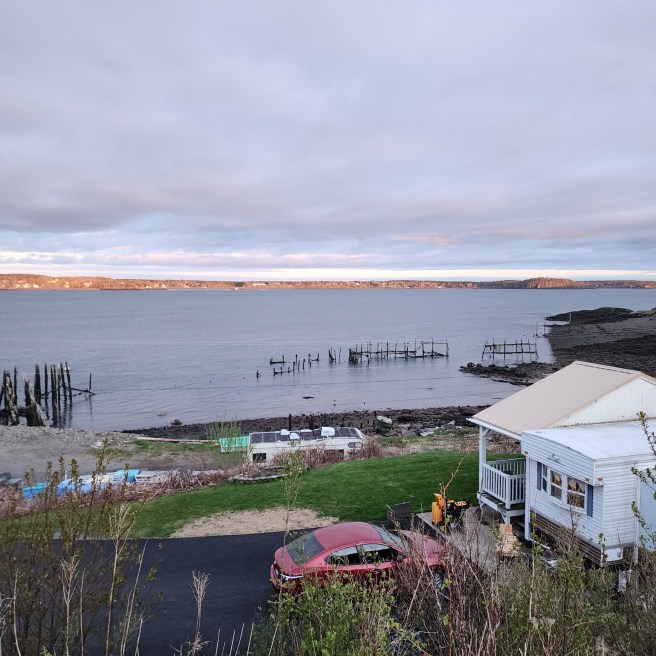
Our home, by the way, had an unobstructed view of the water.