More on John Shackford junior’s impact

I’m presuming that the house Jonathan Delesdernier Weston recollected as town’s second conventionally wood-framed house, built after 1812 but removed shortly before 1888, was John junior’s. The 1855 map shows a J. Shackford house at the southeast corner of Water and Middle streets that doesn’t match current buildings. Weston, incidentally, built the 1810 Federal-style house at the corner of Boynton and Middle streets, a place now noted as housing John Jacob Audubon on his residency in town.

The Eastport Sentinel in September 8, 1880, noted, “The close observer, as he walks about town, notices many changes and improvements within the past year. … It is of the fixing up that we all speak particularly. The John Shackford house on Water Street has been repaired and remodeled by Mr. Warren Brown so that it bears little resemblance to its former self.” Brown was a tailor and fish packer with a growing family, and the John Shackford in question would have been dead 12 years. As a further complication, among the residences destroyed in the 1889 fire was Brown’s.

John junior’s first son, Benjamin Batson Shackford (1811-1884), most likely
spent his early life “aboard his family’s ships training for his shipmaster’s qualifications,” as Joanne Shackford Parkes wrote in the Shackford Family History blog.  “In 1833, when he turned 21, he married Harriet Bibber, daughter of Thomas Bibber and Dorcas Pettengill. They made their home in Eastport and had eight children.

“Seventeen years later, the family was doing well financially as reflected in Benjamin’s 1850 Census report of having property valued at $1,400. By then, Benjamin, the sea captain of the brig Waredale, was traveling to Baltimore, St. Thomas [Virgin Islands], and Trinidad.”

She found that in 1855, newspapers reported the Waredale and Shackford sailing from Norfolk to St . Croix in February; Guayanilla, Puerto Rico, to New York and then St. Thomas in May; Maracaibo, Venezuela, to Eastport in July; and Eastport to Calais and then to Bathurst, Africa, in October.  She adds to that his sailing multiple times between 1856 and 1858 to Trinidad, bringing back molasses. And in mid-1858, he added South Carolina; the Turks; Mobile, Alabama; Surinam; and Matanzas, Cuba, and Remedios, Cuba, to his rounds.

The 1860 Census valued his real estate at $1,200 and his personal assets at $400. That year, as Parkes wrote, he sailed on multiple trips to Puerto Rico, up and down the New England coast, and to the Turk islands. By 1863 he was sailing the Waredale frequently to Jamaica and Cuba.

She then describes how in 1864, on his second trip as captain of the bark Zelinda from Matanzas or New Orleans to Philadelphia (reports vary), he was overtaken and boarded by the Confederate privateer ship Florida while off the coast of South Carolina. The crew was placed aboard another captured ship, the schooner Howard and sent back to port while the captain of the Florida set fire to and destroyed the Zelinda. “It appears that the crew was not allowed to take much with them, and after the Civil War ended, Capt. Benjamin B. Shackford filed a claim in the Alabama courts reporting that he had lost his belongings, and in 1875 he was reimbursed $2,303.85 for his losses. In 1883 he gave a deposition stating that another member of his crew had also suffered a loss of clothes, outfits, and articles.”

She notes that when Benjamin’s father John died in 1866 without a will, he left properties valued at $3,200. “The probate dragged out until 1872 and finally resulted in a division of the land which included some prime real estate in Eastport which was divided between Benjamin and the families of his siblings, Charles William and John L. Shackford.

“This increased Benjamin’s real estate holdings significantly and, in the 1870 census, he reported real estate valued at $3,000. The American Bureau of Shipping lists him as the master of the L.L. Wadsworth around that time and newspaper articles show him sailing to Freeport and Trinidad. While his last trip on the L.L. Wadsworth was around 1872, Benjamin continued to list his occupation as sailor in the 1880 Census.

After a life of sailing and adventure to many places in the world, Benjamin Batson Shackford died in Eastport in 1884 at the age of 72.

His children were Joshua Shackford (1834-?); John Edward Shackford (1836-1862), blacksmith, died in New York; Harriet Elizabeth Shackford (1838-1861); Marietta Shackford (1840-?), married Joseph R. Gilman; Ann Pearce Shackford (1841-1924), married Andrew V. Bradford, moved to Oregon by 1900, died in Oregon in 1924, gravestone is in Eastport, Maine;
Emma Shackford (1842-?); Gertrude Shackford (1844-?); and Stella Woodwell Shackford (1853-1918), married William Pearce Higgins, died in Oregon.

Remember, John junior grew up in the house we now own.
John Shackford junior had his own legacy

In following the history of our house, we’ve veered off from Captain John and Esther’s children as other families added their names to the dwelling. At this point, I’d like to return to the Shackfords to give you a better sense of the family’s additional impact on the community as well as ways the town itself changed over the years. When the Shackfords first arrived, the place wasn’t even called Eastport but rather Passamaquoddy or Moose Island on Passamaquoddy Bay. Sometimes it even went by all three at once. While the sons’ and sons-in-law’s escapades during the War of 1812 have been noted, their seafaring ventures continued well after.

~*~

John junior, for instance, not only commanded the first vessel owned in the town, but he also ran the first packet in the Boston and Eastport line, “through winter’s storms and summer’s fogs.” A packet was a new concept in shipping, with vessels departing on a regular schedule, rather than waiting for a full load or a set number of passengers. The innovation could be risky for the investors or highly profitable, depending.

In a fuller telling, he “was commander of the first vessel owned in the town and commander on the first freight and passenger traffic boat established between Eastport, Portland, and Boston, and his last packet, the Boundary, the swiftest vessel on the coast after 21 years in this service, had to give place to steamships.”

The May 9, 1828, edition of the Eastern Argus announced that the schooner Boundary, 142 tons with John Shackford, master, the schooner Edward Preble, and the Thomas Rogers would be running between Eastport and Boston, stopping at Portland both directions. That gives us a date and a possible commercial association of the three vessels. After that, newspaper mentions of the Boundary arriving or departing Eastport or Boston with Captain Shackford at the helm were common.

He “knew by sight all the dangerous places along the coast, but never had more than a passing acquaintance with them, and during his long experience as shipmaster never had occasion to call upon his underwriters for a dollar.  The Boundary, his last packet, so well known as the swiftest vessel on the coast, was driven off the route on the introduction of steamships, when she was 21 years old; but for 20 years after she was a staunch craft, engaged in the coasting trade.”

Coasting, should you wonder, refers to traffic that followed the coastline rather than crossing the open ocean. The swift, agile coasting schooners could easily run into trouble further out from the coast.

The December 2011 edition of the Maine Coastal News described the Boundary as having two masts and dimensions 79 by 22 by 9 feet. And, yes, she was built on Shackford Cove in 1825 by Robert Huston.

There was a legal tangle on June 26, 1826, when, as commander of the Boundary, Captain John appeared before the Boston board of alderman to respond to charges of an alleged breach of the law to prevent the introduction of paupers from foreign ports.

Captain John junior’s sons included three shipmasters: Benjamin Batson Shackford, who died in Eastport in 1885, aged 73; Charles William Shackford, master of the brig Esther Elizabeth, who with his vessel was lost at sea in the winter of 1853-1854; and John Lincoln Shackford., who died at St. Thomas, West Indies. More on him later.

John’s wife, Elizabeth Batson, came from another seafaring family. She died in 1830. Did she travel with him, as many captains’ wives and families did? I suspect he married a second time, perhaps to Eliza A. who died in Eastport on February 17, 1899, age 84 years four months five days.

When John junior died on August 12, 1866, he left no will. His obituary in the Eastport Sentinel, in the manner of the time, did not name other family members, something that might have revealed whether he had remarried after his first wife’s decease. Instead, it said, “He was a devotional man always found at prayer meetings and public preaching when he was able to be there.”

Remember, John junior grew up in the house we now own.
The allure of gold, too

Back to Elsie’s son, Ethel Olmstead. Several accounts have him marrying Abigail C. Harrington and having the son and three daughters, as recorded in the Census. She may be the Abigail Harrington born September 4, 1815, in Eastport to Andrew Harrington, who came to Moose Island from New Brunswick.

Another Loyalist connection?

Ethel’s gold-digger occupation noted in the Census leads us to the California Gold Rush. He died July 22, 1852, in San Francisco and is buried in Golden Gate cemetery, a potters’ field (the gravestone name has been transcribed as Esther and the birth date is 1812 by one source), although Yerba Buena is a second possibility. Both lines of argument have the same date of death but no cause. Natural or violent? Did he go by way of a sailing vessel around treacherous Cape Horn or perhaps crossing Panama? Perhaps working on one of the Shackford vessels? It makes more sense than a wagon train crossing the Prairie, considering the distance from Downeast Maine to the Oregon Trail and then points west. As for a cause of death? We can only speculate.

The Gold Rush angle thickens with the death of Major Ethel Olmstead of Calais, Maine, on March 15, 1856, at age 70, in El Dorado County, California. “No road leads up to the grave and the few trees and bushes surrounding the grave hide it from the outside world” outside the historic gold mining camp of Wild Goose Flat on the east side of the North Fork of the American River in the Sierra Nevada Range.

I do love the description of his final stop, “southerly from Rattlesnake Bar and easterly from Horseshoe Bar.” Those may be watering spots more than places in the river, should you wonder. Perhaps that’s gives you an idea of how widely some individuals traveled from the easternmost homes. His second wife, son, and daughter all continued in California after his death. In Calais, he had been a blacksmith.

This Ethel turns out to be the uncle of the Ethel of our house. I’m guessing neither of them struck it rich.

Since both Abigail and her son James were living at the time of the house sale to the next owner, more questions remain.

I’ll also note that having additional residences in Boston and New York was not uncommon for shipowners or captains, so I do wonder about Lucy Hooper’s husband’s occupation. One more thing to check out, when I can.

Curiously, the recording of that deed did not include a book-and-page citation to a previous sale, leaving me stymied on furthering the property’s earlier history. Still, as you’ve seen, I finally connected the line.

The widow purchases the property title

In a transaction dated December 27, 1859, Elise purchased the property from the Shackford estate heirs for twelve hundred dollars. In addition to Captain John senior’s sons Jacob, John, and William and daughters Esther and Hannah, grandson Samuel Shackford,, and their spouses as the sellers, we find the name Myrick D. Bibber, the furniture merchant who built at the corner of Water and Shackford streets around 1840.

Note that daughter Sarah Shackford Lincoln is not mentioned in this agreement (she died in 1846). In December 1841 she had sold “my right title and deed [?] to the estate of my Father John Shackford, late of Eastport” to William Shackford and Bibber.

In the 1860 Census, the household was enumerated under Elsie’s daughter, Abigail C. Olmstead, 46, dressmaker, personal value $15 or $1,500 — the script is difficult to read. Elsie — or Eliza, as the Census recorded her — was 83 and had a real estate value of two thousand dollars.

The household also had boarders: storekeeper Peter Kane, 21; Sarah Leighton, 72; and Sophia Gleason, 67.

Ten residents in our house would be tight, even if the two ells attached at the time had living space.

An inventory of Elsie’s estate was ordered in August 1868 after she had been declared non-compos mentis and placed under the guardianship of her step-grandson John S. Pierce [Pearce], by way of Hannah Shackford Pearce.

Her death, October 19, 1868, was reported in the Eastport Sentinel as “Mrs. Elizabeth, relict of the late Captain John Shackford, 78 years.” The age would correspond to Elsie’s.

In 1880, her daughter-in-law, Abigail Olmstead, was recorded as age 65 living in the household of her youngest daughter, Mary A. Roberts, 31, in Boston.

The linkage to Fisher Ames Buck and later owners was finally apparent.

That sale was by Abigail’s daughters.

Confirming our house as Captain John’s homestead

The Shackford children had their joint holdings surveyed in January 1833, with Hannah Shackford’s husband, Darius Pearce/Pierce, performing the task. A flurry of real estate transfers followed, formalizing their agreements.

By 1820, according to the Census, the sons were heads of household.

Trying to follow the transactions gets rather confusing.

William and Jacob had even gone into business together in 1833, turning their attention away from seafaring. Their dealings included waterfront between the high-tide and low-water stretches as well as bands of shorefront below our house that would be developed into wharves.

From what I see, the boys weren’t getting a family discount. In 1830, John junior paid his father $1,000 for one parcel next to his brother William’s. In a transaction dated December 30, 1831, John senior specifies a band of waterfront “partially in front of my own dwelling house,” with the sellers being himself and “my wife Elsie.”

Among the deals were one on the easterly side of Water Street “to the fence of my homestead” and then westerly to Water Street, confirming that his homestead included both sides of the road.

Of special interest to me in confirming that our house was the one John senior occupied are the two deeds conveying adjoining land along Water Street. First was a sale to Myrick Bibber, a furniture merchant, on June 13, 1839, for a lot on the southwest corner of Water and Shackford streets, and then on July 10, to Daniel Aymar for the lot between the two.

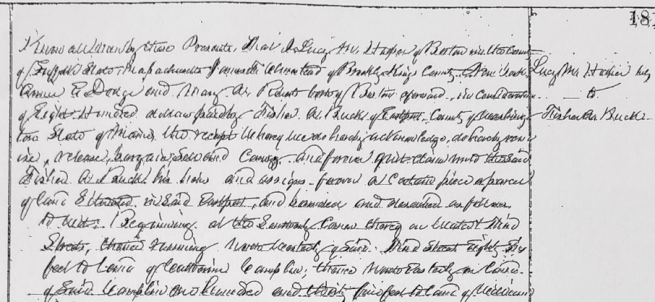
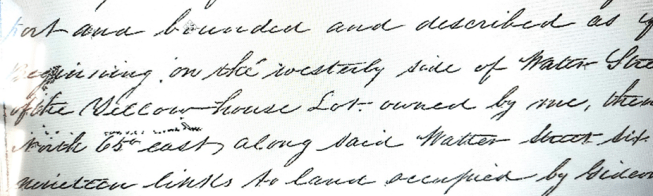
Each of them is measured to the line of “the yellow house lot owned by me.”

Here’s how the description appeared on the two deeds recorded at the Washington County courthouse.

I was surprised to see that he signed the deeds with his mark, X, as did his wife in several instances. New England was noted for its nearly universal literacy, both men and women.

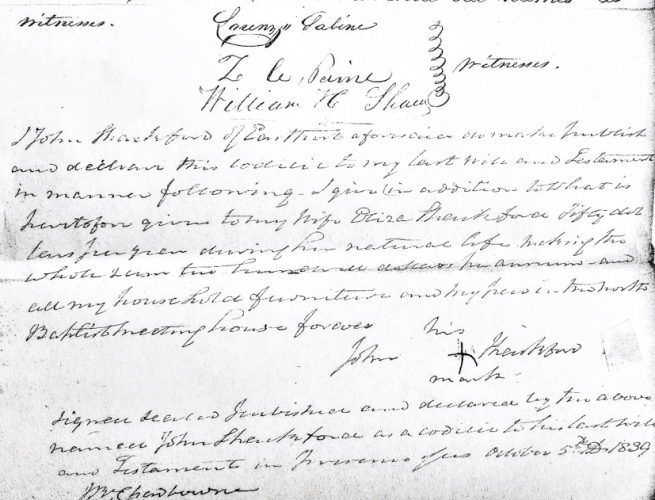
Here’s his X on his will.

Grandson Samuel Shackford said Esther, John’s first wife, “had been well reared and was a woman of superior intelligence” and that her children “were indebted to their mother for nearly all the educational advantages they ever enjoyed.” Unlike her husband, she signed some of the documents, as noted in the record, “her seal.” “School-teachers were rarely obtainable, in those days, in this then out-of-the-world. For a brief period, the services of William Lloyd Garrison’s [future] mother were secured to teach in the family” when she lived on neighboring Deer Island, Canada..

The real estate transactions indicate the children were all literate.

Esther died June 21, 1830. His second wife enters the picture rather obliquely soon thereafter.

His will of June 14, 1832, bequeathed “to my beloved wife Elsie the use during her life of my homestead or the house in which I now live, together with the lot and privileges thereto.”

Further down, it directs his six children and grandson Samuel to pay “to my wife Elsie the aforementioned annuity of one hundred & fifty dollars. And on my demise the homestead on house in which I now live with the lot come privileges pertaining thereto, and the one of which I have willed I am bequeathing to her during her life, I am bequeathing to them, my six children … in the same proportion of my other property.”

A harder to read codicil of October 5, 1839, raises the amount of the annuity to “my wife Eliza Shackford” to $200 during her natural life and “all my furniture and my pew in Baptist meetinghouse forever.”

After Captain John’s death, as Samuel Shackford confirmed, Elsie (or Elise, in his account) obtained the Revolutionary War veteran’s pension based on his service.

Elsie was later recorded in the 1850 Eastport Census as Eliza Shackford, 70, living in a household headed by Abigail Winslow, 37, along with four children — Anna E, 12; Lucy M., 6; James F., 4; and Mary A., 2; as well as Ethel Olmstead, 37, with his occupation as “gold digger” in the metal mining industry. An index to that Census listing placed Ethel as the head of household, even though he was at the bottom in the family. I am perplexed by the Winslow identity.

All of it, of course, has relevance on the house we bought.

Worshiping together, too

The Shackfords and Olmsteads had more in common than their livelihoods on and around the sea.

The oldest church in Eastport, founded in either 1798 or 1802, was the Calvinist Baptists, as some in town knew them, or more accurately, Particular Baptists, largely in line with the majority of Baptists today. That group moved into its Washington Street house of worship in 1837. (Today, it’s the Eastport Arts Center.)

The second congregation in town was the Free Will Baptists, organized in 1816 and incorporating with the state in 1820. Darius and Ethel Olmstead along with John and William Shackford and their brothers-in-law John Hinkley and John C. Lincoln were named in the incorporation papers.

Among other things, Free Will Baptists avoided alcohol consumption and, in its Northern stream, opposed slavery. As a rite, it practiced foot-washing. The denomination stemmed from the Dutch Mennoninte-influenced General Baptists in England, unlike the Baptists just down the hill. I am curious to learn how much our Shackfords and Olmsteads hewed to the denomination’s values. The General Baptists, I should point out, were earlier a strong influence on the emerging Quaker movement in Britain. My Quaking Dover book details more.

The Free Will Baptists dedicated their first meetinghouse in town in 1819, a year before the other Baptists had theirs. They were later known as North Christian Church, with the building at Washington and High streets.

Next to organize in town were the Congregationalists, 1819, and Unitarians, 1821. Roman Catholics had a chapel in 1828, early for New England.

The 1820 Census for Eastport has the brothers Darius, Ethell, and Jesse Olmstead as heads of household.

Two years later, Mrs. Darius Olmstead (Elsie Haddon) and Mrs. Ethel Olmstead (Nancy Ann Haddon) were among the charter members of the Eastport Benevolent Female Society, as were Mrs. William Shackford, Mrs. Jacob Shackford, and Mrs. John Shackford.

The Olmsteads and Shackfords obviously shared in an emerging social structure, having arrived in the Passamaquoddy region at the same time.

All of it, of course, has relevance on the house we bought.

A surprise dimension opened

Courthouse records go only so far in piecing together a story like this. But the names I had found did give me enough to start turning to online genealogies, Find-a-Grave posts, and related histories to augment the investigation, often including the exasperating process of eliminating possibilities before chancing upon nuggets.

A conventional telling I found repeated contained this: “Captain John Shackford died at his home in Eastport, Maine, on Christmas day, 1840, having attained the eighty-seventh year of his age, and his widow obtained a pension from the U.S. government by reason of his service in the American revolution.”

Christmas, by the way, was not observed in Massachusetts, and likely not Maine at the time, even now that it was an independent state. As many journals of the time noted, “It was an ordinary day.”

The quick mention of his widow slid by almost unnoticed. It seemed to be an error, no, considering that Esther had died a decade earlier?

My big “ah-hah!” moment came in coming across a free ebook copy of the 1888 Eastport and Passamaquoddy, a Compilation of Historical and Biographical Sketches compiled by William Henry Kilby. Of special interest was in the 506-page book was a chapter, “Captain John Shackford and His Family,” by his grandson Samuel Shackford, living in Chicago. I’ve already referred to it, but the most crucial part for me was this: “After his decease, his second wife, who was widow Elise Olmstead, obtained a pension from the United States government for his services in the Revolution.” The crucial points were that Captain John had married a second time, something not obvious elsewhere, and even better, I now had a name to focus on.

As I soon found, her name was Elsie, though it also appears as Elise, Elsa, and Eliza. She was the widow of Darius Olmstead.

~*~

The September 27, 1831, Eastport Sentinel reported the marriage of Elsie and John Shackford senior, with the Reverend Bonds officiating. In the Sentinel, her name was Mrs. Elsa, widow of the late Darius Olmstead.

Captain John would have been 77 or 78. Elsie, around 52.

She was born around 1779 in Chatham, England, to James Haddon and a presently unknown wife. He then then brought the family to Saint John, New Brunswick.

Elsie’s first husband, Darius Olmstead, was a merchant, “copartners in trade under the firm D&E Olmstead, with his brother Ethel. Between 1822 and 1825 they purchased sections of Central Wharf in Eastport from James Olmstead.

Darius died July 13, 1825, age 48.

He descended from a well-known and prolific colonial family in Connecticut., one that becomes difficult to follow in its many repetitions of Darius and Ethel across generations and geography.

In the instance at hand, Darius was born in 1776 to Aaron and Hannah Peat Olmstead.

His brother Ethel married Nancy Ann Haddon, presumably Elsie’s sister.

While Olmsteads appeared in historic roles during the American Revolution, Aaron was of the Loyalist faction and relocated to Saint John, New Brunswick, at the end of that war.

Partisan alliances aside, the border between the United States and Canada was loosely enforced. In 1798, Aaron drowned in the harbor at Eastport.

Among the children born to Darius and Elsie Haddon Olmstead was son Ethel (a name also spelled Ethal and Ethell in the records). He was born in 1814 in Eastport. Another son was named Darius.

In 1826, Eliza Olmstead, widow, and Ann Olmstead, wife of Ethel, sold a property on Key Street that Darius had purchased from John Shackford in 1810.

With the widow’s remarriage, her son Ethel, around age 16, would have become Captain John Shackford senior’s stepson.

I have nothing more on his brother.

All of it, of course, has relevance on the house we bought.

Theirs was a booming and closely knit family

Captain John and Esther’s adult children eventually built their own homes more or less within a half-moon crescent about a block away in each direction around our house.

John Shackford junior built on the southeast corner of what’s now Water and Middle streets. He married Elizabeth Batson (1790-1830), and probably remarried another Elizabeth afterward.

William built at the southwest corner of Shackford and Middle streets — just beyond the diagonal edge of our block. He married his sister-in-law, Sarah Ann Batson (1788-1837) in 1807, and then Mary Cutter Lincoln, who survived him. She was the daughter of Captain Jacob Lincoln, whose 1790 farm is now the Rossport by the Sea resort in Eastport’s Quoddy Village neighborhood.

Jacob Shackford, meanwhile, built at the southwest corner of Water and Key streets. He married Eliza D. Pearce/Pierce (1794-1869). She was the sister of Darius, husband of Jacob’s sister Hannah. Eliza was born in Rhode Island, like her brother, and died barely a month after her husband’s passing.

Samuel, probably the first male child born in Eastport, died in 1820 of yellow fever at Demerare, South America. He had married Elizabeth, daughter of Otis and Elizabeth Lincoln of Perry, before the Shackford siblings divided the holdings. His son Samuel received a half-share in Captain John’s will.  More on him later. Elizabeth, meanwhile, is the Mrs. Eliza Shackford who married Captain Silvanus Appleby on October 16, 1825, officiated by Charles Morgridge.

The repeated surnames among the spouses continues over the next generation or two. Finding siblings in one family marrying another set of siblings is not uncommon in the period.

Darius Hannah and her husband, Captain Darius Pearce/Pierce, built at 9 Shackford Street, a block northeast of our house. Born in Rhode Island to a prominent family, he came to Eastport and, after marrying, was a surveyor by 1833, the customs inspector in Eastport by 1841, and a merchant.

Daughter Esther and her husband, Joshua Hinckley, lived on Key Street, just to the west of Jacob. She died, 1880, in Dennysville. Joshua’s father, Matthew, had died at sea in 1809 near Sulawesi Tengah, Indonesia; he was born in 1752 in Georgetown, Maine. (Also born in Georgetown and living in Eastport was John Hinkley (1764-after 1850), son of John Hinkley. Cousins?) The Hinkleys, we should note, were among the early returnees to Maine amid the devastating travails of the French and Indian wars. Joshua and his wife, Esther, were living in Portland in 1823 and relocated to Eastport shortly afterward.

Sarah M. “Sally” and her husband, Captain John Lincoln, remain largely nebulous. I had even wondered if they died at sea. Many captains’ wives accompanied their husbands on long voyages, typically serving as navigators as their children grew up aboard ships. What I did eventually find was a real estate transfer dated October 15, 1832, where “Sarah Lincoln, widow of John Lincoln, shipmaster” sold her one-sixth share in the 1826 land purchase to her brothers William and Jacob and brother-in-law Darius Pearce/Pierce for $150. She was born in 1795 and died in 1846.

The Lincolns, who originate in Hingham, Massachusetts, include a branch that came north after Benjamin Lincoln, a celebrated Revolutionary War General, and two others purchased 10,000 acres in to Washington County. His son Theodore arrived to oversee those holdings and, in establishing a related timber industry, was an original settler of Dennysville. Other portions of the tract extended into what would become the towns of Pembroke and Perry. His brother Jacob, came to Moose Island, as noted. And their cousin Otis was an early settler of Perry. They’re the source where the Shackford marriages fit in. Another branch led from Hingham to the 16th president of the United States, should you be asking.

Even before getting to John and Esther’s grandchildren and beyond, I had many loose ends of potential owners of our house who may have led to Lucy M. Hooper of Boston and Brooklyn, New York, and also Anne Dodge and Mary Roberts, both of Boston, the ones who sold the house in July 1875. Trying to run the deeds from them and down to the Shackfords had me stonewalled.

Who were they and how did they come into its ownership?

All of it, of course, has relevance on the house we bought.

Turning to real estate

As the growing village took shape, John senior had his tract surveyed by Benjamin R. Jones, resulting in Shackford’s Plan of lots. A copy of that would help make sense of the wheeling and dealing that followed. Many of the purchasers were by John’s own children, individually or in combinations of partnership often formalizing land they had already “improved” and buildings they had constructed or sites where they would. Others went to Eastport’s new merchants and tradesmen. In all, I find 73 transactions, most of them as a grantor, or seller, recorded at the Washington County courthouse in Machias. I’ve probably missed a few, so take that as a rough figure.

It wasn’t just housing lots, either. Captain John’s waterfront properties were valuable sites for wharves, docks, and storehouses. He was even selling sites between the high and low tide lines. I’ll spare you the tensions between low tide mark claims today.

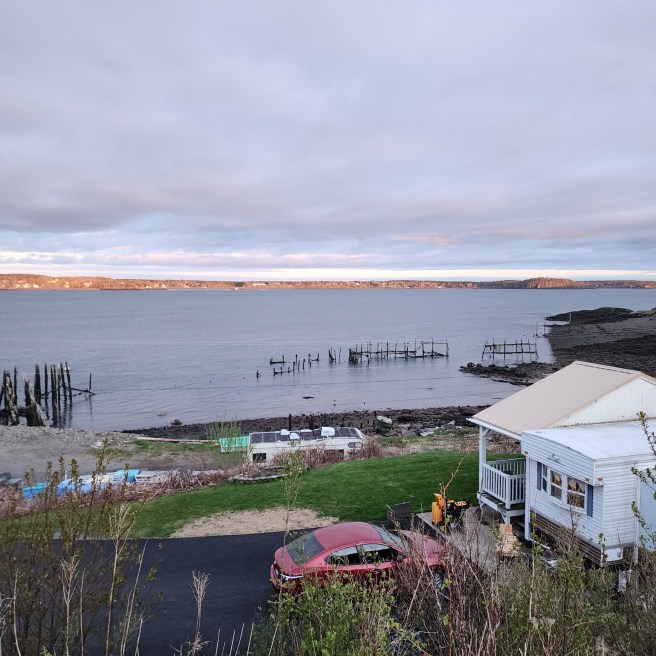
This is how some of the shoreline below our house looks today.

The one transaction I haven’t been able to track down is his title to Shackford Head. Was it simply overlooked by the indexers?

A significant deal took place on April 14, 1826, when his surviving offspring, all in adulthood, paid him $3,000 for the land between High (also known as Back) Street and County Road. And here I thought he had given it to them. Where did I get that idea? That was a huge figure for the time, by the way.

Was he a Scrooge with his offspring? Or merely cunning?

He still had plenty of lots left to sell.

Esther died on June 21, 1830, age 76.

All of it, of course, has relevance on the house we bought.


Another taste of the shipmaster role

Among the many vessels in Eastport by the 1820s, according to historian Jonathan D. Weston, John Shackford senior was one of possibly two residents owning ships of “suitable size and equipment to perform voyages at a distance.”

Captain John’s schooner was the Delesdernier, named after an Eastport family owning the tract just south of his own.

Lewis Frederick Delesdernier was the town’s first customs officer, in fact, and Weston’s grandfather. Note the “D” for the middle name.

Was the naming of the ship an inside joke? I’ll take it that way. He may have also been an investor in shares, another common practice.

The remaining ships of note in Eastport, incidentally, were “owned by inhabitants of other parts of the country.”

All of it, of course, has relevance on the house we bought.